Online Visa Processing Options Compared: Government Portal vs. White‑Label vs. API

The moment a traveler hits the “book now” button, the clock starts ticking. Every extra click—especially a mandatory detour to a government website—puts the booking and its revenue at risk. That’s why travel brands serious about conversion and ancillary sales are re-thinking how they surface visa requirements. Should you simply link customers to the official government portal, switch on a hosted white-label experience, or wire a visa API directly into your stack? This deep-dive compares all three online visa processing options so you can make an informed, ROI-driven decision.
1. The Three Main Models Explained
1.1 Government Portals (Send-Away Links)
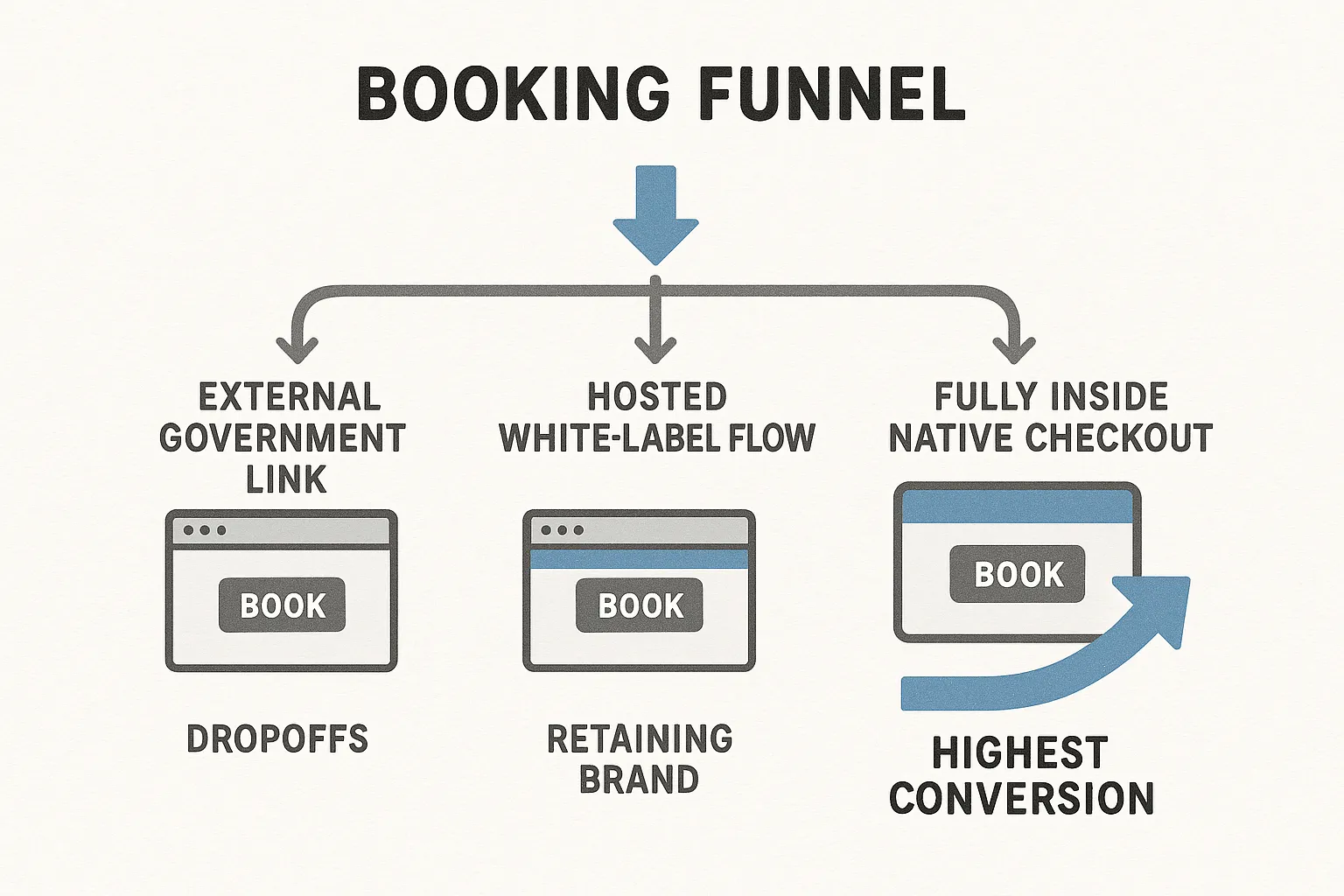
The default approach for many OTAs and airlines is to hand travelers a list of official links—“Need a visa for India? Click here.” It ticks the compliance box but sacrifices visibility and revenue. Travelers must:
- Exit your funnel and navigate unfamiliar portals
- Re-enter data they already typed during booking
- Handle payments, documents, and follow-ups on their own
Result: form abandonment, support tickets, and lost cross-sell opportunities.
1.2 White-Label Visa Applications
A white-label solution is a fully hosted, co-branded web or mobile flow that lives on your sub-domain (e.g., visas.yourbrand.com) or inside an iframe. SimpleVisa’s no-code option is a typical example. You control the look and feel without writing backend code. Benefits include:
- Fast go-live (often <30 days)
- Revenue share on every approved application
- Automated email/SMS reminders and status updates
- Built-in compliance reporting
1.3 Visa Processing APIs
For brands with engineering muscle, a visa API pipes eligibility checks, dynamic document lists, and submission endpoints straight into your existing checkout, app, or PSS. This “embedded” model powers native UX, end-to-end data ownership, and extensive automation. See our step-by-step post on how eVisa APIs work.
2. Side-by-Side Comparison
| Criterion | Government Portal | White-Label Solution | Visa API Integration |
|---|---|---|---|
| Time to Market | Instant (link out) | 2–4 weeks | 6–12 weeks |
| Up-Front Engineering | None | Minimal (embed script) | Medium–High (SDK, backend) |
| Booking Conversion Impact* | –3–7% drop | +2–5% lift | +4–8% lift |
| Ancillary Revenue Potential* | $0 | $$ (rev share) | $$$ (custom pricing) |
| Brand Control | None beyond link text | Co-branded UI, limited flow edits | Full UX control |
| Compliance Liability | Low (traveler self-service) | Shared with provider | Shared with provider |
| Data Ownership | None | Limited (events, revenue) | Full (raw application data) |
| Support Ticket Volume | High | Medium | Low |
| Typical Use Cases | Low-volume niche routes | Fast MVP, low code teams | Global OTAs, airlines, super-apps |
*Industry benchmarks from SimpleVisa network, Jan 2024 – Jun 2025 (9.4 M bookings).
3. How the Models Perform in Real-World Scenarios
3.1 Last-Minute Bookings
A Spanish traveler booking Dubai flights 36 hours before departure needs a UAE eVisa now. With a government link, you lose sight of the journey and risk a denied boarding call. White-label flows surface fast-track options and auto-notify when approved. An API can go further—displaying real-time eligibility, fees, and processing time before the traveler commits to the flight.
3.2 Multi-Passenger, Multi-Leg Trips
Families or tour groups juggle several passports and destinations. Government sites force each traveler through separate portals. White-label apps usually support group checkouts; APIs can pre-fill data from the booking file and cascade updates across PNRs.
3.3 High-Risk Compliance Markets
In regions with hefty carrier fines for inadmissible passengers (think Canada’s C$3,200 penalty or the EU’s forthcoming ETIAS enforcement), airlines need immediate admissibility signals. Only an API can stream visa status back into DCS and trigger automated “no-board” flags.
4. Cost Breakdown & ROI Forecast
Below is a conservative 12-month model for a mid-size OTA handling 500 K annual bookings to visa-restricted destinations (15% attach-rate opportunity).
| Metric | Government Links | White-Label | API |
|---|---|---|---|
| Engineering Cost | $0 | $8 K setup | $60 K (dev+QA) |
| Incremental Bookings Saved | –$420 K* | +$110 K | +$270 K |
| Visa Ancillary Revenue | $0 | $180 K | $430 K |
| Support Cost Change | – | –$35 K | –$60 K |
| Net 12-Mo Impact | –$420 K | +$255 K | +$640 K |
*Assumes 3% funnel drop on $280 average order value.
5. Security & Compliance Considerations
Whether you outsource to a white-label provider or consume an API, demand enterprise-grade controls:
- AES-256 encryption at rest & TLS 1.3 in transit
- Role-based access controls (RBAC) across dashboard and API keys
- ISO 27001 and GDPR alignment with clear data-retention SLAs
- Real-time watch-list screening and audit logs (see our checklist of top security features).
Government portals naturally comply with their own standards, but you inherit zero visibility into progress or denial reasons—data that could power better CX and machine-learning fraud models.
6. Decision Framework: Five Questions to Ask Your Team
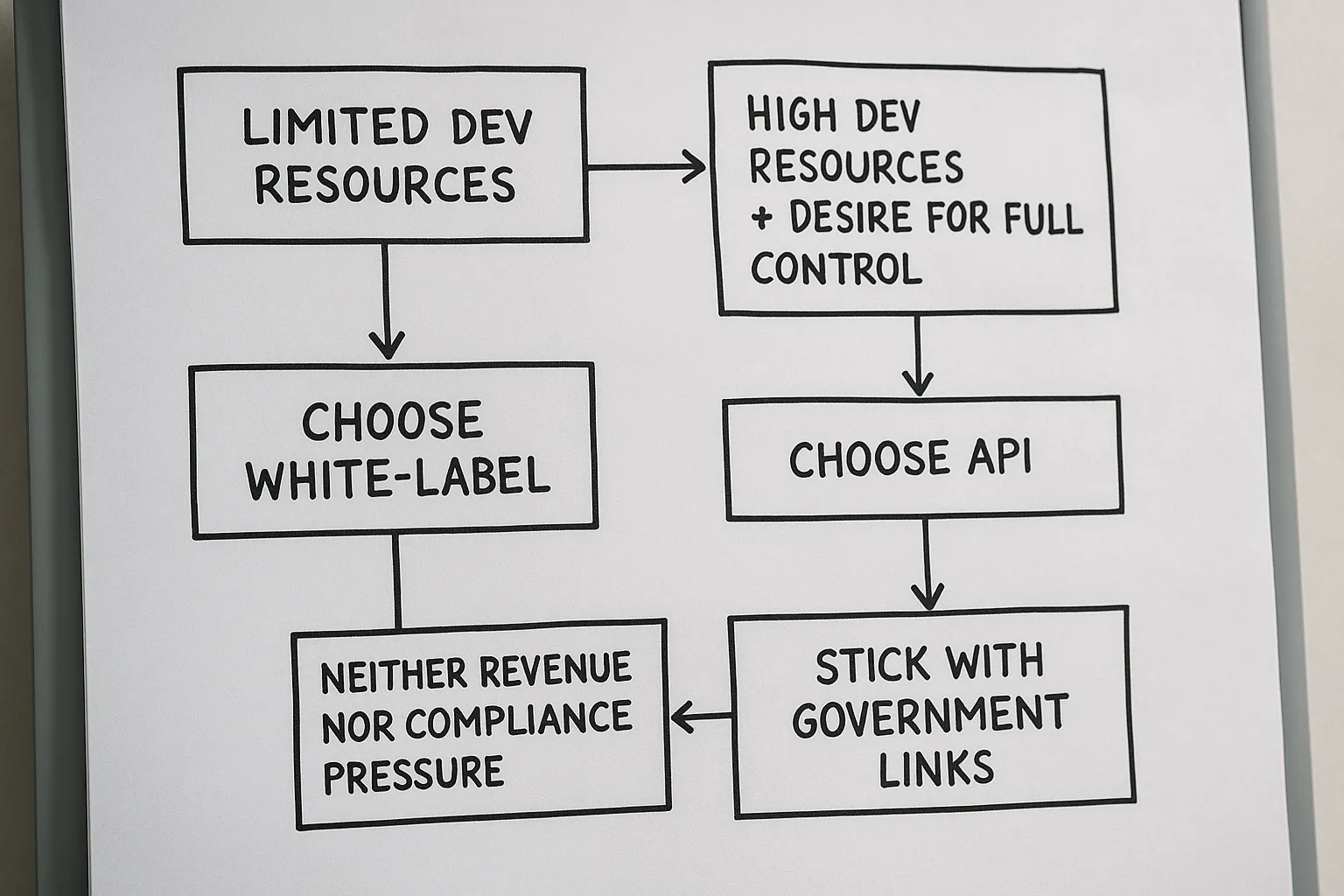
- What’s our engineering bandwidth for the next two quarters? If limited, start white-label; roadmap an API later.
- How valuable is owning the visa UX and data? For loyalty programs and personalization, data gravity favors an API.
- What revenue target do we assign to ancillaries? If six figures matter, link-outs won’t cut it.
- What’s our compliance exposure? Airlines facing fines need embedded eligibility checks—white-label at minimum, API ideally.
- How fast do we need to launch? A seasonal spike or marketing campaign may justify a white-label MVP first.
7. Putting It All Together
- Government portal links remain the quickest fix but leak revenue, data, and brand equity.
- White-label visa applications offer the fastest revenue-generating upgrade with low code demands and shared compliance.
- API integrations deliver the highest conversion, richest data, and deepest automation—at the cost of greater engineering lift.
Forward-thinking travel brands often pursue a hybrid roadmap: launch a white-label flow in weeks to validate demand, then graduate to an API when resources free up. This staged approach secures early ancillary gains while building a defensible, data-driven moat.
Ready to see concrete numbers for your own funnel? Book a 30-minute demo to explore SimpleVisa’s white-label and API solutions, compare revenue scenarios, and map a go-live plan tailored to your tech stack.