Applying for US Travel Visa: Common Mistakes to Avoid
Applying for a U.S. visitor visa looks straightforward on the surface—complete the DS-160 form, pay the fee, schedule an interview, and wait for a decision. Yet the U.S. Department of State refused or abandoned more than 2.7 million non-immigrant visa applications in FY 2024, a reminder that small errors can derail an entire trip (Source: travel.state.gov NIV workload statistics). Below is a practical guide to the pitfalls that trip up travelers most often, plus simple fixes you can implement today.
The Two Main Paths for Short-Term U.S. Travel
Before we dive into mistakes, make sure you are on the right application path. For most leisure or business visits under 90 days, travelers fall into one of two buckets:
| Document | Who It Applies To | Typical Validity | Application Channel |
|---|---|---|---|
| ESTA (Electronic System for Travel Authorization) | Citizens of 40 Visa Waiver Program countries | Two years; max 90 days per stay | Online only, usually approved within minutes |
| B-1/B-2 Visitor Visa | All other nationalities or trips over 90 days | Up to 10 years multiple entry (country-specific) | DS-160 form + consular interview |
SimpleVisa provides eligibility APIs that surface the right path automatically inside a booking flow, but if you are applying on your own, verify which category fits your passport before you pay any fee. Choosing the wrong path is the very first (and surprisingly common) mistake.
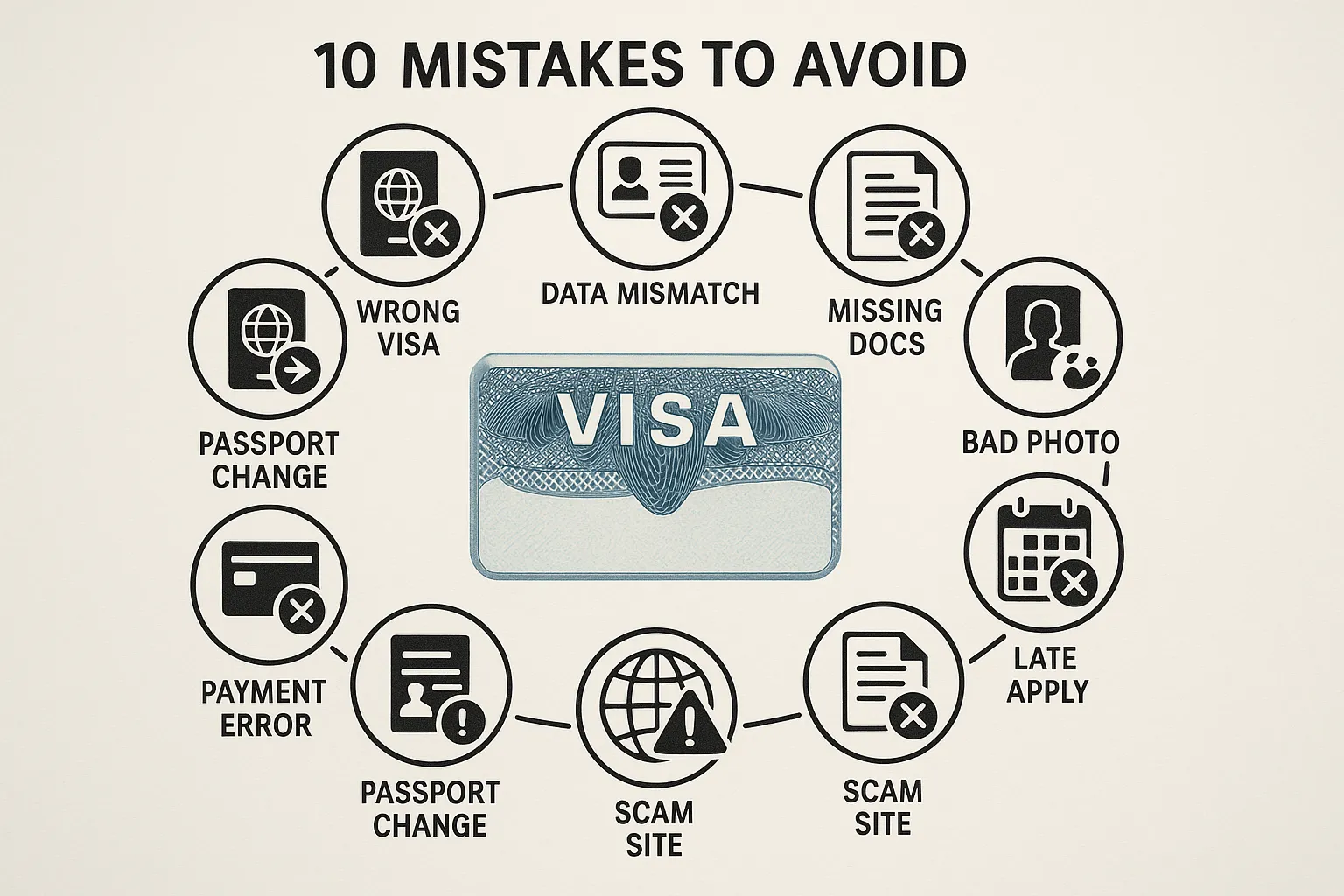
10 Common Mistakes When Applying for a U.S. Travel Visa—and How to Avoid Them
1. Picking the Wrong Visa Category or Purpose Code
Problem: Selecting tourism (B-2) when your itinerary includes paid speaking engagements, or requesting ESTA even though you plan a 120-day stay. Purpose mismatch is among the top cited refusal reasons under section 214(b).
Fix:
- Cross-check trip details against State Department definitions.
- When in doubt, describe the most specific activity on your DS-160 and during the interview.
- Travel agencies can embed SimpleVisa’s rules engine to auto-flag purpose mismatches in real time.
2. Inconsistent Personal Data Across Documents
Problem: Your DS-160 lists a different employment title than your employer letter, or your passport shows “María” but the form says “Maria.” Automated fraud filters treat mismatched data as a red flag.
Fix:
- Copy every field exactly from the machine-readable zone of your passport.
- Use a single source of truth file for name, address, and dates and paste from it.
- Run a final side-by-side check before hitting “Submit.”
3. Skipping Critical Supporting Documentation
Problem: Travelers assume the embassy will not review bank statements or proof of ties unless explicitly requested. Lack of evidence can make it difficult for a consular officer to conclude you intend to return home.
Fix:
- Prepare recent bank statements, employment verification, property deeds or lease agreements showing residence.
- Organize documents in a clear, logical folder you can present quickly at the window.
- If you book through a partner site that uses SimpleVisa, document checklists appear automatically after payment.
4. Submitting a Non-Compliant Photo
The U.S. photo spec is unforgiving: taken within six months, 2 x 2 inches, white background, no glasses, neutral expression. Photo errors force applicants to reschedule biometrics, adding weeks.
Fix:
- Use the State Department’s free online photo tool or a professional studio familiar with U.S. requirements.
- Double-check the digital size (240 KB to 10 MB, square aspect ratio) before upload.
5. Under-Preparing for the Consular Interview
Problem: Treating the interview as a formality. Consular officers have about three minutes to assess eligibility. Vague answers or memorized scripts raise doubts.
Fix:
- Be ready to clearly explain the purpose, duration, and funding of your trip in plain language.
- Bring printed confirmations—hotel bookings, conference invites, return tickets—and reference them naturally.
- Practice concise, honest responses; do not volunteer unrelated information.
6. Applying Too Late
Average global wait time for a B-visa interview dropped to 120 days in 2025 after pandemic backlogs, but certain posts still exceed 250 days. Last-minute applications can wreck travel plans.
Fix:
- Check current interview wait times on travel.state.gov and apply as soon as flights are even tentatively planned.
- For ESTA travelers, apply at least 72 hours before departure to allow for secondary screening.
- Read our detailed timeline guide, “How long does it take to get a US electronic visa?” for planning tips.
7. Omitting Past Overstays, Arrests, or Visa Denials
Problem: Hoping old issues have vanished from databases. In reality, consular officers see most prior U.S. immigration interactions and often those of Schengen, Canada, and Australia through information-sharing agreements.
Fix:
- Disclose everything honestly. A well-explained past infraction is less damaging than a perceived attempt to conceal it.
- Bring documentation that shows resolution (court dismissal, proof of timely departure after overstay forgiveness, etc.).
8. Using Unofficial or Scam Websites
Hundreds of look-alike domains charge inflated fees or harvest personal data. Victims frequently arrive at the embassy with fake confirmation pages.
Fix:
- For DIY applications, use only URLs ending in .gov. The legitimate ESTA site is https://esta.cbp.dhs.gov.
- Compare fees: the official ESTA fee remains 21 USD in 2025; anything higher signals a third-party service.
- Review our security guide “Electronic Visa Scams: How to Protect Yourself from Fraud” for more red flags.
9. Payment Hiccups and Receipt Errors
Problem: A mistyped CGI reference number or expired credit card causes the system to reject payment but still mark the slot as occupied, forcing applicants to wait 24 hours before trying again.
Fix:
- Use a credit card with 3-D Secure enabled and verify the bank allows international transactions.
- Save and print the payment receipt immediately; consular staff may ask for it at biometrics.
10. Ignoring ESTA Updates After Renewal or Passport Change
ESTA is linked to a specific passport number. Travelers who renew passports but keep the old ESTA authorization routinely get denied boarding at check-in.
Fix:
- Re-apply for ESTA every time you receive a new passport, even if the old ESTA’s two-year validity has not expired.
- Update your airline profile with new passport details to sync Advance Passenger Information (API) transmissions.
Quick-Reference Pre-Submission Checklist
- Confirm you are eligible for ESTA; if not, complete the DS-160 for B-1/B-2.
- Copy personal data exactly from your passport.
- Take a compliant 2 x 2-inch photo in the last six months.
- Gather financial proof, employment letters, itinerary and invitation letters, translated if required.
- Pay the correct fee on the official platform and print the receipt.
- Schedule biometrics and interview as early as possible; monitor email for reschedule notices.
- Prepare concise answers for typical interview questions: purpose, funding, prior travel, family ties.
- Double-check passport validity: at least six months beyond intended stay and two blank pages.
- Scan and securely back up every document in encrypted cloud storage.
Travel advisors and OTAs integrating SimpleVisa’s API can surface this checklist automatically post-booking, reducing support tickets and boosting approval rates.
How SimpleVisa Helps Travel Brands Prevent These Errors
- Real-time eligibility engine chooses ESTA vs B-visa based on passport, trip length, and purpose.
- Dynamic form autofill pulls customer data from the PNR, cutting mistyped fields by up to 68 percent.
- Integrated document scanner validates photo dimensions and detects background color issues before submission.
- Built-in fraud-site detector routes users to the correct .gov payment page, protecting them from scams.
- White-label status dashboard provides automated reminders for interview appointments, passport renewals, and ESTA re-applications.
If you run a travel platform and want to reduce refusal-driven cancellations while generating new ancillary revenue, book a 15-minute demo at simplevisa.com to see these tools in action.
Final Thoughts
Applying for a U.S. travel visa will never be completely risk-free, but almost every refusal tied to the 10 mistakes above is preventable. Whether you are a traveler filling out a single DS-160 or a travel company handling thousands of passengers per day, meticulous data entry, honest disclosure, early timing, and use of official channels dramatically boost approval odds. Implement the checklist, leverage automation where possible, and turn the administrative hurdle of border compliance into a streamlined step on the journey—not a roadblock.