Visa Booking Flows: Boost Conversion in Checkout

Most travel checkouts were built for flights and rooms, not immigration rules. That is why even small visa friction can derail an otherwise perfect conversion. The good news is that modern visa booking flows can lift attach rates, prevent denied boardings, and add meaningful ancillary revenue without hurting your core checkout performance.
In this guide, we show where and how to place visa options in checkout, the UX patterns that consistently convert, what to measure, and a 30‑day rollout plan. Examples reference SimpleVisa’s integration models because they are fast to deploy for airlines, OTAs, cruise lines, and tour operators, but the principles apply broadly.
Where visa fits in your booking funnel
You have three high‑impact touchpoints. Each plays a different role.
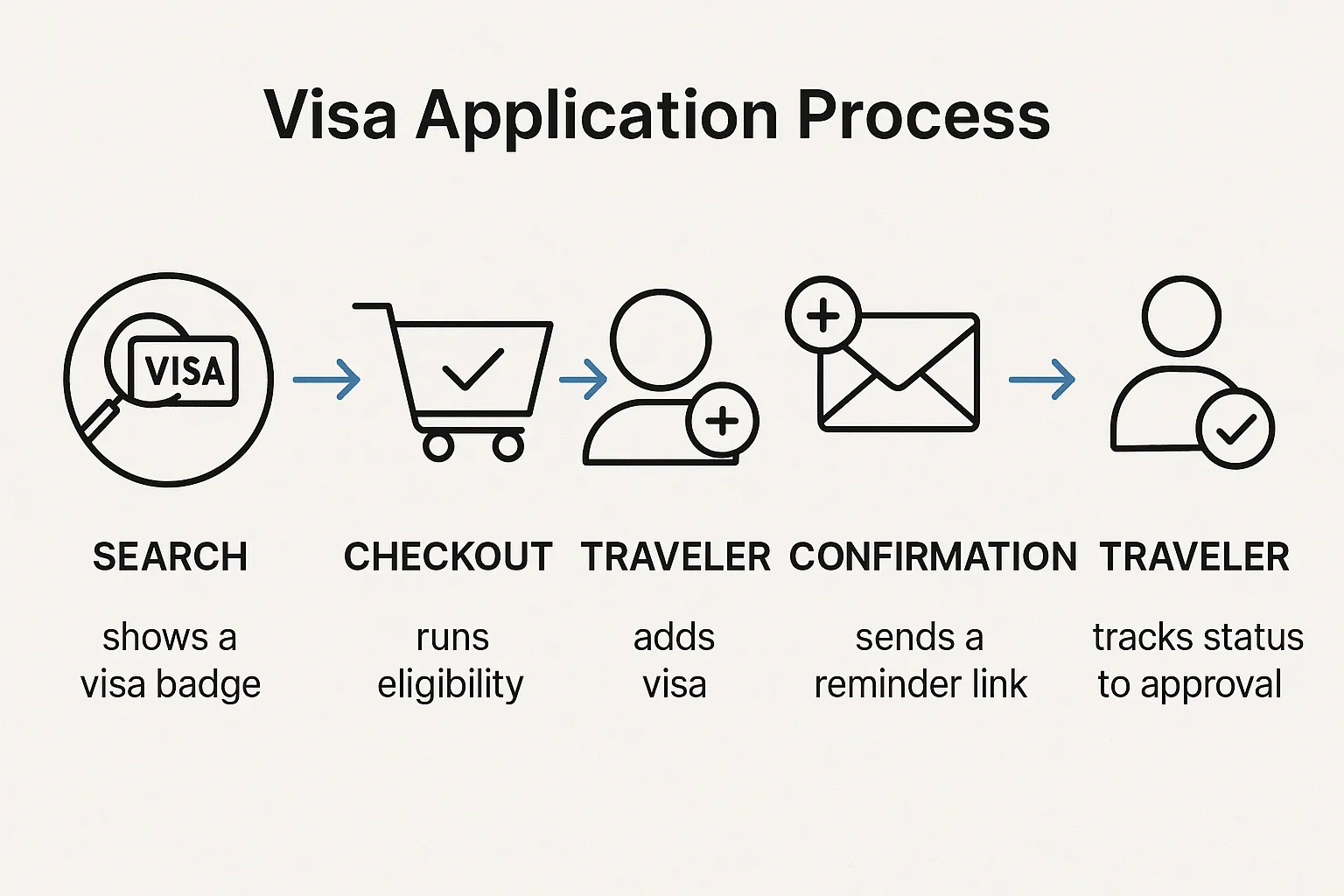
- Discovery and search results, set expectations
- Show a small “Visa may be required” badge on eligible routes and nationalities. Link to a lightbox or drawer explaining requirements and typical timelines. Keep it educational and non‑blocking at this stage.
- Benefit, reduces later surprise and improves trust without adding steps.
- Checkout, drive the decision
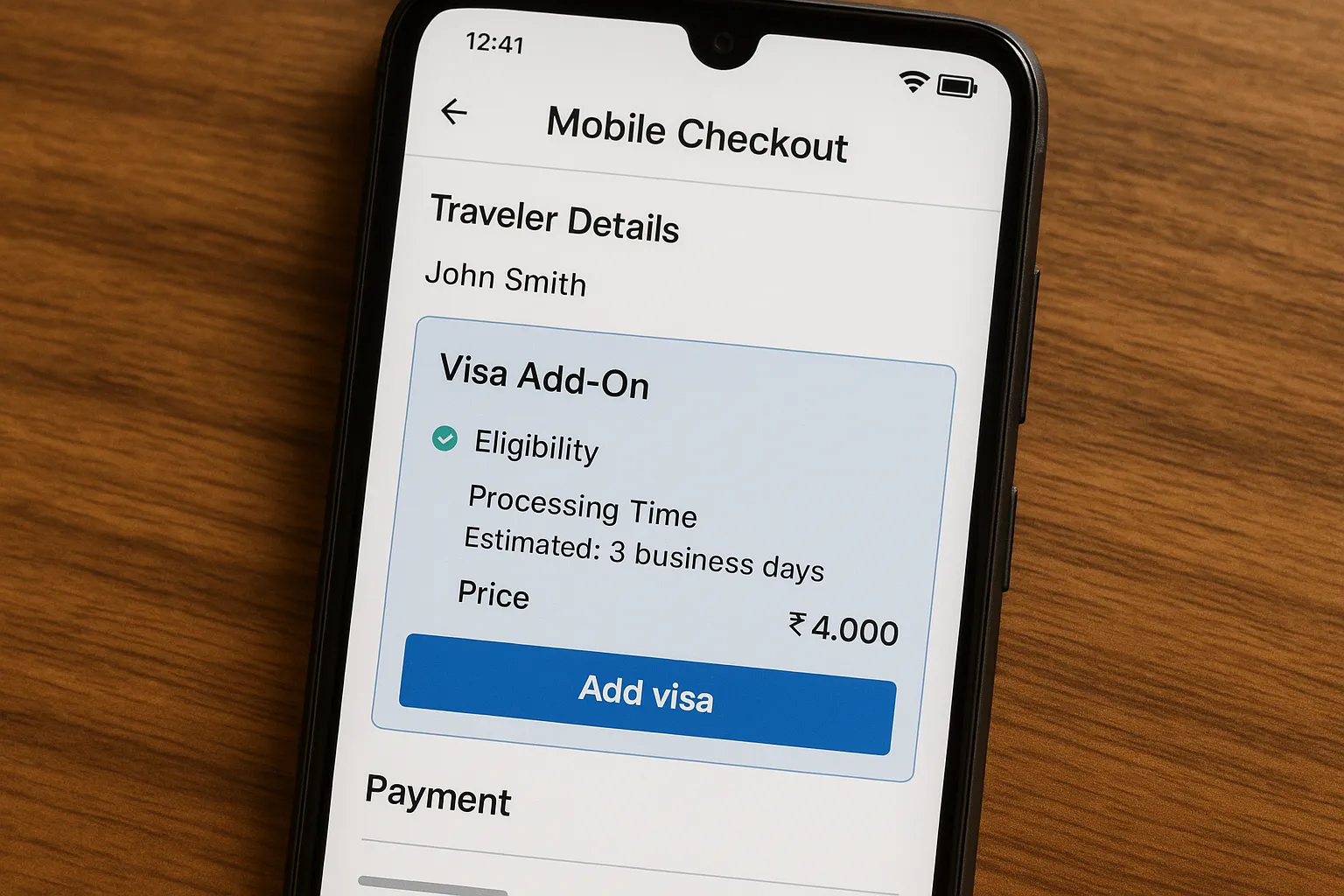
- Best placement, after traveler details and before payment. Run a background eligibility check using itinerary, nationalities, and dates, then present a pre‑filled visa option for each traveler who needs it.
- Offer clear actions, Add visa now or I will do this later. Use the latter to capture lead intent and trigger post‑booking reminders.
- Post‑booking, recover undecided travelers
- Send a confirmation banner and email with a one‑click link to complete the visa online. This is critical for short booking windows and multi‑segment trips. See the templates in Building a seamless post‑booking visa journey.
For a deeper marketing overview, see the Ultimate guide to marketing eVisa services during the booking flow.
12 checkout tactics that boost visa conversion without hurting core sales
- Progressive disclosure, never a wall of fields
- Start with a compact visa card that shows destination, estimated processing window, and price. Expand into steps only after the traveler clicks Add visa.
- Dynamic eligibility and hiding logic
- If no visa is needed for a passenger, do not show the card. If it is optional, present value and convenience. If mandatory for boarding, use clear but calm copy that explains the risk of not securing it in time.
- Pre-fill from known PAX and itinerary data
- Use traveler details already collected in checkout to pre-populate visa fields. Good pre-fill removes cognitive load and reduces errors. More on the data flow in Future of Travel APIs, from flights to visas in a single call.
- Plain-language microcopy and real-time validation
- Replace legalese with short, specific hints. Validate as the user types, and accept minor format variations. If you need a document upload, show the specification right next to the uploader. If a photo fails, explain why and how to fix it. Practical patterns are covered in Why travelers abandon visa forms and 6 UX fixes that convert.
- Upfront, local-currency pricing and taxes
- Price the visa service in the checkout currency with taxes and fees included. Avoid last‑step surprises. If multiple speeds are available from the issuing authority, ladder the options with clear differences.
- Trust signals at sensitive steps
- Briefly explain security, data use, and who processes the visa. Link to a concise privacy page. If your vendor offers security credentials or audits, surface that. Vendor selection guidance here, Top 8 security features to demand in any electronic visa solution.
- Mobile-first capture for documents
- Assume most users are on phones. Support camera capture for passport and photos with live hints. Allow Save and resume so travelers can finish on desktop later without losing progress.
- Clear timelines and alerts
- Show the earliest recommended apply‑by date based on the itinerary. Offer opt‑in reminders via email or SMS if the traveler taps I will do this later.
- Bundles that make sense
- Pair the visa with logical add‑ons, for example insurance that covers rebooking if a visa is delayed. Avoid noisy cross‑sells. If you try bundles, A/B test whether price anchoring helps or hurts.
- Accessibility and localization
- Translate core visa copy and error messages for your top languages. Respect screen readers and large tap targets. Visa stress is high, so inclusive design matters.
- Social proof, light and credible
- Replace generic testimonials with short, proof‑oriented statements like Approval guidance backed by live status tracking and Secure digital storage in your account.
- Frictionless fallback
- If the traveler declines in‑checkout, give a simple, trackable post‑booking link. Do not dead‑end the user.
Tactics by funnel step
| Funnel step | What to show | Why it helps |
|---|---|---|
| Search and results | Visa may be required badge plus Learn more | Sets expectations and reduces checkout surprise |
| Traveler details | Background eligibility check | Personalizes the offer before payment |
| Payment step | Compact, pre‑filled visa card with local pricing | Converts intent while motivation is highest |
| Confirmation | One‑click finish visa link, reminders | Recovers undecided users, protects against denied boarding |
Pricing, packaging, and revenue share options
Visa services monetize best when the value exchange is obvious, save time, reduce risk, complete in minutes. You can experiment with:
- Flat service fee versus revenue share with your vendor
- Tiered options when an issuing authority provides different processing speeds
- Bundles with insurance or lounge access for time‑pressed travelers
For commercial models and trade‑offs, see 7 revenue‑sharing models for online visa processing partners.
What to measure and how to test
Focus on a small, actionable KPI set:
- Visa attach rate, percentage of eligible passengers who add a visa in checkout or within 72 hours post‑booking
- Ancillary revenue per booking, total visa revenue divided by all bookings on eligible routes
- Application completion time, median time from start to submit
- Approval rate, completed applications that are approved versus rejected or withdrawn
- Customer effort and support, tickets per thousand bookings and CSAT
A practical guide with definitions and dashboards is here, 5 KPIs to track after deploying a visa management platform.
Data context, according to our recent analysis of 9.4 million bookings, global average eVisa attach rates were 7.6 percent with higher performance in Southeast Asia and the GCC. See the regional breakdown and ideas to lift conversion in Which regions generate the highest eVisa upsell rates.
A/B tests that usually pay off
- Placement, after traveler details vs just before payment
- Copy tone, mandatory for boarding vs recommended convenience, both truthful, different emphasis
- Price framing, single price vs tiered options with clear value differences
- Action labels, Add visa now vs Secure your visa now
- Reminder cadence, single reminder vs 2‑step sequence at T+2 hours and T+24 hours
Run clean tests for at least two booking cycles on your top visa‑relevant routes. Use guardrails to ensure base conversion does not dip.
Integration patterns that respect your checkout
You do not have to rebuild your cart to add a high‑converting visa flow.
-
No‑code widget, embed a hosted component on the checkout or confirmation page. Configure branding, languages, and eligible routes in minutes. See the Quick tutorial to embed an eVisa widget in under 30 minutes.
-
White‑label visa application app, launch a branded portal on your domain and link from checkout and post‑booking emails. This is fast to market with full branding.
-
API integration, surface eligibility, pricing, and the full application workflow inside your native UX. Ideal when you want complete control and unified analytics. Compare options in API vs white‑label app, which integration model suits you.
Technical tips
- Prefill traveler data you already collect to minimize input. Do not duplicate fields.
- Use webhook events to update order status and trigger reminders.
- Observe privacy and consent standards, link to clear policies, and select vendors with strong controls. See Developer Q&A, authentication best practices and Top security features to demand.
Operational tips
- Train support teams with a one‑page playbook that defines when to encourage in‑checkout purchase versus post‑booking follow‑up.
- Monitor denied boardings and chargebacks. Automated visa checks typically reduce both, which contributes to ROI. For the business case, read The hidden costs of manual visa processing.
30‑day rollout plan
Week 1, scope and design
- Choose integration model, widget, white‑label, or API
- Identify eligible routes and nationalities and define hide/show logic
- Draft compact visa card, headline, price, estimated processing window, primary CTA
Week 2, implement and test
- Embed in a staging checkout
- Configure branding, languages, and currencies
- Instrument events for attach rate, revenue, completion time, and approval rate
Week 3, launch controlled pilot
- Roll out to 10 to 20 percent of eligible traffic on top routes
- Start two A/B tests, placement and copy tone
- Prepare post‑booking reminder templates and cadence
Week 4, measure and iterate
- Review KPIs and support tickets
- Expand traffic, keep the best variants, and plan the next tests
- Share learnings with commercial and operations teams
Frequently asked questions
Where exactly should the visa offer appear in checkout? After traveler details and before payment. This is late enough to be personalized and early enough to act, without blocking the sale.
Will adding a visa step hurt my core conversion? Not if you keep it compact, optional, and pre‑filled. Use progressive disclosure and A/B test the placement. Many brands see higher net conversion due to reduced anxiety and fewer post‑purchase surprises.
What if the traveler already has a visa? Provide a visible Skip or I already have one link. Offer a short checklist to verify validity and entry rules. Capture that signal to stop reminders.
How do we handle multi‑passenger carts? Run eligibility per passenger and present a separate, pre‑filled card per traveler. Keep actions independent. One person can buy, others can skip.
How do we manage different nationalities and complex itineraries? Use an eligibility engine tied to route, nationality, and travel dates. With an API approach, you can compute requirements in the background and only surface relevant options. See Future of Travel APIs.
What KPIs should we watch first? Start with visa attach rate, ancillary revenue per booking, application completion time, approval rate, and visa‑related support tickets. Learn how to instrument these in 5 KPIs to track.
How do we keep data secure? Select a vendor with encryption at rest and in transit, robust authentication, audit logs, and clear data‑retention controls. Map consent into your checkout so travelers know who processes what. See Top security features to demand.
What if a visa is denied? Offer quick re‑application guidance or alternative destination suggestions in post‑booking communications. For a full recovery playbook, read Visa denied, 9 recovery strategies every OTA should offer.
Get started
SimpleVisa helps brands add high‑converting visa booking flows to checkout with minimal engineering. Choose an API for full control, a white‑label app for speed, or a no‑code widget you can ship today. Join 400 plus sites that guide customers through border requirements, lift ancillary revenue, and reduce denied boardings.
Ready to see it in your checkout? Request a demo at https://simplevisa.com.