Electronic Visa Services: Features That Actually Matter

If you sell travel, electronic visa services can feel like a black box. Every provider promises speed, AI, and global coverage. What actually moves the needle for your customers and your P&L is simpler, measurable, and very specific. This guide breaks down the features that matter, explains why they matter, and gives you practical tests to run before you sign a contract.
Start with outcomes, not buzzwords
For most airlines, OTAs, TMCs, tour operators, and cruise lines, the right eVisa stack should deliver three quantifiable outcomes:
- Fewer denied boardings and trip disruptions.
- Higher conversion and new ancillary revenue at booking and post‑booking.
- Lower support burden with clear visibility over compliance.
SimpleVisa’s analysis of 9.4 million bookings found an average eVisa attach rate of 7.6 percent, with certain regions far higher. If your provider cannot instrument and lift attach rates, you are likely leaving margin and NPS on the table.
Features that actually matter
1) Coverage depth and rule accuracy
Border rules change often. The differentiator is not a long country list, it is the freshness and provenance of those rules.
What to look for:
- Machine‑readable rules engine that updates daily and shows a changelog with timestamps and sources.
- Clear handling for special cases, including transit visas, dual citizens, minors, and multi‑leg itineraries.
- Validity calculators that align visa validity with itinerary dates and 90‑in‑180 style limits.
Questions to ask vendors:
- How often do you update rules and how are updates audited?
- Can you show example diffs for a recent policy change?
- How do you treat edge cases like cruise shore visas, land borders, or passport renewals mid‑trip?
2) Conversion‑first application UX
Most abandonment happens because applications feel long, confusing, or unpredictable. Great UX is not decoration, it is conversion insurance.
What to look for:
- Mobile‑first, progressive forms with inline validation and plain‑language help.
- Auto‑fill from booking data, OCR from passport scans, and instant photo checks.
- Transparent pricing in local currency with no surprise documents late in the flow.
- Save and resume, status tracking, and group or family applications in one session.
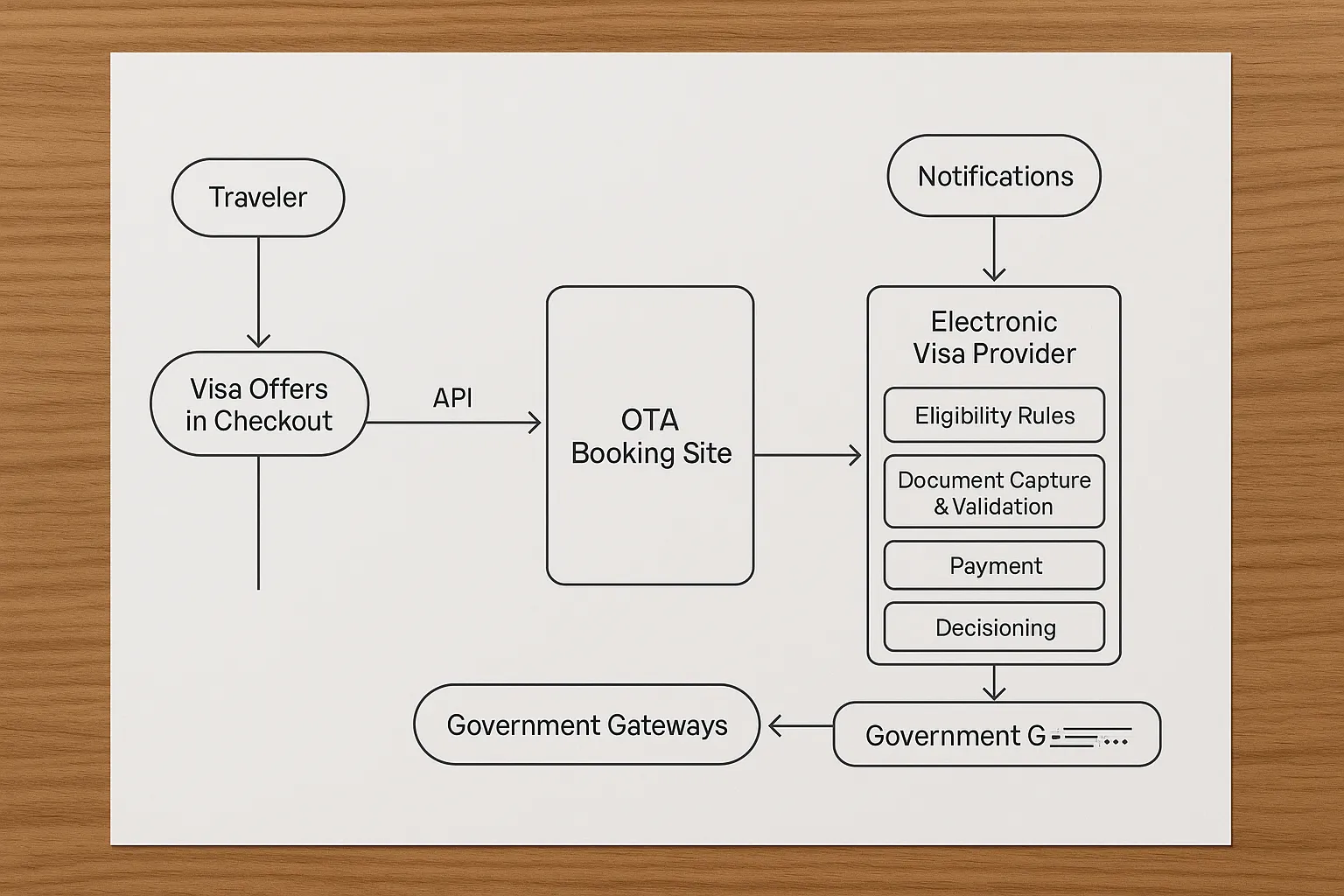
3) Integration choices that match your roadmap
You should not contort your product to fit a vendor’s stack. Insist on options.
- API for full control inside your booking flow.
- White‑label hosted app for speed to market.
- No‑code widget for rapid validation, then migrate to API as you scale.
Learn the trade‑offs in this practical guide, API vs. White‑Label App: Which Visa Integration Model Suits You?
4) Decision speed and approval rate, not just average processing time
Raw averages hide tail risks that cause missed flights. You need predictable throughput.
What to look for:
- Approval‑rate reporting by route, nationality, and visa type, with trend lines.
- SLAs that separate eligibility checks, application submission, and government turnaround.
- Proactive flagging for likely manual review or additional documents.
5) Security, privacy, and compliance by design
Visa data is high‑sensitivity PII. Security cannot be a footnote. Review the stack end to end.
- Encryption in transit and at rest, strong key management, and role‑based access control.
- Multi‑factor authentication and certified biometric liveness checks where applicable.
- Data minimization, configurable retention, and deletion workflows. GDPR and ISO‑style controls with immutable audit logs.
Deep dive the non‑negotiables here, Top 8 Security Features to Demand in Any Electronic Visa Solution
6) Reliability and observability
Visa downtime becomes booking abandonment within minutes. Demand transparency.
- Public status page, uptime SLAs, and incident postmortems.
- Idempotent APIs, clear rate limits, and robust webhooks with signature verification.
- Staging and sandbox environments with deterministic test cases.
7) Payments and pricing travelers trust
Unexpected fees and declined cards are conversion killers.
- Clear fee breakdowns before the first form field, including government, service, and optional add‑ons, charged in the user’s currency.
- Support for major cards, 3‑D Secure, and local payment methods where relevant.
- Refund and reissue policies that are easy to find and easy to trigger.
Cross‑industry lesson: regulated e‑filing markets have already set the bar on trust. This overview of the best 2290 e‑file provider explains why authorization, security, a user‑friendly portal, swift processing, and transparent pricing are non‑negotiable. The same principles apply to electronic visa services.
8) Post‑submission operations that scale
Most of the workload begins after a traveler clicks Pay.
- Real‑time status, ETA predictions, and multi‑channel notifications to reduce where‑is‑my‑visa contacts.
- Assisted support options for complex cases, plus admin views for your agents.
- Automated policy‑change alerts for trips that may be impacted before departure.
9) Analytics and revenue instrumentation
If you cannot see it, you cannot improve it.
- Built‑in dashboards and exportable events for attach rate, completion rate, approval rate, and revenue by route and segment.
- A simple path to feed these events into your BI stack for A/B testing and cohort analysis.
Quick feature matrix and what good looks like
| Feature | Why it matters | What good looks like |
|---|---|---|
| Rules engine and coverage | Prevents wrong advice and denied boarding | Daily updates with sources, changelog, edge case handling, validity calculators |
| Application UX | Lifts conversion and lowers support | Mobile‑first, auto‑fill, inline checks, transparent pricing, save and resume, groups |
| Integration options | Aligns with your roadmap and resources | API, white‑label, and no‑code, with migration path and SDKs |
| Decisioning and SLAs | Controls tail risk, not just averages | Route and nationality approval metrics, stepwise SLAs, proactive flags |
| Security and compliance | Protects PII and brand | Encryption, MFA, RBAC, audit logs, data minimization, GDPR‑aligned controls |
| Reliability and tooling | Avoids revenue‑impacting downtime | Uptime SLA, status page, idempotent APIs, webhooks, sandbox |
| Payments and pricing | Builds trust and reduces churn | Local currency, 3‑D Secure, refunds, simple fee breakdown |
| Post‑submission ops | Reduces tickets and stress | Real‑time status, ETA forecasting, multi‑channel alerts, admin views |
| Analytics and KPIs | Enables optimization and ROI proof | Attach, completion, approval, and revenue metrics with exports |
Nice‑to‑haves that rarely move the needle
- Generic travel content or blog‑style visa articles without machine‑readable rules in product.
- Vague AI claims that do not ship as measurable features like auto‑fill accuracy or fraud detection precision.
- Styling options that add brand polish but do not improve completion time or approval rate.
- Guarantees of entry that no provider can legally make. Only border officials decide entry.
Ten questions for your next RFP
- What is your 90‑day average approval rate by visa type, route, and nationality, and how do you calculate it?
- How do you version your rules, who edits them, and how are edits reviewed and rolled back?
- Show me your incident history and uptime for the last 12 months, including postmortems.
- What SLAs do you commit to for eligibility checks, submission, and status updates?
- Which integration options do you support and what are typical go‑live timelines for each?
- How do you handle groups, families with minors, dual citizens, and multi‑segment itineraries?
- What security certifications and audits do you hold, and can we review your data‑retention defaults?
- Which payment methods and currencies do you support, and how do refunds work?
- What analytics export and webhook events are available, and at what granularity?
- Can you share two references in our region and segment, and a sample pilot plan?
Pilot scenarios that reveal the truth
Run these five tests in a two to four week pilot. Measure completion time, support contacts per application, approval rate, and attach rate uplift.
- A last‑minute booking with a same‑airport international transit that requires a transit visa.
- A family of four with one dual citizen and a minor, applying in one session.
- A cruise itinerary with three ports that each require different permits.
- A passport renewal between booking and travel, with visa transfer or reissue.
- An offline check‑in scenario, verifying what agents see and how exceptions are handled.
What you can standardize today
- A layered integration plan, no‑code widget to validate demand, white‑label for speed, API for scale.
- KPI baselines, attach rate, completion time, approval rate, and per‑route revenue, with weekly reviews.
- A security checklist mapped to your procurement process, encryption, MFA, RBAC, audit logs, retention.
- Clear playbooks for common exceptions, photo failures, payment declines, extra document requests.
Frequently Asked Questions
What defines a high quality electronic visa service? Accuracy of rules, conversion‑first UX, reliable integrations, transparent pricing, strong security, and measurable approval and attach rates. If a feature does not improve one of those, it is likely a distraction.
How should I compare approval rates across vendors? Ask for approval rates segmented by route, visa type, and nationality, and insist on the definition used. Some vendors exclude incomplete applications or specific visa types, which inflates numbers.
What uptime SLA should I require? Many travel brands aim for 99.9 percent or better with a public status page, clear incident SLAs, and idempotent API guarantees. Evaluate historical incident reports, not only promises.
Which integration model should a smaller OTA start with? If engineering resources are limited, start with a white‑label or no‑code widget to validate attach rate and support impact, then graduate to an API once you have clear ROI and product requirements.
Can any provider guarantee entry at the border? No. Providers can improve approval odds and compliance, but only border officers decide entry. Avoid vendors that imply guarantees.
How quickly can we go live? No‑code and white‑label models can often launch in days, while a full API build typically takes a few sprints. Success depends on your internal resources, payment setup, and localization.
The SimpleVisa difference, built for outcomes
If you want an electronic visa partner that ships the features that matter, SimpleVisa offers:
- Visa processing automation that plugs into your booking flow through API, white‑label, or no‑code.
- Guided applications that raise completion rates and reduce support workload.
- Security by design, with audited controls and privacy practices aligned to major frameworks.
- Proven commercial impact, ancillary revenue generation and high approval rates, used on 400 plus sites.
Travel is won on trust, speed, and clarity. See how quickly you can add compliant eVisa services that travelers love and your finance team applauds. Request a demo at simplevisa dot com and we will show you a pilot plan tailored to your routes, markets, and timeline.