Visa Application Customer Service: Escalation That Works

Visa applications are high stakes for travelers and high cost for travel brands when something goes wrong. A missed form field can become a missed flight, and an unclear status update can snowball into refunds, rebookings, chargebacks, and poor reviews. The fastest way to cut both traveler anxiety and operational cost is to design visa application customer service with escalation that works, meaning a clear path from first contact to the right expert, at the right speed, with the right authority to resolve.
This playbook distills practical escalation patterns used by high-performing airlines, OTAs, TMCs, and tour operators. It shows where automation should do the heavy lifting, where human expertise must take over, and how SimpleVisa fits into a scalable support model that improves approvals, protects margins, and lifts NPS.
What “good” escalation looks like in visa support
Good escalation balances speed, accuracy, and compliance. It is not about pushing tickets up a chain, it is about getting the traveler to the next best action with confidence. The essentials are:
- Clear severity definitions and owners, so agents never hesitate on who handles what.
- Time-bound SLAs based on departure timing and case risk, not generic support targets.
- Automated triggers that flag risk before the traveler notices a problem.
- Playbooks that combine operational steps with traveler-facing communication, so each handoff reduces uncertainty.
- Governance that limits who can change sensitive data and how decisions are logged for audit.
When to escalate a visa case immediately
The single most common failure in visa application customer service is waiting too long to escalate. Use unambiguous triggers that promote speed over second-guessing. Typical escalation triggers include:
- Imminent departure and incomplete or at-risk application, for example under 72 hours to wheels up with missing documents or open requests from authorities.
- Identity or data mismatches, such as name order differences between passport and application, incorrect passport number, or PNR details that do not match the form.
- Government request for information, additional security questions, or background checks that require precise guidance and time-boxed follow up.
- Payment failures after multiple attempts, or 3‑D Secure issues that block timely submission.
- Photo or document non-compliance, for example background color, size, glare, or illegible scans that need re-capture instructions.
- Biometric appointment disruptions, like VAC closures, reschedules, or capacity constraints.
- Suspected fraud, duplicate applications, or watchlist false positives that require compliance review.
- Platform or government-portal outages, where you must switch to a fallback process and keep travelers informed in real time.
Build a simple, scalable escalation ladder
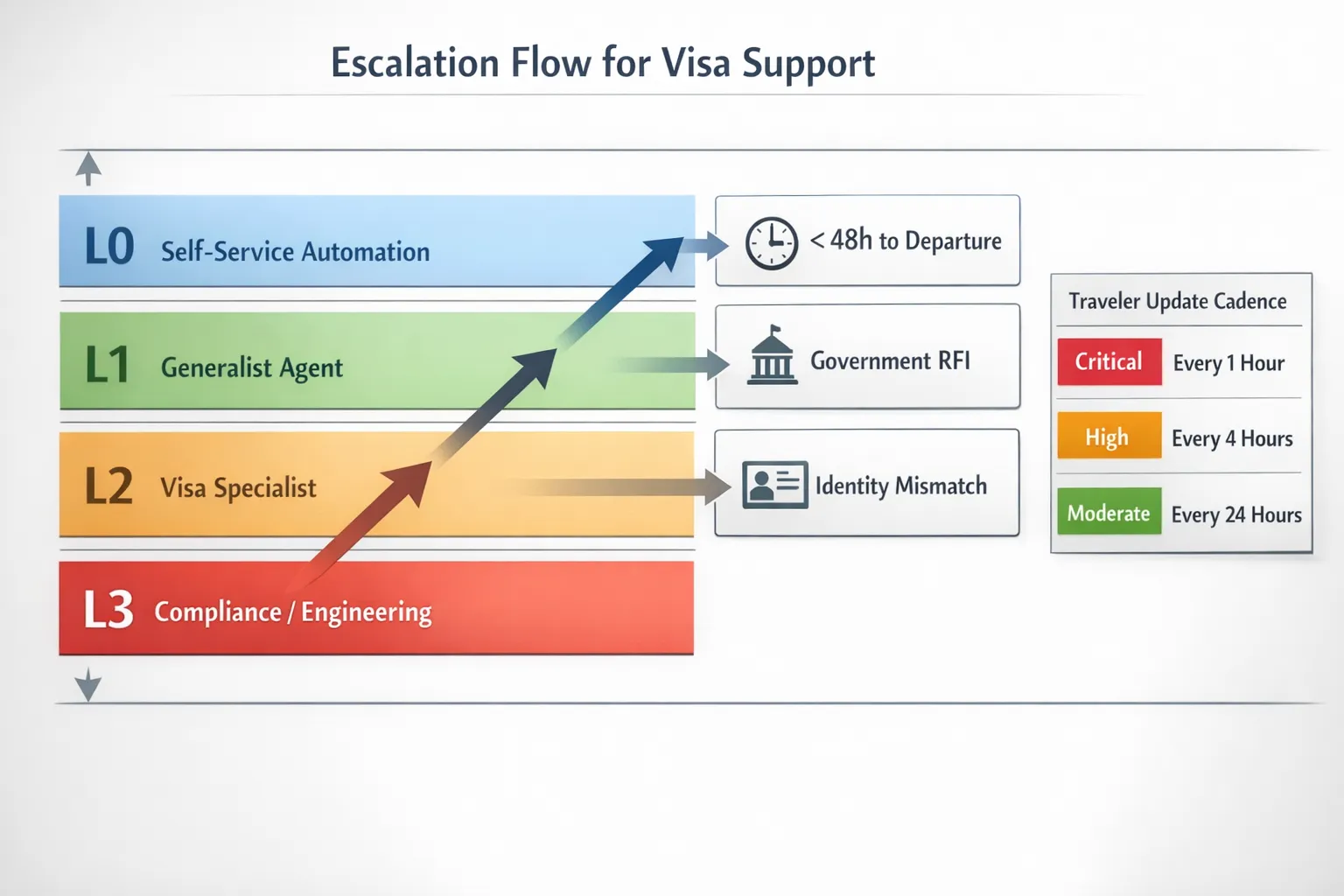
A tiered model still works for visa support, provided it is lightweight and backed by swarming for time-critical cases.
- L0, self-service and automation, in-flow checkers, status pages, eligibility rules, and contextual help that solve common questions without human contact.
- L1, generalist agents, trained on checklists and scripts, who handle routine questions, confirm requirements, and collect missing artifacts.
- L2, visa specialists, who correct application logic, advise on government RFIs, select the correct pathway, and coordinate any re-submissions.
- L3, compliance and engineering, who handle identity risk, data disputes, vendor and API incidents, and high-impact policy updates.
- External, government or embassy, engaged via defined channels only when the case requires formal clarification. Be transparent that third parties cannot guarantee expedited outcomes.
Swarming works well when departure is near or an incident affects many travelers. Pull L2 and L3 into the room early, set a single case owner, and broadcast clear customer updates on a defined cadence.
A practical SLA matrix for visa cases
Use a severity model that keys off both time to departure and risk to entry. Treat the matrix below as example targets to localize for your brand and destinations.
| Severity | Definition example | First response target | Resolution owner | Update cadence | Example actions |
|---|---|---|---|---|---|
| Sev 1, Critical | Under 48 hours to departure with incomplete or at-risk application, portal outage affecting submissions | 15 minutes | L2 specialist, with L3 on call | Every 60 minutes | Priority doc capture, alternative routing, re‑submission, airline coordination |
| Sev 2, High | Government RFI or mismatch with 2–7 days to departure | 1 hour | L2 specialist | Every business day | RFI response plan, doc guidance, status verification |
| Sev 3, Standard | Routine questions, payment retries, photo re-upload with 8+ days | 4 hours | L1 agent | Every 72 hours | Step-by-step instructions, automated reminders |
| Sev 4, Advisory | Policy clarifications, future trips, non-urgent cases | 1 business day | L1 agent | As agreed | Knowledge-base links, eligibility guidance |
Automate the moment a case deserves escalation
Automation removes guesswork and buys you time. Implement these detection and routing patterns:
- Departure-aware risk scoring, combine PNR dates, passport nationality, destination, and current application status to raise severity as departure nears.
- Document AI pre-checks, validate photo and scan specs before submission to cut rework and prevent late-stage rejections.
- Real-time webhooks to support, trigger tickets when a government portal requests new information, when payment fails, or when a status flips to rejected or approved with a data mismatch.
- Proactive reminders, scheduled nudges for travelers to upload missing documents and for agents to chase RFIs before SLAs are at risk.
SimpleVisa integrates through API, white-label portals, or no-code widgets, and can feed these alerts into your help desk or custom tools. If you run a light engineering team, the no-code option still gives you meaningful auto-escalation without a long build.
Playbooks for the issues that cost you the most
Playbooks should be one page each. Focus on inputs, decisions, outputs, and traveler copy. Here are four high-impact examples.
1) Name or passport-number mismatch after approval
- Inputs, government approval notice, traveler’s passport image, PNR.
- Decisions, is the mismatch acceptable at border for this country, or must you correct and re-issue.
- Outputs, corrected application if required, updated traveler documents, carrier notes if permissible.
- Traveler copy, explain the data difference in plain language, confirm whether re-issue is needed, state expected timing and what the traveler must do.
2) Government RFI within seven days of travel
- Inputs, RFI content, required documents, traveler availability.
- Decisions, whether to respond as-is, seek an official clarification, or recommend itinerary changes.
- Outputs, compiled response with compliant scans, timestamped submission, follow-up schedule.
- Traveler copy, list documents needed, a deadline, and set a daily update cadence until the case closes.
3) Photo or scan rejection
- Inputs, rejection reasons and spec sheet.
- Decisions, whether a quick re-capture solves it or if a professional photo service is needed.
- Outputs, validated file with pass/fail pre-check.
- Traveler copy, include a single checklist for background, size, lighting, and a link to your nearest-available compliant photo option.
4) Payment and submission failures
- Inputs, payment error codes, 3‑D Secure logs.
- Decisions, alternative card, offline payment, or government fee workaround if supported.
- Outputs, successful submission receipt and transaction ID.
- Traveler copy, confirm no double charge, outline next step in one sentence, and include the receipt when successful.
Communicate like the outcome depends on it
In visa application customer service, clarity is a feature. Write updates that reduce cognitive load:
- Lead with status, the plain-English state today.
- Specify the next step and who owns it.
- Give a time window for the next update even if nothing changes.
- Avoid jargon and acronyms unless you define them once.
Pro tip, maintain short templates per severity that agents can personalize in seconds. Use the same structure across email, SMS, push, and chat so travelers never see inconsistent guidance.
Staffing, schedules, and the on-call you actually need
Visa issues do not respect business hours, especially for global customer bases. Cover what matters without overstaffing:
- Follow the sun, staff L1 in your top origin time zones, keep a lean L2 roster with documented handovers.
- True on-call at L3 only, reserve compliance and engineering for real incident windows and policy shifts.
- Certification and refreshers, train L1 for 80 percent of questions and certify L2 on the top 10 destinations you sell. Refresh quarterly or when rules change.
If you are building the program from scratch, a seven-day sprint is realistic to get agents job-ready when you focus on destinations, tools, scenarios, and escalation policies.
Governance, privacy, and audit
Escalation without controls creates risk. Put guardrails in place:
- Data minimization, collect only what a destination requires. Tokenize or redact documents in tickets where possible.
- Role-based access control, L1 should not be able to edit identity data after submission. L2 changes should be logged with reason codes.
- Immutable audit trails, log who did what and when, including government submissions, traveler consent, and any data corrections.
Borrow from one-stop, end-to-end models
Industries that thrive on complex, multi-step workflows often win by consolidating expertise under one roof. End-to-end operations with clear quality gates and certifications build trust because customers sense that nothing falls through the cracks. For a useful parallel, see how a one-stop apparel development partner positions its start-to-finish services and quality assurances. The lesson for travel brands, simplify the customer journey by owning the workflow and the handoffs, then make the escalation path obvious and fast.
Where SimpleVisa fits in your escalation design
SimpleVisa was built to lower friction for travelers and lower cost for partners:
- Visa processing automation, eligibility, document capture, validation, and submission reduce rework and late escalations.
- Integration options, API for deep booking-flow embedding, white-label app for fast go-live, and no-code widgets when speed matters most.
- Guided applications, reduce abandonment and clarify requirements upfront so L1 handles far fewer repetitive contacts.
- Premium eVisa management, a managed path for complex trips and corporates who need white-glove support.
- Custom data services and webhooks, push real-time status changes into your help desk and CRM to auto-create tickets and route by severity.
- Commercial uplift, ancillary revenue generation with high approval rates, already live on 400 plus partner sites.
You do not need to rip and replace your stack. Start by adding SimpleVisa where it will deflect the most tickets and supply the most useful triggers, exactly where your escalation model needs them.
A 30-day rollout plan
You can assemble a working escalation program in one month if you focus on the highest-impact flows.
- Days 1–5, define severity levels, owners, and SLAs. Pick the top 10 routes or destinations that drive 80 percent of your visa contacts. Draft four one-page playbooks and three message templates per severity.
- Days 6–10, wire automation. Enable status webhooks to your help desk, configure departure-aware risk scoring, and turn on photo and document pre-checks.
- Days 11–15, train L1 and L2 on the playbooks. Run red-team drills for imminent departures and government RFIs. Confirm on-call schedules for L3.
- Days 16–20, soft launch on two markets. Measure response times, escalation rates, first-contact resolution, and approval rates.
- Days 21–30, iterate. Fix gaps in templates, tweak severity thresholds, and roll to additional markets.
The metrics that prove it is working
Make the scoreboard visible and tie it to continuous improvement:
- First response time by severity, actual versus target.
- Escalation rate, percentage of L1 contacts that require L2 or L3.
- Application completion time, from start to submission and to decision.
- Approval rate and rework rate, approvals on first submission and percentage needing correction.
- NPS or CSAT on visa contacts, segmented by severity and destination.
- Cost per resolved case and ancillary revenue per booking when visa services are attached.
When you see Sev 1 volume dropping and approval rates rising for the same traffic, the system is doing its job.
Final word
Visa application customer service is best-in-class when escalation is predictable, fast, and minimally invasive for the traveler. That takes crisp definitions, automated triggers, small but capable expert teams, and message templates that reduce anxiety. With SimpleVisa’s automation, integration options, and guided flows, you can stand up a reliable model quickly and let your agents focus where human judgment adds the most value.
Ready to design escalation that works and turns compliance into customer confidence and revenue? Contact SimpleVisa to explore an API, white-label, or no-code launch that fits your stack and timelines.