Service Fee Visa Pricing: Set It Right

Getting the visa service fee right is the difference between a healthy ancillary line and a conversion killer. Price too low and support costs eat your margin. Price too high and shoppers bounce, or worse, accuse you of hidden fees. This guide gives travel leaders a practical framework to set, test, and scale service fee visa pricing with confidence.
Who this is for: heads of ancillary, e‑commerce leads, product managers, revenue and operations teams at airlines, OTAs, cruise lines, tour operators, TMCs, and superapps embedding border‑compliance services.
Start with unit economics, not guesswork
Before you choose a pricing model, map your real per‑application costs. They are more than a government filing fee and a payment charge.
| Cost component | What it includes | How to control it |
|---|---|---|
| Government fees | Base filing fee, surcharges for priority lanes, biometric/port fees when applicable | Disclose clearly, pass through at cost, cache updates hourly to avoid stale amounts |
| Platform/processing | Eligibility checks, form automation, secure submission, status polling, data storage, audit logs | Use a provider with volume pricing and high approval rates to reduce rework |
| Payment and FX | Card network fees, 3‑D Secure costs, currency conversion and spread, refunds/chargebacks | Offer local payment methods, batch refunds, round prices in local currency to reduce declines |
| Customer support | Live chat, email, phone, multilingual support, proactive status notifications | Invest in in‑flow guidance and document validation to cut contacts per application |
| Rework and resubmissions | Fixing rejected photos, missing fields, resubmitting after a refusal or government RFI | Automated document checks and pre‑flight eligibility rules reduce rework rate |
| Compliance and security | PCI scope, GDPR/CCPA, ISO audits, access controls, fraud tooling | Choose certified partners, minimize data retention, tokenize wherever possible |
| Risk and breakage | Fraud, duplicate submissions, abandoned carts at pay step | Upfront fee clarity, trusted seals, and known‑good payment rails reduce breakage |
If you need a deeper primer on fee components, read Fee for Visa, How Costs Are Calculated and Visa Processing Fee Explained on our blog:
Choose a pricing model that fits your audience
Your service fee should express the value you add: accuracy, speed, peace of mind, and fewer denied boardings. Different buyer segments respond to different pricing patterns.
| Model | Best for | Pros | Watch‑outs |
|---|---|---|---|
| Flat service fee | ETAs and simple eVisas in leisure markets | Easy to understand, quick to compare, low support effort | Can be misaligned with complex cases; may cap upside |
| Tiered service levels | Mixed audience, business travelers, families | Lets you anchor with Standard, highlight Priority, and upsell Concierge support | Requires crystal‑clear benefits by tier, plus SLA discipline |
| Dynamic markup on gov fee | Price varies by destination and complexity | Keeps margins proportional, scales well across markets | Avoid the appearance of hidden markups, show a clear breakdown |
| Bundled or waived fee | Loyalty members, corporate accounts, premium fares | Lifts conversion and NPS, supports membership value | Make the subsidy visible so value is perceived, not invisible |
| Family/group pricing | Multi‑passenger leisure and tours | Prevents sticker shock, reduces cart friction | Cap support time per file so large groups do not erode margin |
For partner models beyond retail, see 7 Revenue‑Sharing Models for Online Visa Processing Partners.
Build your starting price with a simple formula
Translate unit economics into a launch price using a transparent equation. Define these variables per market and visa type:
- Cg, government fees you pass through
- Cp, platform and processing cost per application
- Cpay, payment and FX cost per successful charge
- Cs, average support cost per application
- Cr, expected rework cost multiplied by rework probability
- M, target gross margin on your service component (not on Cg)
Price formula:
- Service fee target, S = (Cp + Cpay + Cs + Cr) divided by (1 minus M)
- Display price, P = Cg plus S
Two tips make this practical across dozens of routes and nationalities:
- Use guardrails, minimum S and maximum S, to avoid extreme prices on edge‑case visas.
- Round to friendly local price points to reduce cognitive load.
Show your value, show the breakdown
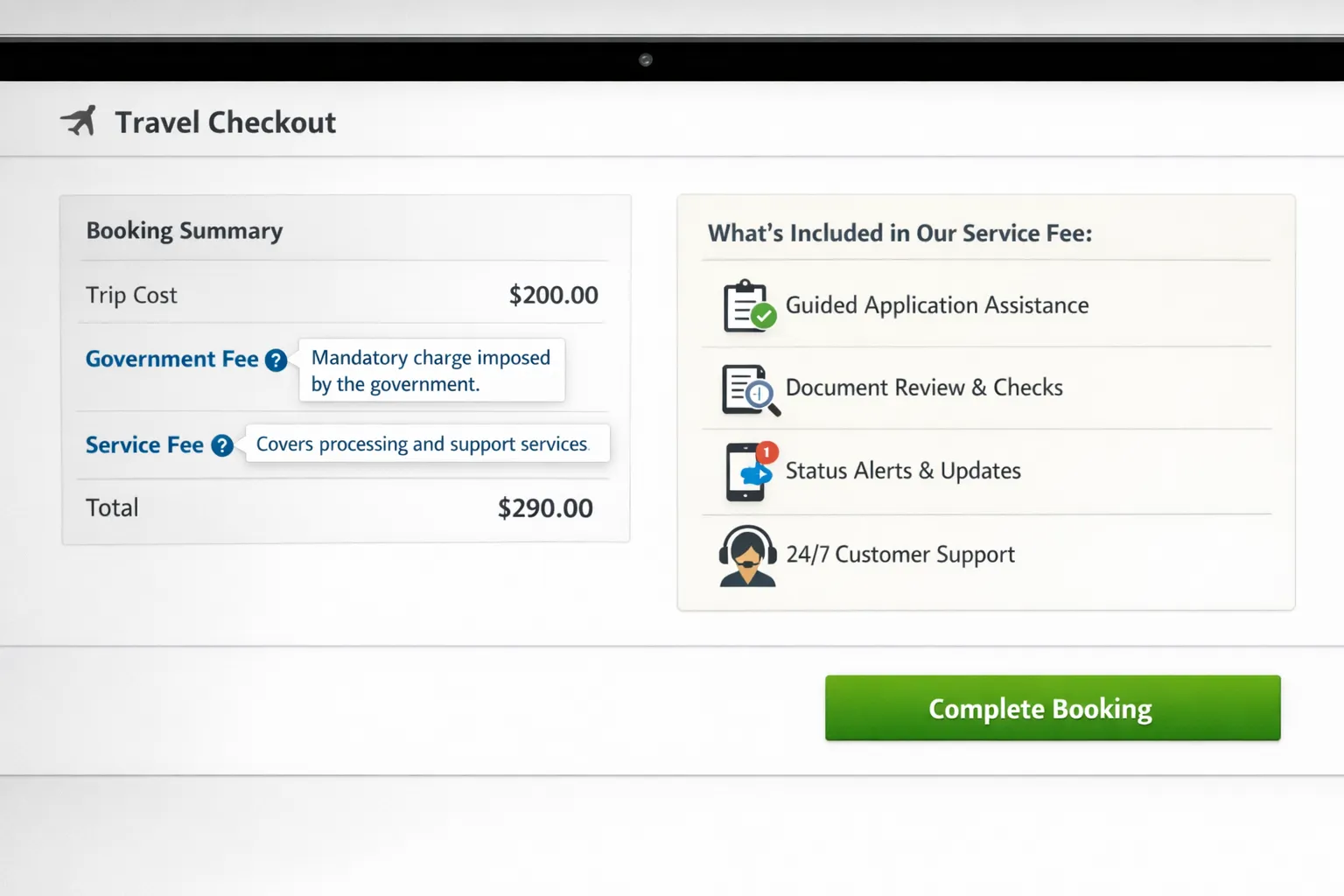
Travelers are primed to distrust “mystery fees.” You will convert more at the same price if you present a clear breakdown and explain your role in plain language.
- Display the government fee and your service fee as separate lines, with short tooltips that explain each.
- Clarify what your service fee buys: guided forms, document checks, status tracking, and support if something goes wrong.
- Be upfront about exceptions: some destinations require consular visits or biometrics. Briefly describe how you assist if those apply.
- Localize currency and include taxes where required. Avoid last‑step surprises.
- Publish refund and re‑application rules in one place. Shoppers equate clarity with competence.
If you need copy patterns and placement ideas, use the templates in our Ultimate Guide to Marketing eVisa Services During the Booking Flow.
Design tiers that anchor, not confuse
A strong tier design does three things: anchors value, nudges to the middle option, and gives an escape hatch for urgency.
- Standard, the price leader, delivers full compliance for typical timelines.
- Priority, the hero, adds faster handling or extended support hours and becomes the most selected option.
- Concierge, the premium, offers white‑glove help for complicated itineraries or groups.
Keep the comparison chart simple. Limit to three to five benefit rows and one clear SLA per tier. If governments offer paid priority processing, explain that this is separate and will be passed through at cost when applicable.
Localize pricing without losing control
Service fee expectations vary by market and visa type. Calibrate with real attach‑rate data and competitor scans, then tune price bands by region and product.
- ETAs and low‑effort eVisas: lean on flat fees and drive volume.
- Multi‑document or high‑risk markets: a tier or dynamic markup better reflects the work and risk profile.
- Corporate or managed travel: bundle the service fee into program pricing, then display a $0 line item at checkout to reinforce value.
SimpleVisa’s analysis of 9.4 million bookings shows that attach rates vary significantly by region. Use those insights to prioritize where a modest price test will have the biggest revenue impact. See Which Regions Generate the Highest eVisa Upsell Rates? New Research.
A/B test with the right KPIs
Price is a product change. Treat it like one. Define success, run clean splits, and give tests enough time to stabilize across weekdays and booking windows.
Core metrics to monitor:
- Attach rate, shares of eligible bookings that start an application
- Application completion rate, starts to paid submissions
- Approval rate, particularly if lower fees increase volume from first‑time applicants
- Customer contacts per application, a proxy for clarity and value perception
- Refund and chargeback rates, indicators of misaligned expectations
- Ancillary revenue per booking, to ensure price lifts do not reduce overall attach
For instrumentation and dashboards, borrow from our playbook in 5 KPIs to Track After Deploying a Visa Management Platform.
Governance and compliance check
Even perfect pricing fails if it falls foul of advertising or consumer‑protection rules. Set internal guardrails before you launch.
- Display total payable amounts and any optional add‑ons before the pay step.
- Use the exact legal name of the document, for example eVisa, eTA, or travel authorization, and avoid implying guaranteed entry.
- Keep receipts precise. Itemize government fees, your service fee, and taxes where applicable.
- Localize terms and conditions. Some jurisdictions require specific wording on refunds and cooling‑off periods.
Tip: link to government sources inside tooltips sparingly. It improves trust but do not send users away from checkout. Summarize the relevant rule and offer a “Learn more” link post‑purchase.
Pricing pitfalls to avoid
- Hidden markups on government fees that appear only at payment. Shoppers will recognize this and abandon.
- Over‑segmenting tiers. More than three tiers depresses selection and raises support costs.
- Setting one global price. It will be too high in some markets and too low in others.
- Promising speed you do not control. Be clear when faster decisions are at the government’s discretion.
- Underestimating rework. A small rework rate can erase margin if your fee is set too tightly.
A 30‑day launch plan for service fee visa pricing
Week 1, discovery and baselines:
- Pull three months of data on eligibility volumes, attach, completion, support contacts, and approval rate by country pair and passport.
- Compute unit costs per application and rework rates. Draft price bands per product.
Week 2, pricing design and copy:
- Choose your primary model by product, for example flat for ETAs, tiered for complex eVisas.
- Write price and value copy, fee breakdown labels, and refund rules. Localize to your top five markets.
Week 3, implementation and QA:
- Configure bands, guardrails, and rounding rules in your pricing service.
- Stage A/B test variants and instrument KPIs and events.
Week 4, soft launch and iterate:
- Start with 10 to 20 percent of eligible traffic per market. Watch early signals on attach, completion, and contacts.
- Roll up to 50 percent if signals are neutral or positive. Commit to a two‑week run before declaring a winner.
Where SimpleVisa fits
If you are still calculating fees manually, or sending travelers to third‑party sites, you are leaving conversion and margin on the table. SimpleVisa provides three ways to embed compliant pricing and workflows where travelers already are:
- API integration for booking flows with programmatic control over price bands, fee breakdown, and A/B tests
- A white‑label visa application app with pre‑built pricing and localization controls
- A no‑code widget that can be live in under an hour and supports fee transparency out of the box
Our platform powers guided applications, document checks, and status tracking, with service available on 400 plus partner sites. Many partners pair pricing experiments with our rules engine to lift attach rate without increasing support load. To see configuration options, request a walkthrough.
Explore related resources to deepen your pricing strategy:
- Ancillary Revenue Explained: Turning Compliance Into Profit
- Ultimate Guide to Marketing eVisa Services During the Booking Flow
- Which Regions Generate the Highest eVisa Upsell Rates? New Research
Quick checklist to set your service fee right
- Define true per‑application costs, including rework and support
- Pick a model per visa type and audience, not one price for all
- Show a clear government fee plus service fee breakdown in local currency
- Localize price bands, round sensibly, and explain value in one sentence
- Test tiers and copy together, not price in isolation
- Track attach, completion, approval, support contacts, and refunds weekly
- Review guardrails quarterly as routes, fees, and traveler mix evolve
Set service fee visa pricing as deliberately as you price seats, bags, or insurance. When you do, you will see higher attach, fewer support tickets, and a healthier ancillary P&L.
Ready to implement transparent, testable pricing and lift conversion in weeks, not months? Book a SimpleVisa demo to see API, white‑label, and no‑code options in action.