Visa Online Service SLAs: Metrics That Matter

Visa requirements are a conversion killer when they fail quietly. A traveler books a flight, hits the visa step, the eligibility data is outdated or the application flow errors, and the booking turns into a chargeback, a support ticket, or a denied boarding.
That is why service-level agreements (SLAs) for a visa online service matter. Not just “99.9% uptime,” but the metrics that actually protect your revenue, your customers, and your operational teams.
This guide explains the SLA metrics that matter most for visa and travel-authorization services (eVisas, eTAs, ETIAS-style authorizations), how to define them, and how to measure them in production.
SLA vs SLO vs KPI (and why it matters in visa workflows)
Teams often mix these terms, which leads to vague contracts and painful escalations.
- SLA: A contractual commitment (with remedies) for a defined service, measured in a defined way.
- SLO: An internal reliability target (often tighter than the SLA) that engineering uses to manage quality.
- KPI: A business outcome metric (conversion, attach rate, revenue per booking). KPIs are influenced by the service, but not always fully controlled by it.
In a visa online service, you typically want SLAs for what the vendor controls (API availability, data update cadence, support response time) and KPIs for what you optimize together (attach rate, completion time).
If you want a reliability framing your engineers will recognize, Google’s SRE approach to SLOs and error budgets is a solid reference point: Site Reliability Engineering (Google).
The 7 SLA metric groups that actually impact travel operations
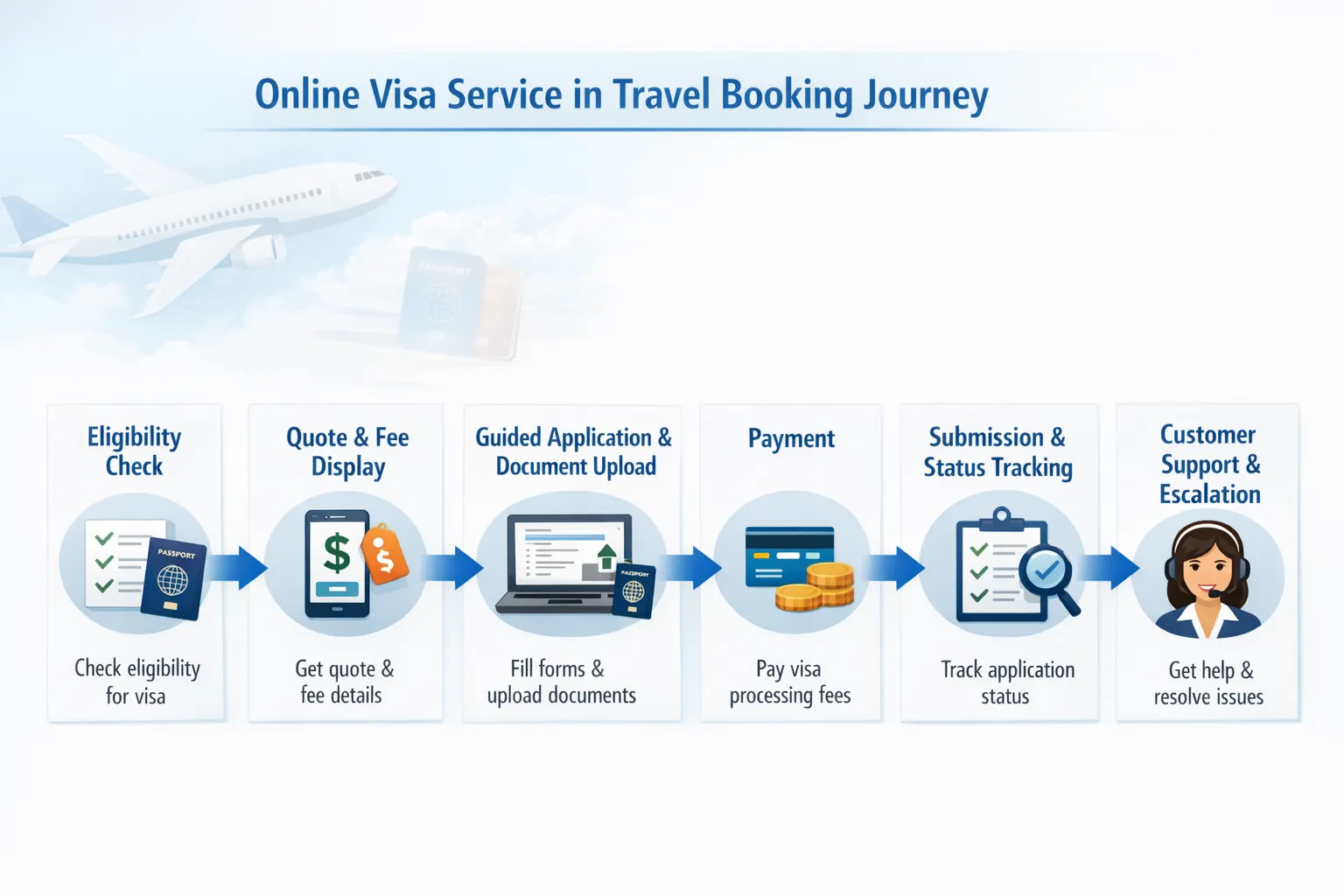
Most visa integrations touch checkout, post-booking communications, payments, document capture, and government submission. Your SLAs should mirror that chain.
1) Availability that matches your booking reality
“Uptime” is not one thing. A visa service can be “up” while the step that matters (pricing, eligibility, payment, submission) is failing.
Define availability per critical component, for example:
- Eligibility endpoint availability (can you determine if a traveler needs a visa or authorization?)
- Quote and fee calculation availability (can you display accurate fees at checkout?)
- Application session availability (can the traveler complete the flow?)
- Submission pipeline availability (can completed applications be transmitted to the issuing system when applicable?)
Also define:
- Measurement method: synthetic monitoring from agreed regions, or real traffic, or both.
- Exclusions: scheduled maintenance windows, force majeure, third-party government portal downtime (if applicable).
Practical tip: ask for separate SLA reporting for web app vs API, if you use both.
2) Latency SLAs (because checkout is a performance environment)
Visa steps often live inside a conversion-sensitive flow. If eligibility takes 2 seconds instead of 200 ms, you will feel it.
Common latency commitments to ask for:
- p95 and p99 API response times (not just averages)
- Time to first byte (TTFB) for embedded widgets
- End-to-end time for key actions (create application session, upload a document, receive a status update)
Also specify regional performance expectations if you sell globally.
If you need a neutral definition of percentile latency and why it matters, Cloudflare has a clear explainer: Understanding latency and performance.
3) Data quality SLAs (rule accuracy and update speed)
For travel brands, visa “data” is not content. It is compliance logic. A single wrong rule can cause denied boarding, rebooking costs, and reputational damage.
Data SLAs you should consider:
- Rule accuracy rate: how often the eligibility and document requirements are correct for a given passport, destination, transit pattern, and travel dates.
- Change-to-publish time: how quickly rule changes are reflected after they are confirmed.
- Coverage SLAs: which destinations, nationalities, and document types are supported (eVisa, eTA, consular visa guidance, transit rules).
- Data provenance and escalation: what sources are used and how disputes are handled.
It is reasonable to require a defined correction workflow (for example, triage within X hours, fix or workaround within Y hours) even if the vendor cannot “guarantee” government behavior.
For context on how the industry commonly consumes entry requirement data, many airlines and travel companies rely on IATA Timatic as a reference point: IATA Travel Centre.
4) Application workflow SLAs (the metrics travelers actually experience)
Even when the API is healthy, customers can fail because of UX friction, document validation issues, or payment errors.
Operationally meaningful workflow SLAs include:
- Application completion success rate: share of users who start and reach a submitted state (excluding voluntary abandonment definitions you agree on).
- Upload success rate and document validation accuracy (false rejects create churn and tickets).
- Payment authorization success rate (and clear fallbacks).
- Session continuity (resume capability after device switch or timeouts, when supported).
This is where you should align on event definitions. “Submitted” must mean the same thing to your analytics team and the vendor’s reporting.
5) Status and notification SLAs (webhooks, emails, and operational calm)
In travel, “no news” creates tickets. Travelers and agents want to know what is happening, even if the answer is “still in process.”
For B2B integrations, notification SLAs often matter more than dashboards.
Define SLAs for:
- Webhook delivery success rate (with retries and idempotency expectations)
- Webhook delivery latency (time from status change to your system receiving it)
- Status freshness (how often the system polls or receives updates from downstream systems)
- Incident communications (how quickly you are notified when the vendor detects broad impact)
Also specify support for reconciliation (for example, re-sending missed events) so your operations team is not debugging blind.
6) Support SLAs (and the difference between “response” and “resolution”)
Visa-related problems are time-sensitive. A “we’ll get back to you” response in 24 hours is not helpful when departure is tomorrow.
Support SLAs should define:
- First response time by severity (P1, P2, P3)
- Time to mitigation (not only time to final resolution)
- Escalation path (named roles or on-call coverage expectations)
- Hours of coverage (24/7 vs business hours) and supported languages where relevant
A good SLA also defines what qualifies as a P1 in your context, such as “checkout blocker,” “incorrect eligibility shown,” or “submission outage.”
7) Security and compliance SLAs (what happens when something goes wrong)
Even if you already validated a vendor’s security posture, your SLA should define operational obligations.
Examples of SLA-able commitments:
- Security incident notification window (when you will be informed after discovery)
- Breach containment and coordination process
- Vulnerability remediation timelines by severity
- Audit support (how quickly they provide evidence for your compliance needs)
- Data retention and deletion timelines (especially if you operate under GDPR/CCPA-type expectations)
For baseline context on information security management, ISO/IEC 27001 is the common reference standard: ISO/IEC 27001 overview.
A practical “metrics that matter” table for visa online service SLAs
Use this as a starting point for your SLA schedule. Adjust thresholds to your traffic patterns and risk tolerance.
| SLA metric | What you measure (definition) | How to measure | Why it matters |
|---|---|---|---|
| Component availability | Availability per critical component (eligibility, pricing, application, submission, tracking) | Synthetic checks + real traffic logs | Prevents silent failures that still “count as uptime” |
| API latency (p95/p99) | Response time percentiles per endpoint | APM + agreed sampling window | Checkout performance and abandonment risk |
| Error rate | Share of requests returning errors (4xx/5xx) by endpoint | Gateway logs, vendor reports | Early signal of degraded service |
| Rule accuracy | Confirmed-correct eligibility and requirements for tested itineraries | Joint test suite + dispute log | Avoid denied boarding and rebooking costs |
| Rule update latency | Time from confirmed policy change to production availability | Change log timestamps | Keeps guidance current in fast-moving regions |
| Webhook delivery latency | Time from status change to partner receipt | Signed event logs | Keeps travelers informed, reduces tickets |
| Webhook delivery success | Delivered events / expected events with retries | Event reconciliation | Prevents “lost applications” perception |
| Support first response (by severity) | Time to first human response after ticket creation | Ticketing timestamps | Sets expectation during time-sensitive issues |
| Time to mitigation (P1/P2) | Time to restore acceptable service or workaround | Incident timeline | Protects revenue during incidents |
| Security incident notification | Time from detection to customer notification | Incident timeline | Enables your internal response and comms |
SLA clauses that travel companies often forget (but later regret)
Clear responsibility boundaries
Visa workflows include governments, payment providers, document capture, and email/SMS delivery. Your SLA should explicitly map:
- What the visa online service controls
- What third parties control
- What “best effort” means when a dependency fails
This prevents finger-pointing during high-pressure travel disruptions.
A shared test suite for “rule accuracy”
If your SLA includes data accuracy, agree on how accuracy is audited. A common pattern is a living library of real itineraries (passport + destination + transit + dates) that you both run weekly.
Release and change management expectations
If you embed a widget or depend on an API schema, you need commitments around:
- Deprecation windows
- Versioning strategy
- Advance notice for breaking changes
Reporting cadence and raw data access
Ask for monthly SLA reports, but also ensure you can access:
- Raw event logs (at least aggregated by endpoint)
- Incident postmortems for major events
- A status page or equivalent communications channel
How SimpleVisa fits into SLA-driven vendor evaluation
If you are building or upgrading a visa online service offering, align SLAs with the integration model you choose.
SimpleVisa provides multiple delivery options that can influence the SLA surface area you manage:
- API integration for travel sites (deep integration into booking flows)
- White-label visa application app (faster rollout with branded experience)
- Custom data services (when you mainly need requirements and eligibility)
- No-code implementation option (useful for piloting)
If you are currently comparing providers, you may also want a broader evaluation framework beyond SLAs, such as how to evaluate a visa processing company or online visa services compared.
A simple SLA negotiation playbook (without the legal jargon)
Start from traveler-impact scenarios
Before you debate numbers, list your top failure scenarios:
- Checkout cannot determine eligibility
- Fees cannot be calculated accurately
- Application submission fails near departure
- Status updates stop flowing, creating ticket spikes
- Rule change causes incorrect guidance at scale
Then map each scenario to a measurable SLA metric.
Define severity levels in business terms
Avoid generic “P1 is critical.” Make it concrete, for example: “P1 includes any incident that blocks starting or submitting an application for more than X% of sessions.”
Require measurable remedies
Remedies do not have to be only service credits. Some travel brands also negotiate:
- Priority support coverage during peak seasons
- Dedicated incident channels for P1 events
- Enhanced reporting or joint war rooms during major outages
Your legal team can translate that into enforceable language.
Frequently Asked Questions
What is an SLA in a visa online service? An SLA is a contract that defines measurable commitments for the visa service (like availability, response time, support responsiveness, and update cadence), including how those metrics are measured and what happens if they are missed.
What metrics matter most for visa and eVisa services? The most operationally important metrics are component availability (not just overall uptime), latency at p95/p99, error rate, rule accuracy and rule update speed, notification/webhook delivery performance, and support time to mitigation for critical incidents.
Can a visa provider guarantee visa approval rates in an SLA? Not in a strict sense, because governments make final decisions. However, a provider can commit to metrics they control that influence outcomes, such as application validation quality, completeness checks, and processing workflow reliability.
How do we measure “rule accuracy” for entry requirements? The best approach is a shared test suite of real itinerary scenarios (passport, destination, transit, dates) plus a dispute and correction log that tracks confirmed errors, fix times, and recurrence.
Do SLAs differ for API integrations vs white-label visa apps? Yes. APIs typically require stricter latency, versioning, and webhook SLAs, while white-label apps often place more emphasis on end-user workflow success rates, session continuity, and branded support handling.
Build SLAs that protect conversion, compliance, and your ops team
If your visa journey is part of your booking flow, SLAs are not a procurement checkbox. They are your operational guardrails.
If you are evaluating a visa online service partner or tightening your current contract, SimpleVisa can help you align integration options (API, white-label app, or data services) with the SLA metrics that matter for your business. Explore the platform at SimpleVisa or request a conversation with the team to review your SLA requirements and rollout plan.