Online Travel Visa Application: Timeline and Fees
If you have ever searched for an online travel visa application at the last minute, you have probably discovered the two things that matter most: how long it takes and what it really costs.
The tricky part is that “visa” is often used as shorthand for several different entry documents (eVisas, eTAs/ETAs, consular visas), and each comes with its own timeline, fee structure, and potential add-ons. This guide gives you a realistic planning framework so you can budget time and money before you book non-refundable flights.
Step 1: Confirm what “visa” you actually need
Before estimating timelines and fees, clarify the document type required for your nationality, destination, and trip purpose.
| Entry document type | What it is (in practice) | Typical application channel | Typical timeline | Typical fee pattern |
|---|---|---|---|---|
| eTA / ETA / ESTA | Travel authorization for visa-exempt travelers (not a visa, but required to board/enter) | Online form, usually light documentation | Minutes to 72 hours (sometimes longer if flagged) | Usually lower, mostly government fee |
| eVisa | A visa issued digitally (approval delivered electronically) | Online form plus uploads (passport scan, photo, and sometimes proofs) | 1 to 15 business days is common | Government fee plus potential processing tiers |
| Consular/embassy visa | A traditional visa that may require biometrics and/or an interview | Online forms plus in-person steps | Often weeks (sometimes longer) | Higher total cost (fees + appointment + travel/admin costs) |
If you are not sure which one applies to you, a practical starting point is checking your destination’s official immigration website, or using a trusted requirements checker before you finalize travel plans.
The online visa application timeline (from start to “ready to travel”)
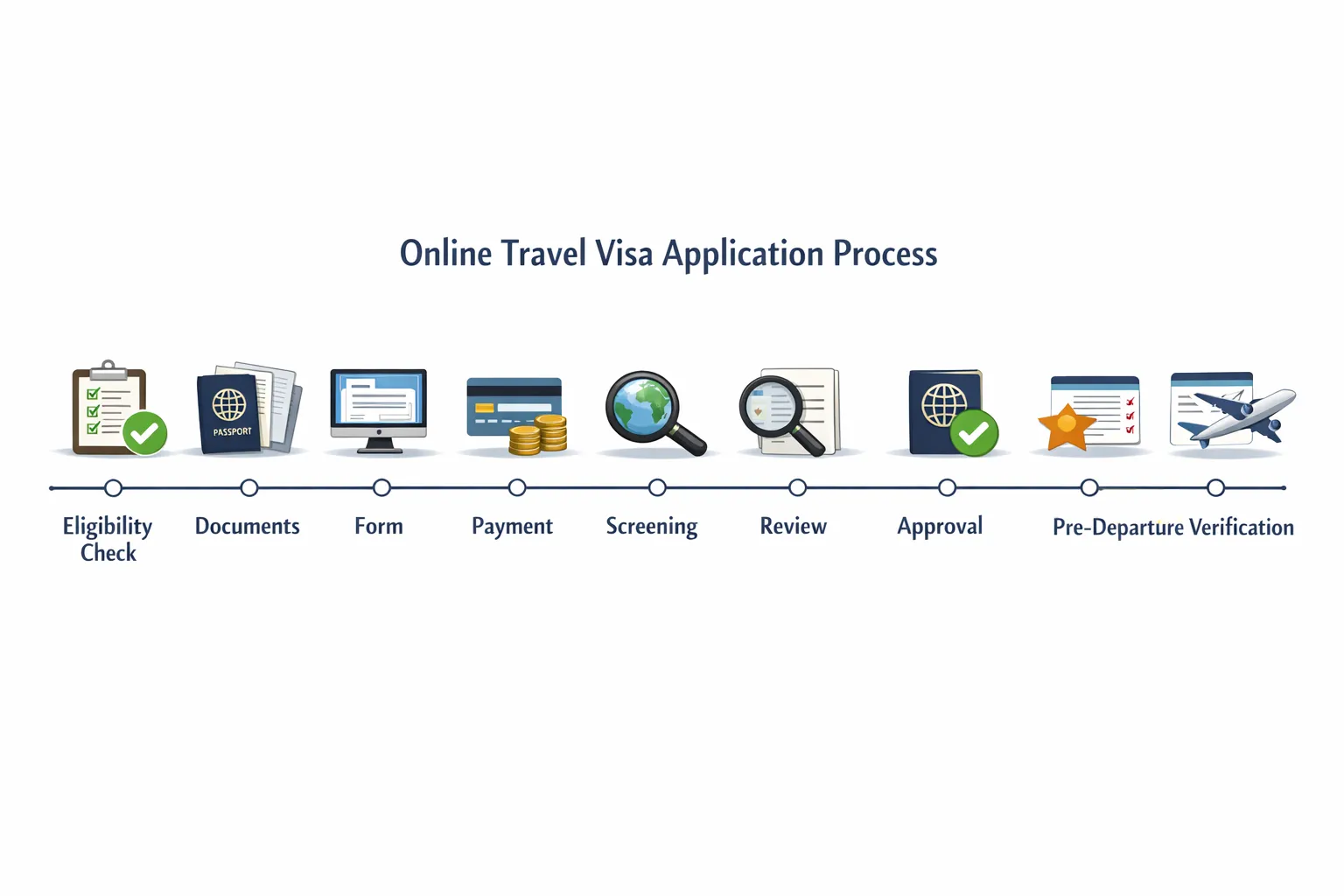
Even when the application itself takes 20 minutes, the end-to-end timeline typically includes document prep, review queues, and follow-ups.
A realistic timeline, step by step
| Stage | What happens | Typical time range | What can extend it |
|---|---|---|---|
| Eligibility check | Confirm document type, validity rules, and required uploads | 10 minutes to 1 day | Multi-country itineraries, transit rules, unclear purpose |
| Document preparation | Passport scan, photo, supporting proofs, translations if needed | 30 minutes to several days | Missing documents, photo rejections, needing new passport |
| Form completion | Online form entry and validation | 15 to 60 minutes | Long travel history sections, address/employer details |
| Payment + submission | Fee payment and final submission | Minutes to hours | Card declines, 3-D Secure issues, bank fraud checks |
| Automated screening | System checks identity fields, watchlists, format rules | Minutes to 24 hours | Name mismatches, system downtime |
| Manual review | Officer review and decision (many eVisas include manual checks) | 1 to 15 business days | Peak season volume, incomplete information |
| Additional document request (if triggered) | You provide clarifications or extra proof | Adds 2 to 10+ days | Slow email response, hard-to-get documents |
| Issuance + delivery | Approval is issued and delivered (PDF, email, portal download, or passport-linked record) | Minutes to 48 hours | Email filtering, portal access issues |
| Pre-departure verification | You verify details and ensure you can present proof at boarding/border | 10 minutes | Incorrect passport number, wrong dates, wrong visa type |
The planning rule most travelers miss
A good planning target is not “processing time,” but processing time plus buffer.
- For many eVisas, a sensible buffer is at least 1 to 2 weeks beyond the stated average.
- For consular visas, build around appointment availability, not just processing time.
If your trip involves weddings, cruises, group tours, or events with fixed dates, your risk tolerance should be even lower.
Why timelines vary so much
Two applicants can file the same day for the same destination and get different outcomes. These are the most common drivers.
1) Data quality and consistency
Small inconsistencies are a frequent cause of delays:
- Passport number, issue/expiry dates, or name order not matching the passport MRZ
- Photo not meeting requirements (background, glare, size, recentness)
- Travel dates that conflict with eligibility rules
2) Peak seasons and staffing
Many destinations experience predictable surges (summer, major holidays, large events). Even fully digital systems can develop backlogs when manual review capacity is limited.
3) Security and manual checks
Some applications are routed for enhanced screening based on travel history, similar names, incomplete answers, or other risk signals. This does not automatically mean refusal, but it often means a longer queue.
4) In-person steps for “not quite online” visas
Some visas begin online but still require:
- Biometrics at a visa center
- An interview appointment
- Passport submission for labeling
In those cases, your timeline is constrained by appointment slots, courier times, and local operating hours.
Visa fees: what you are actually paying for
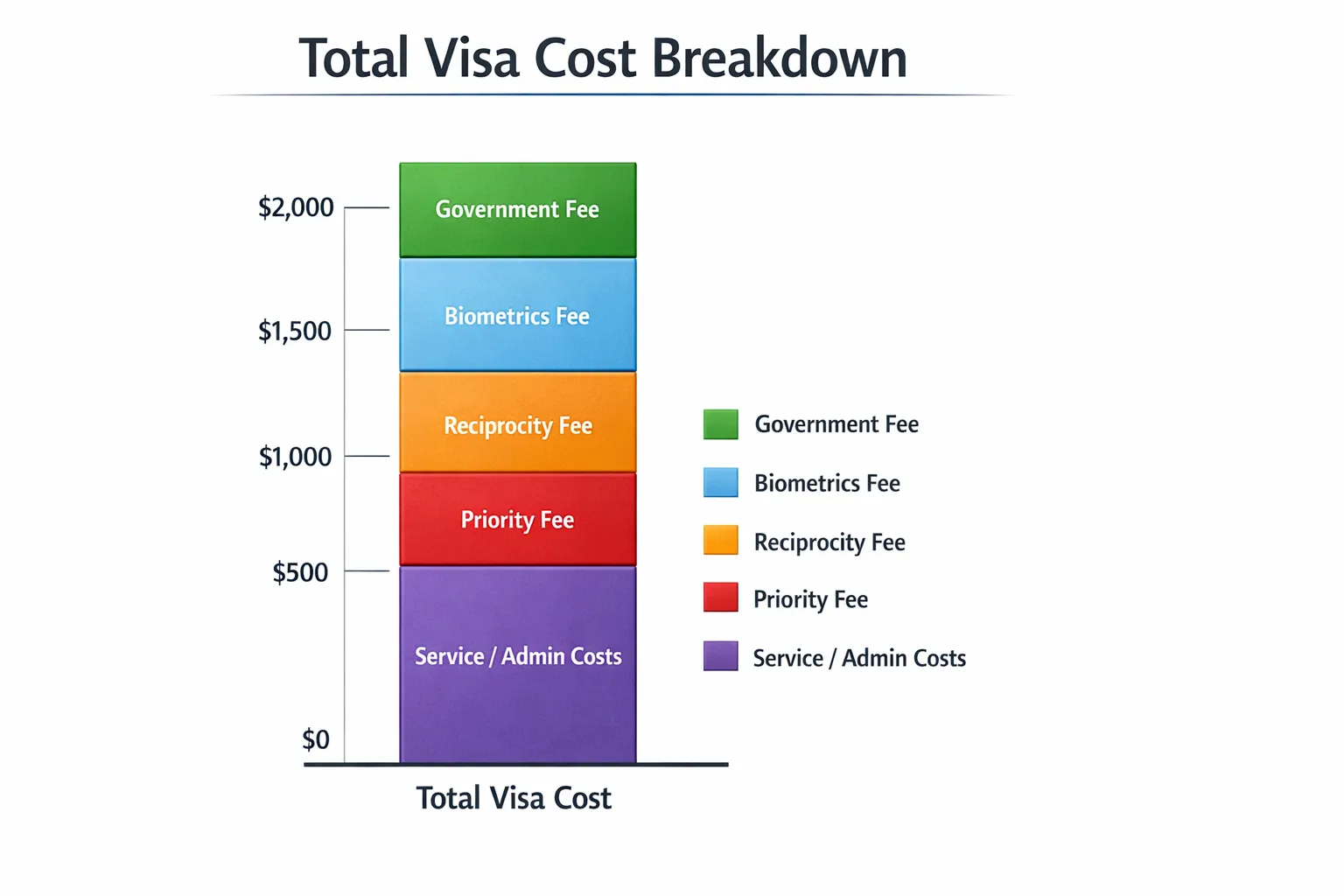
A common frustration is thinking a visa “costs $X,” then discovering multiple layers of fees. The cleanest way to budget is to separate government charges from service and logistics costs.
Common fee components
| Fee component | Who charges it | What it covers | Notes |
|---|---|---|---|
| Government application fee | Government/immigration authority | Permission to apply, processing, system costs | Often non-refundable even if refused |
| Biometric fee | Government or visa application center | Fingerprints/photo capture | Usually applies to consular-style processes |
| Reciprocity fee | Government | Nationality-based fee adjustments | Not applicable for all countries |
| Priority/expedite fee | Government or authorized channel | Faster processing queue | Availability varies, not always guaranteed |
| Courier/printing/admin fees | Visa center or logistics provider | Passport return, document handling | Common with in-person steps |
| Service fee | Visa platform or agency | Guidance, validation, support, submission handling | Varies widely, should be transparent |
Typical fee ranges (and a few safe reference points)
Exact prices change, and they vary by nationality and visa class, but the ranges below help you estimate a realistic budget.
| Document type | Typical government fee range (rough) | Total “real world” cost range (rough) | Notes |
|---|---|---|---|
| eTA/ETA/ESTA | Low (often under $50) | Low to moderate | Usually minimal documents, fewer add-ons |
| eVisa | Often $20 to $150 | Moderate | May include optional faster processing tiers |
| Consular/embassy visa | Often $50 to $250+ | Moderate to high | Can include biometrics, courier, translations, travel to appointment |
For a couple of widely cited examples (always verify before paying):
- The U.S. ESTA fee is $21 as published by U.S. Customs and Border Protection on the official ESTA site.
- The EU confirmed the Schengen visa fee increased to €90 (adults), with official guidance available via the European Commission.
- The EU’s planned ETIAS fee is €7 for most adult applicants, per official EU information on ETIAS (timelines and operational details can shift, so check current status before travel).
How to avoid delays that turn into extra costs
Visa friction often becomes expensive indirectly: rebooking flights, changing hotel dates, paying “rush” fees, or purchasing last-minute support.
Build your timeline around the worst-case, not the best-case
If the destination says “processed in 3 business days,” treat that as a median, not a promise. Your safest approach:
- Assume a document request is possible.
- Assume weekends and public holidays do not count.
- Assume your first photo upload may be rejected if requirements are strict.
For a more granular planning approach, SimpleVisa’s guide on when to apply for an eVisa can help you back-plan from your departure date.
Treat “cheap” providers as a risk signal
If a site is advertising a visa at a price that looks too good (or too fast), you may be looking at:
- A non-official intermediary with aggressive markups later
- A scam site collecting passport data
- A “processing fee” that appears at checkout
If you want a security-first walkthrough, see Travel Visa Online: How to Apply Safely.
Know which mistakes trigger fee losses
Many government application fees are non-refundable once submitted, even if you made an error. The most common (and costly) triggers are:
- Choosing the wrong visa class for the purpose of travel
- Passport expiring too soon for entry rules
- Typos in passport number or name fields
- Uploading unreadable scans or non-compliant photos
A practical way to reduce those errors is using a pre-submit checklist like Everything You Need Before Submitting an Online Visa Application.
What travel companies should communicate about timelines and fees
If you are an OTA, airline, tour operator, or DMC, timelines and fees are not just traveler concerns. They directly influence conversion, support volume, and denied-boarding risk.
Set expectations in plain language
Travelers do better with:
- A date-based promise (“Apply by March 10 for a March 25 departure”) rather than “5 to 7 days.”
- A clear fee breakdown (government fee vs. service fee vs. optional expedite) rather than one blended number.
Use real customer language to improve your visa UX
One underrated way to find friction points is to look at where travelers complain and ask questions in public, especially on Reddit threads about “How long did it take?” and “Is this fee legit?”. If you want a scalable way to mine those conversations for insights (and even discover demand for your travel add-ons), tools like turn Reddit conversations into customers can help identify recurring objections and decision triggers.
Where SimpleVisa fits
SimpleVisa is designed to help travel businesses streamline visa and border requirement workflows without forcing customers to leave the booking journey. Depending on your stack and time-to-market needs, SimpleVisa can be embedded via API, offered through a white-label visa application app, or delivered as a data service. The goal is simple: reduce confusion about requirements, guide customers through the application, and support ancillary revenue while maintaining a high approval rate.
If you are evaluating how to operationalize this, a helpful background read is What Is Travel Document Automation? Definitions, Benefits, and Myths.
A simple way to estimate your own “ready to travel” date
To estimate when you should start an online travel visa application, add three blocks:
- Preparation time (documents, photos, clarifying details)
- Official processing time (published average, not minimum)
- Buffer time (to absorb document requests, weekends, peak season)
For straightforward eVisas, that often means starting weeks ahead, not days. For anything involving appointments or biometrics, it often means starting months ahead.
When timelines and fees are handled upfront, the visa step stops being the part of the trip that surprises you, and becomes just another checklist item you can complete with confidence.