Do You Need to Be Visa-Ready Before Booking?

A surprising number of “travel disasters” start after someone has paid for flights and hotels, when they finally check entry rules and realize they need a visa, an eVisa, an ETA, or extra documentation they cannot get in time. So, do you need to be visa-ready before booking?
It depends on your risk tolerance, the destination’s requirements, and how refundable your trip is. Below is a practical framework you can use (and one travel brands can embed into their booking flow) to avoid denied boarding, last-minute cancellations, and expensive rebooking.
What “visa-ready” actually means (it’s more than having a visa)
“Visa-ready” is not always the same as “visa approved.” In practice, being visa-ready means you can answer three questions confidently before money is on the line:
- Do I need a visa or travel authorization for this itinerary and passport? Requirements change by nationality, destination, transit points, trip length, and purpose.
- Can I realistically get it in time? Some authorizations are minutes to days, some visas require appointments, biometrics, interviews, or mailed passports.
- Will my documentation stand up at check-in and border control? Airlines enforce entry rules at check-in, often using tools like IATA Timatic to verify passenger eligibility.
Visa-ready also includes basics that travelers sometimes overlook, like passport validity rules (many countries require 6 months remaining), name consistency, and onward travel requirements.

A simple decision framework: book first or get visa-ready first?
Use this quick matrix to decide how cautious you should be.
| Your situation | Risk level if you book now | Best approach |
|---|---|---|
| You are visa-free or need a fast eTA/ETA-style authorization and you have weeks before departure | Low | Booking first is usually fine, apply soon after booking |
| You need an eVisa with variable processing times and you are traveling in peak season | Medium | Check eligibility and document requirements first, then book (or book refundable) |
| You need a consular/embassy visa, interview, biometrics, or passport submission | High | Get visa-ready before booking, or only book flexible/refundable options |
| Your itinerary includes tight transits, multiple countries, or a stopover with separate tickets | Medium to high | Validate requirements for every segment before paying |
| You have a new passport, name change, dual citizenship, or prior refusals/overstays | High | Verify rules early, expect extra checks, avoid nonrefundable bookings |
If you do only one thing: don’t guess. Confirm requirements using official government sources, your airline, or a trusted visa data/provider.
When you should be visa-ready before booking
There are scenarios where booking first is not “spontaneous,” it is simply financially risky.
1) The trip is expensive or nonrefundable
If you are buying:
- Nonrefundable long-haul flights
- Cruise cabins with strict cancellation windows
- Tour packages with deposits
- Event travel (concerts, sports finals) where prices spike
…you want to reduce uncertainty. Even a small chance of visa delay can wipe out the savings of an “early deal.”
2) Your destination requires a traditional visa (or anything involving appointments)
Embassy/consular visas can include appointment backlogs, in-person biometrics, interviews, document legalization, or courier delivery. These steps can turn a “simple” application into a calendar problem.
If you are not sure whether your trip needs an eVisa, an ETA, or a consular visa, confirm first (and confirm for transit too).
3) Your travel purpose is not “straightforward tourism”
Entry rules often change based on purpose:
- Tourism vs. business meetings
- Short courses vs. full-time study
- Paid work vs. remote work
- Media activity or research
Booking first can lock you into dates that do not match the visa category you actually need.
4) You are close to passport validity limits
Many travelers only discover passport validity rules during online check-in. If your passport is close to expiration, you may need to renew first, then apply for any required authorization with the new passport details.
5) You are building a complex itinerary (multi-country, open-jaw, separate tickets)
Separate tickets and multi-stop itineraries introduce “hidden borders,” meaning you might need:
- Transit visas
- Proof of onward travel
- Different authorizations for different countries
Being visa-ready here means validating every country you touch, not just the final destination.
When it’s usually okay to book first (and apply after)
Booking before you apply can be reasonable if you structure the trip to keep your downside limited.
1) You have a low-friction authorization and enough time
Examples include many eTA-style approvals or visa-free travel scenarios. Even then, apply soon after booking. “It only takes minutes” is not a strategy if there is a random delay, a manual review, or an error that needs correcting.
2) Your booking is flexible
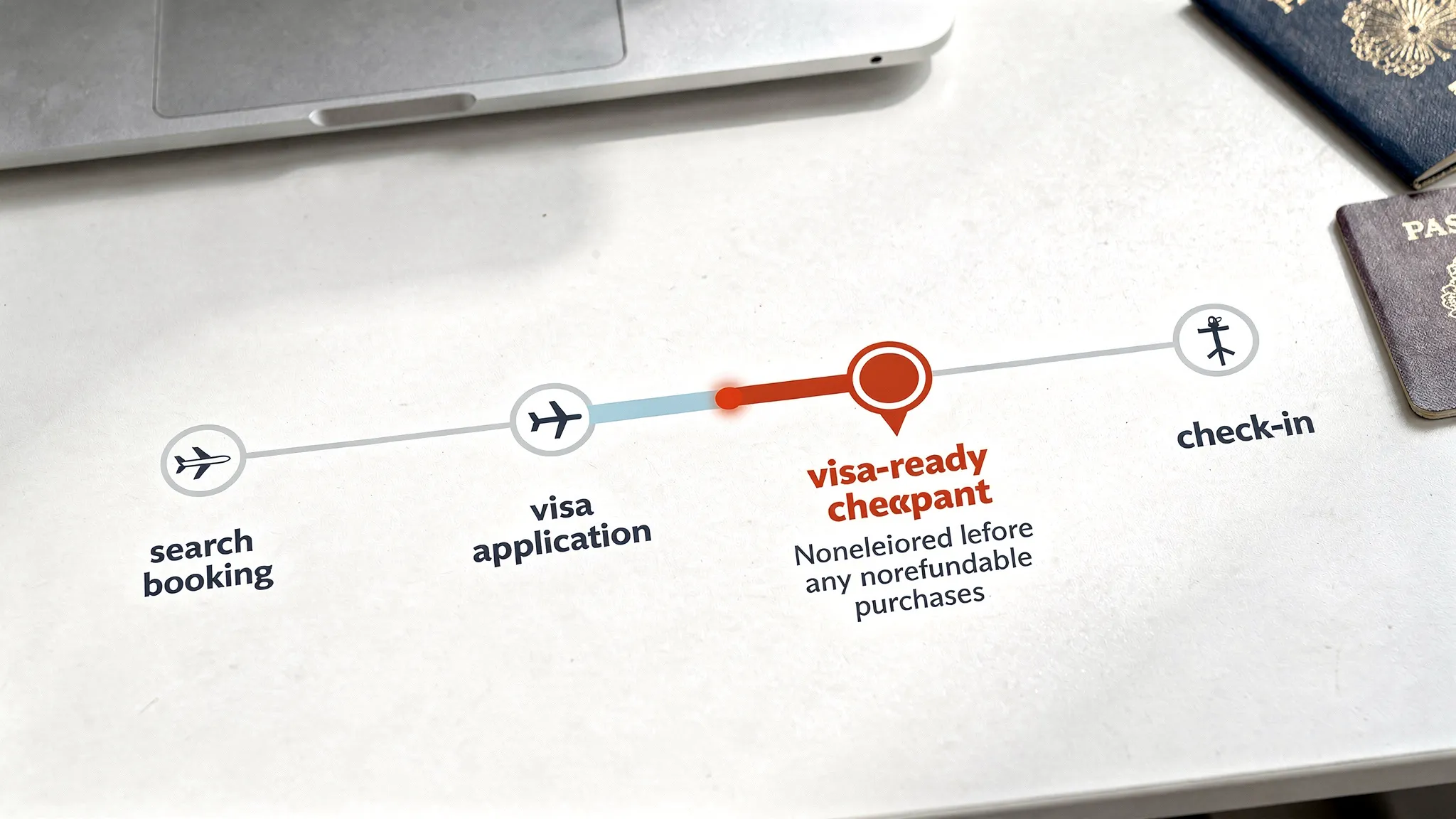
If you can cancel for free or change dates cheaply, you can book first and treat visa approval as a checkpoint.
A practical approach is:
- Book refundable or changeable
- Apply immediately
- Only lock in the nonrefundable parts once authorization is granted
3) You must book to apply
Some destinations require proof of accommodation, return tickets, or itinerary details. In those cases, visa-ready means choosing the right kind of booking (flexible, refundable, or held reservations when permitted).
A “visa-ready” checklist you can do in 10 minutes before you pay
This is the pre-booking routine that prevents most issues.
- Confirm entry requirement for your passport, destination, and dates (and any transits).
- Check passport validity against destination rules.
- Match traveler details exactly (name order, spacing, passport number, date formats).
- Estimate processing time and add buffer for weekends, holidays, and document fixes.
- Confirm proof requirements (onward ticket, funds, accommodation, invitation letters).
- Prepare digital copies (passport bio page, photo, supporting docs) so you can apply quickly.
In other compliance-heavy industries, the advantage often comes from turning “document chaos” into a clear workflow. For example, legal teams increasingly use tools like AI-powered litigation document workflows to transform complex paperwork into ready-to-file outputs. Travel documentation is different, but the operational lesson is the same: fewer manual steps and clearer guidance reduce errors.
What travel brands should do: make customers visa-ready inside the booking journey
For airlines, OTAs, tour operators, cruise lines, and TMCs, this question is not just traveler advice, it is a conversion and operations issue.
If a customer books a trip they cannot legally take, the downstream costs show up as:
- Higher support volume (“Do I need a visa?” tickets)
- Last-minute cancellations and chargebacks
- Airport disruptions and denied boarding
- Lower NPS due to “surprise” requirements
A modern approach is to surface visa requirements early and make the path to action immediate, either:
- Embedded in the booking flow via an API integration
- Post-booking through a white-label application journey
- As a data service feeding your eligibility and messaging logic
SimpleVisa’s core focus is streamlining this process for travel businesses through automated visa processing, integration options (API, white-label app, and no-code implementation), and guided applications that help customers complete requirements with less friction.
What “visa-ready by design” looks like
A strong traveler experience usually includes:
- Eligibility checks before payment (based on passport and itinerary)
- Clear next steps (what to apply for, what documents are needed)
- A guided application that reduces errors and rework
- Status visibility so customers do not have to ask support
Common mistakes that make people think they’re visa-ready (when they aren’t)
Even experienced travelers get caught by these:
Booking with the wrong passport details
Dual citizens and travelers renewing passports often apply with one passport and book with another. Airlines and border systems care about the document you will use to travel.
Assuming an approval guarantees entry
A visa or authorization typically permits you to travel to the border, not to enter unconditionally. Border officials can still refuse entry if requirements are not met (purpose, funds, length of stay, prior issues).
Forgetting transit and airport rules
Some itineraries require you to clear immigration during transit or change terminals, which can trigger additional entry requirements.
Not planning for errors
A single typo can create a mismatch that becomes a check-in problem. Visa-ready means allowing time to correct mistakes.
Frequently Asked Questions
Do I need a visa before booking a flight? Not always. If you are visa-free or only need a fast travel authorization, you can often book first. If the visa process involves appointments, passport submission, or uncertain processing times, it is safer to be visa-ready before booking (or book refundable).
What if the visa application requires a flight or hotel booking? Use flexible reservations when possible, and avoid locking in nonrefundable bookings until you understand requirements and timelines. The goal is to have enough itinerary detail to apply without taking on unnecessary financial risk.
How far in advance should I apply after booking? Apply as soon as you can after booking, especially during peak travel seasons. Even “quick” online authorizations can be delayed by manual review, data mismatches, or additional document requests.
Does an eVisa or ETA guarantee entry? No. It generally authorizes travel and preliminary eligibility, but border control can still ask for supporting documents and can refuse entry if conditions are not met.
Can airlines stop me from boarding if my visa is not sorted? Yes. Airlines are responsible for checking eligibility at departure. If you cannot meet entry requirements, you may be denied boarding at check-in.
How can a travel company help customers become visa-ready without adding friction? By integrating eligibility checks and guided applications into the booking or post-booking journey. This reduces surprises, support tickets, and airport issues while improving customer confidence.
Make “visa-ready” a normal part of booking
If you are a traveler, the safest rule is: validate entry requirements first, then decide how refundable your booking needs to be.
If you are a travel business, the bigger opportunity is to make visa-readiness an integrated experience instead of a last-minute scramble. SimpleVisa helps travel brands streamline visa checks and applications through flexible integration options (API, white-label app, data services, and no-code implementation).
Explore SimpleVisa at SimpleVisa.com to see how visa readiness can fit naturally into your customer journey.