Get in Travel Compliance: What Airlines Check at Boarding
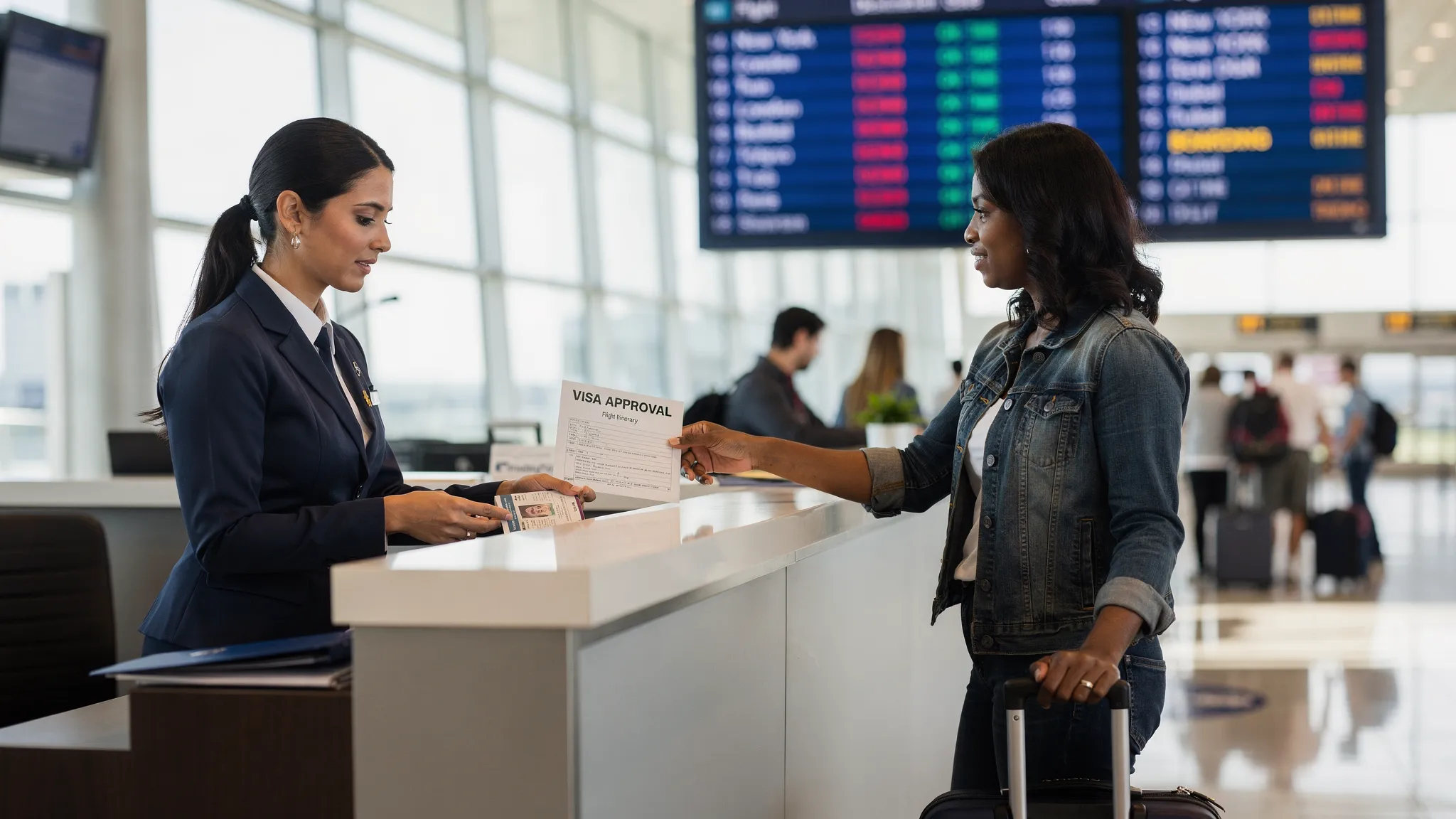
Airlines do not “check visas” to be helpful, they do it because they are required to. If a passenger arrives at the destination without the right entry permission, the carrier can be held responsible for return transport and may face penalties under destination-country rules. That’s why boarding compliance has become a core operational function, and why getting in travel compliance starts long before the passenger reaches the gate.
This guide breaks down what airlines typically check at boarding, how those checks happen (systems vs. humans), where mistakes occur, and what travel brands can do to reduce denied boarding and last-minute chaos.
Why airlines check documents at boarding (and why the gate is the last line of defense)
Most countries place legal obligations on carriers to ensure travelers have required documents before transport. In practice, airlines run a layered process:
- Pre-booking and post-booking guidance: surfacing entry rules early reduces abandonment and support volume.
- Check-in validation: the most common moment to catch missing visas, expired passports, or mismatched names.
- Gate verification: a final control because travelers can change itineraries, passports can be replaced, and requirements can be misunderstood.
Airlines may rely on industry data sources and government messaging to operationalize these checks. One of the best-known tools in the industry is the IATA Timatic database, which is widely used to determine passport, visa, and health documentation requirements for a given itinerary.
The two types of checks: “identity” vs. “permission to travel”
At boarding, airline staff and systems are usually validating two separate things:
1) Identity: “Are you the person on the ticket?”
This is primarily about matching:
- Passenger name (PNR) to passport name
- Date of birth and gender markers
- Document number (depending on process)
Even a small mismatch (missing middle name handling, swapped surname order, diacritics) can trigger manual review, especially on international itineraries.
2) Permission to travel: “Are you allowed to enter (or transit) the destination?”
This includes the entire matrix of:
- Visa or eVisa requirements
- eTA/ESTA-style travel authorizations
- Passport validity rules
- Transit permissions
- Special cases (minors, dual nationals, refugees, residents)
- Health requirements when applicable
Airlines typically do not decide admissibility at the border, that is a government function. But they do decide whether to let someone board.
What airlines check at boarding: the practical compliance checklist
Exact requirements vary by destination, nationality, route, and even transit airport. Still, these are the checks that most commonly drive a “document OK” or “no board” outcome.
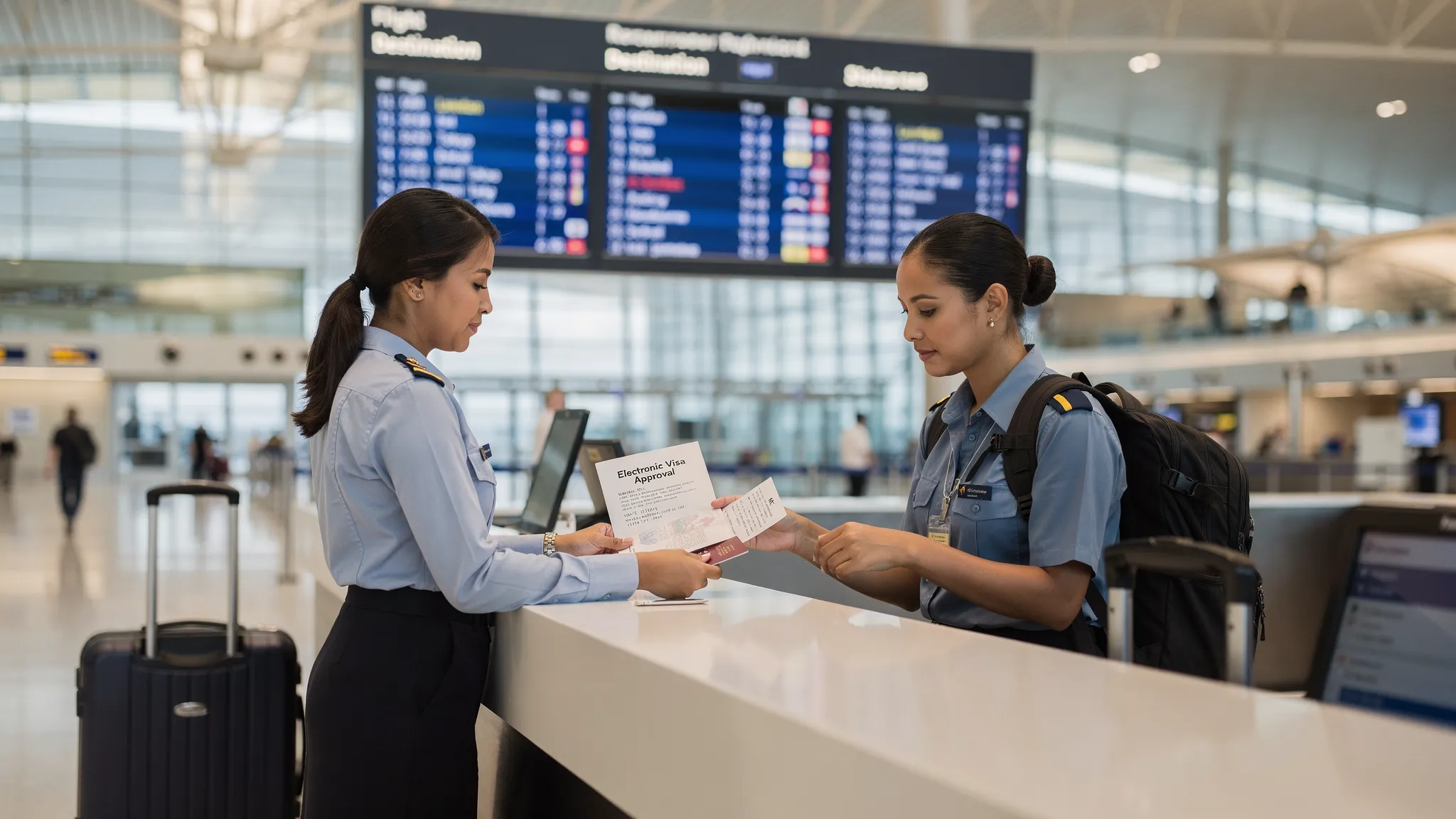
Passport validity (including “extra months” rules)
Airlines commonly check:
- Passport is not expired
- Passport has enough remaining validity for the destination’s rules
- Passport has sufficient blank pages if a stamp is required (less relevant for purely digital processes, but still applicable in many places)
Many destinations require a buffer (often 3 or 6 months) beyond the date of entry or intended departure. Because these rules differ by country, carriers usually rely on a rules engine or trusted travel document database rather than memory.
Visa, eVisa, or entry permit for the destination
This is the obvious one, but it is rarely simple. Airlines may need to validate:
- Whether a visa is required for the traveler’s nationality
- Whether the traveler holds the correct visa type for the purpose (tourism vs. business vs. transit)
- Whether the visa is single-entry or multiple-entry, and whether it has already been used
- Validity dates and allowed stay
- Any required supporting items tied to the visa class (for example, return ticket expectations)
For electronic permissions (eVisas, eTAs, travel authorizations), verification can range from “visual inspection of an approval PDF/email” to structured checks, depending on destination and airline capability.
If you want a primer on how electronic visas work operationally, SimpleVisa’s overview is a helpful companion: How does an electronic visa work?
Transit and connection compliance (often overlooked)
A passenger can be compliant for the final destination and still be non-compliant for a transit point. Common examples:
- Transit visa requirements based on nationality and airport
- Separate rules for “airside transit” vs. “entering the country” during a long connection
- Different terminals requiring immigration re-clearance
This is why airlines look at the full itinerary, not only the endpoint.
Proof of onward travel or return ticket (where required)
Some destinations require travelers to show onward travel, especially for short-term visitor entries. At boarding, airlines may request:
- Return ticket
- Onward ticket to a third country
Even when not legally mandated in every case, airline staff may ask for it when entry rules or past denial patterns make it prudent.
Residence permits, visas in old passports, and dual nationality edge cases
Boarding issues frequently occur when a traveler has:
- A residence permit in a separate document (or digital status) that must be shown
- A valid visa in an old passport but travels with a new passport
- Two passports and chooses the “wrong” one for the route (for example, presenting a passport that requires a visa when the other does not)
These are not rare. They are simply hard to handle consistently without guided workflows and clear customer prompts.
SimpleVisa has a dedicated guide that helps explain one of these scenarios: How to transfer your electronic visa to a new passport
Minor travel documents and consent requirements
For minors, airlines may check (depending on route and national rules):
- Passport for the child
- Visa/eVisa authorization for the child (many authorizations are individual)
- Consent letter(s) if traveling with one parent or a non-parent guardian
Because these rules are jurisdiction-specific, they are a common source of last-minute disputes at check-in.
Health documentation when mandated
Health documentation requirements have evolved since the pandemic era, and they still appear in certain contexts. Depending on destination and current policy, airlines may need to validate items such as:
- Vaccination certificates
- Health declarations
- Proof of insurance (sometimes required by visa programs)
The key operational point is that these requirements can change quickly, which increases the value of real-time rule updates.
How these checks happen operationally: systems, data, and people
Airlines typically blend three layers of validation.
Airline systems (PNR, check-in, and DCS)
The passenger’s itinerary and identity details live in airline systems. During check-in, document details are captured and may be validated against rule sources.
Government-required passenger data submissions (API/APIS)
Many jurisdictions require carriers to transmit passenger information before departure. In the United States, for example, airlines transmit data through APIS under U.S. Customs and Border Protection requirements. (Reference: U.S. CBP APIS information).
These submissions do not replace the need for a visa check, but they increase the importance of accurate identity data and document numbers.
Manual agent review
Even with automation, airline agents often make the final call, especially for complex itineraries and exceptions. When information is unclear, they may escalate to a supervisor or airline support desk.
The most common reasons travelers get denied boarding for “documents”
Denied boarding is often framed as “missing visa,” but in practice, the top failure patterns are broader:
- Passport validity is short by a few days or weeks relative to the destination’s buffer rule
- Name mismatch between booking and passport (spacing, order, missing surname, diacritics)
- Wrong authorization type (eTA vs. visa, transit vs. entry)
- Authorization not linked to the passport used (common after passport replacement)
- Transit requirement missed (especially multi-leg itineraries)
- Last-minute application timing (approval not received before departure)
On the traveler side, better planning helps. For travel sellers and airlines, better workflows prevent these issues from becoming airport incidents.
For timing best practices, SimpleVisa’s guidance is relevant across many programs: When should I apply for an electronic visa?
A quick reference table: what is checked, what evidence is accepted
The specifics always depend on country rules, but this table reflects common boarding-day patterns.
| What airlines check at boarding | What they are trying to prevent | Typical evidence accepted (varies by destination) |
|---|---|---|
| Passport validity and condition | Refusal at arrival due to invalid passport | Physical passport, sometimes a scan in advance for pre-check |
| Entry permission (visa/eVisa/eTA/ESTA/ETA) | Carrier liability and return transport costs | Visa sticker, approval letter/PDF, digital authorization confirmation |
| Transit permission | Stranding at transit point or denied transfer | Transit visa, onward ticket, proof of airside transit eligibility |
| Passenger identity match (PNR vs passport) | Fraud, mis-ticketing, inadmissible passenger data submissions | Passport MRZ scan, manual review, corrected name (if permitted) |
| Onward/return travel | Refusal due to insufficient proof of exit | Return ticket, onward itinerary |
| Special cases (residency, dual nationality, minors) | Exceptions that invalidate default rule logic | Residence permit, both passports, consent letters for minors |
What airlines and travel sellers can do to reduce denied boarding (without slowing conversion)
Boarding compliance becomes much easier when it is treated as a guided customer journey, not a last-minute checkpoint.
Surface requirements earlier, in the booking flow or immediately after purchase
When travelers only learn they need a visa at the airport, you get the worst possible combination: distressed customers, staff time, missed flights, and chargeback risk.
A better pattern is:
- Show a clear entry-requirements snapshot during booking for the traveler’s nationality
- Trigger post-booking reminders with deadlines and document upload prompts
- Provide a guided application path when a visa or travel authorization is required
This is where travel document automation and embedded visa services can sit naturally inside the travel stack. If you want the concept defined in detail, see: What Is Travel Document Automation? Definitions, Benefits, and Myths
Reduce exceptions by collecting the “right” data once
Most compliance failures are data-quality failures:
- Incomplete passenger details
- Wrong passport number
- Mixed documents for different legs
Guided data capture, document scanning, and structured validation help prevent the downstream scramble.
Offer a compliant application path, not just a link to “go figure it out”
Travelers often abandon or mis-complete visa applications when:
- Requirements are unclear
- Document uploads are confusing
- The process is too long on mobile
SimpleVisa positions itself specifically in this gap, helping travel businesses guide customers through border requirements through solutions that can be embedded via API, delivered through a white-label app, or implemented with no-code options (based on your integration needs). If you want to evaluate fit before building anything, their overview of visa platform outcomes and operational value is a useful reference point: 8 reasons to streamline travel and elevate customer experience with a Visa Solution
Keep compliance data up to date
Visa and entry rules change frequently, and changes do not always align with airline schedule planning. Operationally, this means:
- Your rule source must update quickly
- Your customer communications should be easy to revise
- Your support team should have a single “source of truth”
Stale content is a compliance risk.
Design for “day-of-travel proof”
Even in digital-first visa programs, travelers still need to present proof in messy real-world conditions: dead phone, poor Wi‑Fi, offline check-in desk.
Practical best practices include:
- Encourage passengers to store approval evidence offline (PDF download)
- Offer clear instructions on whether a printout is advisable for the destination
- Make it easy to retrieve status quickly without searching email threads
The takeaway: boarding checks are predictable, but only if you operationalize them
Airlines check passports, visas, transit permissions, and identity consistency at boarding because they have to. The variability of global rules means manual processes will always create edge-case failures.
If you are an airline, OTA, or travel platform, the most reliable way to “get in travel compliance” is to move document readiness upstream: validate eligibility earlier, guide the customer through applications, and keep rule content continuously updated.
For teams exploring integration options, SimpleVisa offers multiple models (API, white-label, data services, and no-code implementation) aimed at helping travel businesses streamline visa processing and reduce boarding friction. Learn more at SimpleVisa.