I Need Visa Now: Options for Urgent Processing

If you are thinking “I need visa now,” you’re not alone. Last-minute work trips, family emergencies, and sudden itinerary changes happen every day, and the visa step is often the one that can stop a traveler at check-in.
The good news is that “urgent processing” can mean very different things depending on your destination and passport. In some cases, you do not need a visa at all, or you only need a fast online travel authorization. In other cases, the only realistic solution is a consular emergency appointment (or changing plans).
This guide walks through the fastest legitimate options, what to do in the first 30 minutes, and how to avoid common traps that cost time.
First, confirm what you actually need (visa vs eVisa vs eTA)
When someone says “visa,” they might mean one of four different entry requirements:
- Visa-free travel: no visa or pre-authorization required (you still must meet entry rules).
- eTA / ETA / ESTA-style authorization: a digital pre-travel authorization for visa-exempt travelers (often fast, but not always instant).
- eVisa: a visa application submitted online, usually requiring documents and sometimes longer processing.
- Consular (sticker) visa: applied for through an embassy/consulate, often the slowest and most appointment-dependent.
Before you pay any fees or upload anything, confirm the requirement using an official source for your destination. Good starting points:
- U.S. ESTA (Visa Waiver Program): U.S. Customs and Border Protection (CBP)
- UK ETA: UK government ETA guidance
- Schengen short-stay visa rules and timelines: European Commission visa policy
If you’re booking travel for others (customers, employees, groups), do not rely on social posts or forums for eligibility. Visa rules change, and airlines can deny boarding if documentation is not correct.
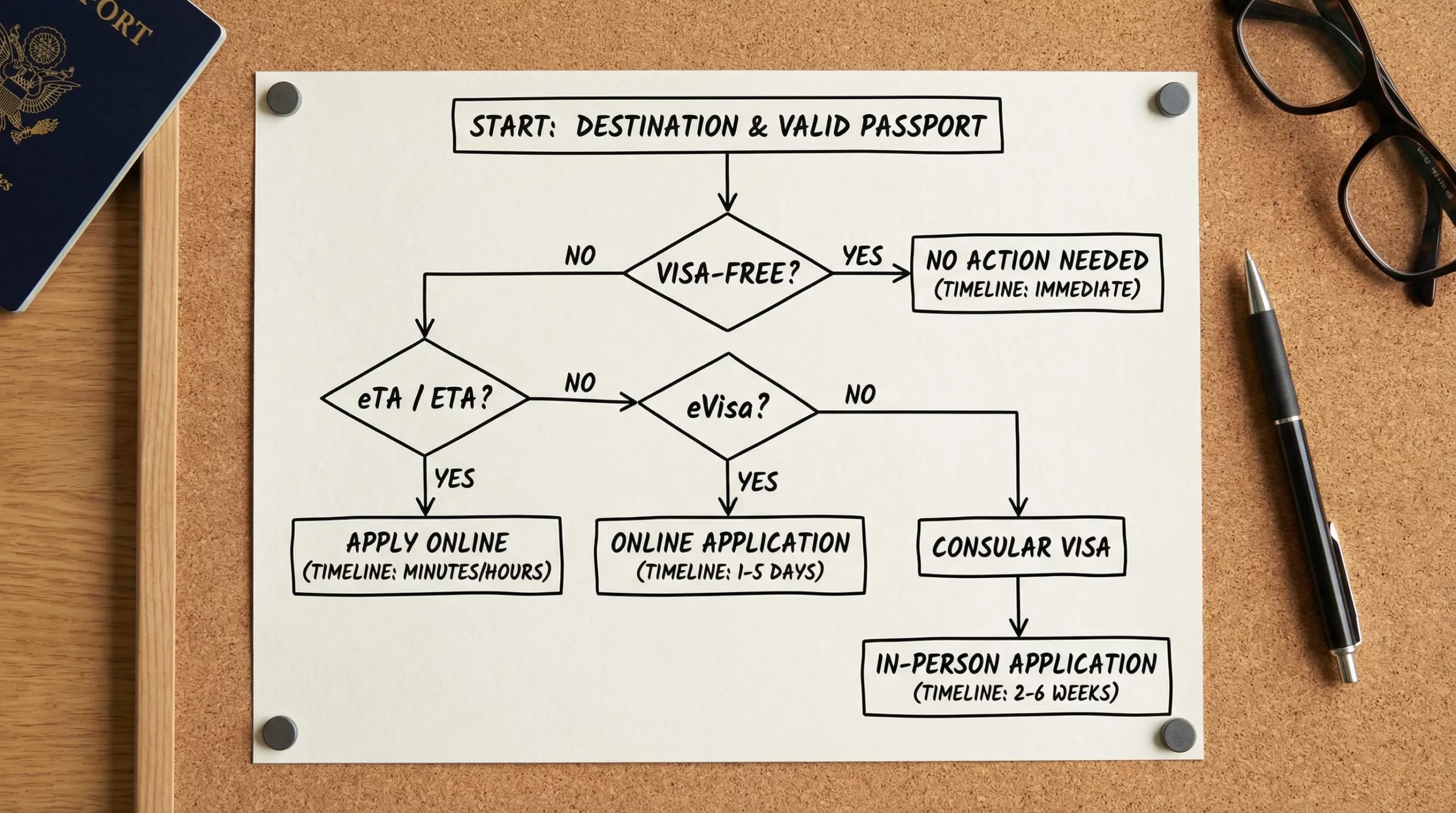
“I need a visa now”: the urgent options that are actually realistic
Option 1: If you qualify for visa-free travel, stop searching for a “rush visa”
Many last-minute travelers lose hours because they assume a visa is required when it is not. If you are visa-free, your urgent work is usually:
- Ensure your passport validity meets entry rules.
- Confirm permitted activities (tourism vs business meetings vs paid work).
- Prepare supporting documents that immigration may request (return ticket, accommodation, proof of funds).
Even visa-free travel can fail at the airport if your passport is expiring soon, your name does not match bookings, or your purpose of travel appears inconsistent.
Option 2: eTA / ETA / ESTA (often the fastest legitimate route)
If your destination uses a travel authorization system for visa-exempt travelers, this is frequently the fastest path.
Examples include:
- U.S. ESTA (for eligible Visa Waiver Program travelers). CBP notes you should apply as soon as you begin planning, and decisions can be fast but may take up to 72 hours.
- UK ETA for eligible nationals, processed digitally through official channels.
Two important realities for urgent travel:
- “Fast” does not mean “guaranteed instant.” Automated screening can still route some cases to manual review.
- You must apply through the official government platform (or a trusted partner surfaced inside a legitimate travel booking flow). Many third-party sites market “urgent ESTA” or “priority ETA” at inflated fees.
Option 3: eVisa with expedited or priority processing (when offered)
Some countries offer:
- A standard eVisa, plus an expedited or urgent service tier.
- Priority processing based on additional fee, time window, or limited daily capacity.
This can work well when you are within days (not hours) of departure, and you can provide clean digital documents quickly.
What to watch:
- Document rules are strict (photo specs, file formats, passport bio page clarity).
- Some systems accept your submission instantly but still take time to review.
- Any mismatch (passport number, date of birth format, name order) can trigger delays.
If you need help understanding the online flow mechanics (and where delays usually appear), SimpleVisa’s overview of how eVisas function is a useful background read: How does an electronic visa work?
Option 4: Visa on arrival (possible, but risky for urgent travelers)
Visa on arrival can be a legitimate option in some destinations, but it is not always “safe” for urgent travel because:
- Airlines may still require proof you are eligible.
- Requirements can depend on arrival airport, nationality, onward travel, or payment method.
- Queues and secondary screening can be significant.
If you are traveling because time is critical, visa on arrival is best treated as a backup only when official sources clearly confirm eligibility.
Option 5: Consular visa emergency appointments or expedited requests
If you need a traditional consular visa (often true for longer stays, work, study, or certain nationalities), urgent options typically fall into these buckets:
- Emergency appointment requests (often limited to medical/family emergencies, urgent business, humanitarian reasons).
- Expedite requests after filing, sometimes available only with documented justification.
- Changing the destination or routing to a country where you can enter sooner under different rules.
What you should know upfront:
- Consular capacity is the limiting factor, not how fast you can fill the form.
- Even if an appointment is granted, you may still face passport return timelines.
- For Schengen short-stay visas, the European Commission notes standard processing is generally 15 calendar days but can take longer in certain cases, so “same-week” is not always realistic.
Quick comparison: which urgent path fits your timeline?
Processing times vary by country and individual case, but this table reflects typical urgency logic (not a guarantee).
| What you might need | How urgent travelers usually get it | When it’s realistic | Key risk to avoid |
|---|---|---|---|
| Visa-free entry | No application, just comply with entry rules | Same day | Passport validity and purpose of travel issues |
| eTA/ETA/ESTA | Online authorization through official channel | Hours to a few days | Manual review delays, scam sites |
| eVisa | Online application, sometimes with expedited tier | Days to weeks | Document errors and name mismatches |
| Consular visa | Embassy/consulate appointment + processing | Weeks to months (emergency exceptions exist) | No appointments available, passport return timing |
| Visa on arrival | Eligibility confirmed in official guidance | Same day (arrival) | Airline denial at check-in, unclear eligibility |
The 30-minute triage checklist (do this before you submit anything)
If you truly need urgent processing, speed comes from making the right decision early.
- Confirm your destination(s) and all transit points (a transit country can impose separate rules).
- Confirm your passport nationality exactly as you will travel.
- Check passport expiration date and whether you have blank pages (for consular visas).
- Identify the correct requirement: visa-free, eTA/ETA, eVisa, or consular.
- Find the official application channel (government site) and read the processing time guidance.
- Check if expedited processing exists and what proof it requires.
- Gather digital essentials: passport scan, photo, itinerary, accommodation details, payment method.
- Verify your name formatting in your airline booking matches your passport (including middle names if required by the destination system).
If you want a deeper pre-submit prep list for online visas, this is a strong companion resource: Checklist: Everything You Need Before Submitting an Online Visa Application
What actually speeds up an urgent visa or eVisa
Most “urgent visa” delays are self-inflicted. The biggest accelerators are operational, not magical shortcuts.
Clean, compliant digital documents
For online processes, your passport bio page and photo are often the first gate. If uploads are blurry, cropped, low resolution, or wrong aspect ratio, your application can be delayed or refused.
Perfect consistency across every field
Make sure every detail matches your passport and supporting documents:
- Full name order
- Passport number
- Issue and expiry dates
- Date of birth format (month/day vs day/month errors are common)
- Employer or hotel names (if required)
Applying through the right channel the first time
Urgent travelers are targeted by websites that look official. If you submit through an unofficial site:
- Your application may not be filed at all.
- You may pay inflated fees.
- You may lose time correcting data or disputing payments.
For a practical security checklist and red flags, see: Travel Visa Online: How to Apply Safely
What can slow you down even if you do everything right
Even perfect applications can be delayed. Common factors include:
- Manual review triggers: certain travel history patterns, incomplete travel details, or security screening flags.
- Peak travel seasons: systems and support queues get overloaded.
- Payment verification issues: cards declined due to fraud controls or cross-border payment blocks.
- Multiple-country itineraries: additional checks, especially if you need separate authorizations.
The practical takeaway: if you are inside a tight window, treat “estimated processing time” as a best case, not a promise.
If you travel in 48 hours: a realistic action plan
When departure is very close, your goal is to eliminate uncertainty.
- Prioritize destinations where you are visa-free or eligible for a rapid eTA/ETA.
- If an eVisa is required, check whether expedited processing exists and submit only if you can meet document specs immediately.
- If a consular visa is required, check emergency appointment rules and consider rerouting or postponing if appointments are not available.
- Avoid “guaranteed approval” claims. No legitimate provider can guarantee a government decision.
- Keep printed and offline copies of confirmations, approvals, and receipts in case you lose connectivity while traveling.

For travel companies: how to support customers who say “I need visa now”
Urgent visa questions do not just create stress for travelers, they create abandoned bookings, support spikes, and denied boarding risk for travel brands.
A practical approach is to surface the right requirement early and guide completion inside the customer journey:
- Show entry requirements at booking or post-booking, not after the customer arrives at the airport.
- Guide travelers through the correct application path (eTA/ETA vs eVisa vs consular), based on passport and itinerary.
- Offer a white-label or embedded flow so customers do not leave your experience to search randomly.
- Use data services or integrations to keep rules current and reduce agent guesswork.
SimpleVisa supports travel businesses with visa processing automation via API integration, a white-label visa application app, and custom data services designed to fit into booking flows or post-booking servicing. If you are handling urgent-document requests at scale, start with an overview of travel document automation and how it fits into the journey: What Is Travel Document Automation?
Final reality check: “urgent” does not mean “impossible,” but it does require the right path
If you are thinking “I need visa now,” the highest-impact move is to identify the correct requirement quickly and use official channels with accurate, compliant documents.
In many cases, the fastest solution is not “rush processing,” it is realizing you only need an eTA/ETA, or choosing an itinerary that matches what you can obtain within your time window.
For travelers, the safest next step is to verify your requirement using official guidance, then complete the application carefully the first time.
For travel businesses, the long-term fix is to make visa and authorization checks part of the booking experience, so urgent cases become the exception, not the norm.