How to Avoid Denied Boarding: Pre-Flight Document Checks
Denied boarding is not just an inconvenience, it can turn into a missed connection, a wasted hotel night, and a stressful rebooking spiral. And unlike weather delays, documentation problems are one of the few travel disruptions you can prevent with the right pre-flight checks.
This guide breaks down what to verify, when to verify it, and what to do if something does not match, so you can reach the check-in counter (or the gate) confident that your travel documents will pass.
What “denied boarding” means when the issue is documentation
Many travelers associate denied boarding with overbooking. But airlines also deny boarding when a passenger cannot meet entry or transit requirements. That can include:
- Missing or incorrect visa or electronic travel authorization
- Passport validity that does not meet destination rules
- A name mismatch between passport and ticket
- Not having required supporting documents (for example, onward travel proof)
Airlines generally have strong incentives to catch these issues before departure. If they fly an inadmissible passenger, they can face fines, transport costs, and operational disruption.
The pre-flight document checklist (the essentials)
Think of this as your “green light” set of checks. If any item is unclear, treat it as a risk and verify early.
1) Passport: validity, condition, and details
Start with the document that everything else is tied to.
- Expiration buffer: Many countries require your passport to be valid beyond your arrival date (often 3 or 6 months). Verify the rule for your destination and any transit points.
- Physical condition: Water damage, torn pages, or a loose cover can trigger extra scrutiny.
- Blank pages: Some itineraries still require stamps, even when you hold an eVisa.
- Biographic details: Confirm your name (including middle names), date of birth, and passport number are consistent across bookings and applications.
2) Visa, eVisa, or travel authorization (ETA, ESTA, ETIAS)
Countries use different systems, and “visa-free” is often not the same as “no paperwork.” Examples include:
- The United States’ ESTA for Visa Waiver Program travelers (official ESTA information)
- The UK’s expanding ETA scheme (UK government ETA guidance)
- The EU’s upcoming ETIAS authorization for visa-exempt visitors (ETIAS official site)
Key checks that prevent last-minute surprises:
- Correct document type for your purpose (tourism vs business vs transit)
- Validity dates and number of entries
- Passport linkage (many eVisas/eTAs are electronically tied to a specific passport number)
- Approval status (pending is not approved)
If you are applying online, accuracy matters. Even small errors can lead to refusal or a document that does not validate at check-in. (If this is a frequent pain point, SimpleVisa has deeper guidance on handling name mismatches on tickets, passports, and eVisas.)
3) Ticket and itinerary alignment
Airline and border systems typically validate eligibility using a combination of identity details and itinerary logic.
Verify:
- Route and transit points (you may need a transit visa even if your final destination is visa-free)
- One-way vs round-trip rules (some destinations frequently ask for onward travel)
- Same-day connections vs overnight transits (rules can differ)
4) Special situations that trigger extra checks
Some travelers should plan additional verification:
- Dual citizens (which passport are you traveling on, and is your authorization tied to that passport?)
- Minors (consent letters, custody documents, and additional ID can apply depending on the route)
- Residency permits (carry the physical card if applicable, not just a photo)
When to do checks: a practical timeline that works
Doing everything the night before a flight is the most common way people end up at the airport with no options.
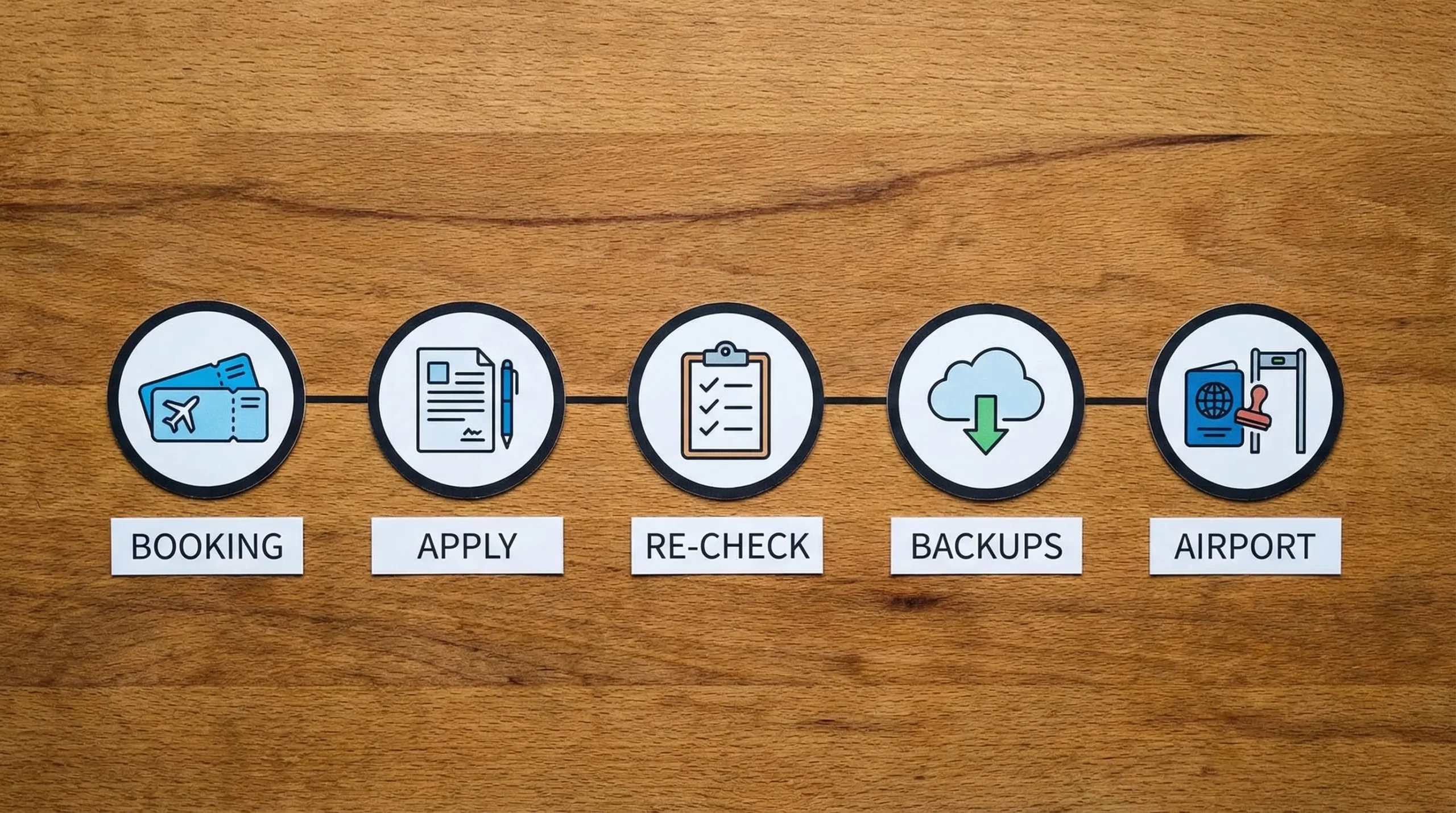
Use this timeline as a safer workflow:
| Timing | What to check | Why it matters |
|---|---|---|
| At booking (T-60 to T-14) | Passport expiry buffer, route (including transits), basic visa requirement | Avoid buying a trip that is not document-feasible |
| After booking (T-14 to T-7) | Apply for visa/eVisa/ETA (if required), confirm passport-linked details | Processing time and corrections need breathing room |
| Pre-departure (T-7 to T-72h) | Re-check rules, confirm approvals, confirm name and passport number match ticket | Rule changes and data-entry errors surface here |
| Day before (T-24h) | Save offline copies, print backups if needed, check airline check-in prompts | Airports and agents vary in what they ask to see |
| Day of travel | Carry originals, arrive early if documents are complex | Gives time for manual review if needed |
The most common “document fail” scenarios (and how to prevent them)
Passport validity rules are misunderstood
Two travelers can fly the same route and face different outcomes because passport rules depend on nationality and destination. A common mistake is assuming “passport valid through the trip” is enough.
Prevention tips:
- Verify the destination’s buffer requirement and apply it to your exact arrival and departure dates.
- If you are close to the threshold, renew the passport first, then apply for any eVisa tied to that passport.
The eVisa is approved, but the details do not match
For electronic visas and authorizations, the “document” is often a record in a system that gets queried at check-in. If the passport number, name spelling, or date of birth is wrong, the system may not validate.
To prevent this:
- Copy names exactly as shown in the passport (be consistent with spacing and order).
- For tight accuracy, use the passport’s machine readable zone (MRZ) as the reference for spelling.
- Keep the approval email and reference number accessible, but remember that the core issue is whether the authorization validates electronically.
Transit requirements get overlooked
Transit rules are a major source of surprises, especially when:
- You change airports in the same city
- You leave the international transit zone
- You have an overnight layover
If a transit country requires a visa for your nationality, you can be stopped before the first flight even departs.
Supporting documents are required at check-in
Even with an eVisa, some itineraries commonly trigger requests for:
- Proof of onward travel
- Accommodation details
- Proof of funds (varies widely)
Whether you are asked can depend on route patterns, local enforcement, and the discretion of the airline agent. Your goal is not to overpack paperwork, it is to be able to produce the basics quickly if asked.
What to do if you discover a problem (without panicking)
If you spot a documentation issue, the best next step depends on what kind of issue it is.
If it is a name mismatch
- Do not assume it will be fine at the airport. Airlines often require an exact match.
- Contact the airline immediately to ask about name correction policy.
- If the mismatch is in your visa or authorization, contact the issuing authority or platform to correct it (re-issuance may be required).
If your eVisa or authorization is pending
- Treat pending as not valid for travel.
- Check whether expedited processing exists through official channels.
- Consider changing the departure date if approval timing is uncertain.
If your passport is too close to expiry
- Passport renewal is often the only fix.
- If you renew, remember that any passport-linked authorization usually needs to be re-applied for or transferred (depending on the destination’s rules).
For travel businesses: how to reduce denied boarding with systematic pre-flight checks
If you are an airline, OTA, cruise line, or tour operator, documentation issues are not just customer pain, they are operational and financial risk.
A strong approach usually has three components:
1) Eligibility checks early in the journey
The earlier you surface requirements, the more likely travelers will complete them. Many travel brands now introduce document checks:
- In the booking flow
- Immediately post-booking
- In pre-departure reminders
This is where travel document automation is most effective: rules are complex, and manual guidance does not scale.
2) Guided applications and document validation
When travelers are required to apply for an eVisa or ETA, friction and errors tend to spike.
Platforms like SimpleVisa are designed to streamline that experience for travel businesses by offering guided visa applications, online visa processing, and multiple integration options (API integration, white-label app, and no-code implementation), so requirements can be handled closer to the booking context.
3) Governance and accountability (including data and content ownership)
Travel-rule content, eligibility logic, and compliance workflows become valuable assets over time. As you partner, integrate, and scale, it helps to treat your compliance content and product flows as protectable IP, especially if you invest in proprietary messaging, data enrichment, or customer education.
If you need support thinking through protection, enforcement, or licensing strategy around your product assets, a specialist like Third Chair for IP enforcement and licensing can be a helpful reference point.
Frequently Asked Questions
What documents do I need to avoid denied boarding on an international flight? At minimum, you need a valid passport that meets destination validity rules, and any required visa, eVisa, or travel authorization for your destination and transit points. You should also be ready to show onward travel or accommodation details if requested.
Can I fly if my eVisa is approved but I did not print it? Often yes, because many eVisas are validated electronically, but not always. Some destinations or airline agents may still ask to see a printed copy or an offline PDF. Bringing an offline copy (and a printout when feasible) is a low-effort backup.
Why does my passport name need to match my ticket exactly? Airline check-in systems and border validation tools frequently require an exact match to clear identity checks. Differences in spelling, spacing, or order of names can trigger manual review or refusal at check-in.
Do I need to check transit visa rules if I stay in the airport? Sometimes yes. Some countries require a transit visa based on nationality, airport, time of day, or whether you must re-check baggage. Always verify requirements for every stop, not only your final destination.
How early should I do pre-flight document checks? Ideally at booking, then again 7 to 72 hours before departure. Early checks prevent unfixable last-minute issues, and late checks catch itinerary changes and approvals that did not finalize.
Make pre-flight checks easier for your travelers (and your ops team)
If you are a travel business, the fastest way to reduce documentation-driven denied boarding is to move from ad hoc reminders to an automated, embedded process.
SimpleVisa helps travel brands streamline visa and eVisa requirements with travel document automation that can be integrated into booking flows via API, delivered through a white-label visa application app, or launched with a no-code implementation option. If you want to reduce denied boarding risk while creating a new ancillary revenue stream, explore SimpleVisa at SimpleVisa and evaluate the integration model that fits your travel journey.