Invitation Letters for Visas: Templates That Work

An invitation letter can be the difference between a smooth visa application and a frustrating request for more documents. It is not a “magic approval” document, but when it clearly explains who is inviting whom, for what purpose, for how long, and who is responsible for which costs, it helps visa officers quickly understand the story behind the trip.
Below you will find practical guidance plus copy-and-paste invitation letter templates that work well for the most common travel scenarios.
What is an invitation letter for a visa (and when is it needed)?
A visa invitation letter is a signed statement from a host (a person or organization in the destination country) that confirms they are inviting the applicant and, in some cases, providing accommodation and/or financial support.
You are most likely to need an invitation letter when:
- You are visiting family or friends and staying at their home.
- You are traveling for business meetings, a conference, training, or a site visit.
- You are attending an event where the organizer issues invitations.
- A destination’s checklist specifically mentions “invitation letter” or “proof of accommodation from host.”
For many destinations, “invitation letter” is simply one acceptable way to show purpose of travel and accommodation arrangements. Requirements vary by country and by visa type, so always confirm using official guidance for your destination.
Helpful reference pages include the European Commission’s overview of Schengen visa requirements and the U.S. Department of State visa information.
Who should write the invitation letter?
The best invitation letter comes from the party with the most credible connection to the trip:
- Family or friends visit: the host (resident or citizen) where the traveler will stay.
- Business travel: the inviting company in the destination country.
- Conference or event: the organizer (or the hosting institution).
- Tour package: the local operator or hotel can sometimes provide confirmation, but many consulates prefer standard bookings over “personal invitation” in tourism cases.
If a traveler is working with a travel agency or OTA, the agency typically does not “invite” the traveler, but it can help ensure the letter matches the rest of the application and is consistent with the itinerary.
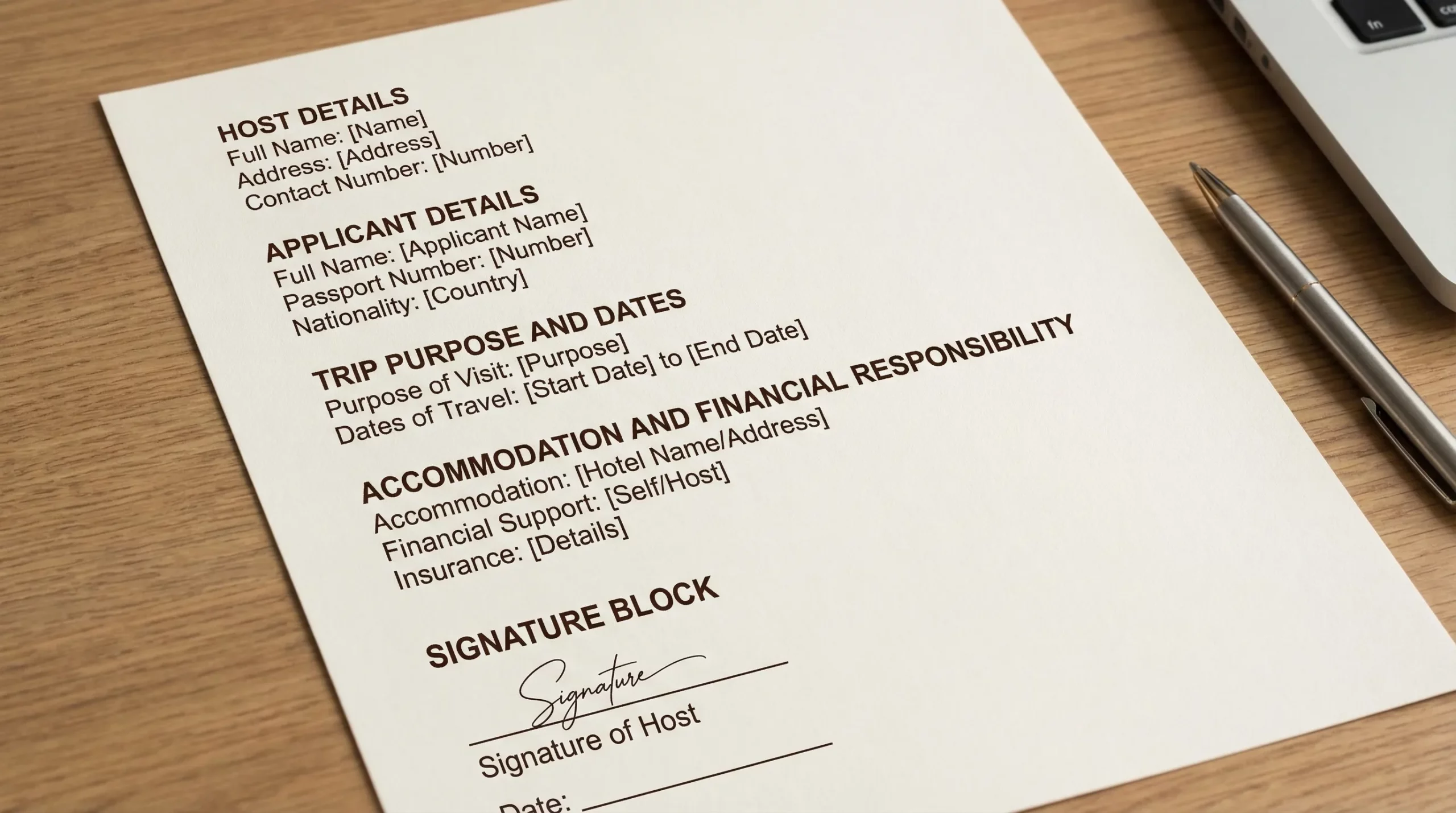
What a strong invitation letter must include
Visa officers look for clarity, consistency, and verifiable details. Most effective letters include:
- Host details: full legal name, address, phone, email, immigration status in the destination (citizen, permanent resident, visa holder), and ID number if relevant.
- Applicant details: full legal name, date of birth, passport number, nationality.
- Trip details: purpose, arrival and departure dates, cities to be visited, where the applicant will stay.
- Relationship (when relevant): how the host knows the applicant, how long they have known each other.
- Financial responsibility: who pays for flights, accommodation, daily expenses, insurance.
- Signature and date: wet signature or e-signature depending on local rules.
Quick checklist table (what to include by scenario)
| Scenario | Who writes it | Primary goal of the letter | Common supporting attachments (if requested) |
|---|---|---|---|
| Visiting family/friends | Individual host | Confirm accommodation and relationship | Host ID/residence proof, proof of address, sometimes bank statements |
| Business trip | Destination company | Confirm purpose of visit and business legitimacy | Company letterhead, registration proof, meeting agenda |
| Conference/event | Organizer/institution | Confirm attendance and dates | Registration confirmation, event schedule |
| Medical visit | Clinic/hospital | Confirm appointment and dates | Appointment letter, treatment estimate (if applicable) |
Use this table as a starting point, then align it with the destination’s official document checklist.
Common mistakes that get invitation letters ignored (or questioned)
Most rework requests happen for simple reasons:
- Mismatch with the application: dates, passport number, or spelling differ from the visa form and itinerary.
- Vague purpose: “tourism” is fine, but “tourism with friend, staying at host address, visiting X and Y cities” is better.
- No accountability: the letter implies the host supports the traveler but does not explicitly say what they cover.
- Missing host status: not stating how the host is legally residing in the destination.
- Unverifiable contact info: no address, no phone number, or an email that looks unrelated.
- Overpromising: guarantees of approval, aggressive language, or irrelevant personal details.
A simple rule: your invitation letter should be consistent with the traveler’s itinerary, accommodation proof, and proof of funds. If you want a broader preparation checklist, use SimpleVisa’s guide: Checklist: Everything You Need Before Submitting an Online Visa Application.
Invitation letter templates that work (copy and customize)
These templates are written in a neutral tone that consulates typically prefer. Replace bracketed fields with real information, and remove any sentence that does not apply.
Template 1: Visiting family or friends (host provides accommodation)
[Host Full Name]
[Host Full Address]
[City, State/Province, Postal Code]
[Country]
[Host Phone Number] | [Host Email]

[Date]

To: [Embassy/Consulate of Country] / Visa Officer
Subject: Invitation Letter for Visa Application - [Applicant Full Name], Passport No. [Passport Number]

Dear Visa Officer,

I, [Host Full Name], born on [Host Date of Birth], currently residing at [Host Full Address], am writing to invite [Applicant Full Name], born on [Applicant Date of Birth], passport number [Applicant Passport Number], to visit me in [Destination Country].

Relationship to applicant: [e.g., friend / cousin / partner]. We have known each other since [Year] and keep in contact via [brief optional detail].

Purpose of visit: [tourism / family visit].
Planned travel dates: [Arrival Date] to [Departure Date].
Address where applicant will stay: [Host Full Address].

Financial responsibility:
- I will provide accommodation for the applicant during the above dates.
- [Choose one]
  - The applicant will cover their own travel and living expenses.
  - I will also contribute to the applicant’s living expenses during the stay.

I confirm that the applicant will comply with the laws of [Destination Country] and will depart before the authorized stay ends.

If you require any additional information, please contact me at [Host Phone Number] or [Host Email].

Sincerely,

[Host Signature]
[Host Full Name]
[Host Citizenship/Residency Status, ID Number if applicable]
Template 2: Business invitation letter (company letterhead)
Use official letterhead whenever possible.
[Company Name]
[Company Address]
[Company Phone] | [Company Email] | [Company Website]

[Date]

To: [Embassy/Consulate of Country] / Visa Officer
Subject: Business Invitation - [Applicant Full Name], Passport No. [Passport Number]

Dear Visa Officer,

This letter is to confirm that [Company Name], located at [Company Address], invites [Applicant Full Name], born on [Applicant Date of Birth], passport number [Applicant Passport Number], employed by [Applicant Employer Name] as [Job Title], to visit [City, Country] for business purposes.

Purpose of trip: [meeting / contract discussion / training / site visit / conference attendance].
Proposed dates of visit: [Arrival Date] to [Departure Date].
Location(s) of meetings/activities: [Office Address(es)].

Financial responsibility:
- [Choose one]
  - The visitor will cover travel and living expenses.
  - [Company Name] will cover [accommodation / local transportation / meals] during the stay.

We confirm that the visitor will not engage in paid work in [Destination Country] beyond the permitted business activities under the requested visa category.

Please contact [Contact Person Full Name, Title] at [Phone] or [Email] if additional information is required.

Sincerely,

[Signature]
[Contact Person Full Name]
[Title]
[Company Name]
Template 3: Conference or event invitation letter (organizer)
[Organizer/Institution Name]
[Address]
[Phone] | [Email] | [Website]

[Date]

To: [Embassy/Consulate of Country] / Visa Officer
Subject: Invitation to Attend [Event Name] - [Applicant Full Name], Passport No. [Passport Number]

Dear Visa Officer,

We are pleased to invite [Applicant Full Name], passport number [Applicant Passport Number], nationality [Nationality], to attend [Event Name] taking place in [City, Country] from [Event Start Date] to [Event End Date].

The attendee is registered as: [speaker / participant / exhibitor / delegate].
Registration/Reference ID (if available): [ID].

If applicable, financial support provided by the organizer:
- [None / registration waived / accommodation provided / other]

We confirm that this invitation is issued for the sole purpose of attending the event.

For verification, please contact [Contact Person] at [Email] or [Phone].

Sincerely,

[Signature]
[Name]
[Title]
[Organizer/Institution Name]
Template 4: Medical visit invitation letter (clinic/hospital)
[Clinic/Hospital Name]
[Address]
[Phone] | [Email] | [Website]

[Date]

To: [Embassy/Consulate of Country] / Visa Officer
Subject: Medical Appointment Confirmation - [Patient Full Name], Passport No. [Passport Number]

Dear Visa Officer,

This letter confirms that [Patient Full Name], born on [DOB], passport number [Passport Number], has a medical appointment at [Clinic/Hospital Name] in [City, Country].

Appointment date(s): [Date(s)].
Type of consultation/treatment (general): [e.g., specialist consultation / diagnostic tests].
Estimated treatment period (if known): [Start Date] to [End Date].

Please note: This letter confirms scheduling only and does not guarantee treatment outcome.

For any questions, contact [Contact Person/Department] at [Email] or [Phone].

Sincerely,

[Signature]
[Name]
[Title/Department]
[Clinic/Hospital Name]
How to make your template “work” in real applications
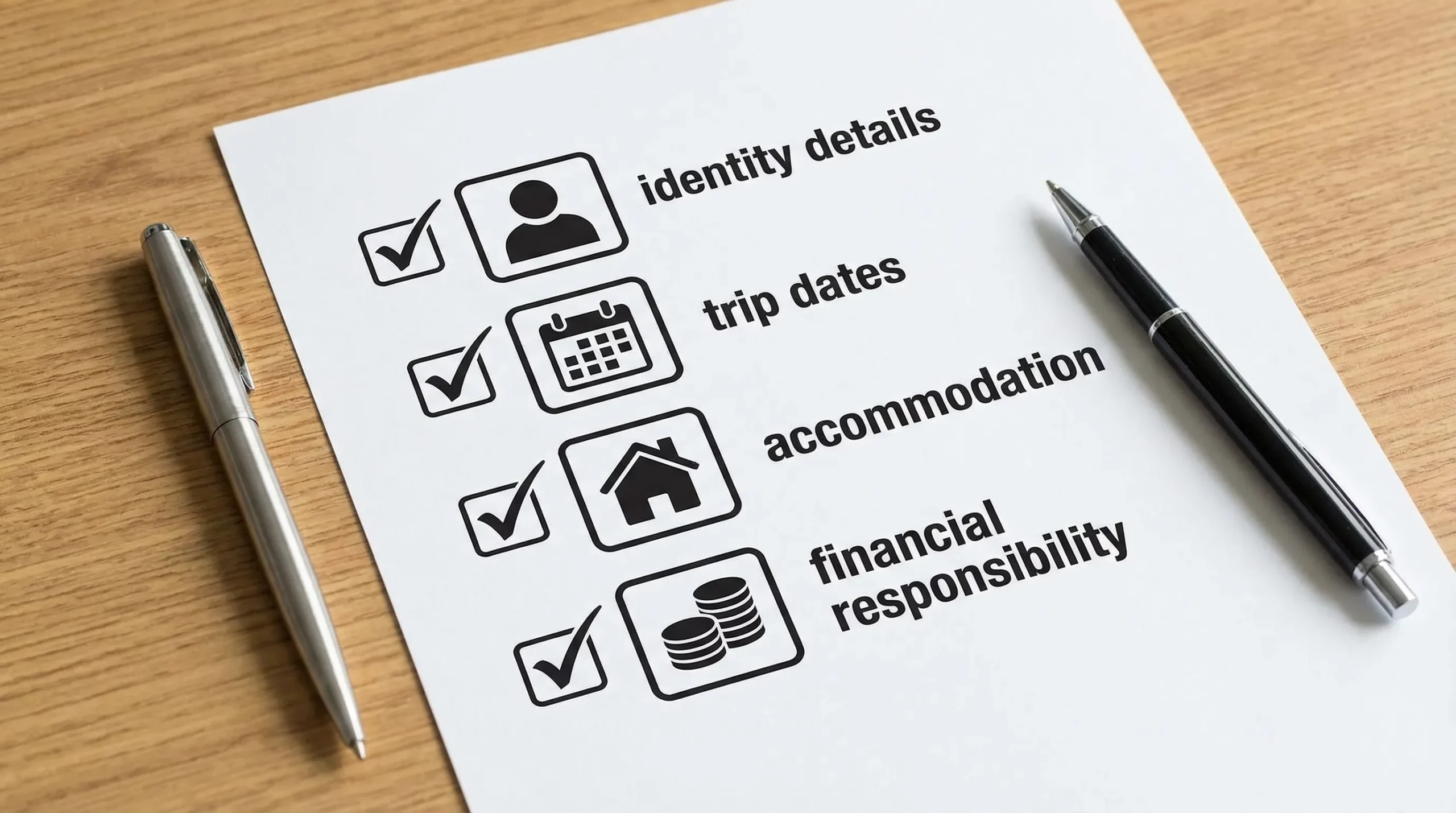
A good template is only step one. What makes invitation letters effective is how well they connect with the rest of the application.
Match the invitation to the supporting documents
If the host provides accommodation, the application should not also submit hotel bookings for the same dates unless there is a clear reason (for example, side trips). If the letter says the applicant is self-funded, make sure proof of funds supports that.
If you want a consolidated view of what travelers typically need beyond the invitation letter, see 10 Essential Documents You Need for an Electronic Visa Application.
Keep it one page when possible
Many visa officers scan for key facts. One page is ideal, two pages can be acceptable if necessary, but avoid long narratives.
Use consistent naming (especially for passports)
Copy the applicant’s full name and passport number directly from the passport bio page. Consistency is a frequent issue across tickets, passports, and eVisas. SimpleVisa also covers this risk area in detail here: Handling Name Mismatches on Tickets, Passports, and eVisas.
Add verification signals (without oversharing)
“Verification signals” are details that help an officer trust the letter quickly, such as company letterhead, a reachable phone number, or a host’s clear address. Do not attach sensitive documents unless requested.
For travel businesses: operational tips to reduce invitation-letter back-and-forth
Invitation letters are a common friction point because customers often do not know what “good” looks like. If you manage customer journeys at scale (airline, OTA, tour operator, TMC), a few process tweaks can reduce rework:
- Standardize templates by scenario (business, family visit, event) and localize spelling formats (US vs international date formats) to reduce confusion.
- Add a pre-submission validation step that checks dates, passport number length, and that accommodation and payer logic is coherent.
- Provide customers a single upload slot labeled “Invitation letter or proof of accommodation,” instead of scattering it across multiple steps.
SimpleVisa is built to simplify border-crossing administration, including guided customer visa applications and travel document automation. If you want to reduce incomplete submissions and improve conversion, start with the broader process view in What Is Travel Document Automation? Definitions, Benefits, and Myths.
Frequently Asked Questions
Do invitation letters guarantee visa approval? No. They support the application by clarifying purpose, accommodation, and sometimes financial responsibility, but the decision is always made by the issuing authority.
Should the invitation letter be notarized? Sometimes. Many destinations accept a simple signed letter, while others may require notarization or a formal invitation process. Check the official checklist for the destination and visa type.
Can I submit an email invitation instead of a signed letter? Some consulates accept printed emails, but a dated and signed letter (or a letter on organizational letterhead) is usually stronger.
What if my host is not paying for anything? That is fine. The letter should simply state the host is providing accommodation (if true) and clarify that the applicant will cover their own expenses.
What details must match other documents? Names, passport numbers, travel dates, address of stay, and the stated purpose of the trip should be consistent across the visa form, itinerary, and supporting documents.
Is an invitation letter required for eVisas too? Sometimes. Many eVisa systems still ask for “proof of accommodation” or “invitation” depending on the country and travel purpose. Always check the destination’s eVisa document list before submitting.
Need help turning requirements into a smooth application flow?
If you are a travel brand looking to reduce visa-related booking friction, SimpleVisa helps you guide customers through border requirements with automation, API integration, and white-label options.
Explore resources like Travel Visa Basics: What to Know Before You Book or visit SimpleVisa to learn how to integrate visa guidance and applications into your customer journey.