Transit Without a Visa: When Airside Rules Still Fail
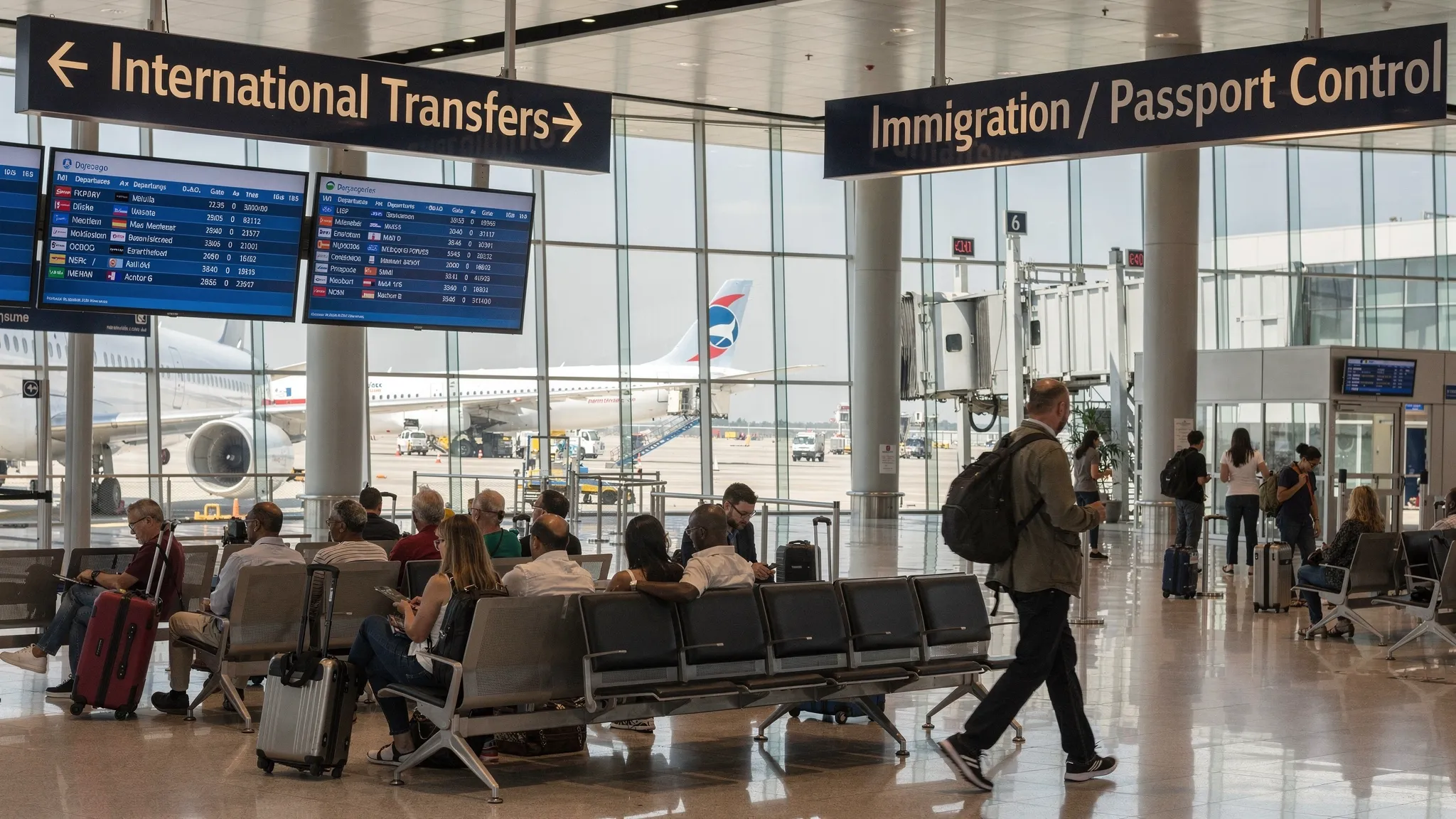
Most travelers have heard the rule of thumb: “If you stay airside, you can transit without a visa.” In practice, that shortcut fails often enough to cause missed flights, denied boarding, surprise fees, and angry support tickets.
For travel brands, transit is also where compliance complexity spikes. The itinerary is multi-country, the customer is time constrained, and the airline is legally responsible for transporting inadmissible passengers. That is exactly why “airside” is not a guarantee, it is a conditional privilege that disappears as soon as one detail changes.
What “airside transit” really means (and why it’s not a single rule)
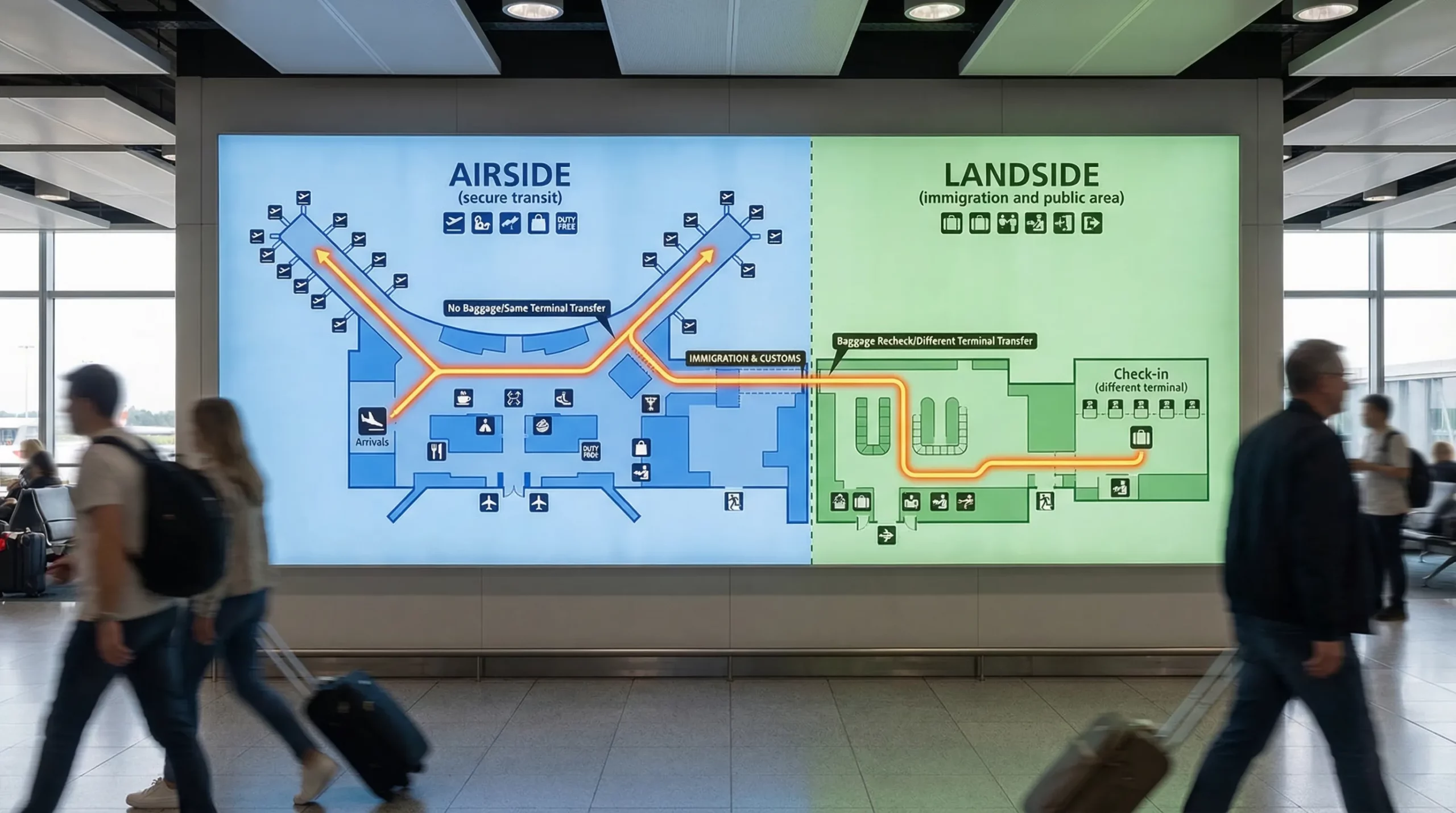
Airside refers to the secure area of an airport after security screening, where passengers wait to board flights. Landside is the public area outside immigration and security.
A true airside connection typically requires all of the following:
- You arrive and depart from an airport that supports sterile (international) transfers.
- You can reach your next gate without passing immigration.
- Your baggage is checked through to the final destination.
- Your onward boarding pass is issued, or can be issued without entering the country.
The moment any of those assumptions breaks, you may need to clear immigration, which means you are no longer “transiting,” you are entering. And entry, even briefly, can trigger visa or electronic travel authorization requirements.
When transit without a visa usually works
Transit without a visa is most likely to work when the itinerary is designed for transfers, not improvised around price.
In general, it is safest when:
- You are on one ticket (or one protected connection) for the full journey.
- Your airline checks baggage to the final destination.
- The connection is same airport, same day, with no terminal change that requires re-screening through landside.
- The transit country allows airside transit for your nationality.
Important: even if the above is true, some countries still require an airport transit visa for specific nationalities. For Europe, these rules can come from both Schengen-wide policy and country-specific implementation. A starting point is the EU overview on short-stay visas and transit concepts via the European Commission.
9 ways “airside” transit fails in the real world
Below are the most common trip designs and disruptions that turn “no visa needed” into “you cannot board.”
1) Self-transfer (separate tickets)
If the traveler books two separate tickets, the first airline often has no obligation to protect the connection. Many airports also will not allow baggage transfer or boarding pass issuance airside for unrelated tickets.
Result: the traveler may need to enter the country to re-check baggage, triggering entry requirements.
2) Baggage is not checked through
Even on a single itinerary, baggage rules can vary by carrier, route, and interline agreements. Low-cost carriers frequently require passengers to collect and re-check bags.
Result: collecting luggage usually happens after immigration.
3) Terminal change that requires landside transit
Some airports require passengers to exit the sterile area to move between terminals, especially when switching between non-connected terminals or when security layouts differ.
Result: “just changing terminals” can mean immigration plus security.
4) Overnight connections and airport closures
Airside areas can close overnight in some airports, or the passenger may be required to leave the secure zone due to operational reasons.
Result: a “safe” same-day transit plan becomes an entry and hotel stay, which can require a visa.
5) Irregular operations (IRROPS) rerouting
Cancellations and misconnects trigger rebookings, sometimes through a different hub or even a different country.
Result: the passenger who planned an airside transfer may be rerouted to an airport that does not permit sterile transit for their nationality, or where the new connection requires entry.
6) Airline check-in policies and document checks
Even if the transit rules technically allow airside transfer, airlines can deny boarding if documentation is unclear or cannot be confidently verified. Carriers face penalties for transporting inadmissible passengers, so they tend to be conservative.
Result: denied boarding happens at origin, not at the transit airport.
7) The country requires an airside transit visa for certain nationalities
Some jurisdictions require an airport transit visa even when the passenger remains airside. The UK’s transit rules, including the Direct Airside Transit Visa (DATV) concept for certain nationalities, are explained on the official UK government guidance: Transit visas.
Result: “I won’t leave the airport” does not matter for certain passports.
8) “Transit” through countries that do not offer sterile transit
A key example is the United States, which generally requires travelers to clear immigration for connections (no general sterile international transit). The U.S. Department of State outlines the C-1 transit visa category and related requirements.
Result: many travelers need a visa or ESTA eligibility for a U.S. connection, even if they never intend to stay.
9) Small data mismatches that force manual intervention
A name mismatch between passport and ticket, an expired passport, or an incorrect nationality field can force a passenger out of the normal transfer flow.
Result: airline staff cannot validate eligibility quickly, and the traveler is treated as a higher compliance risk.
A quick risk table: what triggers a transit visa problem
This table is intentionally practical. It is designed for travel sellers and support teams triaging “Do we need a visa for this connection?” tickets.
| Risk trigger | Why it breaks airside transit | What happens in practice |
|---|---|---|
| Separate tickets (self-transfer) | No protected transfer, often no airside baggage transfer | Passenger must enter country to re-check, or is denied boarding |
| Baggage not checked through | Bags are typically collected after immigration | Entry requirements apply |
| Terminal change via public area | Some airports do not connect terminals airside | Immigration required, new visa/ETA rules may apply |
| Overnight or long layover | Airport may require exit from secure zone | Entry required, hotel stay may be impossible without visa |
| IRROPS reroute | New hub may have different transit rules | Passenger needs new authorization immediately |
| “Transit visa required” nationality | Some countries require an airside transit visa | Denied boarding at origin if not held |
| U.S. connection | No general sterile transit | Entry screening required, ESTA/visa needed |
| Document/name mismatch | Airline cannot confidently validate eligibility | Manual review, delays, potential denial |
The traveler-facing checklist (simple enough to fit in a booking flow)
If you want fewer last-minute escalations, ask these questions before confirming “no visa needed.”
- Is this itinerary one ticket or a self-transfer?
- Will the passenger check bags? Are they checked through to the final destination?
- Does the connection require a terminal change? If yes, is it airside?
- Is the layover overnight or long enough that the airport may require exiting airside?
- Does the transit country require an airport transit visa for the passenger’s nationality?
- Is the connection through a country where transit typically requires entry clearance (for example, the U.S.)?
If any answer is uncertain, treat it as a “needs verification” case, not a “no visa” case.
Why this matters for airlines, OTAs, and tour operators
Transit visa confusion is not just a traveler inconvenience. It hits core business metrics:
- Conversion loss: customers abandon checkout when they cannot understand border requirements.
- Denied boarding costs: rebooking, refunds, chargebacks, and service recovery.
- Support volume: visa questions are time consuming and require accurate, current rules.
- Operational risk: carriers can face fines and repatriation costs if an inadmissible passenger is transported.
That is why transit rules belong in the same operational category as payment fraud and schedule changes: they must be handled systematically.
How travel document automation prevents “airside” surprises
Airside transit issues are usually predictable when the system has the right inputs. Automation is less about “faster visas” and more about correct eligibility, earlier.
The minimum data needed to assess transit correctly
| Data point | Why it matters |
|---|---|
| Passport nationality (and sometimes residence) | Transit visa rules are often nationality specific |
| Full route (including transit airports) | Different airports and countries have different transit regimes |
| Ticketing and carrier structure | Separate tickets and non-interline segments change baggage and transfer feasibility |
| Baggage intent (checked vs carry-on) | Checked baggage is a common trigger for needing entry |
| Layover duration and day change | Overnight connections can force landside exit |
| Terminal and airport transfer constraints | Some transfers require leaving the sterile zone |
The best time to catch the problem
From a traveler experience standpoint, there are three high-leverage moments:
- Before payment: surface a clear requirement, “You may need a transit visa because your baggage is not checked through.”
- Immediately post-booking: trigger a guided application for the required electronic visa or eVisa equivalent when applicable.
- Pre-departure monitoring: remind travelers to complete pending documents before check-in windows open.
Where SimpleVisa fits for transit-heavy itineraries
SimpleVisa’s core value for travel businesses is reducing border friction by making visa and authorization steps easier to complete and easier to operationalize.
Depending on your product and team setup, SimpleVisa can be deployed as:
- An API integration inside your booking flow (to guide customers through requirements where they purchase travel).
- A white-label visa application app for a branded experience without building the workflow from scratch.
- A custom data service when you need visa and border requirement data in your own tooling.
- A no-code implementation option for faster launch when engineering time is limited.
The goal in a transit context is straightforward: fewer “I thought I didn’t need a visa” cases, and more customers completing the right authorization (including electronic visa workflows) before they get to the airport.
If you already sell ancillaries, transit compliance is also a natural add-on because it is tied to trip success. When implemented well, it can support both customer satisfaction and ancillary revenue without adding friction.
Frequently Asked Questions
Can I always transit without a visa if I stay in the airport? Not always. Some countries require an airport transit visa for certain nationalities, and many practical factors (baggage, terminals, overnight layovers) can force you to enter the country.
What is the difference between an airport transit visa and a regular visa? An airport transit visa typically allows you to remain in the international transit area only, while a regular visa (or visa waiver/eTA) allows entry past immigration, even for a short stay.
Do separate tickets change visa requirements for transit? They often do. Separate tickets can require baggage re-check and re-issuance of boarding passes landside, which can trigger entry requirements and make “airside transit” impossible.
Why do airlines deny boarding even when I think I am eligible to transit? Airlines are responsible for verifying passenger admissibility. If documentation is unclear, rules are complex, or the itinerary creates transit risk, the airline may deny boarding to avoid compliance penalties.
How can travel companies reduce transit visa-related support tickets? By integrating automated eligibility checks and guided applications in booking and post-booking flows, using up-to-date border requirement data and clear customer prompts.
Make “no visa needed” a verified answer, not a guess
Transit rules are too conditional for generic FAQs and too risky for last-minute airport discovery. If your customers book complex itineraries, you need transit logic that accounts for ticket structure, baggage, airports, and nationality-specific transit visa rules.
SimpleVisa helps travel brands embed visa and authorization journeys where they belong: inside the booking and post-booking experience.
- Explore SimpleVisa solutions at simplevisa.com
- If you want to discuss integration options (API, white-label, or data services), request a demo via the contact options on the site.