Visa for Multi-Country Trips: How to Apply in the Right Order

Multi-country itineraries look effortless on a map. In reality, they can trigger the most frustrating kind of travel disruption: a single missing visa (or a visa issued with the wrong validity window) that derails the entire trip.
The fix is not just “apply early.” It is apply in the right order, based on processing time, entry rules, appointment availability, and how one application often depends on documents from another.
Why the order matters for multi-country visa planning
When you visit multiple destinations, you are juggling overlapping constraints:
- Some visas require an embassy appointment, biometrics, or mailed passports.
- Some electronic visa (eVisa) systems only allow applications within a specific time window before arrival.
- Many countries expect proof of onward travel, accommodation, and in some cases evidence you can legally enter your next stop.
- If a passport renewal is needed, it must happen before any application that ties authorization to that passport number.
The result is a simple rule: your itinerary should be built around the slowest, most restrictive requirement.
Step 1: Turn your itinerary into a visa “dependency list”
Before you apply for anything, write down each stop and identify its entry category:
- Visa-free
- eTA/ETA (travel authorization)
- eVisa (online visa processing)
- Consular visa (sticker/foil, embassy or visa center)
- Special permits (tour permits, border passes, regional authorizations)
If you need a refresher on document types (especially eVisas vs eTAs), it helps to review the basics first: Travel Visa Basics: What to Know Before You Book.
The dependency questions that determine application order
For each destination, answer these questions:
- How long can it take? Not the advertised minimum, the realistic range.
- Does it require an appointment or biometrics? If yes, appointment backlog often becomes the critical path.
- Is there an “earliest apply” window? Common with some eVisas and authorizations.
- Is entry tied to the first port of entry or a named itinerary? Common with regional schemes.
- Do I need another visa to prove onward travel? This is the hidden dependency many travelers miss.
Step 2: Apply using the “slow-to-fast” sequencing framework
A practical way to think about order is to apply from the most restrictive to the least restrictive, while respecting any “earliest apply” windows.
Here is a framework that works for most travelers.
Priority 1: Anything that requires appointments, biometrics, or passport submission
These are the visas that can break your timeline because you cannot fully control processing:
- Consular visas that require an interview.
- Visas that require fingerprints/biometrics at a visa application center.
- Applications that require mailing in your passport.
Apply for these first, even if the destination appears later in your route. If the visa is denied or delayed, you still have time to reroute.
Priority 2: Regional or itinerary-linked authorizations (when the rules depend on sequencing)
Some authorizations care about how you move through a region.
A common example is the Schengen Area’s approach to where you lodge your application: the usual rule of thumb is applying through the country that is your main destination (often where you spend the most time) or your first point of entry when time is equal. If you build a “France-Germany-Italy” trip but apply through the wrong place, you can create problems at the border or during future applications.
Because these decisions are itinerary-dependent, lock the itinerary first, then apply.
Priority 3: eVisas with longer processing ranges or stricter document checks
Not all eVisas are “instant.” Some are fast; others can stretch if you trigger manual review or need to upload additional documents.
This is where preparation matters. If you want a clean, no-surprises document pack before you hit submit, use a checklist like: Checklist: Everything You Need Before Submitting an Online Visa Application.
Priority 4: eTAs/ETAs and quick authorizations
These are often last (but not last-minute). They can be fast, but you still want a buffer in case:
- Your passport data is flagged for manual review.
- You make a typo and must reapply.
- You discover eligibility constraints based on prior travel history.
If your route includes the EU/UK authorization landscape, note that rules and timelines continue to evolve. SimpleVisa maintains dedicated explainers like the ETIAS application process and related guidance for UK ETA travelers.
A simple table: Which documents usually come first?
Use this table as a starting point for sequencing. Always verify destination-specific rules.
| Document type | Typical friction level | Why it should be earlier (or later) | Usually apply… |
|---|---|---|---|
| Consular visa with interview | High | Appointment availability is unpredictable | First |
| Visa requiring biometrics | High | VAC slots and document corrections add time | First |
| Passport renewal | High | New passport number invalidates pending/issued authorizations in many systems | Before anything else |
| Regional or itinerary-linked visa | Medium to high | Wrong “issuing country” choice can cause refusal or future scrutiny | Early, once itinerary is stable |
| eVisa (online) with manual review risk | Medium | Extra document requests can extend the timeline | Mid-early |
| eTA/ETA authorization | Low to medium | Usually quick but errors can still delay travel | Later (not last-minute) |
Step 3: Back-plan dates so validity windows align with your route
The biggest multi-country mistake is getting approvals that are technically valid, but valid at the wrong time.
Key timing terms to check (for every destination)
- Validity period: how long the visa can be used.
- Entry window: the timeframe in which you must enter after issuance.
- Length of stay: how long you can remain per entry.
- Number of entries: single-entry vs multiple-entry.
For sequencing, the critical piece is the entry window. A destination might issue a visa valid for 90 days, but require entry within 30 days of approval. That changes when you should submit.
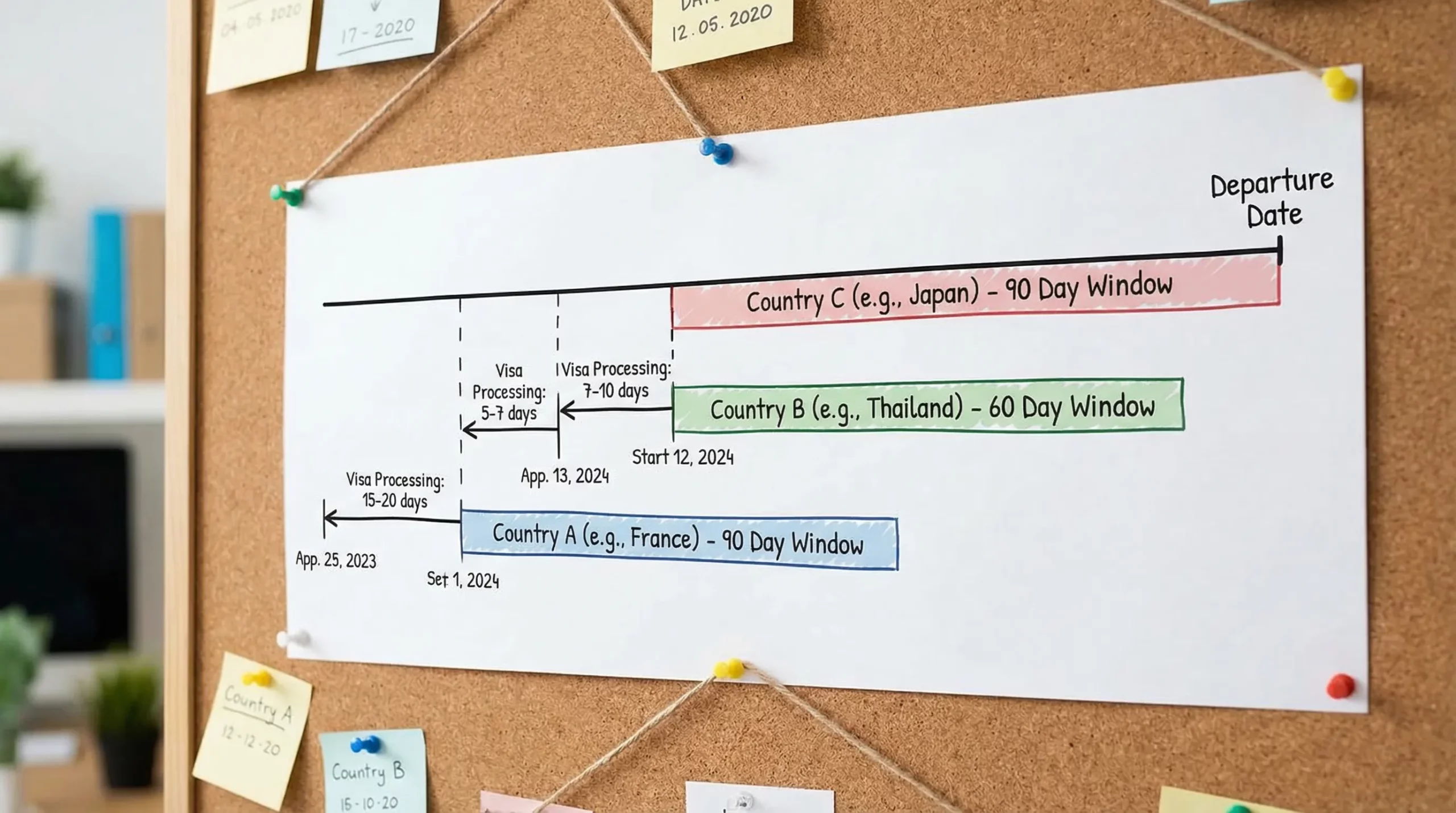
The “anchor date” method
Pick your first international departure date as the anchor. Then work backward:
- Reserve the longest buffer for consular visas and anything requiring appointments.
- Place eVisas next, timed so approval lands inside the allowed entry window.
- Place eTAs/ETAs last, with enough margin to correct errors.
If you want a deeper timing walkthrough (without rehashing full application mechanics), this guide is useful: When should I apply for an e-visa?.
Step 4: Prevent cross-application conflicts (the hidden multi-country traps)
Multi-country trips fail less from “forgetting a visa” and more from small inconsistencies that compound across forms.
Keep your identity data identical everywhere
Use your passport’s machine-readable zone (MRZ) as the source of truth for:
- Name order and spacing
- Passport number
- Date formats
- Nationality and place of birth naming conventions
Even minor mismatches can create delays, especially if you apply across multiple portals.
Do not book non-refundable segments too early
Some visas require confirmed flights; others accept reservations. For multi-country trips, avoid locking expensive legs until your most restrictive visa is secured.
Watch for onward travel proof that depends on the next visa
Some countries are strict about evidence that you can enter your next stop. If your next stop requires a visa, you may be asked to show that visa.
This creates a sequencing rule that surprises travelers:
If Country B may ask for proof you can enter Country C, you may need Country C’s visa before you finalize Country B’s application.
There is no universal rule here, but it is common enough that you should check each destination’s documentation requirements carefully.
Transit rules can require their own authorizations
International transit can trigger visa requirements even when you are not “entering” the country, depending on:
- Whether you leave the airport
- Your nationality
- Terminal changes
- Overnight connections
Build transit stops into the same dependency list as your main destinations.
Step 5: Use a single “document pack” across all applications
A clean document pack speeds up online visa processing and reduces back-and-forth.
At a minimum, keep a secure folder with:
- Passport bio page scan (and any required signature page)
- Compliant passport photo (and the raw original)
- Proof of accommodation and onward travel
- Travel insurance (if relevant)
- Bank statements or proof of funds (if relevant)

If you are applying through multiple portals, document quality matters. Many “processing delays” are simply rejected uploads due to size, glare, cropping, or unreadable text.
For travel businesses: multi-country visa order is also a conversion problem
If you sell complex itineraries (tours, cruises, multi-stop air), visa confusion is not just a traveler headache. It leads to:
- Abandoned bookings
- More customer support contacts
- Last-minute denied boarding risk
- Missed ancillary revenue opportunities
That is why many travel brands embed visa guidance and guided applications directly into the booking flow.
SimpleVisa supports this with visa processing automation, API integration, a white-label visa application app, and custom data services that help surface border requirements at the right moment.
If you operate a white-label travel add-on, remember that documentation is not only operational, it is also brand and product. When you scale internationally, it can be worth speaking with specialists in trademarks, contracts, and intellectual property, such as Studio Legale Coviello’s IP and trademark services to protect your know-how and brand assets.
Frequently Asked Questions
What is the best order to apply for visas on a multi-country trip? Start with anything requiring embassy appointments, biometrics, or passport submission, then handle itinerary-linked/regional visas, then eVisas, and finish with eTAs/ETAs.
Should I apply for visas in itinerary order (country 1, then 2, then 3)? Not usually. It is safer to apply in “risk order,” starting with the slowest or most restrictive processes, unless an eVisa has a strict earliest-apply window.
How do I avoid applying too early for an eVisa? Check the destination’s earliest submission window and entry-by deadline. Back-plan so the approval arrives inside the allowed entry window, not months before.
Do I need a visa for airport transit on a multi-country route? Sometimes. Transit visa rules depend on nationality, whether you change terminals, and whether you pass immigration. Include transit points in your visa planning.
Can one visa application require proof of entry into the next country? Yes. Some destinations may request onward travel proof and, in certain cases, evidence that you can legally enter your next stop. This is why multi-country visa sequencing is not always linear.
Make multi-country visa planning simpler
If you are a travel business guiding customers through multi-country trips, the hardest part is not the form, it is getting the sequencing, eligibility, and document requirements right for each itinerary.
SimpleVisa helps travel brands streamline border crossing administration with automation tools that integrate into booking flows (API), run as a white-label app, or deliver requirements via data services.
Explore SimpleVisa at simplevisa.com to see how guided visa applications can reduce friction and unlock ancillary revenue without adding operational burden.