Building a Visa Rules Engine: Build vs Buy Decision Guide

Visa and entry requirements have become a product surface, not just a compliance checkbox. In 2026, travel brands are juggling an expanding mix of eVisas, eTAs/ETAs, and new pre-travel authorization programs, plus frequent policy updates that can change what a traveler needs between “search” and “check-in.” That makes one question inevitable for product and engineering leaders:
If we want reliable, in-flow eligibility checks (and the ability to sell online visa processing as an ancillary), should we build a visa rules engine or buy one?
This guide breaks down what a visa rules engine actually is, what it takes to run it at production quality, and how to make a build vs buy decision you can defend to leadership, legal, and operations.
What a visa rules engine is (and what it is not)
A visa rules engine is the logic layer that evaluates a traveler’s situation and returns a decision like:
- Visa required, not required, or conditional
- eVisa or travel authorization required (for eligible nationalities)
- Supporting documents required (passport validity rules, onward travel, accommodation proof)
- Timing guidance (when to apply) and constraints (stay limits, entry windows)
It is usually fed by a structured rules dataset and returns an explainable result suitable for UI, customer support, and audit logs.
A visa rules engine is not necessarily:
- A full application workflow (forms, document upload, payments, submission)
- A case management tool for human agents
- A government decision system (it can only reflect published rules and known interpretations)
Many teams blur these boundaries. In practice, the best implementations treat the rules engine as the “truth layer,” and then attach UX flows (booking, post-booking, white-label app) and operational processes (support, escalation, refunds) on top.
If you want a broader framing, SimpleVisa covers this in its overview of Travel Document Automation, where the rules engine is one of the core components.
The minimum inputs and outputs your engine must support
If your engine only considers passport nationality and destination, it will be wrong too often to trust at scale. Real-world eligibility depends on itinerary context and traveler attributes.
| Category | Typical inputs | Typical outputs |
|---|---|---|
| Traveler identity | Passport nationality, passport expiry date, place of birth (sometimes), dual citizenship flags | Eligibility per nationality, warnings when traveler may have multiple options |
| Trip details | Origin, destination(s), transit points, travel dates, trip length, number of entries needed | Requirements per segment, transit requirements, stay limits (where determinable) |
| Traveler status | Residency/visa status in third countries (sometimes), purpose of travel (tourism/business/transit) | Visa type guidance and disqualifiers |
| Operational context | Carrier rules, check-in cutoffs, what you can collect in-flow | Whether you should prompt at booking, post-booking, or pre-departure |
| Compliance | Source references, rule effective dates, rule version | Explainability and auditability |
Explainability is not optional
For travel brands, “visa required” is not enough. You need:
- Why (which rule triggered)
- What to do next (apply for eVisa, apply at embassy, or no action)
- What could change (effective dates, passport expiry edge cases, transit exceptions)
Explainability reduces support load and improves conversion because travelers trust what they understand.
Build vs buy: the real trade-offs (beyond engineering)
Most teams start with a technical question and end with an operational reality: the hard part is not the code, it is keeping rules accurate, current, and defensible.
When building a visa rules engine can make sense
Building can be rational if you have one or more of these conditions:
- You already license authoritative data and have a team to normalize and interpret it.
- You need highly bespoke logic (for example, a complex corporate travel policy layer, or deep integration into internal identity and risk systems).
- You have a mature content-ops and compliance function that can handle daily rule updates, approvals, and incident response.
- Your product strategy requires full control over the decision model, including custom confidence scoring and internal policy overrides.
Even then, many “build” programs still buy components (data feeds, eVisa processing, document validation) and assemble them.
When buying is the safer default
Buying is usually the right call if:
- You want to launch quickly and iterate on conversion.
- You cannot justify a permanent rules maintenance team.
- Your business needs include online visa processing, not just “requirements content.”
- You plan to offer visa assistance across many destinations and passport combinations.
Buying is also the more defensible posture when you consider brand risk. If your guidance causes denied boarding, missed trips, or chargebacks, the cost is rarely limited to refunds.
The hidden scope of “building” (what teams underestimate)
A production-grade visa rules engine requires more than a rule evaluator.
1) Rules acquisition and normalization
Rules are published in many formats, across many sources, and they change without a developer-friendly changelog. You need a repeatable pipeline:
- Monitoring and ingest
- Normalization into a consistent schema
- Validation and human review
- Versioning and effective date handling
Many teams use authoritative datasets and industry sources such as IATA Timatic for carrier compliance contexts (see IATA Timatic). You still need to map that information into a model your product can use.
2) Exceptions, edge cases, and itinerary modeling
The moment you support:
- Multi-stop trips
- Airside vs landside transit
- One-way vs round-trip
- “Passport valid for X months” rules that interact with stay length
…you are doing itinerary reasoning, not just a lookup.
3) QA, regression testing, and incident response
A rules engine must behave like a payments or fraud system: tested continuously and monitored in production.
Expect to build:
- Regression test suites across representative itineraries
- Rule diffing and “what changed” reporting
- Monitoring for spikes in “unknown,” “manual review,” or support escalations
- A rollback strategy when a rule update introduces bad outcomes
4) Legal, compliance, and audit trails
Your engine becomes a compliance artifact. You will need:
- Rule provenance (source links and timestamps)
- Rule version history
- Decision logs tied to booking or traveler sessions
- Data retention policies for PII
If you operate in multiple regions, privacy requirements can also become non-trivial (for example, GDPR obligations in the EU).
A practical build vs buy comparison (TCO, speed, and risk)
This table is intentionally qualitative because costs vary wildly by coverage, volume, and markets.
| Dimension | Build | Buy |
|---|---|---|
| Time to first launch | Longer (data + rules + QA + UX integration) | Shorter (integrate and iterate) |
| Ongoing maintenance | High and permanent | Mostly vendor-managed (still needs oversight) |
| Accuracy risk | You own it | Shared with vendor (contract-dependent) |
| UX control | Full control | High with API, moderate with white-label |
| Coverage expansion | Slow and expensive | Usually faster if vendor already covers markets |
| Auditability | You design it | Ask vendor for logs, rule versions, and source traceability |
| Revenue enablement | You still must build application flows | Often available via embedded flows and services |
Architecture options if you do build
There is no single “correct” architecture, but successful teams converge on a few patterns.
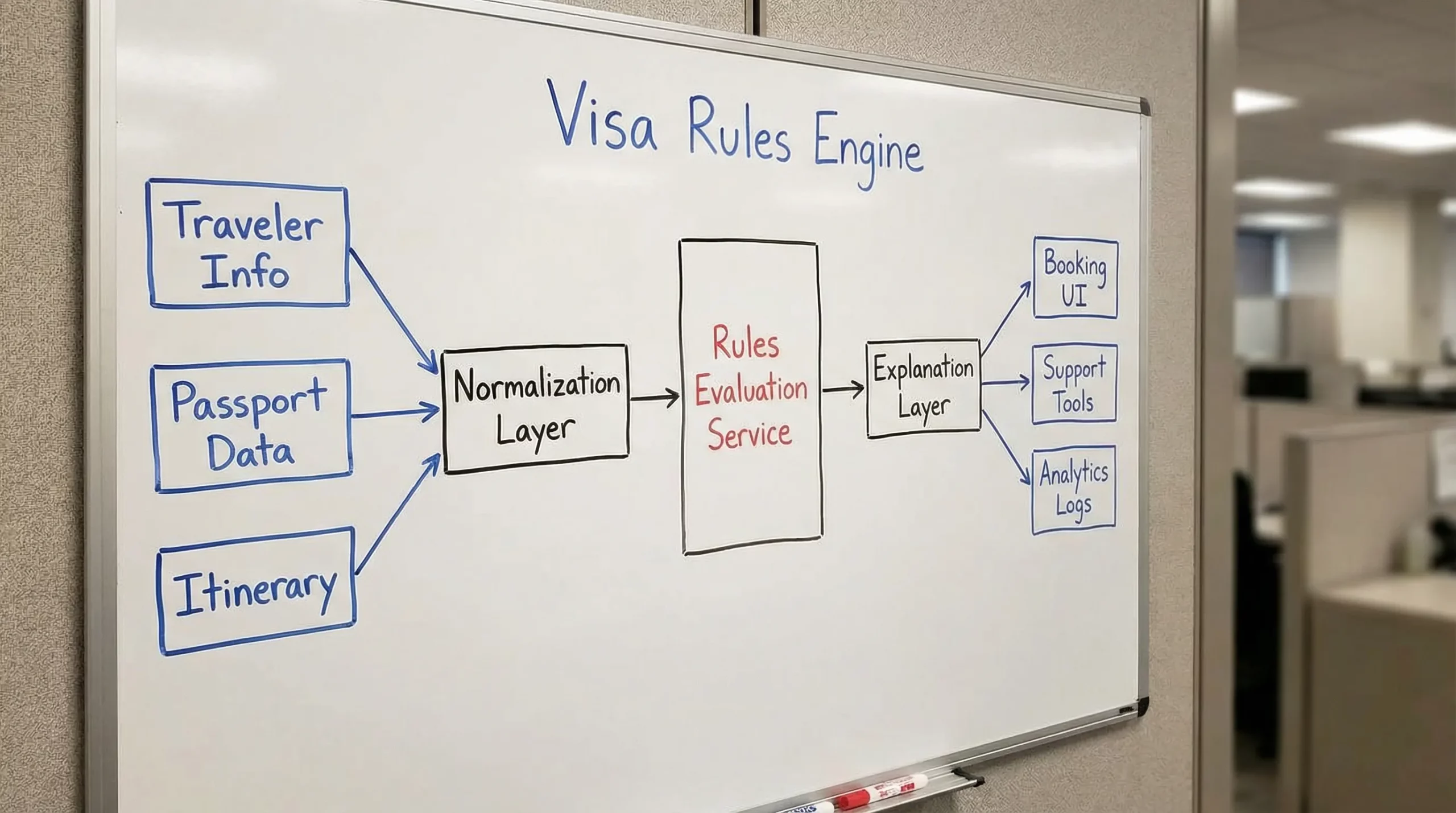
Core components to plan for
- Data model: how you represent nationalities, destinations, transit, stay limits, entries, and effective dates.
- Rule authoring format: decision tables, a rules DSL, or a standard like DMN (Decision Model and Notation) if you want business-readable logic.
- Evaluation service: stateless API with deterministic results, versioned rulesets, and idempotent requests.
- Explanation layer: maps internal rule triggers to human-readable guidance.
- Observability: decision logs, rule versions, and anomaly detection.
“Rules as code” vs “rules as data”
- Rules as code can be powerful but makes updates slower and ties policy changes to release cycles.
- Rules as data (decision tables or structured rules) supports faster updates and better governance, but needs more tooling.
Most travel businesses prefer “rules as data” once they experience real change frequency.
Data sourcing: where rule engines go wrong
A common failure mode is mixing sources without a clear hierarchy. You want a consistent policy on:
- What counts as authoritative
- How often you refresh
- How you handle conflicts
- How you show sources to users
For traveler-facing policies, official government pages should be part of your citation strategy (for example, the EU’s official ETIAS information at europa.eu and the UK’s ETA guidance at GOV.UK).
Even with official sources, interpretation matters because:
- Requirements can differ by point of entry (airport vs land border)
- Transit rules can be conditional and hard to summarize
- Some requirements are “recommended” until enforced operationally
That is why many travel brands choose to buy a rules engine from a provider that specializes in change management and operational validation.
Decision framework: the questions that settle build vs buy
Use this as a pragmatic internal worksheet.
| Question | If your answer is “yes” | Lean |
|---|---|---|
| Do you need to launch within a quarter? | You need speed and iteration | Buy |
| Will requirements be shown inside booking flow (high volume)? | Mistakes are expensive at scale | Buy (or hybrid) |
| Do you have dedicated policy ops staff to maintain rules daily? | Maintenance is feasible | Build or hybrid |
| Do you need full visa application and eVisa management, not only rules? | You need workflows, payments, tracking | Buy |
| Are your itineraries complex (multi-leg, transit-heavy)? | You need mature itinerary reasoning | Buy |
| Do you require custom policy overlays (corporate rules, internal risk scoring)? | You need internal logic layers | Hybrid or build |
| Is your brand on the hook for denied boarding costs and support spikes? | Risk tolerance is low | Buy |
| Do you already have contracts for authoritative datasets and legal review? | You can sustain governance | Build or hybrid |
The most common “best of both” outcome: hybrid
Hybrid is often the winning approach:
- Buy the rules dataset, update pipeline, and eligibility API.
- Build your orchestration layer, UI, analytics, and any internal policy overlays.
This gives you speed and coverage without giving up product differentiation.
If you buy: what to demand from a visa rules engine vendor
Treat this like a compliance-critical vendor selection, not a content widget.
Non-negotiables for travel brands
- Coverage clarity: where the vendor has strong rules, and where results are “best effort.”
- Update process: how changes are detected, validated, and pushed, plus notification mechanisms.
- Rule versioning: ability to reproduce what the engine returned at time of booking.
- Explainability: user-ready reasons, not just codes.
- Security and privacy: encryption, access controls, and clear data retention.
- Integration options: API for embedded flows, plus a no-code or white-label option if you want speed.
- Operational support: escalation paths for edge cases and traveler support handoffs.
If security is a key concern, SimpleVisa’s guidance on what to demand is a useful checklist: Top 8 Security Features to Demand in Any Electronic Visa Solution.
Where SimpleVisa fits (rules engine plus monetizable flows)
SimpleVisa is designed for travel businesses that want to turn border requirements into a smoother customer journey and a measurable ancillary line.
Depending on how you want to deploy, SimpleVisa supports:
- API integration for embedding eligibility checks and online visa processing into booking or post-booking flows
- A white-label visa application app for faster go-live with branded UX
- Custom data services if you need rules delivered into your own experience
- No-code implementation options for teams that want to validate the commercial case before deeper engineering work
If you are deciding between integration models, this comparison can help: API vs. White-Label App: Which Visa Integration Model Suits You?.
And if you want a developer-focused view of how embedded visa APIs work in practice, see: How eVisa APIs work: Step by Step.
Implementation tips (regardless of build or buy)
A few rollout patterns consistently reduce risk:
- Start with eligibility only, then add upsells (eVisa, ETA, appointment support) once accuracy and UX are stable.
- Run shadow mode: compute decisions in the background and compare against support outcomes before showing results to travelers.
- Build a “needs review” lane for ambiguous cases instead of forcing a confident answer.
- Treat rules changes like deployments: review, test, monitor, and rollback.
If you want to measure impact after launch, SimpleVisa’s KPI guide is a solid starting point: 5 KPIs to Track After Deploying a Visa Management Platform.
Frequently Asked Questions
What is a visa rules engine? A visa rules engine is a service that evaluates traveler and itinerary inputs (passport, destination, dates, transit, trip length) and returns entry requirements and next-step guidance in an explainable format.
Why is building a visa rules engine difficult? The complexity is less about coding and more about rule sourcing, normalization, constant updates, exception handling (especially transit), testing, and auditability.
Is buying a rules engine enough to sell eVisas? Not always. Selling eVisas typically requires application workflows, document collection, payments, status tracking, and support operations. Some vendors provide these as part of a visa management platform.
Can we start with a lightweight solution and evolve later? Yes. Many travel brands launch with a no-code or white-label flow to validate conversion and attach rates, then migrate to deeper API integration as volume grows.
How do we handle edge cases where rules are unclear? Design for uncertainty: present conditional guidance, request additional inputs (transit type, residency), or route to human review rather than guessing.
Where should we cite requirements from? Prefer official government guidance when available (for example, EU ETIAS and GOV.UK for the UK ETA), and maintain a clear internal hierarchy for sources and updates.
Turn visa requirements into a product advantage
If you are weighing a build vs buy decision for a visa rules engine, the fastest way to de-risk it is to see how an embedded or white-label flow performs in your booking journey.
Explore SimpleVisa’s integration options at simplevisa.com or request a demo to evaluate the best path for your team (API, white-label, data services, or a hybrid approach).