eVisa for Groups: One Link to Collect Docs From Every Traveler
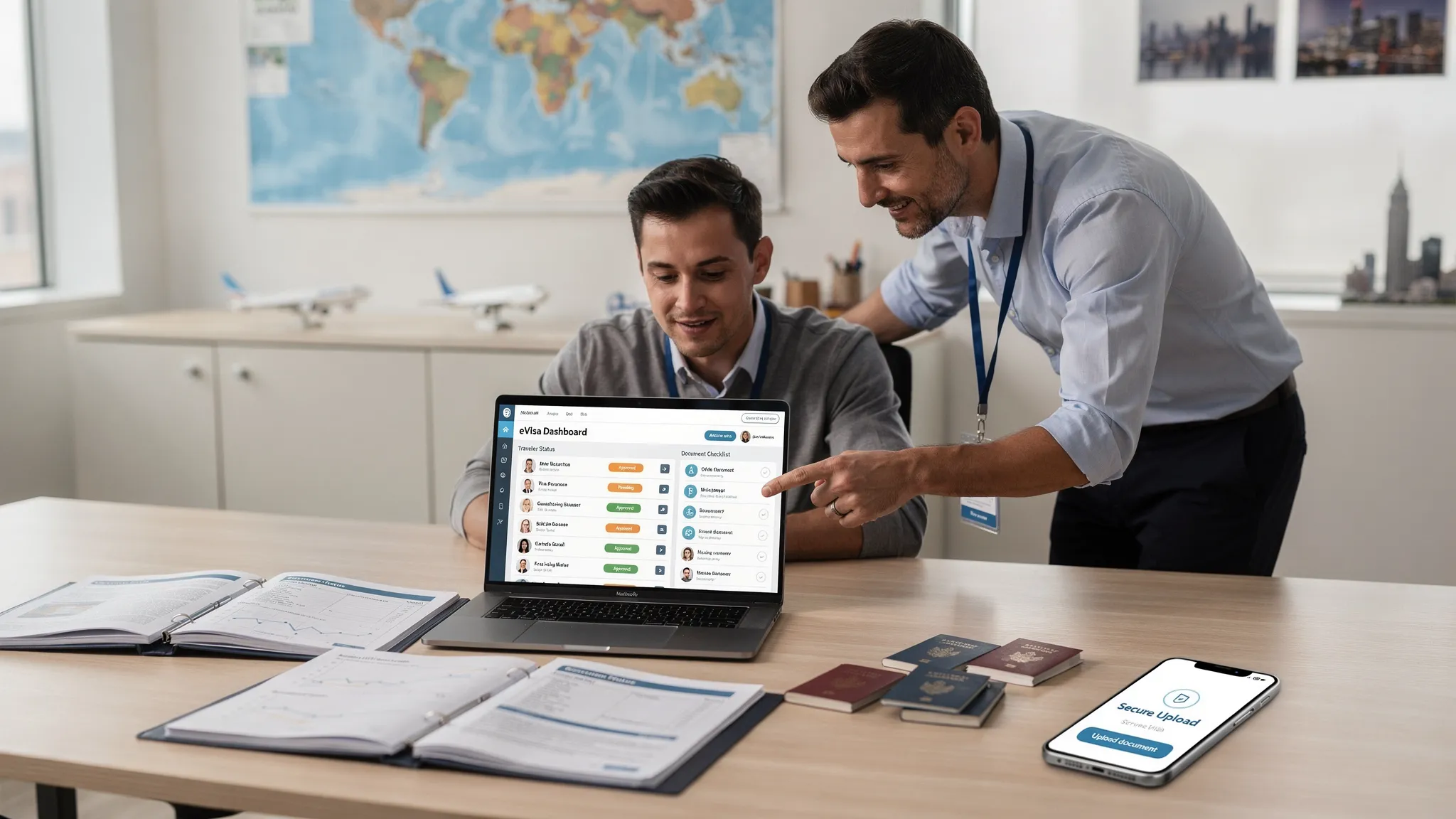
Group travel should be operationally simple, but eVisa paperwork turns it into a coordination problem fast. One traveler uploads the wrong passport page. Another sends a photo that fails the background rules. A family misses a consent letter for a minor. Meanwhile, your team is chasing attachments across email threads, WhatsApp messages, and shared drives.
A single, secure link that each traveler can use to submit their own documents is one of the most effective patterns for group eVisa handling. It reduces bottlenecks, prevents version chaos, and creates a clean audit trail for your ops and support teams.
This guide breaks down how the “one link for the whole group” model works, what to collect, and how travel businesses can operationalize it without turning visa support into a manual back office.
Why group eVisa document collection fails in the real world
Group applications usually break for reasons that have nothing to do with the immigration authority and everything to do with process design.
1) The “single point of failure” organizer
When only the group leader can upload documents, the entire group’s timeline becomes dependent on one person. If they are busy, traveling, or not detail-oriented, everyone waits.
2) Too many file sources, no system of record
Email attachments get buried. Messaging apps compress images. Cloud folders collect duplicates like “passport_final_FINAL2.jpg”. In visa workflows, duplication is not harmless, it creates submission errors.
3) Requirements differ by traveler type
Families and school groups often include minors. Business groups may require invitation letters. Mixed-nationality groups can trigger different eVisa requirements depending on passport, destination, and travel dates.
4) The hardest moment is not submission, it’s follow-up
Most operational load appears after “we sent the link”:
- Someone partially completes the form and disappears
- A document is uploaded but rejected due to format or glare
- Names don’t match ticket data
- Passport renewals happen mid-trip planning
If you cannot see status per traveler, you cannot manage exceptions efficiently.
What “one link for groups” actually means (and what it should do)
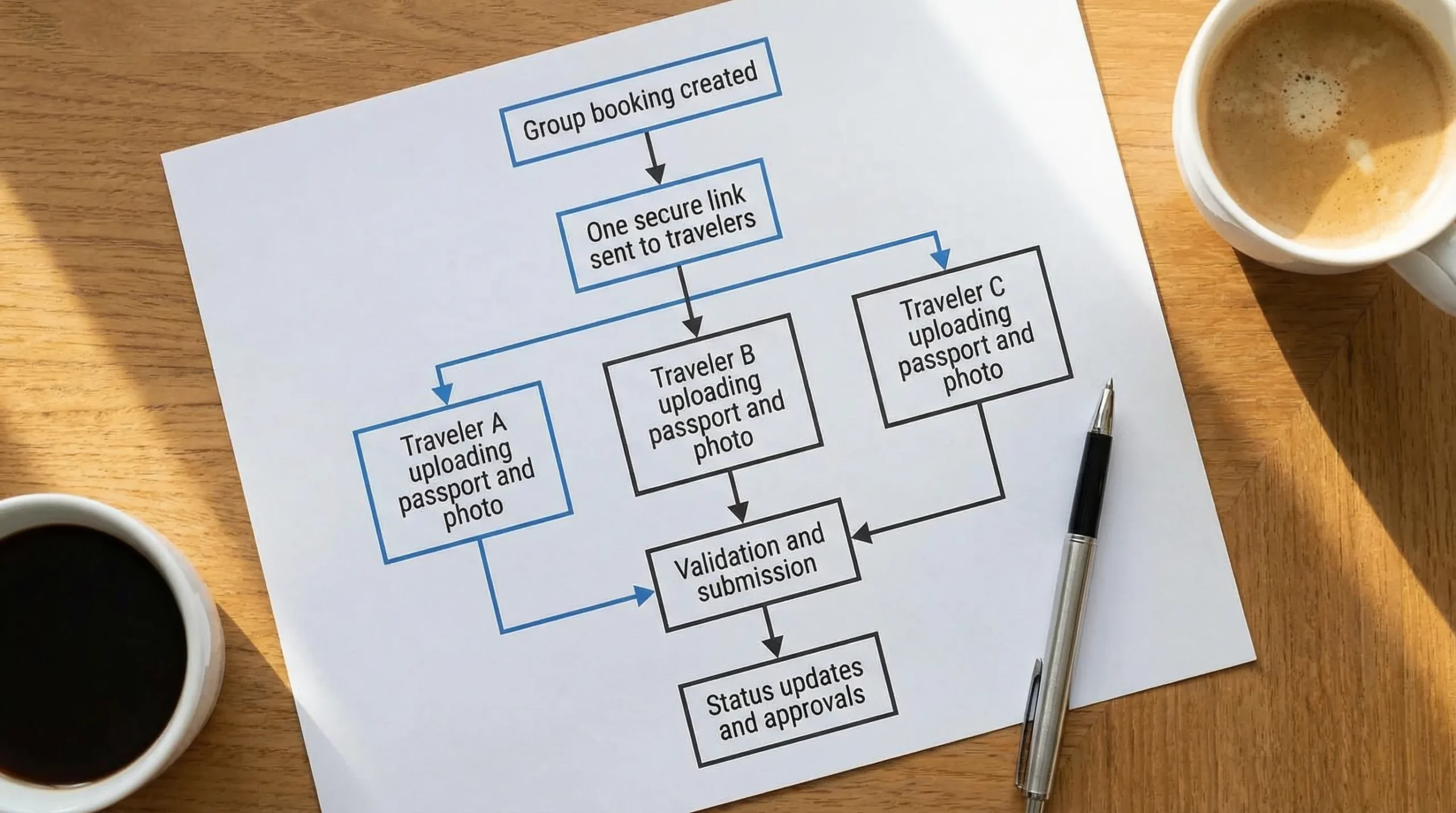
The goal is not literally one shared upload box. It is one link that invites each traveler into their own guided flow, while keeping the group together for tracking and operations.
In a robust group eVisa workflow, the link should enable:
- Per-traveler identity and progress (each person has their own record)
- Central group visibility (organizer and your ops team can see who is done)
- Consistent document standards (format, size, photo rules, required pages)
- Automated reminders (without support agents manually chasing people)
- Secure handling (least-privilege access, audit logs, clear consent)
A useful mental model is: one group invite link, many individual submissions, one operational dashboard.
The minimum document set you should collect from every traveler
Most eVisa processes share a common foundation. Even when requirements vary by country, group document collection works best when you start with a standardized baseline, then add conditional requirements.
Here is a practical baseline that covers the majority of eVisa and travel authorization journeys:
| Document / data item | Why it matters for group processing | Common failure mode to prevent |
|---|---|---|
| Passport bio page scan | Core identity and passport number | Cropped MRZ line, glare, low resolution |
| Passport validity details | Some destinations require 3 to 6+ months validity | Traveler renews after submission, data mismatch |
| Digital passport-style photo | Many eVisa forms enforce strict photo rules | Wrong background, shadow, filters |
| Personal data (name, DOB, address) | Used to populate the visa application | Spelling not matching passport, swapped first/last name |
| Travel dates and entry point (if required) | Some eVisas are date-bound | Inconsistent itinerary across the group |
For deeper preparation guidance, you can point travelers to a pre-submission checklist like SimpleVisa’s resource on everything you need before submitting an online visa application.
Group-specific additions to plan for early
Groups hit edge cases more often than solo travelers. Build these into your intake logic so they appear only when relevant:
- Minors: parental consent forms, birth certificates, guardian passport scans (country-dependent)
- Business travel: invitation letters, host company details (country-dependent)
- Multi-stop itineraries: confirm which country requires the eVisa and which segment triggers it
- Mixed nationalities: do not assume “one rule fits all” for the group
Designing the link-based workflow to reduce drop-off
A group link solves coordination only if the flow itself is easy to complete. The best-performing implementations typically share a few UX principles.
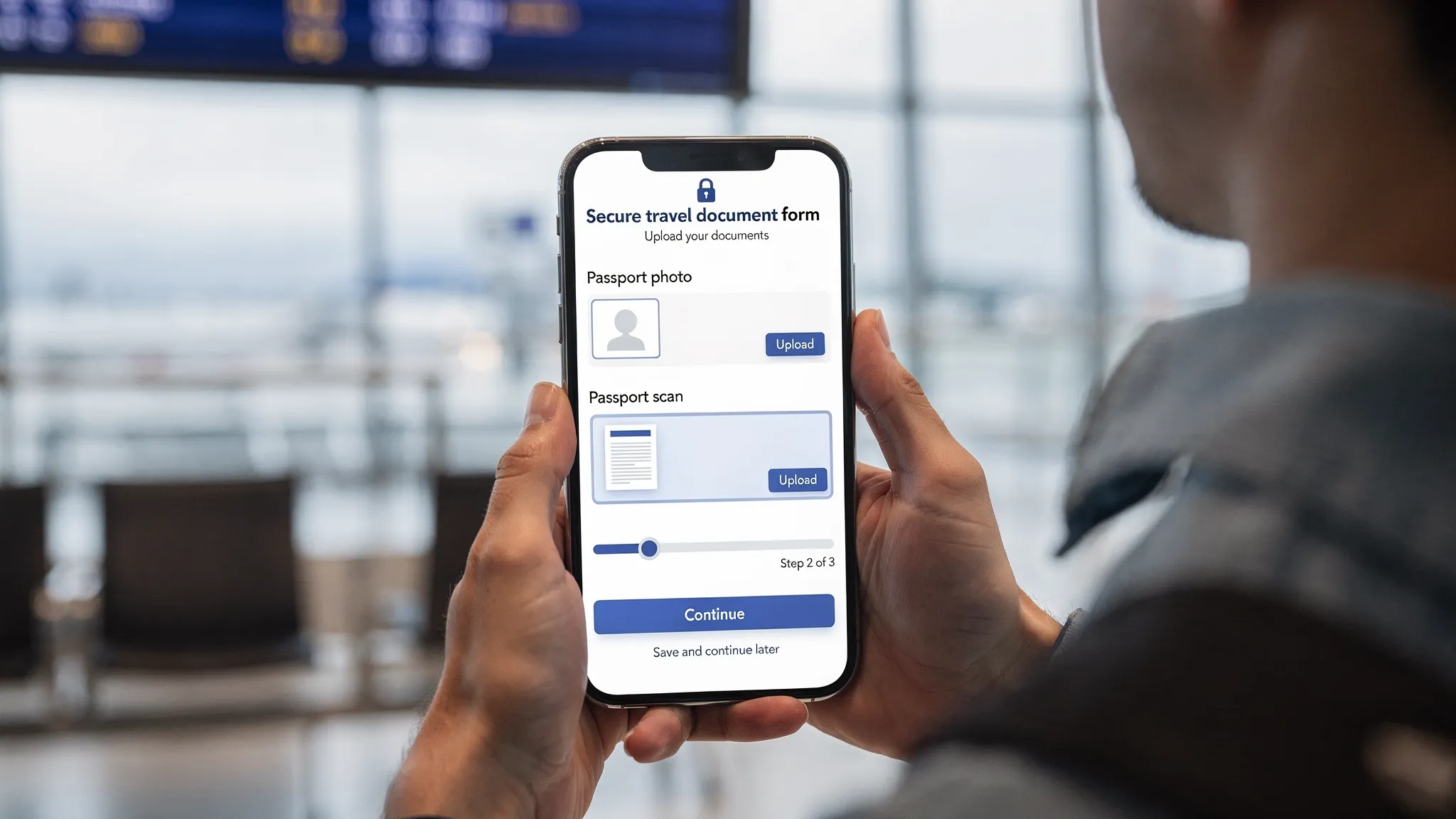
Make it mobile-first, because travelers will complete it on phones
In group contexts, the completion moment is often asynchronous: in a taxi, during lunch, between meetings. If your upload and form experience is not mobile-friendly, completion rates drop.
A mobile-first flow usually includes:
- Camera capture with guidance (reduce glare, show the full passport page)
- Automatic quality checks (blur, cut-off MRZ line, wrong orientation)
- Clear “save and continue later” behavior
Use progressive disclosure instead of a long, intimidating form
Long forms look worse in groups because travelers compare notes. If one traveler says “it took me 25 minutes,” others delay.
A better approach is:
- Collect identity and passport first
- Validate what you can immediately
- Ask for conditional documents only when triggered by traveler profile or destination rules
Give the organizer visibility without creating privacy risk
Organizers need to know who is “done,” but they should not automatically gain access to everyone’s passport scan.
A common best practice is to show:
- Completion status by traveler (not the raw documents)
- What is missing (for example “photo required”) without exposing the file
If you operate in markets where privacy regulation applies, keep consent and data minimization in mind. For example, the EU’s GDPR principles highlight purpose limitation and collecting only what is necessary.
Operations: what your team needs to manage group eVisa cases at scale
A one-link intake flow is only half the system. The other half is how your ops, support, and product teams handle exceptions.
Status tracking that matches the real journey
Group journeys benefit from clear, traveler-level states. Even if you do not expose every internal status to customers, your internal team should be able to distinguish:
- Invited, not started
- In progress
- Submitted (awaiting decision)
- Approved
- Rejected (and why)
- Needs traveler action (missing doc, clarification)
If you are building or integrating a visa management layer, it helps to model your events in a way that aligns with travel document automation concepts. SimpleVisa’s overview of what travel document automation is provides a useful framework for how these workflows are typically structured.
Standardize how you name and store files
Even with a link, you still need consistent organization. A simple convention prevents expensive mistakes:
- Include traveler full name as on passport
- Include document type
- Include last 4 digits of passport number (where appropriate and compliant)
- Include timestamp of upload
This is especially important when groups have similar names or family members.
Build an escalation path for “hard cases”
In every group, one traveler becomes the exception. A structured escalation path reduces time-to-resolution:
- Automated request for a re-upload when quality checks fail
- A human review queue for ambiguous cases
- A clear cutoff date tied to departure (so the group understands urgency)
Commercial impact: why group eVisa flows are also an ancillary revenue opportunity
For travel sellers, groups are high-value bookings, but also high-risk bookings. If even one traveler cannot board due to missing authorization, the customer experience collapses.
Adding a guided eVisa flow as part of the post-booking journey can create revenue while reducing disruption, especially when the experience feels like help, not a hard sell.
The “one link” model supports this because it:
- Keeps travelers inside a controlled experience instead of sending them to search engines
- Reduces support cost per traveler, since progress is visible
- Creates natural moments for compliant add-ons (for example expedited handling where available)
SimpleVisa’s content on how eVisa APIs work step by step is a good reference if you are exploring embedded flows that keep visa handling inside your booking or manage-my-trip experience.
Implementation options: embedded, white-label, or data service
Travel brands typically implement group eVisa collection in one of three ways:
| Model | Best for | What “one link” looks like |
|---|---|---|
| Embedded (API-integrated) | OTAs, airlines, high-volume platforms | Link is generated per booking or PNR, travelers complete steps in an embedded flow |
| White-label application | Fast time-to-market, limited engineering bandwidth | Organizer shares a hosted link with the brand’s look and feel, each traveler completes their own intake |
| Data service (requirements only) | Brands that want to inform first, sell later | Link points to a guided requirements and document checklist, then routes to application when ready |
SimpleVisa supports multiple integration paths (API integration, white-label app, and custom data services), which makes it a fit for travel businesses that want to start with a quick deployment and evolve into deeper automation.
Reliability matters more than you think (yes, even power)
Group document collection is time-sensitive. Deadlines cluster around departure, and your ops team needs to respond quickly when an exception appears.
That is why operational resilience matters: stable internet, secure devices, and reliable power in the office or service center handling sensitive traveler documents. If your operations are based in Northern Germany, working with specialists in backup power and electrical infrastructure can be a practical risk reducer, for example Notstrom & Elektrotechnik Sven Sanny for planning and installing emergency power systems.
A practical rollout plan for travel teams
To launch a group eVisa link flow without over-engineering it, focus on these pillars:
Start with one group segment
Pick a use case where the value is obvious:
- Tour operator group departures
- School trips
- Corporate offsites
- Cruise shore-excursions with short lead times
Define your “group-ready” standards
Document what “good” looks like:
- Accepted file formats and max sizes
- Photo rules and common rejection reasons
- SLA expectations for support and review
- How you handle minors and mixed nationalities
Instrument the flow from day one
Even basic reporting helps you improve quickly:
- Completion rate per traveler
- Average time to upload passport and photo
- Re-upload rate (a proxy for quality issues)
- Support contacts per group
For measurement ideas tailored to visa platforms, SimpleVisa’s guide on KPIs to track after deploying a visa management platform can help you choose metrics that correlate with conversion and operational load.
Where SimpleVisa fits
If you are designing a group eVisa experience, the right partner should help you do two things well:
- Guide each traveler through the visa application with the right document prompts and quality checks
- Connect the workflow to your booking journey (embedded via API, launched via white-label flow, or powered by visa data services)
SimpleVisa provides visa processing automation, API integration, a white-label visa application app, and custom data services, all of which can support the “one link for the group” operating model when implemented as part of a structured post-booking journey.
To evaluate fit, ask for a walkthrough of the group experience: how invitations are handled, how traveler-level status is tracked, how exceptions are managed, and what no-code options exist if you want to pilot quickly on a limited set of routes.