White-Label Visa Hub SEO: Pages That Capture High-Intent Traffic

High-intent visa searches are some of the most commercially valuable queries in travel.
When someone types “Do I need a visa for Vietnam?” or “Kenya eTA requirements for US citizens,” they are not browsing for inspiration. They are trying to remove a booking blocker, often within days of departure. A white-label visa hub gives travel brands a way to capture that intent, keep travelers on-site, and route them into a guided visa application flow.
This article is a practical SEO blueprint for building visa hub pages that:
- Rank for transactional visa queries (not just generic “what is an eVisa” content)
- Scale safely with programmatic templates
- Convert with clear, compliant CTAs and trust signals
Start with the goal: rank, then route to completion
Visa hub SEO fails when it treats “traffic” as the finish line. The finish line is:
- A traveler confirming requirements for their passport and itinerary
- A traveler starting an online visa processing flow
- A traveler completing and paying without leaving your experience
That means every high-intent page should answer, quickly:
- Is a visa/eVisa/eTA required for this traveler?
- Can I apply online, and how long will it take?
- What documents will I need?
- What do I do next, right now?
If you want a broader view of how visa and entry flows fit into travel platforms, SimpleVisa’s overview of travel document automation is a good foundation.
Information architecture that Google (and humans) can understand
A visa hub works best as a structured, crawlable library. Avoid burying everything inside search widgets or JavaScript-only experiences.
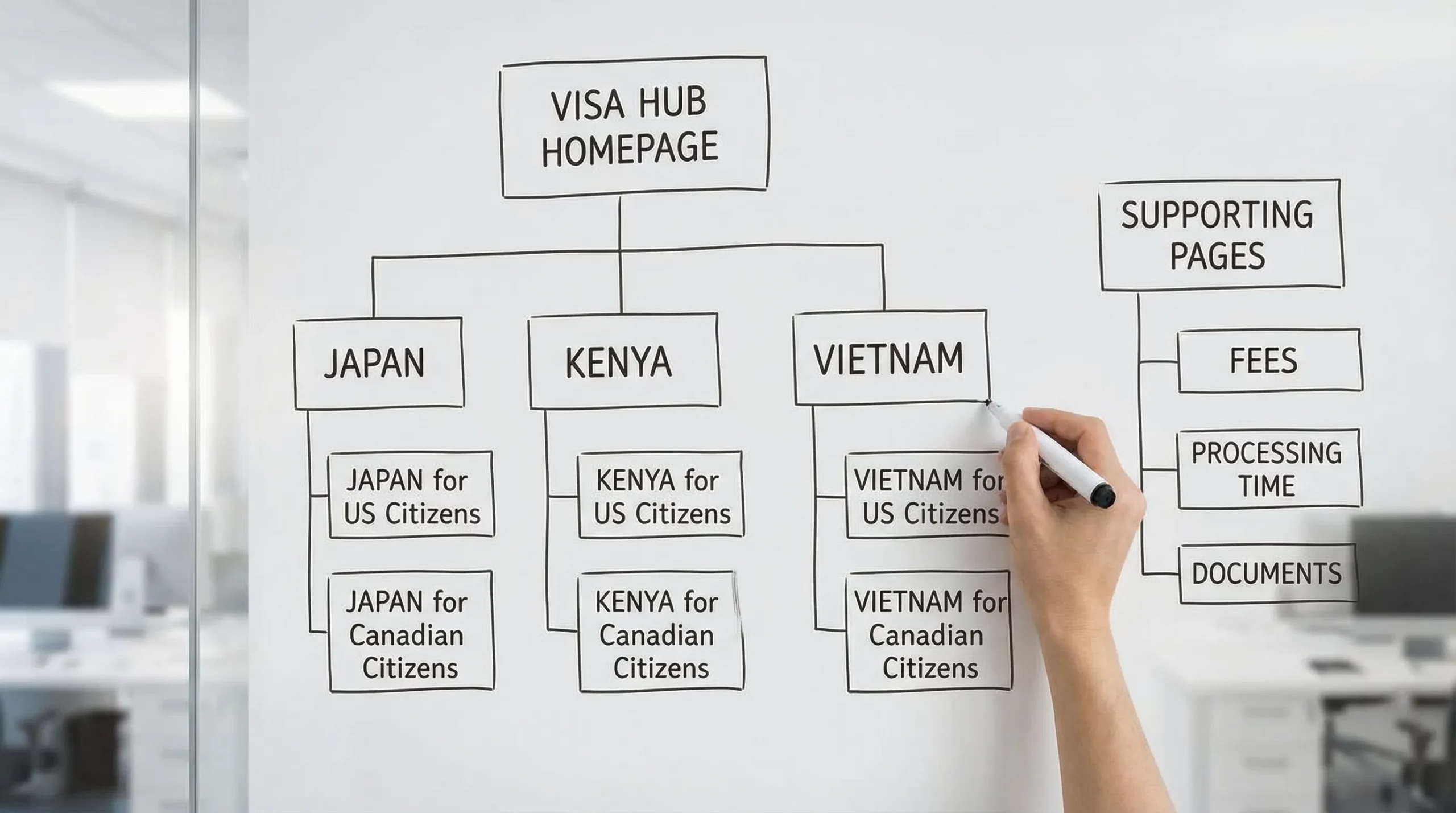
Recommended hub structure
A scalable pattern looks like this:
- /visa/ (hub homepage)
- /visa/{destination}/ (destination requirements overview)
- /visa/{destination}/{nationality}/ (passport-specific eligibility page, the highest intent)
- Optional supporting templates:
- /visa/{destination}/fees/
- /visa/{destination}/processing-time/
- /visa/{destination}/documents/
The key is to separate:
- Destination overview pages (useful for broad discovery)
- Nationality-to-destination pages (where conversion intent is strongest)
Avoid common programmatic SEO traps
Programmatic visa SEO can scale, but it also creates predictable risks:
- Duplicate pages from URL parameters (dates, cities, devices) that should not be indexed
- Thin pages where the “US citizens need X” template produces near-identical content across many destinations
- Index bloat (thousands of low-demand combinations that waste crawl budget)
Practical safeguards:
- Keep a strict set of indexable URL patterns (everything else should be canonicalized or noindexed).
- Generate an XML sitemap only for pages you actually want indexed.
- Make passport-specific pages meaningfully different by including sections that truly vary (entry method, allowed stays, common document rules, links to official sources, common refusal reasons).
The 6 page types that capture high-intent visa traffic
Many travel sites publish “how to apply” articles. A visa hub wins when it also builds the decision pages people search right before they act.
1) “Do I need a visa for {destination}?” destination overview pages
These pages target queries like:
- “Do I need a visa for Thailand”
- “Vietnam entry requirements”
- “Turkey eVisa or visa on arrival”
What to include (in this order):
- A plain-language answer at the top (what most travelers need, with clear exceptions)
- A short list of traveler categories (visa-free, eVisa, eTA/ETA, consular visa)
- A clear path to “Check requirements for your passport” (this pushes people into the passport-specific template)
This is where you can link to broader educational content you already have, like Travel Visa Basics: What to Know Before You Book.
2) Passport-specific eligibility pages (highest intent)
These pages target “{destination} visa for {nationality}” queries, for example:
- “Kenya eTA for US citizens”
- “India eVisa for Australian passport”
Why these pages convert:
- The search includes both a destination and a passport, meaning the traveler is already self-qualifying.
- The traveler is usually close to booking or already booked.
On-page elements that matter:
- A prominent eligibility summary (required vs not required, and the likely document type)
- The fastest next step (“Start online application” or “Check eligibility”) with brand-consistent white-label UX
- A short “What you’ll need” section (documents, photo, passport validity)
SimpleVisa supports both embedded and hosted approaches (API, no-code, white-label). If you are deciding which model fits your team, see API vs. White-Label App: Which Visa Integration Model Suits You?.
3) Processing time pages (intent is urgency)
Travelers often search processing time when they are nervous about missing a trip.
Examples:
- “How long does an eVisa take for Sri Lanka”
- “ETA approval time UK”
Best practice: avoid fake precision. Processing times vary by government workload and applicant profile, so structure content around:
- Typical ranges (if you publish any numbers, source them and update frequently)
- What causes delays (incomplete uploads, photo issues, name mismatches)
- “If you travel within X days” guidance (route to support or expedited options when applicable)
You can cross-link to operational content like When should I apply for an e-visa to keep the hub cohesive.
4) Visa fees and total cost pages (intent is comparison)
These pages rank for:
- “{destination} eVisa cost”
- “ETA fee”
- “visa service fee vs government fee”
They also reduce cart abandonment by removing price uncertainty.
A strong pattern is to present:
- What the government charges (if known)
- What changes the price (processing speed, reciprocity, add-ons)
- How refunds work (set expectations clearly)
For a reference structure, SimpleVisa’s explanation of how visa costs are calculated is a useful model.
5) Document checklist pages (intent is preparation)
Document pages rank for:
- “{destination} eVisa documents”
- “photo requirements for eVisa”
But more importantly, they increase approval odds by preventing incomplete submissions.
Keep checklists scannable and practical. You can link out to deeper guides like Checklist: Everything You Need Before Submitting an Online Visa Application.
6) Problem-resolution pages (intent is support, but still transactional)
These pages are underrated for SEO and conversion. They capture travelers who are stuck but still need to apply.
Examples:
- “name mismatch on eVisa”
- “lost electronic visa”
They also reduce support tickets when written clearly. (SimpleVisa already has strong coverage here, such as Handling Name Mismatches on Tickets, Passports, and eVisas.)
On-page SEO template for a high-converting visa hub page
A visa hub page is not a blog post. It is a decision page.
Here is a conversion-oriented content order that works especially well for passport-specific pages.
Above-the-fold essentials
- H1 that matches intent: “{Destination} visa requirements for {Nationality} travelers”
- 2 to 3 sentence answer summary
- A requirement status badge (Required / Not required / Depends)
- Primary CTA: “Start application” or “Check eligibility”
Mid-page: proof, clarity, and friction removal
- Accepted entry methods (eVisa, ETA, visa on arrival, embassy)
- Processing time guidance (ranges and what affects them)
- Fees overview (what affects total cost)
- Document checklist
Bottom: trust and escalation paths
- Data accuracy and sourcing statement (link to official government resources when possible)
- Security and privacy notes (especially near uploads and payment)
- Support path (how to get help)
If you are optimizing conversion as aggressively as ranking, SimpleVisa’s breakdown of form drop-off patterns in Why Travelers Abandon Visa Forms and 6 UX Fixes That Convert pairs well with visa hub SEO.

Structured data and SERP features (without spam)
For visa hub pages, structured data is less about gimmicks and more about clarity.
Commonly useful types:
- BreadcrumbList (helps Google understand hierarchy and can improve breadcrumb display)
- WebPage or Article (depending on whether it reads like a guide)
- HowTo for genuinely step-by-step pages (only if your page is truly instructional)
Reference implementations:
Avoid marking up content that is not present on the page or that changes per user without stable rendering. Visa content is sensitive, and misleading SERP enhancements are not worth the risk.
Internal linking: treat the hub like a product, not a blog category
Internal linking is the difference between “a few pages that rank” and “a system that compounds.”
High-leverage linking patterns:
- From destination content (guides, city pages, tour pages) into the relevant destination visa page
- From destination visa pages into passport-specific eligibility pages (via a selector)
- From eligibility pages into fee, processing time, and document pages
- From post-booking flows (confirmation page, manage booking, pre-departure emails) into the exact eligibility page
If your business sells travel and you want visa attach rate, the hub must be connected to the booking journey. For messaging and funnel placement ideas, see the Ultimate Guide to Marketing eVisa Services During the Booking Flow.
EEAT for visa content: accuracy, accountability, and change management
Visa requirements change frequently. Google also holds “Your Money or Your Life” topics to a higher standard, and visa guidance can impact finances and travel outcomes.
Practical EEAT signals for visa hub pages:
- Clear sourcing (official government portals where possible)
- A visible editorial process (for example, “verified by compliance ops,” or “reviewed against official guidance”)
- A method to handle updates fast (especially for policy shifts like new ETAs)
From a product standpoint, this is where a visa management platform or data service matters. If your team is currently maintaining requirements manually, the long-term cost and risk add up quickly. SimpleVisa has a dedicated perspective on the operational downside in The Hidden Costs of Manual Visa Processing.
What to build first: a realistic MVP roadmap
You do not need every page type on day one. A sensible launch sequence is:
- Visa hub homepage + 20 to 50 top destinations (based on your booking data)
- Passport-specific pages for your top origin markets (the combinations that generate the most bookings)
- Processing time + documents templates (they reduce support and increase completion)
- Fees pages where pricing questions are frequent
- Expand coverage based on search impressions and bookings
If you want a no-code starting point for a fully branded experience, SimpleVisa’s guide on how to offer white-label visa services without writing code is a practical companion.
A simple planning table you can hand to SEO and product
Use this table to align page templates with intent, conversion actions, and technical requirements.
| Page template | Example query intent | Primary CTA | Recommended schema | Biggest risk to manage |
|---|---|---|---|---|
| Destination overview | “Do I need a visa for {destination}?” | Check requirements by passport | BreadcrumbList, WebPage | Overly generic content that does not route to eligibility |
| Passport-specific eligibility | “{destination} visa for {nationality}” | Start application | BreadcrumbList, WebPage | Thin templating across many combinations |
| Processing time | “{destination} eVisa processing time” | Start application or get help | BreadcrumbList, Article | Publishing unsourced or outdated timelines |
| Fees and cost | “{destination} eVisa cost” | Start application | BreadcrumbList, Article | Confusing government fees vs service fees |
| Documents checklist | “{destination} eVisa documents” | Start application | BreadcrumbList, Article | Missing edge cases (minors, business, transit) |
| Problem-resolution | “lost eVisa” / “name mismatch” | Fix path + continue application | BreadcrumbList, Article/HowTo (only if true steps) | Legal overreach, unclear escalation paths |
Where SimpleVisa fits (without rebuilding your stack)
A white-label visa hub is most effective when it is not just content, but a connected workflow.
SimpleVisa supports travel businesses with options that can match different org constraints:
- White-label visa application app for a fully branded hub experience
- API integration to embed eligibility checks and online visa processing directly in booking flows
- Custom data services for requirement logic, coverage, and operational accuracy
- No-code implementation options when engineering bandwidth is limited
If you are evaluating vendors or build-vs-buy, SimpleVisa also provides a detailed framework in How to Evaluate a Visa Processing Company.
The takeaway
“White-Label Visa Hub SEO” is not about publishing more visa articles. It is about building a structured set of decision pages that match how travelers actually search: destination + passport + urgency.
Get the architecture right, focus on passport-specific pages, and treat conversion as part of SEO. Done well, your visa hub becomes a traffic moat and a revenue line, not a support burden.