Refund Window Design for eVisas: Status-Based Examples

Refunds are one of the fastest ways to lose (or earn) traveler trust in an eVisa flow. Not because customers expect free cancellations, but because they expect the rules to match what actually happened in the journey. A “7-day refund policy” feels fair for a hotel, yet it can be impossible for an eVisa that has already been submitted to an authority, incurred third-party costs, or been approved.
A better approach for travel brands is refund window design for eVisas based on status, with clear examples that map each application state to what can (and cannot) be refunded.
Why refund windows are harder for eVisas than for travel inventory
Unlike most ancillaries, an eVisa application moves through irreversible milestones:
- Data collection and validation (reversible)
- Submission (often triggers third-party work and fees)
- Authority review (timing is unpredictable)
- Decision and issuance (value has been delivered, even if travel later changes)
That creates two practical constraints:
- Cost boundary: at some point, real costs are incurred (government fees, processing costs, document checks, payment fees). Some of these are refundable in certain corridors, many are not.
- Compliance boundary: once submitted, “undoing” may not be supported by the issuing workflow, or it may require a formal withdrawal.
So the goal is not “generous vs strict.” The goal is consistent, status-based logic that your support team can defend, your travelers can understand, and your finance team can reconcile.
The statuses that matter (and what they mean for refunds)
You do not need 30 states. You need a small set of statuses that reflect refundability.
Here is a practical status model that works well for embedded checkout, post-booking visa flows, and white-label apps.
| Status (customer-facing) | What it means operationally | Is it usually reversible? | Why it matters for refunds |
|---|---|---|---|
| Draft / Not started | Traveler has not entered enough info to create an application | Yes | No real processing has begun |
| In progress | Traveler is completing form and uploads | Yes | You can safely refund most charges if you collected them early |
| Ready to submit | All required fields are complete, pending final confirmation | Yes | Last checkpoint for a full refund before submission |
| Submitted | Application has been transmitted to a processing system or partner | Sometimes | This is commonly the first “cost boundary” |
| Under review | Authority or processor is reviewing the application | Rarely | Timing risk increases, withdrawal may be limited |
| Action required | Additional info requested (RFI) | Sometimes | Refund logic should consider who caused the delay and whether resubmission is possible |
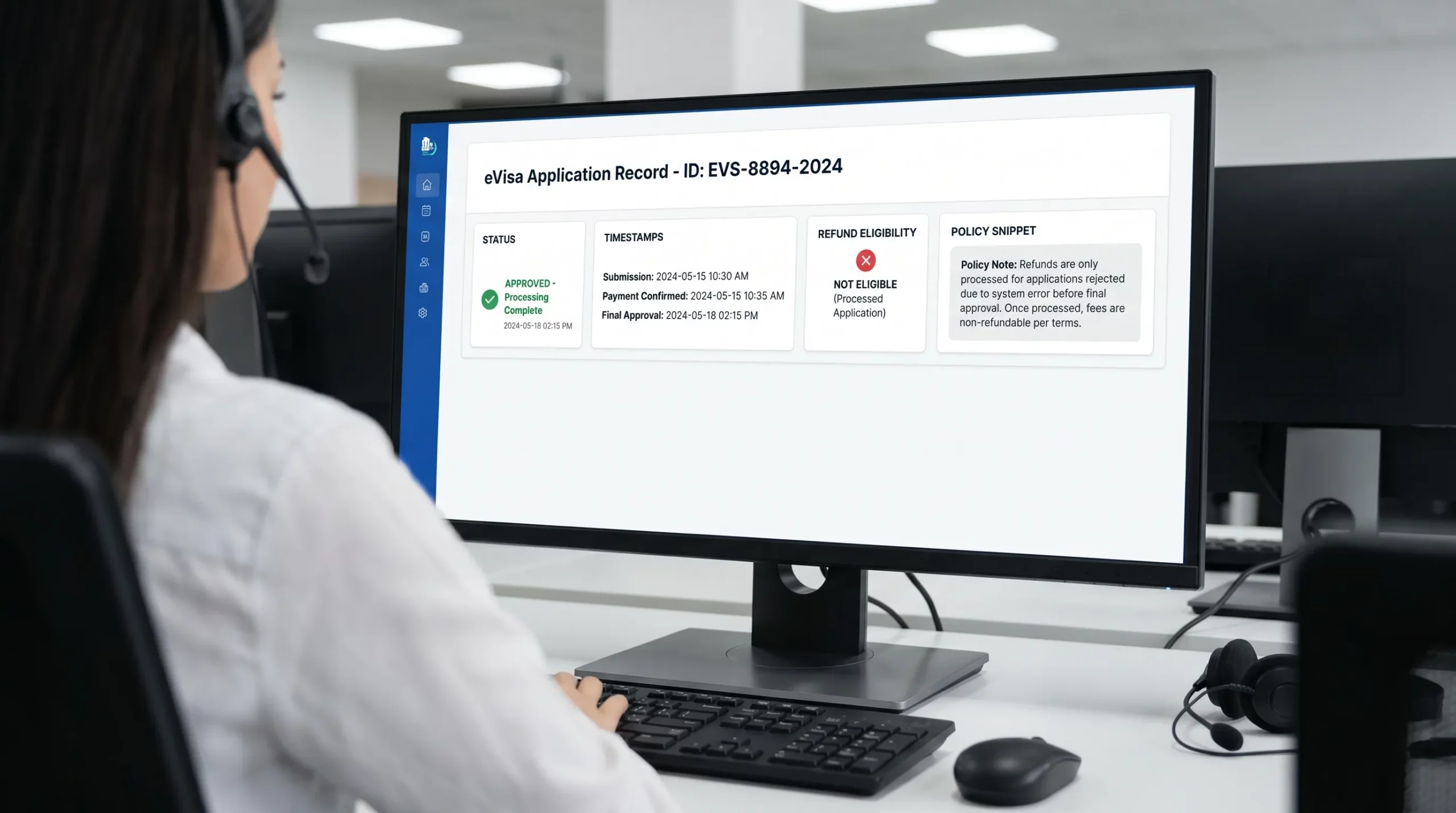
| Approved / Issued | The eVisa (or authorization) has been granted | No | The service outcome is delivered, refunds become exception-based |
| Refused / Rejected | Authority refused the application | No (decision is final) | Policy should clearly state what happens to fees when refusal occurs |
| Expired / Not used | eVisa exists but traveler did not travel | No | This is a common dispute scenario, so wording is crucial |
Tip: For internal reporting, keep richer backend statuses, but expose only those needed for expectations and policy enforcement.
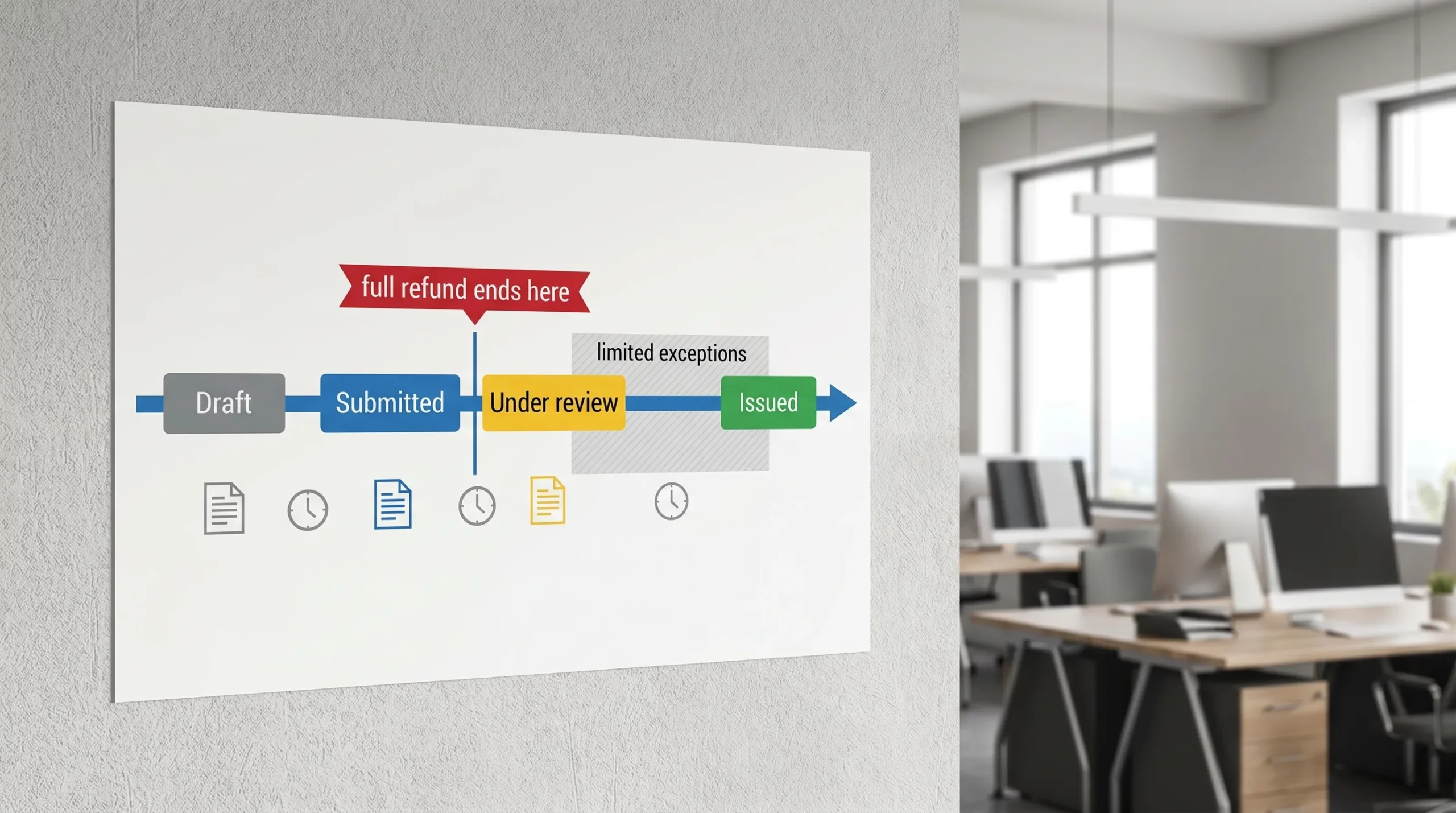
The core design principle: refunds should follow “value delivery,” not calendar days
A calendar-based window (24 hours, 7 days) is easy to communicate, but it is often misaligned with how eVisa processing works.
A status-based refund window anchors policy to observable events:
- “Before we submit your application”
- “After submission but before decision”
- “After a decision is issued”
That alignment reduces:
- Chargebacks (“service not delivered”) when you can prove the delivered milestone
- Support escalations because agents can point to status history
- Operational losses from refunding non-recoverable fees
Status-based refund examples (copy-ready patterns)
The examples below are intentionally generic, because refundability varies by destination, authority, and partner contracts. Use them as starting points for legal and commercial review.
Example 1: Simple and strict (best for low-margin eVisa products)
Policy logic: full refund until submission, partial refund after submission, no refund after issuance.
| Application status | Refund outcome (example) | Typical customer message |
|---|---|---|
| Draft / In progress / Ready to submit | 100% refund | “You can cancel for a full refund until your application is submitted.” |
| Submitted / Under review / Action required | Refund service fee only (government or third-party fees may be non-refundable) | “We have already submitted your application. Some fees may no longer be recoverable.” |
| Approved / Issued | No refund (except duplicate charge or processing error) | “Your eVisa has been issued, the service has been completed.” |
| Refused / Rejected | No refund by default, or service-fee refund only if you choose | “A refusal is an authority decision and is typically not refundable.” |
When this works: you have high volume, standardized destinations, and you want minimal edge-case handling.
Example 2: Customer-friendly with a “cooling-off” window (best for checkout add-ons)
Policy logic: allow a short full-refund window even if payment occurred, as long as submission has not happened.
| Trigger | Refund window (example) | Why it helps |
|---|---|---|
| Customer pays for eVisa add-on | 30 to 60 minutes full refund if status is not Submitted | Reduces immediate regret disputes and accidental purchases |
| Customer cancels trip later | Refund depends on eVisa status, not trip status | Prevents the eVisa policy from being hostage to airline or hotel flexibility |
Suggested microcopy near the purchase button:
- “Full refund available until submission. After submission, some fees may be non-refundable.”
Example 3: Exception-based fairness (best for premium products)
Policy logic: broader exceptions, but only when tied to measurable responsibility.
Common exception triggers you can encode:
- Duplicate purchase (same traveler, same passport, same destination, same travel dates)
- Your system failed to submit, yet charged the customer
- Your system marked a required document as “accepted,” then rejected it later (quality-control issue)
- Customer requested cancellation while still in “Ready to submit,” but submission happened due to automation delay (timing mismatch)
This approach can improve trust and NPS, but it requires stronger logging, event timestamps, and agent tooling.
A practical refund matrix you can implement
Most travel brands end up with a two-dimensional policy:
- Status (what happened)
- Time since status change (how quickly the customer acted)
Here is an implementable matrix you can adapt.
| Status | If cancelled within 1 hour | If cancelled within 24 hours | If cancelled later |
|---|---|---|---|
| In progress / Ready to submit | Full refund | Full refund | Full refund (until Submitted) |
| Submitted | Partial refund (service fee only) | Partial refund (service fee only) | No refund (or partial only) |
| Under review / Action required | Partial refund only if withdrawal is still possible | No refund (unless special case) | No refund |
| Approved / Issued | No refund | No refund | No refund |
| Refused / Rejected | Policy-defined (often no refund) | Policy-defined | Policy-defined |
Important: treat “Submitted” as a boundary only if it truly represents commitment. If your stack has two submission steps (submitted to processor, then to authority), you may want two different cutoffs.
Handling the 4 most common refund disputes
1) “I did not travel, so I want a refund”
This is the most frequent mismatch between travel inventory thinking and document thinking.
What to clarify in UX:
- The eVisa service is the processing and issuance of permission to travel (or the attempt to obtain it), not the trip itself.
A helpful line in receipts and emails:
- “Your eVisa is linked to your passport and is processed independently from your flight or hotel booking.”
2) “I made a mistake in the form, please refund and let me redo it”
A blunt “no refund” often drives chargebacks.
Better pattern:
- Allow correction while in progress.
- After submission, offer a paid amendment flow (if supported) or a discounted reapplication, depending on corridor rules.
3) “My application was refused, so the service failed”
This is sensitive, and your policy should avoid sounding like blame.
Operationally, refusals can still mean real work was performed (validation, submission, liaison). The key is to be explicit upfront:
- Whether any component is conditional on approval
- Whether any fee is refundable upon refusal
If you sell a premium “managed” experience, consider clearly separating:
- “Processing and submission fee”
- “Government fee”
(Refundability differs by destination and contract terms.)
4) “I cancelled before submission, but you submitted anyway”
This is almost always a logging and automation problem.
To prevent it:
- Record a cancellation event immediately.
- Block submission jobs when a cancellation flag exists.
- Show a real-time status receipt in the UI (“Cancellation received at 10:21:05 UTC”).
UI patterns that reduce refunds without being misleading
Refund policy text alone is rarely enough. The best-performing flows make refundability visible at decision time.
Pattern A: Status banner with refund eligibility
Show a small banner inside the eVisa journey:
- “Current status: Ready to submit. Cancel now for a full refund.”
- “Current status: Submitted. Cancellation may be limited.”
Pattern B: Pre-submission confirmation gate
Add a short confirmation step that does two things:
- Confirms passport details (reduces costly errors)
- Re-states the refund boundary (reduces disputes)
Example confirmation copy:
- “Once submitted, your application cannot always be withdrawn. Please verify your passport number and travel dates.”
Pattern C: Receipts that explain what was purchased
A receipt that only says “Visa: $X” invites disputes.
A stronger receipt includes:
- Product name (eVisa / ETA / travel authorization)
- Destination
- Traveler name
- Application reference
- Current status
- Refund policy link
Implementation notes for product and engineering teams
Status-based refunds are easiest when your systems treat status changes as reliable events.
Track the minimum set of refund-critical timestamps
At minimum, store:
- Payment captured time
- Submission time (and submission target if there are multiple)
- Decision time (approved or refused)
- Issuance time (if distinct from decision)
- Cancellation request time
Use consistent reason codes
Reason codes help support, finance, and analytics align. Keep them simple:
- Customer cancellation
- Duplicate purchase
- Processing error
- Incorrect product purchased
- Trip cancelled
- Authority refusal
Make reconciliation easy
Your finance team will thank you if each refund is tied to:
- Original payment ID
- Application reference
- Status at time of refund
- Refund components (service fee vs third-party fee)
If your organization needs to build a robust data layer for this, especially across multiple booking and mid-office systems, working with a specialized data engineering partner can help, for example Anwit SAS data engineering consulting for teams modernizing data governance and transformation.
Where SimpleVisa fits in a status-based refund strategy
A strong refund policy becomes much easier to operate when your eVisa journey is instrumented and consistent across channels.
SimpleVisa is designed to help travel businesses streamline online visa processing through automation and flexible integration models (API, white-label app, and data services). That matters for refunds because it enables:
- Clear, trackable application statuses
- A guided customer visa application experience that reduces errors before submission
- Operational consistency across partners and points of sale
If you are designing the broader journey, these related guides may also help:
- What Is Travel Document Automation? Definitions, Benefits, and Myths
- Fee for Visa: How Costs Are Calculated
Frequently Asked Questions
What is a status-based refund window for an eVisa? A status-based refund window ties refund eligibility to the application’s processing status (for example, “full refund before submission, limited refund after submission”), rather than to a fixed number of days.
Why is “Submitted” usually the key refund cutoff? Because submission often triggers irreversible work and fees (either with a processor or an issuing authority). Even when some components remain refundable, full reversibility is less likely after submission.
Should we refund eVisa fees if the traveler cancels their trip? Usually, trip cancellation should not automatically trigger an eVisa refund. The eVisa service is processed independently from flights and hotels, so refunds should follow eVisa status and refundability of fees.
How do we handle refunds when an application is refused? Make it explicit in your terms whether any portion is refundable upon refusal. Many travel brands choose to keep non-refundable components as-is, while optionally refunding only their own service fee as a goodwill or premium feature.
What statuses should be customer-facing in an eVisa journey? Keep it simple: In progress, Submitted, Under review, Action required, Issued, Refused. More detailed backend states can exist, but exposing too many can confuse customers and increase support.
How can we reduce chargebacks related to eVisa refunds? Show refund eligibility inside the journey, time-stamp major milestones (especially submission), and ensure receipts clearly state what was purchased, for whom, and the current status at the time of purchase.
Build a refund policy your support team can actually enforce
If you are updating your refund window design for eVisas, the fastest win is to map your current statuses to clear refund outcomes, then make those outcomes visible in-flow.
To see how a guided, automated eVisa journey can help standardize statuses across channels (and reduce preventable disputes), explore SimpleVisa’s integration options at SimpleVisa or request a partner demo through your usual contact channel.