Traveler Identity Data Minimization: Collect Less, Approve More

Every extra identity field you ask a traveler to type is a chance to lose a booking, trigger a mismatch, or create a privacy headache you did not need.
In 2026, travel brands are embedding electronic visa (eVisa) and ETA flows deeper into checkout and post-booking journeys. That is good for conversion and ancillary revenue, but it also means you are handling more sensitive traveler identity data than ever. The highest-performing teams are converging on a simple idea: traveler identity data minimization, collect less, but collect it better.
Data minimization is not only a compliance principle. It is a practical growth lever. When you reduce fields, you reduce typos. When you reduce typos, you reduce rework, refusals, and support tickets. When you reduce perceived risk, you increase completion rates.
What “traveler identity data minimization” actually means
Data minimization is a privacy principle that says you should process only personal data that is adequate, relevant, and limited to what is necessary for a specific purpose.
In legal terms, it is explicitly embedded in GDPR’s data minimization principle (Article 5(1)(c)) and is consistent with modern privacy frameworks like the NIST Privacy Framework.
In product terms, it means:
- You do not ask for identity attributes “just in case.”
- You only request data when you are ready to use it.
- You avoid collecting duplicates (same info in multiple formats).
- You design flows so that travelers provide fewer inputs, with fewer opportunities to make mistakes.
This matters in online visa processing because visa and authorization workflows combine the worst ingredients for abandonment: long forms, unfamiliar questions, document uploads, and high perceived sensitivity.
Why collecting more identity data often reduces approvals
Approval outcomes depend on government rules, but a large share of refusals and delays come from avoidable issues: inconsistent names, wrong passport numbers, missing uploads, or answers that do not match supporting documents.
When you over-collect identity data, you create four predictable failure modes.
1) Higher abandonment from longer, more intrusive forms
Travelers are willing to share passport data when they understand why it’s needed. They are much less willing to provide extra details that feel unrelated to the immediate purpose.
Even if they do continue, longer forms increase fatigue and reduce care, especially on mobile.
2) More mismatches across documents and systems
The more free-text fields you collect, the more opportunities you create for:
- Name spelling inconsistencies (including diacritics and spacing)
- Wrong document numbers
- Date format confusion
- Address formatting issues across countries
Those issues can lead to manual review, requests for correction, or refusals.
For a concrete example, name consistency across ticket, passport MRZ, and eVisa is a recurring operational pain point, see Handling Name Mismatches on Tickets, Passports, and eVisas.
3) Lower trust at the exact moment you need a traveler to pay
Identity data collection is a trust test. If your flow asks for too much too early, travelers start wondering:
- “Is this legitimate?”
- “What will you do with my passport scan?”
- “Is this required by the government or by the website?”
Trust concerns are a known driver of form abandonment. If you want to address the UX side directly, pair minimization with the fixes in Why Travelers Abandon Visa Forms, and 6 UX Fixes That Convert.
4) Bigger privacy and security blast radius
From a risk perspective, collecting extra identity data increases:
- Breach impact
- Compliance scope (including retention and deletion obligations)
- Vendor and internal access control complexity
If you are building a visa management platform or embedding a travel API, minimization should be treated as a security requirement, not only a privacy preference. (Related: Top 8 Security Features to Demand in Any Electronic Visa Solution.)
The “minimum viable identity” for eVisa and ETA journeys
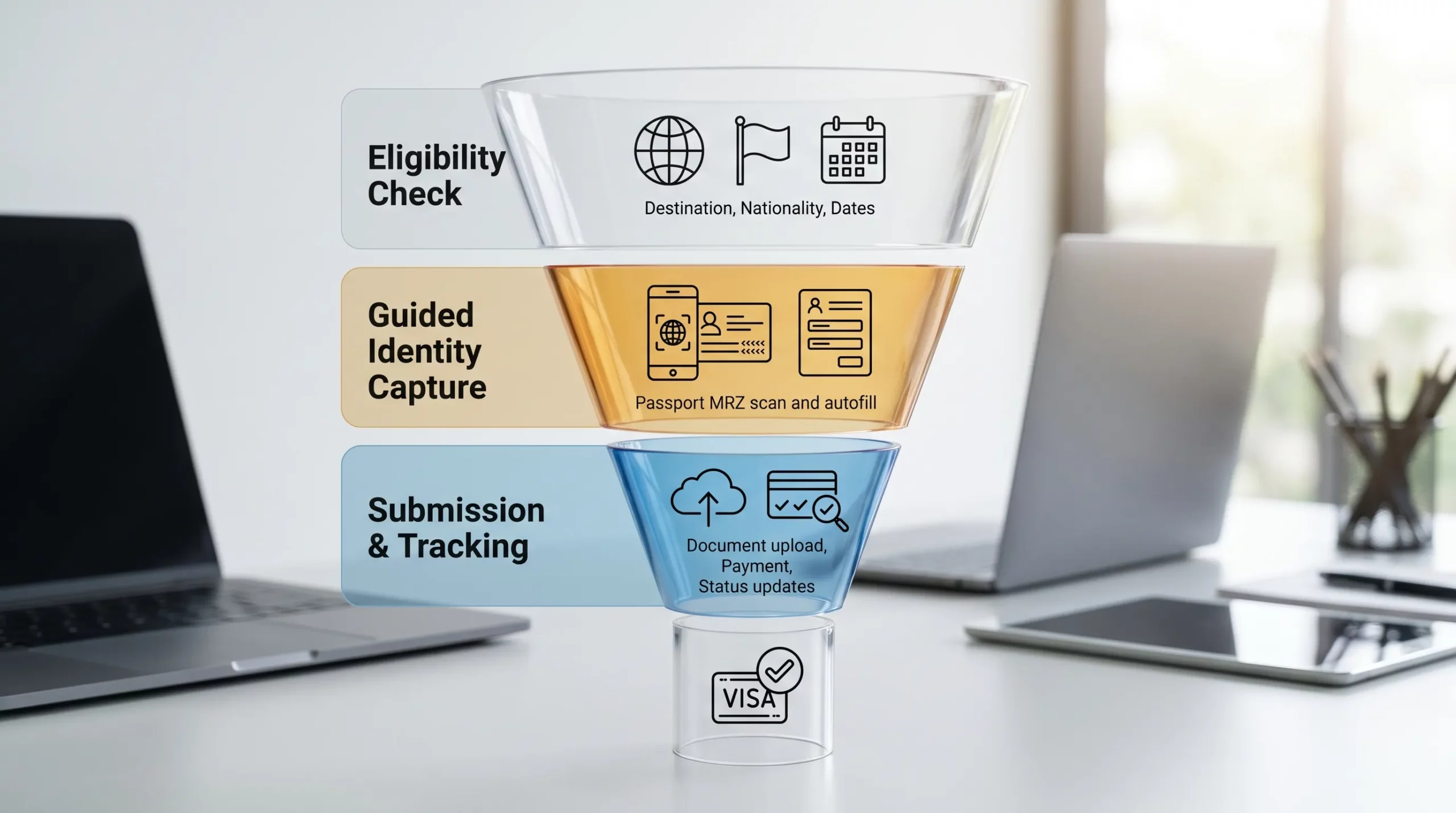
There is no universal global eVisa form. Requirements vary by destination, nationality, and travel purpose. But most efficient flows share one common design: start with the smallest set of inputs that can determine eligibility and next steps.
For many destinations, an initial eligibility check can be done with just:
- Nationality (passport country)
- Destination
- Travel dates (or approximate month)
Only after eligibility is confirmed should you request higher-sensitivity data like passport scans.
The table below shows a practical way to think about “minimum viable identity” in a guided visa application.
| Data element | Why it matters | Best source | When to collect |
|---|---|---|---|
| Passport country (nationality) | Determines whether a visa/ETA/eVisa is required | Traveler selection | First screen (eligibility) |
| Destination(s) | Determines rules and required document type | Booking itinerary | First screen (eligibility) |
| Travel dates | Affects validity windows and timing recommendations | Booking itinerary | First screen (eligibility) |
| Passport number, expiry, name, DOB | Core identity for most eVisa/ETA submissions | MRZ scan/OCR | Only after traveler commits to apply |
| Contact email/phone | Delivery, updates, issue resolution | Traveler entry or account | When status notifications start |
| Address or employment details | Sometimes required by specific programs | Traveler entry, conditional | Only if the rule set requires it |
| Supporting documents (photo, passport scan, etc.) | Proof and identity verification | Camera upload | Just-in-time with clear specs |
The operational takeaway: design the experience to delay sensitive capture until the traveler is clearly eligible and ready to proceed.
Product design patterns that minimize data and increase completion
The goal is not to “collect nothing.” The goal is to collect what is required, at the moment it becomes required, with the lowest possible effort and error rate.
Here are proven patterns travel brands use to reduce identity friction in online visa processing.
- Progressive disclosure: Start with eligibility inputs, then reveal additional questions only when rules require them.
- Conditional logic (rules-driven forms): Ask employment, address, or travel-history questions only for destinations and traveler profiles that require them.
- MRZ-based autofill: Let travelers scan the passport MRZ to populate name, passport number, nationality, and expiry, reducing typing errors.
- Single source of truth: Avoid asking for the same data twice (for example, in both booking traveler details and the visa form). Reuse and map data carefully.
- Inline validation tied to document reality: Validate formats and consistency as users type, and cross-check against MRZ or uploaded documents where possible.
- Document capture with immediate feedback: If a photo is required, enforce size, background, and clarity rules upfront so travelers do not “fail later.”
- Clear “why we ask” microcopy: Short explanations increase trust and reduce drop-off on sensitive fields.
If you are choosing a platform approach for this, note that these patterns are much easier to implement with a rules engine and guided workflows than with static forms. (Related: What Is Travel Document Automation? Definitions, Benefits, and Myths.)
Engineering patterns: minimize exposure without breaking the workflow
Data minimization is also architectural. Even if a government form requires certain identity data, you can still minimize exposure by changing how your systems handle it.
Separate “decisioning inputs” from “identity payloads”
A common mistake is sending full identity payloads to multiple internal services for analytics, personalization, or support tooling.
Instead:
- Use minimal identifiers for internal correlation
- Keep full identity payloads in a dedicated, access-controlled system
- Expose only what each system needs
Tokenize where possible
When partners integrate visa into booking flows, tokenization helps reduce the spread of sensitive fields. Your booking system can store a reference token while the visa processing system holds the sensitive identity details.
Enforce strict retention and deletion
Minimization includes not keeping data longer than needed. Align retention with:
- Legal obligations
- Chargeback windows
- Support timeframes
- Government re-check needs
If you operate globally, map retention to your compliance posture (GDPR, UK GDPR, CPRA, etc.) and document it in internal policies and vendor agreements.
Make access controls role-based and auditable
Identity data should not be broadly visible to every operations user. A support agent may need application status and error codes, but not always full passport scans.
Governance: how to stay compliant while still moving fast
Travel identity flows touch multiple roles: product, engineering, legal, security, customer support, and partner ops.
A practical governance model for traveler identity data minimization usually includes:
- Purpose specification: Define what each data element is used for (eligibility, submission, delivery, compliance).
- Consent and transparency: Provide clear notices and user-facing explanations, especially when uploading documents.
- Vendor accountability: Ensure your processors and sub-processors follow minimization, security, and deletion requirements.
- Incident readiness: Prepare for what happens if data is exposed, including notification workflows.
For travel businesses embedding visas into checkout, it is helpful to treat the visa flow as a dedicated “regulated surface” of your product, similar to payments.
How to measure whether minimization is working
If you cannot measure it, it will drift. The strongest teams treat minimization as a conversion and quality program.
Here are metrics that connect “collect less” to “approve more.”
| Metric | What you are looking for | Why it matters |
|---|---|---|
| Form abandonment rate | Drop-off points by step and field group | Reveals where data feels excessive or confusing |
| Average completion time | Lower time with stable quality | Shorter flows typically convert better |
| Data correction rate | Fewer edits after submission | A proxy for autofill and validation quality |
| Approval rate | Higher approvals for eligible travelers | Shows real-world outcome improvements |
| Support contact rate | Fewer tickets per 1,000 applications | Indicates fewer confusing fields and fewer errors |
If you already track eVisa KPIs, you can extend your dashboard with minimization-specific diagnostics, see 5 KPIs to Track After Deploying a Visa Management Platform.
Where SimpleVisa fits for travel brands
SimpleVisa helps travel businesses embed guided visa and travel authorization journeys without turning checkout into a paperwork maze.
Depending on your product and technical setup, you can:
- Integrate via a travel API into booking flows
- Launch a white-label visa application app
- Use no-code implementation options for faster go-live
- Leverage visa processing automation and guided steps to reduce errors and increase completion
If your goal is to increase ancillary revenue while reducing friction and data risk, traveler identity data minimization should be part of your platform requirements from day one.
For an overview of embedding visa services commercially, see Why Border Crossing Solutions Are the Next Big Ancillary Opportunity.

Frequently Asked Questions
Does data minimization mean I can skip required visa questions? No. It means you only collect what is required for the specific destination and traveler profile, and you avoid collecting extra data that is not needed for eligibility, submission, or delivery.
How do I know which identity fields are truly required for an eVisa? Requirements vary by destination, nationality, and travel purpose. The most reliable approach is using a rules-driven system that can determine requirements dynamically, rather than relying on a static “one-size-fits-all” form.
Will collecting less data really improve approvals? It can. Fewer fields usually means fewer typos and fewer inconsistencies with passport MRZ and supporting documents. That reduces correction cycles and the chance of preventable delays or refusals.
Is passport MRZ scanning safe? It can be, if implemented with strong security controls (encryption, access controls, secure storage) and clear retention and deletion policies. From a UX perspective, it often reduces manual entry errors significantly.
How can travel brands reduce privacy risk if governments still require sensitive data? Focus on architectural minimization: collect data just-in-time, isolate sensitive payloads, tokenize internal references, limit staff access, and delete data when it is no longer needed.
Build a privacy-first visa flow that converts
If your visa journey feels like a long government form inside your checkout, you are probably collecting more identity data than you need, too early, with too many opportunities for travelers to abandon or make mistakes.
SimpleVisa helps travel brands streamline online visa processing with guided applications, automation, and flexible integration options (API, white-label, or no-code). To see what a data-minimized visa flow looks like for your routes and traveler profiles, explore SimpleVisa or request a demo through the site.