Visa SLA Terms Explained: What to Put in Your Partner Contract

Visa partners can make border crossing feel “one click” inside a booking flow, or they can become the hidden operational risk that triggers missed departures, chargebacks, and urgent support escalations.
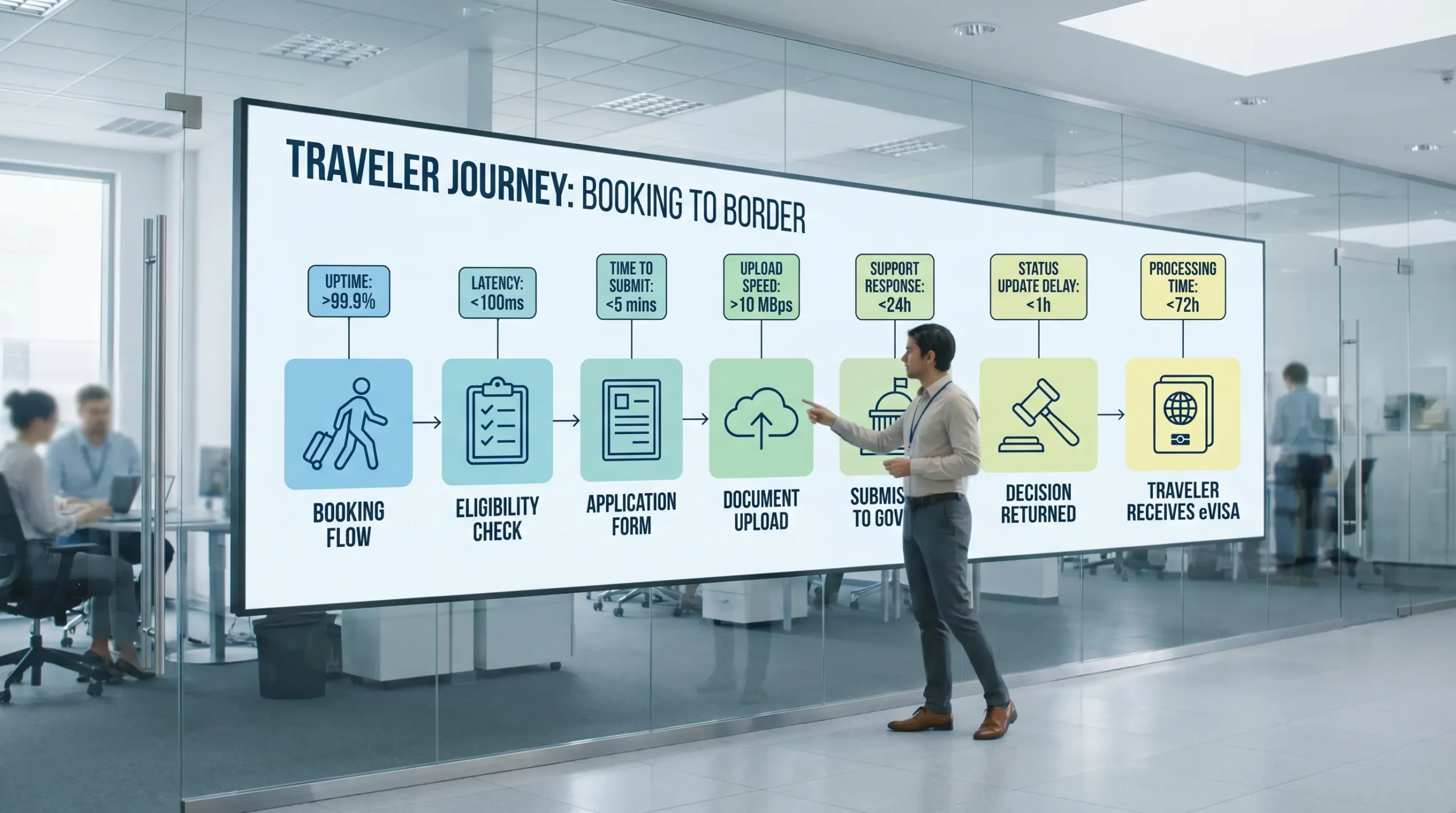
That’s why Visa SLA terms matter. A good SLA turns a vague promise (“fast, reliable eVisa support”) into measurable commitments you can run a business on, with clear definitions, reporting, and remedies.
This guide breaks down the Visa SLA terms most travel brands (OTAs, airlines, cruise lines, TMCs, tour operators) should include in a partner contract, plus example clause language you can adapt with your legal team.
First, clarify what a “visa SLA” can and cannot guarantee
A visa partner can control its own software, operations, and guidance quality, but it cannot control how quickly a government issues a decision.
So the best SLAs separate:
- Provider-controlled performance (API uptime, response times, document checks, submission speed, support responsiveness, status updates)
- Government-controlled outcomes (time-to-decision, final approval or refusal)
This distinction prevents a common contract failure: holding the provider liable for government processing delays while failing to hold them accountable for the things they actually control (like slow submissions, inaccurate requirements, or poor incident communication).
If you want a deeper primer on how the moving parts fit together, see SimpleVisa’s overview of Travel Document Automation.
Where the SLA should live in your contract stack
Most partner agreements split responsibilities across three documents:
- MSA (Master Services Agreement): legal framework (liability, confidentiality, dispute resolution)
- SOW (Statement of Work): scope (channels, markets, integration model, launch plan)
- SLA (Service Level Agreement): measurable performance (metrics, reporting, remedies)
Keep the SLA modular. Visa programs, destinations, and product flows change fast, so you want to update SLA terms without renegotiating the entire MSA.
The core Visa SLA terms to include (with practical definitions)
Below are the most important service levels for a visa management partner, especially when you embed visa eligibility and applications into checkout or post-booking.
1) Platform availability (uptime)
What it covers: availability of the visa application experience and underlying services, such as API endpoints, white-label portal, partner dashboards, webhooks.
Define clearly:
- What counts as “downtime” (timeouts, 5xx errors, failed token issuance)
- Measurement method (provider monitoring vs independent monitoring)
- Maintenance windows (pre-announced, maximum frequency)
- Exclusions (customer’s network, force majeure)
Contract tip: Add a requirement for real-time or near real-time status visibility during incidents, even if the platform is degraded.
2) API performance (latency and error rates)
If you sell visas inside your booking path, latency becomes conversion.
Include:
- Response time targets per endpoint category (eligibility lookup vs application submission)
- Error rate definition (4xx vs 5xx, retries, idempotency behavior)
- Rate limits and burst handling
If you’re evaluating what “good” looks like for travel integrations, SimpleVisa has a useful explainer on how eVisa APIs work.
3) Data freshness and rule accuracy (requirements updates)
Visa friction often starts with bad data: wrong document list, outdated entry policy, or missing nationality edge cases.
Your SLA should specify:
- How often requirements data is reviewed and refreshed
- How “urgent changes” are handled (policy shifts, fee changes, temporary suspensions)
- A correction workflow (how you report issues, expected fix time)
- Source hierarchy (official sources, partner sources, validation processes)
Important: Define accuracy as a measurable operational commitment, not a marketing claim.
4) “Time to submit” vs “time to decision”
Many contracts incorrectly ask for “visa processing time” without defining the boundary.
Use two separate metrics:
- Time to submit: how long it takes the provider to get a complete application from “user started” to “submitted to the issuer,” including document validation and payment capture
- Time to decision: the government’s processing time after submission (trackable, but not SLA-backed)
Contract tip: Require the provider to timestamp each stage (created, documents received, validated, submitted, decision received) so you can audit bottlenecks.
5) Customer support responsiveness (for travelers and partner teams)
Border-document issues are time-sensitive, so support SLAs should be severity-based.
Typical severity tiers include:
- Severity 1: platform down, submissions failing, payment failures at scale
- Severity 2: partial outage, major destination rules incorrect, webhooks delayed
- Severity 3: individual application assistance, document re-uploads, traveler questions
For each tier, define response time, time to mitigation, escalation path, and communication cadence.
6) Status updates, notifications, and webhooks
When travelers can’t see what’s happening, support tickets spike.
SLA terms to include:
- Webhook delivery reliability (retries, dead-letter queues, signature verification expectations)
- Max acceptable delay for status changes to propagate
- Notification obligations when issuer requests more information
7) Approval-rate definitions (only if you use them commercially)
Many providers advertise “high approval rates,” but the metric is easy to manipulate unless you define it.
If you include approval rate in the SLA or commercial model, define:
- Denominator (submitted applications only, or started applications)
- Exclusions (traveler fraud, false statements, missing documents after reminders)
- How re-submissions are counted
- Reporting cadence by destination and passport
SimpleVisa has published its methodology in Inside Look: SimpleVisa’s 99% Approval Rate Explained. Even if you use a different partner, this is a helpful example of the level of definition you should expect.
8) Refunds, chargebacks, and rejected applications
Your partner contract should specify what happens financially when:
- A traveler abandons mid-flow
- An application cannot be submitted due to a provider-side failure
- A government refuses an application
- A traveler is ineligible and was incorrectly guided to purchase
This is where SLA terms intersect with commercial terms. Make sure remedies match the root cause.
9) Security, privacy, and data retention
Visa flows involve passports, biometrics in some corridors, and highly sensitive personal data.
SLA-adjacent contract terms should include:
- Security controls and audit commitments (for example, ISO 27001 alignment, SOC 2 where applicable)
- Breach notification timeline
- Data retention periods and deletion workflows
- Subprocessor disclosure and change notification
- Data residency options if required
For background on information security standards, see ISO/IEC 27001.
10) Business continuity and disaster recovery
Your contract should require documented DR practices, not just a promise.
Include:
- Recovery time objective (RTO) and recovery point objective (RPO) targets (as negotiated)
- Backup frequency and test cadence
- Incident postmortems for major events
A practical Visa SLA table you can paste into a contract draft
Use this as a starting point, then tailor it to your integration model (API, white-label app, no-code widget, or data service).
| SLA area | What to define in the contract | How you measure it | Common remedy types |
|---|---|---|---|
| Availability (uptime) | What systems are covered, downtime definition, maintenance rules | Monthly uptime report, third-party monitoring | Service credits, termination right for chronic breach |
| API latency | Endpoint categories, percentile target, timeout behavior | APM logs, synthetic checks | Credits, escalation, performance remediation plan |
| Error rates | 5xx thresholds, retry rules, idempotency | API gateway logs | Credits tied to error budget burn |
| Data freshness | Update cadence, urgent change SLA, correction workflow | Change logs, audit sampling | Credit, remediation plan, dedicated escalation |
| Time to submit | Start-to-submission timestamps, “complete app” definition | Event logs, random audits | Credits, priority processing coverage (if offered) |
| Support response | Severity tiers, response time, comms cadence | Ticketing timestamps | Credits, dedicated support coverage, escalation |
| Status delivery | Webhook delay thresholds, retry policy, signature validation | Webhook delivery logs | Credits, technical remediation, monitoring improvements |
| Reporting | Monthly business review contents, dashboard access | Delivered reports, meeting cadence | Right to audit, contract cure timelines |
| Security operations | Breach notification window, audit support, retention/deletion | Audit artifacts, incident reports | Termination for cause, indemnities (as negotiated) |
Example Visa SLA clause language (templates)
These are plain-language examples to accelerate drafting. Have counsel adapt them to your MSA.
Example: Availability clause
Service Availability. Provider will make the Services available with a monthly uptime percentage of [X]% excluding (a) scheduled maintenance communicated at least [Y] days in advance and not exceeding [Z] hours per month, (b) force majeure events, and (c) failures caused by Partner systems or connectivity. Uptime will be measured based on [monitoring method] across [covered endpoints/app surfaces].
Example: Requirements data update clause
Requirements Data Maintenance. Provider will maintain visa and entry-requirements content used in the Services and will (a) perform routine reviews at least every [cadence], (b) implement critical changes within [time window] of confirmation, and (c) provide a documented correction process. Partner may report suspected inaccuracies via [channel], and Provider will acknowledge within [time] and resolve or provide an action plan within [time].
Example: Time-to-submit clause (provider-controlled)
Application Submission Performance. For applications marked “complete” (all required fields and documents provided in the required format), Provider will submit the application to the issuing authority within [time window], subject to issuer portal availability. Provider will record timestamps for each stage of the application lifecycle and make them available to Partner via [dashboard/API/report].
Example: Incident communications clause
Incident Notification. Provider will notify Partner of Severity 1 incidents within [time] of detection and provide updates at least every [cadence] until mitigation. Provider will deliver a written post-incident report within [time] after resolution, including root cause, customer impact, corrective actions, and prevention plan.
Example: Chronic breach and termination
Chronic SLA Breach. If Provider fails to meet the [availability/latency/support] service level for [N] months in any rolling [M]-month period, Partner may terminate the affected Services upon [notice period] without penalty.
Don’t forget the “measurement and audit” section
SLAs fail most often not because targets are wrong, but because measurement is ambiguous.
Include:
- Single source of truth: which logs or dashboards govern disputes
- Time zones and business hours: especially for support SLAs
- Data access: what Partner can export (events, application timestamps, ticket metrics)
- Audit rights: limited, reasonable, and privacy-safe
A practical approach is a monthly operational pack that includes uptime, latency, submission timestamps, approval/denial breakdown (by destination), support volume, and top reasons for abandonment.
Common red flags in visa partner SLAs
“We guarantee approvals”
No credible provider can guarantee a government decision. Replace this with clearly defined provider-controlled quality metrics (validation accuracy, completeness rate, time-to-submit, first-time-right submission rate).
“Processing time” with no boundary
If you don’t separate submission speed from government decision time, you end up arguing about the wrong thing during disruptions.
No remedy that matches business impact
A small service credit may be meaningless if the real risk is denied boarding, customer churn, or regulatory penalties. Tie remedies to severity, and ensure chronic breach gives you exit rights.
Requirements data with no correction SLA
Visa rules change constantly. Your contract should assume change, then specify how fast your partner must react.
A simple checklist for negotiating Visa SLA terms
Use this during procurement and security review:
- Are all customer-facing surfaces covered (API, widget, portal, dashboards, webhooks)?
- Are uptime and latency measured independently, not only by the provider?
- Do you have a provider-controlled “time to submit” SLA?
- Is requirements data freshness defined with an urgent-change mechanism?
- Are support SLAs severity-based with escalation paths?
- Do you receive stage timestamps and audit-friendly reporting?
- Are refunds and failed-submission scenarios explicitly covered?
- Are security and data retention obligations written and testable?
If you’re building a broader vendor evaluation pack, SimpleVisa’s Choosing a Visa Processing Service: Key Questions can help structure your RFP.
Frequently Asked Questions
What are Visa SLA terms? Visa SLA terms are the measurable service commitments in a visa partner contract, such as platform uptime, support response times, data update cadence, and provider-controlled submission speed.
Can a visa provider SLA guarantee government processing times? No. A strong visa SLA separates provider-controlled metrics (like time to submit) from government-controlled outcomes (time to decision), and requires transparent timestamps for both.
What’s the most important SLA metric for an embedded eVisa checkout flow? Usually it’s a combination: uptime and API latency (to protect conversion) plus time to submit (to reduce last-minute risk) and requirements data freshness (to prevent incorrect guidance).
Should we include approval rate in the SLA? Only if it’s precisely defined (what counts, what’s excluded, how re-submissions are treated) and paired with reporting. Otherwise it’s better handled as a commercial KPI rather than an enforceable SLA.
Do we need different SLAs for API vs white-label? Often yes. API integrations need latency, rate-limit, and webhook SLAs. White-label experiences need page load performance, form completion reliability, and traveler support SLAs.
Make your visa SLA enforceable with the right integration partner
If you’re drafting or renegotiating a partner contract, SimpleVisa can support visa processing automation through an embedded Visa API, a white-label application experience, or custom data services, with no-code implementation options.
To discuss integration fit and the SLA structure that matches your booking flow, contact SimpleVisa to book a demo.