Visa Help for Families Traveling With Children

Traveling internationally with children can be wonderfully memorable, but the visa paperwork is rarely as simple as adding a child to an adult itinerary. Immigration authorities usually treat every traveler, including infants and toddlers, as an individual applicant. That means each child may need a valid passport, a separate electronic visa or travel authorization, supporting documents, and in some cases proof that the accompanying adult has permission to travel with them.
This guide offers practical visa help for families traveling with children, including what to prepare, where delays happen, and how parents, guardians, travel agents, and tour operators can reduce last-minute stress.
Why family visa applications are more complicated
A solo adult visa application is usually based on one passport, one travel purpose, and one traveler profile. A family application adds more variables: different surnames, custody arrangements, children from blended families, dual citizenship, school schedules, and multiple passports expiring at different times.
The biggest mistake families make is assuming that a child’s travel document requirements are lighter because they are traveling with a parent. In reality, many destinations apply the same entry rules to children as they do to adults, then add extra safeguards to prevent child abduction, trafficking, or unauthorized international travel.
For example, the U.S. Department of State explains that children under 16 need special parental consent steps when applying for a U.S. passport. Similarly, U.S. Customs and Border Protection advises that adults traveling with a child without both parents should carry written consent from the absent parent or parents. Other countries have their own versions of these rules.
The practical takeaway is simple: start with the child’s passport and relationship documents before you begin any visa application.
Do children need their own visa or eVisa?
In most international travel scenarios, yes. If a destination requires an electronic visa, eVisa, eTA, ETA, or traditional visa for your nationality, each child usually needs their own authorization. This often applies even to babies who are not occupying their own airline seat.
There are exceptions depending on nationality, destination, age, residence status, and visa type. Some countries waive fees for minors but still require a separate application. Others require a full application and fee for every traveler. A few destinations may ask for paper documents for minors even when adults can complete online visa processing.
| Requirement | What families should check | Why it matters |
|---|---|---|
| Passport | Each child should generally have their own valid passport | Many countries do not allow children to travel on a parent’s passport |
| eVisa or travel authorization | Confirm whether every child needs a separate application | Children are often individual applicants, even in group travel |
| Passport validity | Check the destination’s minimum validity rule | Some countries require passports to be valid for months beyond travel dates |
| Parental consent | Check if one-parent or non-parent travel requires consent | Border officers may ask for proof of permission |
| Relationship proof | Birth certificates, adoption papers, or guardianship orders may be needed | Helps prove the adult’s legal relationship to the child |
| Transit rules | Review airport transit and layover requirements | A family can need transit authorization even if not leaving the airport |
For a broader preparation list, SimpleVisa’s online visa application checklist is a useful starting point.
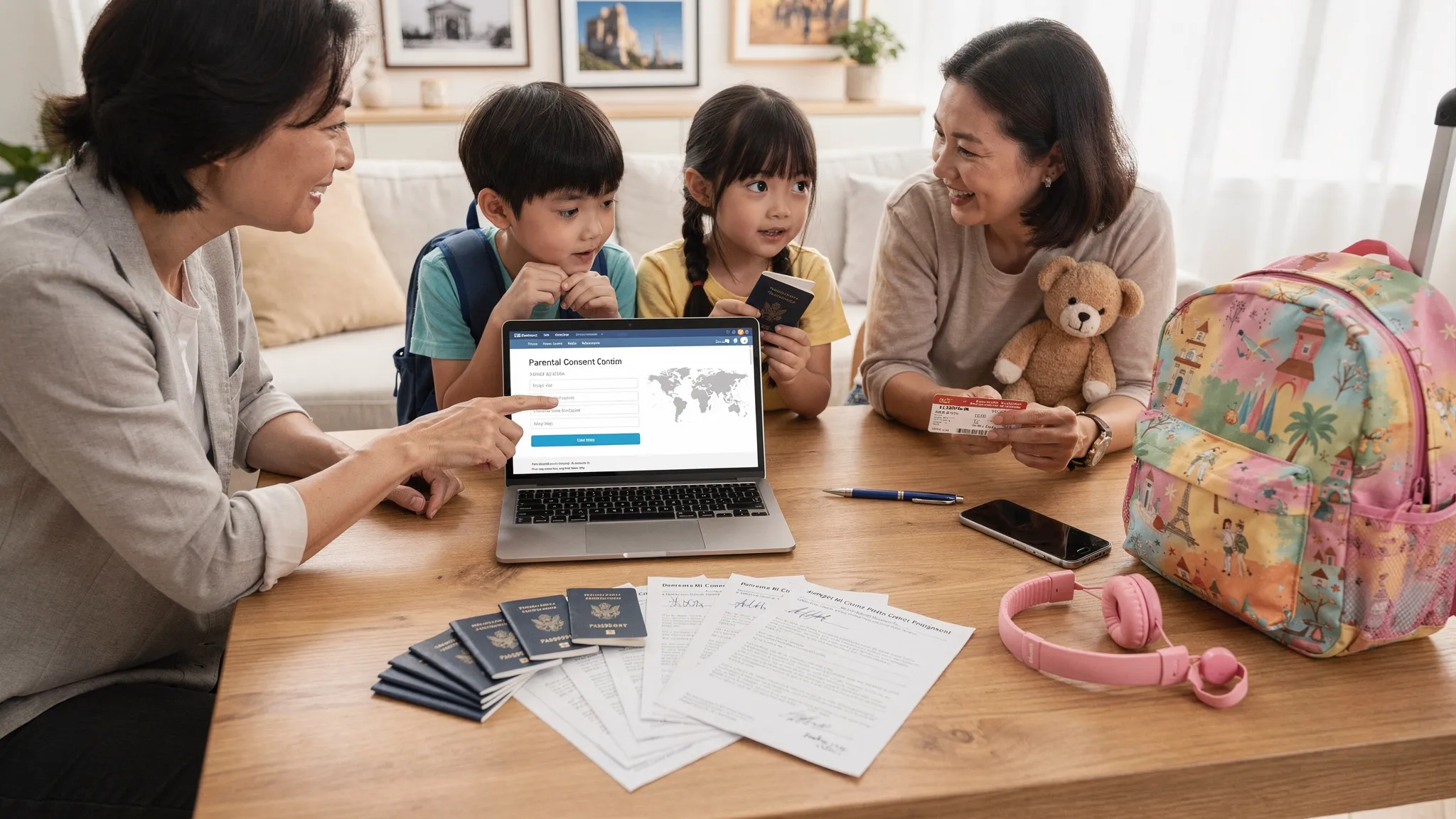
Essential documents for children’s visa applications
Document rules vary by country, but family visa applications commonly require more than a passport scan and a photo. Before starting the online form, create a digital folder for each child so files are easy to upload and compare.
Important documents may include:
- The child’s passport photo page, scanned clearly and in color
- A compliant digital passport photo of the child
- Flight itinerary or booking reference
- Accommodation details or host invitation
- Birth certificate showing parent names
- Marriage certificate, if it helps explain a parent or child surname difference
- Notarized parental consent letter, if one parent is not traveling
- Custody order, adoption decree, or guardianship documents, if relevant
- School enrollment letter, if requested for longer stays or certain visa types
- Health or vaccination documents, if required by the destination
- Proof of funds or sponsorship from the parent or guardian
Do not upload unclear photos of documents taken in poor lighting. Many electronic visa systems use automated document checks, and unreadable scans can lead to delays or rejection. If the child’s passport includes accents, hyphens, multiple surnames, or a long middle name, copy the name exactly as it appears in the machine-readable zone at the bottom of the passport page whenever possible.
When a consent letter is important
A consent letter is often recommended when a child is traveling with one parent, relatives, family friends, a school group, a sports team, or any adult who is not their legal guardian. Requirements vary, but a strong consent letter typically includes the child’s full name, passport number, travel dates, destination, accompanying adult’s details, and contact information for the non-traveling parent or guardian.
Canada provides a helpful official example through its minor child consent letter guidance. Even when a destination does not explicitly require a consent letter, carrying one can help avoid questions at check-in, immigration, or border control.
For children visiting the United Kingdom, GOV.UK guidance for under-18 visitors notes that young travelers may need to show arrangements for travel, accommodation, and consent from a parent or guardian. This is a good reminder that visa approval is only part of the journey. Border officers can still ask practical questions when a child arrives.
Special family situations that need extra attention
One parent traveling alone with a child
If only one parent is traveling, check both entry and exit rules. Some countries focus on entry permission, while others have strict exit controls for resident children leaving the country. Carry a consent letter from the other parent, plus a birth certificate and any custody documents that explain legal responsibility.
Divorced, separated, or blended families
Custody arrangements can affect international travel. If a court order gives one parent sole legal custody, bring a certified copy. If custody is shared, confirm whether written permission from the other parent is needed. Families with different surnames should carry documents that connect the child to the traveling adult.
Children traveling with grandparents or relatives
Grandparents, aunts, uncles, and family friends should not rely on verbal permission. A notarized consent letter, copies of parents’ passports or IDs, and the child’s birth certificate can help demonstrate that travel is authorized.
School trips, sports teams, and group tours
Group travel creates additional risk because one missing visa can disrupt the entire itinerary. Organizers should collect passport details early, verify visa needs for every nationality in the group, and allow time for parents to sign consent forms. Travel businesses and educational tour operators should treat minor documentation as a separate workflow, not a footnote in the booking process.
Dual-citizen children
A child with two nationalities may have different entry rights depending on which passport is used. The visa or eVisa must match the passport used for booking, boarding, and entry. Some countries require their citizens to enter and exit on that country’s passport, so dual citizenship should be reviewed before applying.
Transit and multi-country itineraries
A common family travel issue is ignoring transit requirements. If your family changes airports, passes through border control, or has an overnight layover, the child may need a transit visa or electronic travel authorization. Multi-country trips can also create different rules for each leg of the journey.
Timing: when families should apply
Family applications take longer because every document must be checked for every traveler. A small error on one child’s application can delay the whole trip, especially if the family wants to travel together.
| Timeline | What to do |
|---|---|
| 6 months before travel | Check passport expiry dates for every adult and child |
| 3 to 4 months before travel | Research visa rules for the destination and any transit countries |
| 8 to 10 weeks before travel | Gather birth certificates, consent letters, custody documents, and photos |
| 4 to 8 weeks before travel | Submit visa or eVisa applications, depending on destination processing times |
| 1 to 2 weeks before travel | Verify approvals, names, passport numbers, validity dates, and entry conditions |
| 48 hours before departure | Save offline copies, print key documents, and pack originals if required |
These are general planning windows, not universal deadlines. Some eVisas are processed quickly, while others can take longer during peak travel seasons or when manual review is required. If you are planning school holidays, major events, cruises, or a complex family reunion, build in extra time.
Common mistakes families should avoid
Family visa applications are often delayed by small, preventable errors. The most common problems include using a nickname instead of the passport name, submitting a low-quality passport scan, assuming an infant does not need travel authorization, forgetting a transit requirement, or applying with a passport that will expire too soon.
Another frequent issue is renewing a child’s passport after receiving an electronic visa. Many eVisas and travel authorizations are electronically linked to the passport used in the application. If that passport changes, the visa may no longer be valid for travel, even if the approval email still looks current.
Name mismatches deserve special care. If the airline ticket says Ellie Smith, the passport says Eleanor Anne Smith, and the visa says Eleanor Smith-Jones, the family may face check-in delays. Use one consistent identity source: the child’s passport.
For more prevention tips, see SimpleVisa’s guide to common electronic visa mistakes.
How eVisa systems can make family travel easier
Electronic visa systems can reduce family travel stress because they allow parents to apply online, upload documents digitally, and receive approvals without embassy visits. For families managing school, work, and childcare schedules, avoiding in-person appointments is a major advantage.
Still, online visa processing is only convenient when the family has the right information before starting. Parents should confirm eligibility, file formats, photo specifications, processing time, and payment requirements. If the destination offers family or group application features, use them carefully, but still review each child’s details one by one.
A simple review process helps:
- Compare every visa approval against the matching passport
- Check that names, birth dates, passport numbers, and nationality are correct
- Confirm each traveler’s permitted entry dates and length of stay
- Save a PDF copy of each approval in cloud storage and offline on a phone
- Print copies for the family document folder, especially when traveling with children
Some destinations accept digital proof only, while others may still ask for printed copies. Carrying both is the safer option.
At the airport and border: what families should carry
On departure day, keep essential documents in one accessible folder rather than in checked luggage. Parents often focus on snacks, toys, and boarding passes, but border documents should be just as easy to reach.
Carry the child’s passport, approved visa or eVisa, consent letter if applicable, birth certificate or relationship proof, custody or adoption documents if relevant, return or onward tickets, and accommodation information. If your family has a mixed-nationality itinerary, keep documents grouped by traveler rather than by document type. This makes it faster to answer questions at check-in or immigration.
Remember that a visa approval does not always guarantee entry. Border officials can still ask about travel purpose, length of stay, funds, accommodation, and the relationship between the child and accompanying adult.
How travel businesses can support families better
For airlines, online travel agencies, tour operators, cruise lines, and travel management companies, families are a high-value segment but also a documentation-sensitive one. A missed child visa can mean denied boarding, support escalations, refunds, and a poor customer experience.
Visa help for families is also an opportunity to improve service and generate ancillary revenue. Instead of sending customers to search government websites on their own, travel businesses can guide families through the right requirements during booking or post-booking.
SimpleVisa helps travel businesses streamline visa application workflows through visa processing automation, API integration, white-label visa application options, custom data services, and guided customer visa applications. For family travel, that means businesses can surface relevant border requirements, support online visa processing, and make it easier for customers to complete the right steps before departure.
The best family visa experience is proactive. It tells parents what each traveler needs, explains minor-specific documents in plain language, and reduces surprises after the booking is complete.
Frequently Asked Questions
Do babies need a visa when traveling internationally? Often, yes. If the destination requires a visa, eVisa, ETA, or similar authorization for your nationality, infants and toddlers usually need their own approval. Always check the rule for the child’s passport nationality and destination.
Can my child travel on my passport? In most modern international travel situations, no. Children generally need their own passport. Some legacy exceptions may exist, but families should not assume they apply.
Do I need a consent letter if both parents are traveling? Usually, a consent letter is most relevant when one or both legal guardians are not traveling. However, families should still carry relationship documents if surnames differ or if custody, adoption, or guardianship questions may arise.
Should I apply for all family visas at the same time? Applying together can help keep timelines aligned, but every application must be reviewed individually. Make sure each child’s passport, photo, and supporting documents meet the destination’s requirements.
What happens if my child gets a new passport after the eVisa is approved? The eVisa may be linked to the old passport. Check the issuing authority’s rules before travel. In many cases, you may need to update the authorization, apply again, or carry both passports if allowed.
Can a travel agent help with children’s visa applications? Yes. A knowledgeable travel agent or visa platform can help identify destination-specific rules, organize documents, reduce form errors, and guide families through the application process.
Make family visa support simpler
Families do not just need flights and hotels. They need confidence that every traveler, including every child, has the right documents before reaching the airport.
If your travel business serves families, SimpleVisa can help you add guided visa application support through an API integration, white-label app, no-code implementation option, or custom data service. Visit SimpleVisa to explore how automated border crossing solutions can improve customer experience and create new ancillary revenue opportunities.