No-Code Visa Integration for Travel Sites Explained
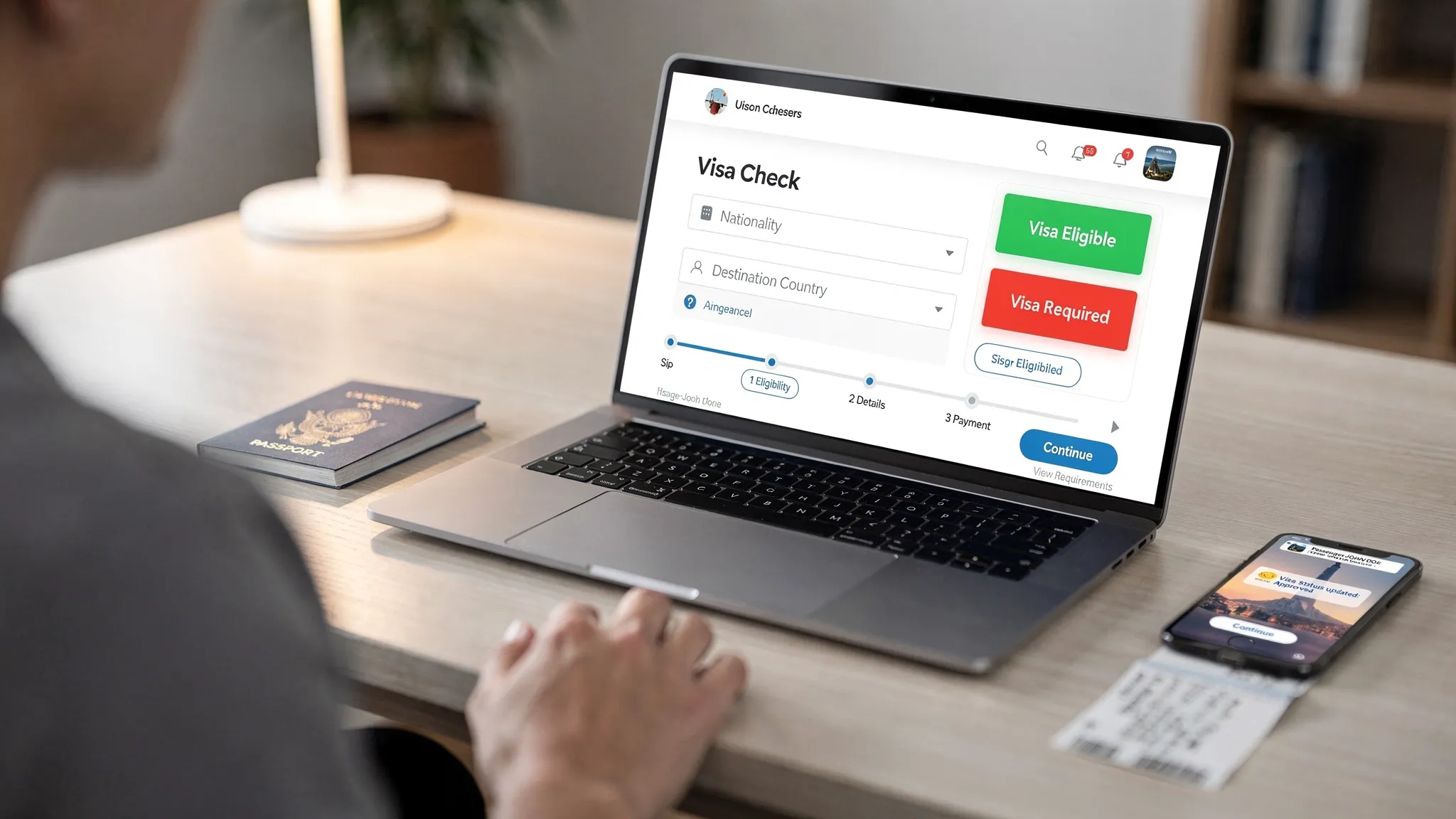
International travel is increasingly digital, but border requirements still create friction at the exact moments travel sites work hardest to convert customers. A traveler may find the right flight, hotel, cruise, or tour, then hesitate because they are not sure whether they need an electronic visa, eTA, health declaration, or other entry document.
For travel businesses, that uncertainty creates two problems at once: a customer experience gap and a missed commercial opportunity. No-code visa integration helps close both without requiring a full engineering project.
Instead of building a custom travel API connection from day one, a travel site can add visa eligibility checks, guided visa application flows, or a white-label eVisa experience using configuration, branding, and simple placement within the customer journey. The result is faster time to market, less operational burden, and a new path to ancillary revenue.
What is no-code visa integration?
No-code visa integration is a way for travel sites to offer visa and border requirement services without building a custom software integration from scratch. It usually relies on a hosted experience, embedded module, white-label application flow, or managed link that can be configured to match a travel brand's customer journey.
In practical terms, the travel business does not need to design its own rules engine, maintain destination-by-destination visa data, create document upload workflows, or manually manage every eVisa application. A visa management platform handles the complex parts, while the travel site controls how and where the service appears to customers.
A no-code setup can support use cases such as:
- Showing travelers whether they need an eVisa or travel authorization before departure.
- Offering guided online visa processing after a booking is confirmed.
- Adding a branded visa application page to a travel agency, OTA, airline, cruise, or tour operator website.
- Creating a new ancillary product without waiting for a long development roadmap.
This is different from a full API integration. With an API, your engineering team connects systems directly and has more control over the user interface, data exchange, and business logic. With no-code, the goal is speed, simplicity, and lower implementation effort.
Why travel sites are prioritizing visa integration now
Visa requirements are no longer a niche post-booking concern. They increasingly affect destination choice, booking confidence, check-in eligibility, customer support volume, and trip disruption risk.
Governments are also expanding digital travel authorization systems. The UK Electronic Travel Authorisation and the European Union's ETIAS travel authorization are two examples of how pre-travel screening is becoming a standard part of international mobility. These programs sit alongside existing systems such as ESTA, eVisas, electronic arrival cards, and destination-specific digital permits.
For travelers, this means more online steps before departure. For travel sellers, it means the booking journey is incomplete if it does not help customers understand border crossing requirements.
A no-code visa integration gives travel sites a practical way to respond quickly. Rather than sending customers to search engines, embassy websites, or third-party providers after purchase, travel brands can keep the experience connected to the trip they just sold.
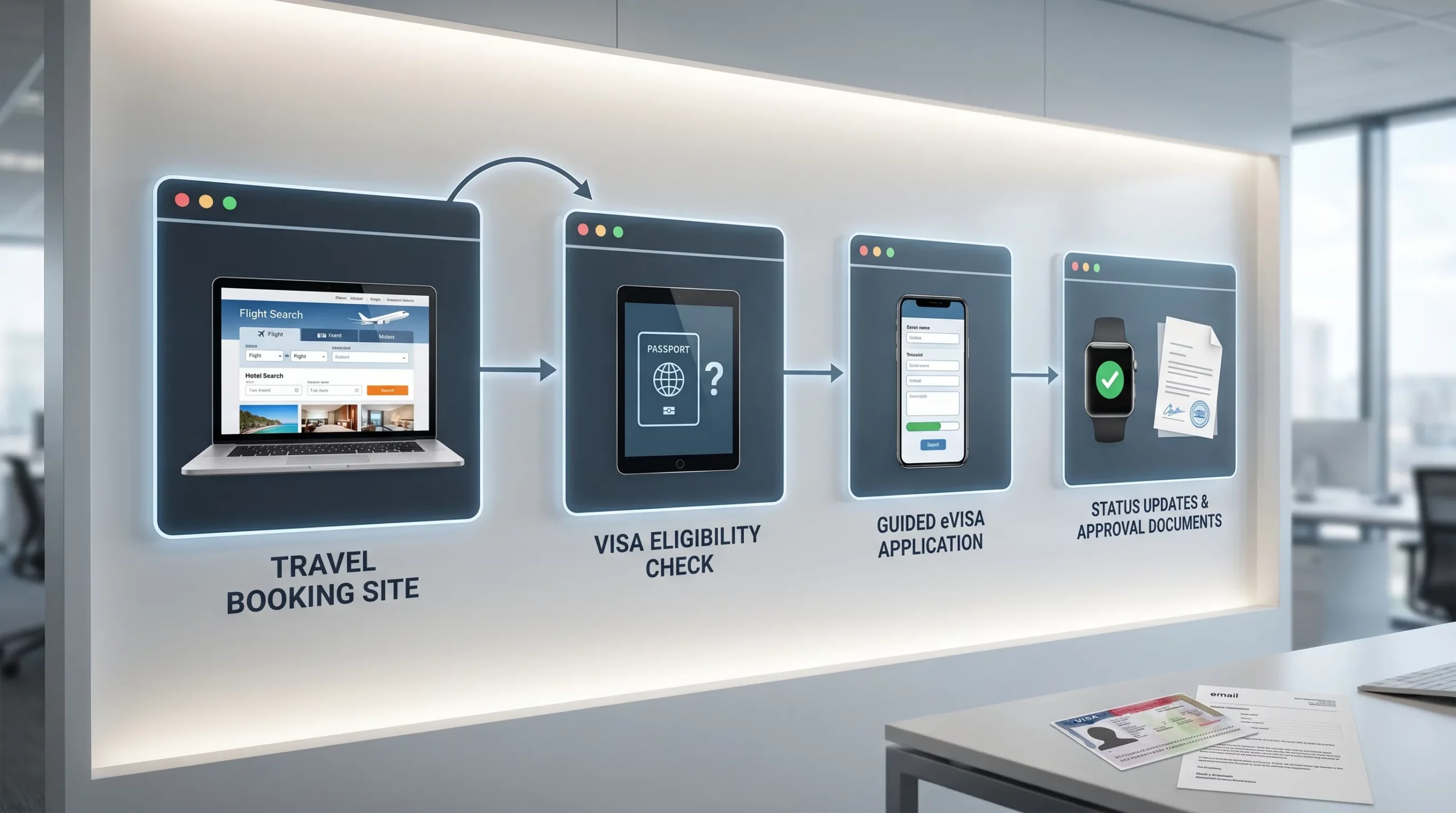
How no-code visa integration works in the traveler journey
A strong no-code visa flow feels like a natural extension of the booking experience. It does not overwhelm the customer with legal complexity, but it does surface the right action at the right time.
The exact setup varies by provider and business model, but most no-code visa integrations follow a similar structure.
| Step | What happens | Why it matters |
|---|---|---|
| Eligibility check | The traveler enters or confirms nationality, destination, travel dates, and passport details. | The site can identify whether a visa, eVisa, eTA, or other document may be required. |
| Requirement display | The platform shows a clear result, such as visa-free, eVisa required, ETA required, or embassy visa required. | Customers get clarity before they become anxious or contact support. |
| Guided application | Eligible travelers are directed into an online visa application flow. | The traveler can complete required forms and upload documents with less confusion. |
| Payment and submission | The traveler pays applicable fees and submits the application through the managed workflow. | The process becomes a revenue opportunity and a service convenience. |
| Status updates | The traveler receives progress updates and final documentation when available. | Better visibility reduces support tickets and last-minute uncertainty. |
The most important point is that the traveler does not need to leave the travel brand's ecosystem at the moment they need help most. Even when the application flow is hosted by a specialist provider, a white-label or branded experience can preserve trust and continuity.
Common no-code visa integration models
No-code does not mean every implementation looks the same. Travel sites can choose a model based on traffic volume, brand control, technical resources, and commercial goals.
| Integration model | Best for | What the traveler experiences | Typical advantage |
|---|---|---|---|
| White-label visa application app | OTAs, travel agencies, airlines, tour operators, and TMCs that want a branded flow | A visa application experience that looks connected to the travel brand | Fast launch with strong brand consistency |
| Embedded widget or module | Sites that want visa services inside booking, checkout, or manage-booking pages | A contextual prompt or application entry point within the travel journey | Better conversion because the offer appears in context |
| Post-booking link or portal | Businesses with limited web resources or email-first workflows | A link from confirmation emails, customer accounts, or support pages | Lowest implementation effort for a pilot |
| Managed data service | Brands that need reliable visa requirement information for support or content teams | Accurate visa guidance surfaced through internal or customer-facing channels | Helps reduce manual research and inconsistent answers |
| Full travel API integration | Larger platforms with engineering capacity and high transaction volume | A fully customized visa journey inside the travel site's own UX | Maximum control, deeper data sync, and scalability |
For many businesses, the best approach is not permanent either-or thinking. A no-code visa integration can be a fast pilot, while a travel API becomes the next step once the business case is proven.
For a deeper comparison of the trade-offs, SimpleVisa has a related guide on API vs. white-label visa integration models.
Where should a travel site place a visa offer?
Placement is one of the biggest drivers of performance. If the visa service is hidden in a footer or help center, customers may never see it. If it appears too early or with vague messaging, it may feel irrelevant.
The strongest placements usually align with moments when the traveler is already thinking about trip readiness.
Pre-booking visa checks are useful for international routes where entry requirements may influence purchase confidence. A small eligibility prompt on a destination, flight, cruise, or package page can help travelers understand whether extra documentation is needed before they commit.
Checkout placement can work well when the travel site already knows the destination, travel dates, and passenger nationality. This is where visa services can become a true ancillary product because the customer is already making trip-related purchase decisions.
Post-booking placement is often the easiest starting point for no-code integration. Confirmation pages, confirmation emails, manage-booking pages, and pre-departure reminders can all invite travelers to complete required documents before they forget.
Support and help center placement is also valuable. If customers search for visa rules, they should be directed to a structured eligibility and application journey rather than a generic article that may not match their passport or itinerary.
Business benefits of no-code visa integration
The obvious benefit is convenience for travelers, but the business case is broader. Visa integration can support revenue, operations, compliance, and customer satisfaction at the same time.
Faster launch without a full product backlog
Travel technology roadmaps are crowded. Engineering teams may already be working on booking performance, payments, loyalty, mobile apps, or supplier connectivity. A no-code visa integration lets product and commercial teams launch a border crossing solution without waiting months for a custom build.
This is especially useful for validating demand. A travel brand can test attach rates, traveler response, support impact, and revenue potential before committing to a deeper API integration.
New ancillary revenue from a real traveler need
Ancillary revenue works best when the offer is relevant, timely, and genuinely useful. Visa assistance meets those conditions for many international itineraries. Travelers already need to solve the problem before departure, so a guided visa application flow can feel like a service rather than an upsell.
The commercial model depends on the provider and partnership structure. Some travel businesses use referral fees, revenue share, service fees, or bundled premium assistance. If you are evaluating models, see SimpleVisa's guide to revenue-sharing models for online visa processing partners.
Lower support pressure
Visa questions can be repetitive and time-sensitive. Support teams often field questions such as: Do I need a visa? When should I apply? Which passport should I use? Why was my application delayed? What documents are required?
A no-code visa management platform can reduce manual back-and-forth by giving travelers a structured path. It also gives support teams a more consistent way to direct customers toward answers and applications.
Better customer experience before departure
A traveler who discovers a missing eVisa the night before departure may blame the entire travel experience, even if the airline, OTA, or agency did not cause the issue. Surfacing visa requirements earlier protects the customer relationship.
This is especially important for multi-destination trips, cruises, business travel, student travel, and last-minute bookings. In those scenarios, border requirements can be complex enough that simple static content is not enough.
What to check before choosing a no-code visa solution
No-code makes implementation easier, but it should not lower your standards. Visa applications involve sensitive personal data, passport details, travel documents, and sometimes biometric or financial information. The vendor must be evaluated like any other critical travel technology partner.
Key evaluation areas include:
- Coverage: Does the platform support the destinations, passport nationalities, and visa types your customers need?
- Accuracy: How does the provider maintain visa requirement data as government rules change?
- User experience: Is the application flow mobile-friendly, clear, and optimized for completion?
- Security: How are passport scans, personal data, payments, and application records protected?
- Commercial model: How are fees, commissions, service charges, refunds, and reporting handled?
- Support: What happens when a traveler has a document issue, rejection, delay, or urgent departure?
- Reporting: Can you track conversion, completion, ancillary revenue, approval rate, and customer satisfaction?
This is where travel document automation becomes more than a convenience feature. It becomes part of the operational backbone of a modern travel site. For a broader framework, read SimpleVisa's guide to choosing a travel document automation platform.
No-code integration checklist for travel sites
A no-code launch is faster than a custom build, but it still benefits from structured planning. The best implementations align commercial goals, customer messaging, support processes, and tracking before launch.
Use this practical checklist before going live:
- Define the initial scope by destination, customer segment, route, or product line.
- Choose the best placement, such as checkout, confirmation page, manage booking, or email.
- Prepare brand assets, customer messaging, privacy notices, and support escalation paths.
- Confirm what trip data can be passed into the visa flow, if any, to reduce traveler re-entry.
- Test common scenarios across passports, destinations, dates, mobile devices, and incomplete applications.
- Train support teams on what the visa service can handle and when customers need official government guidance.
- Set up reporting for conversion, application completion, revenue, support tickets, and customer feedback.
This level of preparation keeps the project simple while avoiding the common mistake of treating no-code as just another link on a website.
Metrics to track after launch
Once your no-code visa integration is live, the goal is not just to prove that customers clicked. You need to understand whether the service improves the travel journey and creates measurable business value.
| KPI | What it shows | Why it matters |
|---|---|---|
| Visa offer click-through rate | How many eligible travelers engage with the visa prompt | Measures placement and message relevance |
| Application start rate | How many visitors begin the visa application flow | Indicates demand and trust in the offer |
| Application completion rate | How many applicants finish the required steps | Reveals UX quality and document friction |
| Ancillary revenue per booking | Revenue generated from visa services across total bookings | Connects the integration to commercial performance |
| Support contact rate | Visa-related support requests before and after launch | Shows operational impact |
| Approval rate | Successful applications compared with completed submissions | Helps evaluate guidance quality and document validation |
| Customer satisfaction | Post-application ratings, complaints, or NPS signals | Confirms whether travelers see the service as helpful |
If you want a more complete measurement framework, SimpleVisa has a dedicated article on KPIs to track after deploying a visa management platform.
When should you move from no-code to an API?
No-code is often the best first move, but it is not always the final destination. As volume grows, some travel sites need deeper integration with their booking engine, CRM, payment flow, loyalty program, or mobile app.
A full API integration may be a better fit when you want to pre-fill application data from passenger records, build a completely custom user interface, create real-time eligibility checks across search results, automate status updates inside your own account area, or run advanced personalization and bundling.
However, that does not make no-code less strategic. In many cases, no-code provides the proof you need before investing more resources. It lets you answer critical questions first: Which routes convert? Which traveler segments need the most help? Which messages work? What revenue can visa services generate? How much support volume can automation reduce?
In other words, no-code is not only a shortcut. It can be a learning layer for your long-term border crossing solutions strategy.
Common mistakes to avoid
No-code visa integration is straightforward, but performance depends on execution. Travel sites often underperform when they make one of several avoidable mistakes.
The first mistake is showing generic visa content instead of personalized requirements. Visa rules depend on nationality, passport, destination, trip duration, transit points, and purpose of travel. A generic page can create false confidence or unnecessary confusion.
The second mistake is placing the visa offer too late. If a traveler receives the first visa reminder one day before departure, the service may still be useful, but the experience feels stressful. Earlier prompts give travelers more time to apply and resolve document issues.
The third mistake is using unclear language. Travelers may not understand the difference between an electronic visa, eVisa, ETA, ESTA, ETIAS, tourist visa, or transit permit. Plain-language microcopy helps them take action without feeling overwhelmed.
The fourth mistake is failing to prepare support teams. Even with automation, customers may ask follow-up questions. Support agents need to know what the platform handles, what the travel brand can answer, and when to direct travelers to official government authorities.
The fifth mistake is not measuring the rollout. Without KPIs, no-code integration becomes a feature rather than a revenue and experience program.
How SimpleVisa supports no-code visa integration
SimpleVisa helps travel businesses simplify border crossing administration and offer visa services to customers through flexible integration options. For brands that want to move quickly, SimpleVisa offers no-code implementation options and white-label visa application experiences. For companies that need deeper control, SimpleVisa also supports API integration and custom data services.
The platform is designed to help travel businesses guide customers through visa requirements, streamline online visa processing, and create ancillary revenue opportunities. SimpleVisa's solutions are available across 400+ sites and support automated visa processing, guided customer applications, and premium eVisa management.
Most importantly, travel brands can choose the path that matches their maturity. A smaller agency may start with a white-label application app. An OTA may begin with a post-booking no-code flow, then later connect a travel API. A cruise line, airline, or TMC may combine visa requirement data, application automation, and support workflows into a broader travel document automation strategy.
Frequently Asked Questions
Does no-code visa integration require developers? Not always. A no-code setup is designed to reduce or remove the need for custom engineering. Some travel sites may still involve a web, product, or operations team to place links, configure branding, update CMS pages, or approve data and privacy settings.
Is no-code visa integration only for small travel agencies? No. No-code can be useful for small agencies, but it is also valuable for larger travel brands that want to pilot a market quickly, launch a white-label service, or add a post-booking visa flow before committing to a full API project.
Can a no-code visa flow generate ancillary revenue? Yes, when the offer is relevant and clearly presented. Visa services can become an ancillary revenue stream because they solve a real pre-trip need. The exact model depends on the commercial agreement with the visa processing partner.
What information is needed to check visa requirements? Requirements vary, but common inputs include nationality, passport country, destination, travel dates, trip purpose, and sometimes transit points or residence country. More detailed visa applications may require passport scans, photos, travel documents, and supporting evidence.
Is no-code less secure than an API integration? Not inherently. Security depends on the provider's infrastructure, data handling, encryption, access controls, retention policies, and compliance practices. A no-code visa provider should still be evaluated carefully because it processes sensitive traveler data.
When is an API better than no-code? An API is usually better when a travel site needs full UX control, deep booking-engine integration, real-time eligibility checks at scale, advanced reporting, or automatic data synchronization with internal systems.
Make visa services part of your travel site without a long build
Travelers increasingly expect digital, guided, and convenient border documentation support. Travel businesses that provide it can reduce friction, improve confidence, and unlock ancillary revenue from a service customers already need.
If your team wants to add visa services without starting with a custom build, SimpleVisa can help you explore no-code, white-label, API, and data-service options for your travel site.
Visit SimpleVisa to learn how your business can simplify visa applications, automate border crossing administration, and offer a smoother pre-travel experience to customers.