Embedded Visa Services vs Redirects: Which Converts Better?
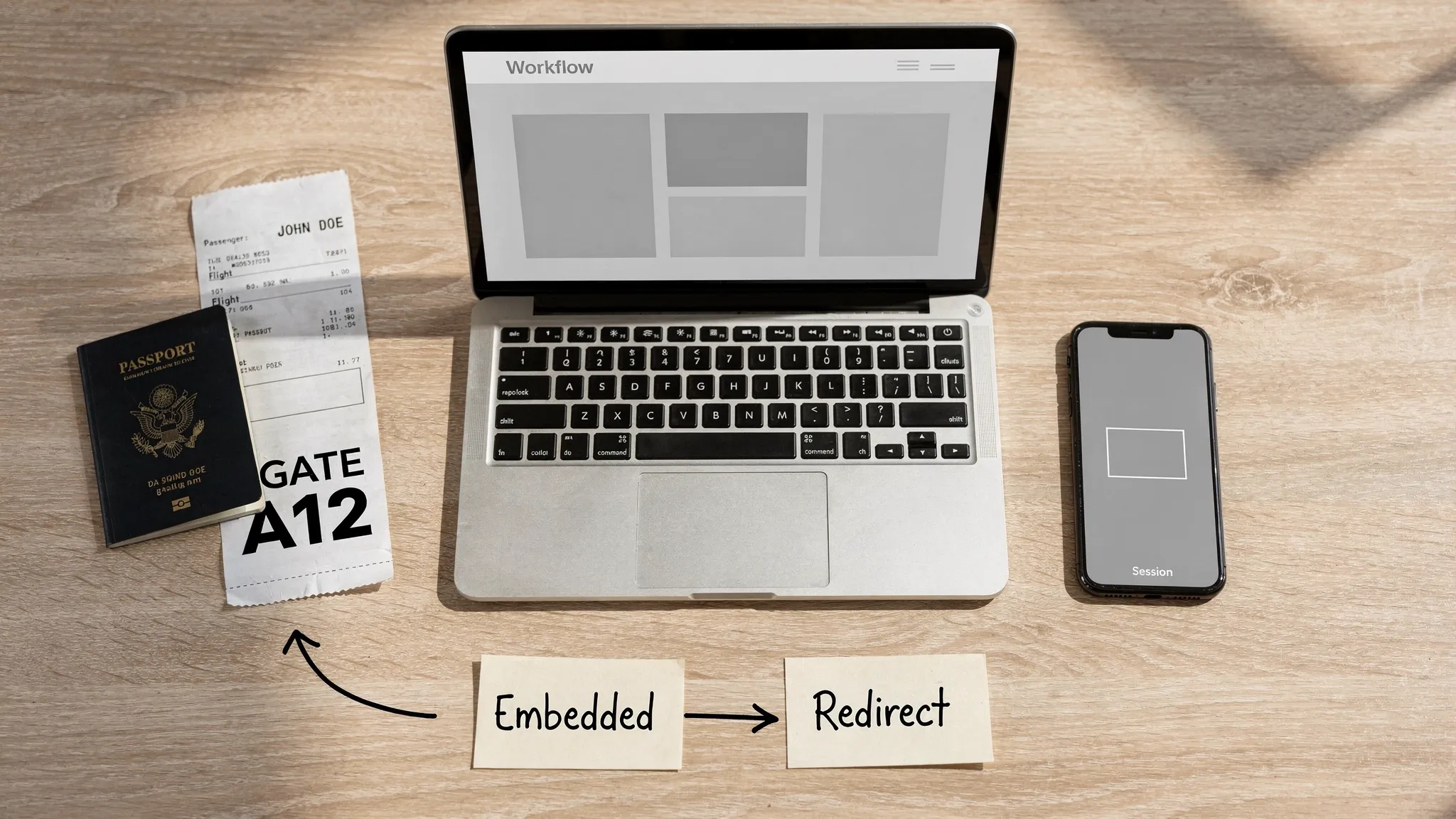
For travel businesses, the question is no longer whether visa services belong in the traveler journey. As eVisas, ETAs, and digital border requirements become more common, customers expect clear answers before they fly, board, or cross a border.
The real conversion question is where that visa journey should happen.
Should you embed visa services directly into your booking flow, manage booking area, or post-booking experience? Or should you send travelers to a separate visa page through a redirect?
The short answer: embedded visa services usually convert better when the offer is relevant, well timed, and easy to complete. Redirects can still work, especially for fast launches or lower-volume programs, but they tend to introduce more friction, weaker attribution, and more traveler drop-off.
Let’s break down why, when redirects still make sense, and how airlines, OTAs, tour operators, cruise lines, and TMCs should choose the right model.
What “embedded visa services” and “redirects” really mean
Before comparing conversion, it helps to define the two models clearly.
Embedded visa services keep the traveler inside your digital experience. Visa eligibility, document requirements, eVisa application steps, payment, and status updates can appear within your website, app, checkout, manage booking page, or customer portal. This can be powered by a travel API, widget, SDK, white-label component, or no-code module.
Redirected visa services send the traveler away from your booking or post-booking journey to a separate visa website or hosted application page. This could be a generic third-party page, a co-branded portal, or a white-label app hosted outside your core flow.
A white-label app can sit between the two models. It may technically involve a new URL, but if it preserves branding, prefilled context, tracking, and a return path, it performs closer to an embedded experience than a generic outbound referral.
| Factor | Embedded visa services | Redirected visa services |
|---|---|---|
| Traveler experience | Stays within the booking or post-booking journey | Leaves the original journey for a separate flow |
| Conversion potential | Usually higher when well implemented | Often lower unless the redirect is highly contextual |
| Time to launch | Fast with a widget or no-code option, longer with full API | Often fastest for basic referral launches |
| UX control | High, especially with API integration | Limited unless using a branded white-label app |
| Data continuity | Easier to prefill itinerary and traveler details with consent | Traveler may need to re-enter information |
| Trust | Stronger when the brand experience is consistent | Depends on landing page quality and brand continuity |
| Attribution | Cleaner tracking across the funnel | More risk of lost sessions and incomplete tracking |
| Best fit | High-volume travel sellers, checkout upsells, post-booking automation | Pilots, low-volume routes, fast MVPs, complex standalone applications |
If you are still deciding between broader integration models, SimpleVisa’s guide to API vs. white-label visa integration is a useful companion read.
Why embedded visa services tend to convert better
Visa services convert when the traveler understands three things quickly: whether they need a visa, why it matters now, and how easy it is to complete the application.
An embedded flow supports all three.
1. It removes the context switch
A redirect asks the customer to leave the place where their travel intent is strongest. They may be booking a flight, confirming a package, checking in for a cruise, or reviewing an itinerary. The moment they click away, they have to reorient themselves.
That context switch creates questions:
“Is this still the same company?”
“Can I trust this site with my passport details?”
“Will I get back to my booking?”
“Do I need this now, or can I deal with it later?”
Each question creates hesitation. In checkout optimization, hesitation is expensive. Baymard Institute’s research on cart abandonment has long shown that friction, unexpected steps, and poor checkout experiences contribute to abandonment. Visa services are not identical to retail checkout, but the same principle applies: the more effort a user has to make, the more likely they are to stop.
Embedded visa services reduce that effort by keeping the next step in the same environment.
2. It captures intent at the right moment
Travelers are most receptive to visa guidance when the requirement is directly connected to the trip they are buying or managing.
A generic redirect says, “Go check your visa requirements.”
An embedded offer can say, “Based on your passport and destination, you may need an eVisa before departure.”
That difference matters. Embedded flows can use trip context, such as destination, travel dates, nationality, residence, route, and trip purpose, to present relevant information instead of generic advice. This turns visa services from an afterthought into a useful part of trip completion.
Relevance is especially important for electronic visa and ETA products because eligibility can vary by passport, transit point, length of stay, and travel purpose. A traveler going to the same country for tourism may have a different requirement than a traveler going for work, study, or a long stay.
3. It reduces repeated data entry
Redirects often force travelers to re-enter information they already provided during booking. Even if the visa application needs additional details, repeating basic data such as name, date of birth, passport number, travel dates, destination, and contact information feels inefficient.
An embedded flow can prefill permitted fields, subject to consent, data protection rules, and the application requirements of the destination. This improves completion because the traveler starts closer to the finish line.
It also reduces errors. Name mismatches, passport typos, date format mistakes, and inconsistent itinerary details are common reasons visa applications become delayed or rejected. When an online visa processing flow can reuse verified booking data, it can help create a more consistent application.
For more on the API mechanics behind this kind of workflow, see How eVisa APIs work: Step by Step.
4. It keeps trust signals close to sensitive fields
Visa applications ask for high-trust information: passport data, travel history, identity documents, photos, and sometimes financial or employment details. A traveler may accept this request inside a familiar travel brand’s experience, especially if the value is clear. They may hesitate if they suddenly land on a third-party domain with unfamiliar branding.
An embedded visa management platform can place trust cues exactly where they matter, such as around passport upload, payment, and consent. These cues include clear pricing, data-use explanations, support availability, brand consistency, and application status visibility.
This is not just a design preference. It is a conversion driver.
5. It improves measurement and optimization
Redirects can make analytics messy. You may know how many users clicked the visa link, but not how many started, abandoned, paid, corrected documents, or completed approval unless the partner shares detailed event data.
Embedded services make it easier to track the full funnel:
- Visa eligibility impressions
- Offer click-through rate
- Application start rate
- Form completion rate
- Payment completion rate
- Approval or issue rate
- Ancillary revenue per eligible booking
- Support contacts per application
This creates a feedback loop. Product and revenue teams can test copy, placement, pricing, reminders, and form design with much more confidence.
Where redirects usually lose conversion
Redirects do not fail because travelers dislike third-party services. They fail when the redirect feels disconnected from the trip.
A weak redirect typically has three problems.
First, it breaks momentum. The traveler moves from a booking or itinerary task into a separate administrative task, often with little explanation. If they are on mobile, the effect is stronger because new tabs, slow loads, and unfamiliar layouts are more disruptive.
Second, it weakens trust. Even when the visa partner is legitimate, the traveler may not recognize the domain. This is particularly risky in a market where travelers are increasingly aware of fake visa websites and phishing attempts.
Third, it reduces accountability. If something goes wrong, the traveler may not know whether to contact the airline, OTA, agency, visa provider, or government authority. That uncertainty can reduce completion and increase support costs.
Redirects also make it easier for customers to postpone. “I’ll do it later” is one of the biggest competitors to any travel ancillary. The longer the gap between booking and application, the more likely the traveler is to forget, miss a deadline, or contact support in a panic.
When redirects can still make sense
Embedded visa services are not always the right first step. There are legitimate cases where a redirect, especially a well-branded white-label redirect, is practical.
A redirect can make sense when you need to launch quickly, validate demand, or offer visa support before investing in a deeper integration. For smaller travel sellers, niche tour operators, or early-stage ancillary programs, speed to market may matter more than perfect funnel control.
Redirects can also be useful for complex applications that require longer document collection, multiple travelers, or manual review. In those cases, the traveler may already expect a dedicated application environment.
The key is to avoid a generic outbound link. A high-performing redirect should still be contextual, branded, trackable, and easy to return from.
| Redirect quality | Conversion impact |
|---|---|
| Generic link to a visa homepage | Usually weakest, because the traveler must restart the process |
| Destination-specific landing page | Better, because the requirement is clearer |
| Co-branded visa page | Better, because trust is stronger |
| White-label app with trip context | Strongest redirect model, because it preserves continuity |
| White-label app with tracking and return URL | Closest to embedded performance for many post-booking use cases |
In other words, the worst redirect is a cold handoff. The best redirect feels like a continuation.
Which converts better by traveler journey stage?
Conversion depends heavily on where the offer appears. A visa service shown during checkout behaves differently from one shown in a post-booking email or support conversation.
| Journey stage | Best-performing model in most cases | Why |
|---|---|---|
| Flight or package search | Lightweight embedded visa requirement check | Helps travelers understand trip feasibility early |
| Checkout | Embedded eVisa offer or widget | Captures high intent before the traveler leaves |
| Post-booking confirmation | Embedded module or branded white-label link | Traveler has committed and needs next-step guidance |
| Manage booking | Embedded status and application flow | Keeps documents tied to the itinerary |
| Pre-departure reminders | Deep-linked white-label or embedded mobile flow | Urgency is high, so fewer steps matter |
| Customer support | Agent-assisted link or internal visa management platform | Support teams need fast, consistent answers |
For most travel brands, the strongest strategy is not “embedded or redirect” everywhere. It is a layered journey. Use embedded checks and offers where intent is high, then use white-label or deep-linked flows where a standalone experience is operationally easier.
How to test embedded visa services vs redirects fairly
A common mistake is comparing an old redirect flow with a new embedded flow and assuming the result is purely due to integration model. To get a useful answer, you need a structured test.
Start by defining the right denominator. Visa conversion should usually be measured against eligible sessions or eligible bookings, not all site visitors.
| Metric | Simple formula | Why it matters |
|---|---|---|
| Offer impression rate | Visa offer views / eligible sessions | Shows whether travelers are seeing the offer |
| Start rate | Application starts / offer views | Measures relevance and call-to-action strength |
| Completion rate | Submitted applications / application starts | Measures form friction |
| Paid conversion rate | Paid applications / eligible sessions | Measures end-to-end commercial performance |
| Ancillary revenue per booking | Visa revenue / total bookings or eligible bookings | Connects conversion to business value |
| Support rate | Visa-related support contacts / applications | Shows operational impact |
| Approval or issue rate | Successful outcomes / submitted applications | Measures application quality, not just sales |
To make the test reliable, keep pricing, eligibility logic, copy, and audience mix as consistent as possible. Segment results by passport nationality, destination, device, booking lead time, and traffic source. A redirect may appear to underperform simply because it is shown on more complex routes or to travelers with less time before departure.
Also track speed. According to Google’s Core Web Vitals guidance, loading performance and interactivity are important parts of user experience. In visa flows, slow pages are not just annoying, they can interrupt document uploads, payments, and mobile completion.
How to make embedded visa services convert better
Embedding the service is not enough. A poorly placed, poorly explained embedded offer can still underperform. The strongest implementations share a few patterns.
Surface the requirement before it becomes urgent
Do not wait until check-in to tell a traveler they may need an eVisa. A better journey introduces visa guidance during booking or immediately after purchase, then follows up as departure approaches.
Early visibility reduces anxiety and gives the traveler time to prepare documents. It also increases the chance that the visa application becomes part of the original trip purchase rather than a separate chore.
Make the offer specific, not generic
Generic visa banners are easy to ignore. A contextual message tied to destination, passport, and dates feels useful.
For example, “Check visa requirements for your trip” is weaker than “Your destination may require an electronic visa before arrival. Check eligibility and apply online.”
The second version explains the problem and the action.
Use progressive disclosure
Visa applications can be intimidating if every requirement appears at once. A better flow starts with eligibility, then asks for only the information needed at each step.
This is especially important on mobile. Document upload, photo capture, passport scans, and payment should feel like a guided sequence, not a long administrative form.
SimpleVisa’s related article on why travelers abandon visa forms and UX fixes that convert covers this topic in more depth.
Be transparent about price and responsibility
Travelers should understand what they are paying for, what government fees may apply, what service support includes, and whether approval is guaranteed. No provider should imply that a visa approval is automatic when the final decision belongs to the relevant authority.
Clear pricing and honest expectations may reduce short-term clicks from unqualified users, but they improve trust and reduce disputes.
Close the loop with status updates
The visa journey does not end at payment. Travelers want to know whether the application was submitted, if more information is needed, when approval arrives, and what document to carry.
Embedded status updates, post-booking reminders, and support visibility help turn visa processing from a risky unknown into a managed part of the trip.
How to improve a redirect if you cannot embed yet
If a full embedded flow is not feasible today, you can still improve redirect conversion significantly.
Use destination-specific deep links instead of sending users to a generic homepage. Match the landing page branding, language, currency, and tone to the original booking experience. Explain exactly why the traveler is being redirected and what they will need to complete the application. Preserve non-sensitive trip context where permitted, such as destination and travel dates, so the traveler does not start from zero. Add a clear return path to the booking or manage trip page. Track events beyond the click, including starts, submissions, payments, and support requests.
These steps turn a redirect into a guided handoff rather than an abandonment risk.
Security and compliance should shape the model
Visa services handle sensitive personal data, so the integration model must be evaluated through a security lens as well as a conversion lens.
Embedded flows need strong API security, consent handling, access controls, audit logs, and data minimization. Redirects need the same standards, plus extra attention to domain trust, phishing prevention, and clear handoff language.
For procurement and technical teams, the right question is not simply “Which converts better?” It is “Which model gives us the best balance of conversion, security, operational control, and launch speed?”
If you are building a vendor checklist, SimpleVisa’s guide to security features in an electronic visa solution can help frame the conversation.
So, which model should you choose?
For high-volume travel brands, embedded visa services are usually the better long-term conversion play. They reduce friction, improve personalization, strengthen trust, and give product teams cleaner data to optimize ancillary revenue.
For brands that need speed, a white-label visa application app or no-code implementation can be the right starting point. It allows you to validate demand, launch quickly, and learn which routes, destinations, and traveler segments generate the strongest eVisa attach rates.
A practical rollout often looks like this: launch a branded or no-code flow first, measure demand, then move high-performing routes or customer segments into a deeper API-powered embedded experience.
SimpleVisa supports multiple paths, including API integration for travel sites, white-label visa application experiences, no-code implementation options, custom data services, guided customer applications, and premium eVisa management. That flexibility matters because not every travel business needs the same integration on day one.
If you want to evaluate performance after launch, use this related guide on KPIs to track after deploying a visa management platform.
Frequently Asked Questions
Do embedded visa services always convert better than redirects? Not always, but they usually have the advantage when the traveler is already in a high-intent booking or post-booking journey. Redirects can perform well when they are branded, contextual, deep-linked, and easy to return from.
Is a white-label visa app considered embedded or redirected? It depends on implementation. A hosted white-label app may use a separate URL, but if it preserves branding, trip context, analytics, and a smooth return path, it can perform much closer to an embedded experience than a generic redirect.
Where should travel brands offer eVisa services for the highest conversion? The best placements are usually checkout, booking confirmation, manage booking, and pre-departure reminders. The right mix depends on the destination, booking window, traveler nationality, and urgency of the visa requirement.
Can redirects still generate ancillary revenue? Yes. Redirects can generate meaningful ancillary revenue, especially if launched quickly across eligible routes. However, embedded flows often give teams more control over optimization, attribution, and traveler experience.
Do I need a full travel API integration to sell visa services? No. API integration gives the most control, but many travel businesses start with a no-code widget or white-label visa application app. The best approach depends on your engineering resources, traffic volume, and desired UX control.
Turn visa requirements into a higher-converting travel experience
Visa and border requirements are becoming a core part of travel retail. The brands that handle them inside the customer journey can reduce friction, improve traveler confidence, and unlock a valuable ancillary revenue stream.
SimpleVisa helps travel businesses integrate visa services through API, white-label, no-code, and data-service options, so you can choose the model that fits your team and your customers.
Ready to compare embedded visa services and redirect flows for your own booking journey? Visit SimpleVisa to explore the right integration path for your travel business.