How Real-Time Visa Status Cuts Support Tickets
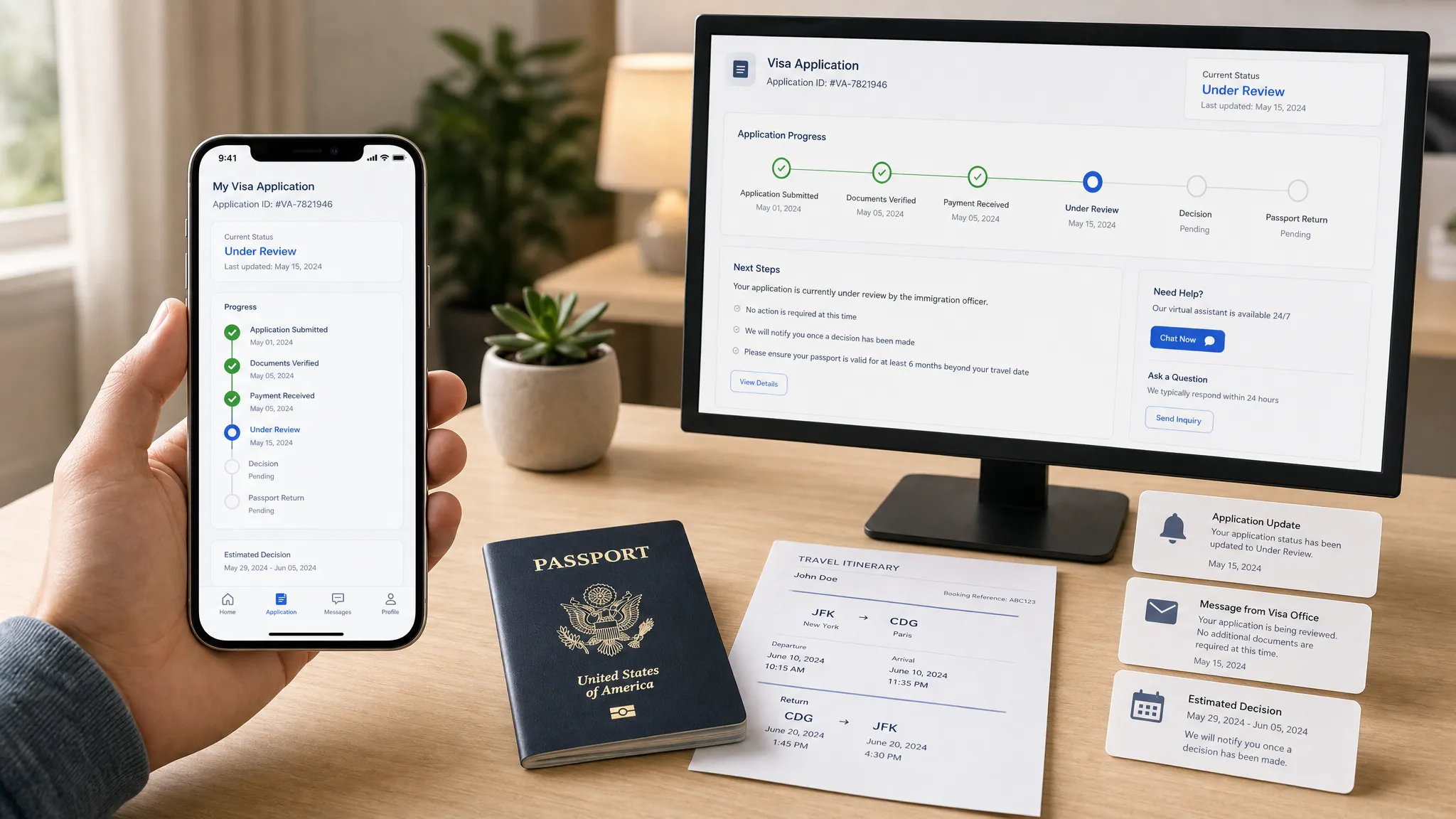
For travel businesses, visa support rarely starts with a complex immigration question. It starts with uncertainty: Has my eVisa been submitted? Did you receive my passport scan? Why is my application still pending? Can I board my flight tomorrow?
When travelers cannot see what is happening, they contact support. When agents cannot instantly see the same information, tickets become longer, escalations multiply, and operational costs rise. Real-time visa status changes that pattern by turning a hidden application process into a visible, guided journey.
This matters even more as digital travel authorizations expand. Systems such as the UK ETA and ETIAS are making pre-travel authorization a normal part of the customer journey. For airlines, OTAs, tour operators, cruise lines, and TMCs, the question is no longer whether travelers will need visa support. The question is how much of that support can be automated before it becomes a ticket.
Why visa status creates so many support tickets
Visa applications are high-stakes, time-sensitive, and often unfamiliar. A traveler may understand flight changes or hotel confirmations, but visa processing feels different because the consequence of getting it wrong can be denied boarding, missed meetings, lost vacation days, or unrecoverable trip costs.
That anxiety creates what support teams might call the visa version of WISMO, or where is my order. In travel, it becomes where is my visa. The traveler is not always asking for a new action. They are often asking for reassurance that the process is moving.
Several factors make visa status especially ticket-prone:
- Government and third-party processing can happen outside the booking platform.
- Travelers may receive emails from multiple senders, including the travel brand, visa provider, and issuing authority.
- Status labels can be vague, such as pending, processing, or under review.
- Missing document requests can be buried in inboxes.
- Departure dates create urgency, especially inside 72 hours of travel.
Customer experience research from Zendesk has consistently shown that customers expect fast, convenient, and increasingly self-service support. Visa journeys are a perfect fit for that shift because many questions are repetitive and status-driven.
| Common visa support ticket | Why it happens | How real-time status helps |
|---|---|---|
| Has my application been submitted? | The traveler does not see a clear submission confirmation | Shows submitted status with timestamp and reference number |
| Do I need to upload anything else? | Document requests are unclear or missed | Displays action required with exact missing item |
| Why is my visa still pending? | Processing is invisible after submission | Shows latest known processing stage and last update |
| My flight is soon, am I safe to travel? | The traveler cannot connect visa status to departure timing | Triggers urgency messaging and escalation rules |
| I was approved but cannot find my visa | Approval email or attachment is lost | Provides secure access to the approved eVisa document |
| What does this status mean? | Internal status codes are exposed to customers | Converts internal labels into plain-language explanations |
Real-time visa status does not remove every support need. Some travelers still need help with refusals, passport changes, edge cases, or destination-specific rules. But it can remove a large share of repetitive tickets that exist only because the traveler cannot see the latest state of the application.
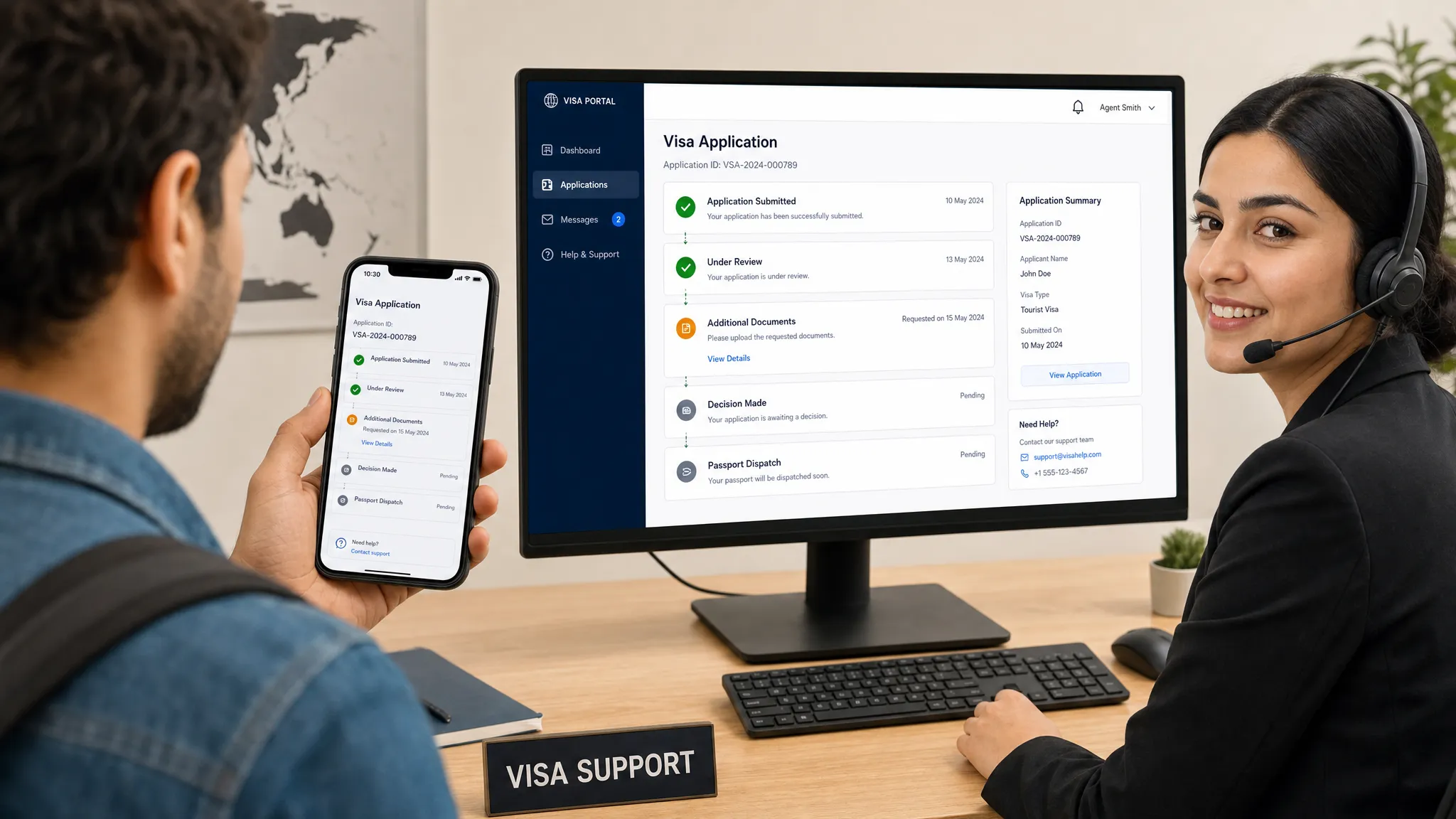
What real-time visa status means in practice
Real-time visa status does not mean every government issues an instant decision. It means the travel brand, traveler, and support team can access the latest available application state as soon as it changes inside the visa workflow.
A strong status system usually captures events such as application started, document uploaded, payment confirmed, application submitted, authority review started, action required, approved, refused, expired, or canceled. These events can be delivered through a visa management platform, a travel API, a white-label application flow, or webhook-based updates.
If a government portal only updates periodically, the traveler-facing interface should still be transparent. It should show the last checked timestamp, the current known status, and what happens next. That honesty is important. A status page that says last updated 2 minutes ago is more reassuring than a generic pending message with no context.
For a deeper technical view of how status events can move between systems, see SimpleVisa’s guide on how eVisa APIs work. For the broader automation layer around visas, ETAs, health declarations, and related documents, this overview of travel document automation explains the core components.
The five ways real-time visa status cuts support tickets
1. It gives travelers a self-service answer before they contact support
The simplest way to reduce support tickets is to answer the question before it is asked. A status panel inside manage booking, a white-label visa app, or a post-booking portal can show travelers exactly where they are in the process.
The best status experiences are not just labels. They combine status, timestamp, next step, and ownership. For example, application under review is better than pending, but application submitted to the issuing authority on June 1, no action needed from you is much more useful.
When travelers can confirm that no action is required, they are less likely to open a ticket simply to check progress.
2. It turns missed document requests into guided next steps
Many visa tickets are caused by incomplete applications. A blurry passport scan, an invalid photo, a missing hotel booking, or inconsistent name formatting can pause an application. If the traveler does not notice the correction request, the case stalls until support intervenes.
Real-time status can surface these issues immediately. Instead of sending a generic email that may be ignored, the visa journey can show action required, identify the exact document, and link the traveler back to the upload step.
This does more than reduce tickets. It can also shorten turnaround time because the traveler fixes the problem sooner. For time-sensitive travel, that can be the difference between approval before departure and an avoidable escalation.
3. It reduces agent handle time when support is needed
Even with excellent self-service, some travelers will still contact support. Real-time visa status helps agents resolve those conversations faster because they no longer have to search across emails, back-office tools, government portals, and partner messages.
A shared source of truth gives the agent immediate answers to essential questions:
- What is the current status?
- When did it last change?
- Who needs to take the next action?
- Is the traveler inside a high-risk departure window?
- Has the approved eVisa been delivered?
This can improve average handle time, first contact resolution, and escalation quality. It also reduces the risk of agents giving outdated or inconsistent information.
4. It enables proactive notifications instead of reactive support
A support ticket is often a delayed notification. The traveler is contacting you because the system did not tell them what changed.
Real-time visa status allows travel brands to trigger proactive emails, SMS messages, push notifications, or in-app alerts when the application reaches a meaningful milestone. Not every status needs a message. Too many notifications can create noise. The key is to notify travelers when the update changes their confidence or requires action.
High-value triggers include submission confirmation, document correction required, approval received, refusal received, passport mismatch found, application approaching departure date, and visa validity nearing expiry for post-booking journeys.
5. It prevents last-minute airport and departure-day escalations
Visa issues become most expensive when they appear late. A customer who discovers a missing authorization at check-in may contact the airline, OTA, airport staff, and visa provider within minutes. One unresolved case can create multiple tickets across multiple teams.
Real-time status helps move those issues upstream. If the application is not submitted, stuck, or missing documents several days before travel, the system can flag it before the traveler reaches the airport. This is especially important for airlines, cruise operators, and travel management companies responsible for complex itineraries.
The operational goal is simple: no traveler should discover a visa problem for the first time at check-in if the issue was visible earlier in the data.
Where to surface real-time visa status in the travel journey
The best place to show visa status is wherever the traveler already expects trip information. If travelers must search for a separate email or log into a disconnected portal, many will still contact support.
A strong post-booking visa journey brings status into the booking experience, confirmation emails, reminder flows, and support tools. SimpleVisa’s guide to building a seamless post-booking visa journey explores this in more detail.
| Touchpoint | Best use of visa status | Support impact |
|---|---|---|
| Booking confirmation page | Show whether a visa or ETA is required and prompt application start | Reduces basic eligibility questions |
| Manage booking page | Display current status, next action, and latest timestamp | Deflects status-check tickets |
| Post-booking email | Confirm submission, approval, or missing documents | Prevents anxiety-driven contacts |
| SMS or push notification | Alert travelers to urgent action required | Speeds up document corrections |
| White-label visa app | Provide a branded, guided application and status experience | Keeps customers inside your ecosystem |
| Agent workspace | Give support teams the same status view as the traveler | Reduces handle time and internal escalations |
| API or webhook events | Sync status into CRM, booking, and notification systems | Enables automation at scale |
The most effective approach is usually multi-channel but not repetitive. A traveler should be able to see the same status in every relevant place, without receiving five different versions of the truth.
Status design matters as much as status data
Real-time data only reduces support tickets if travelers understand it. Internal workflow labels are often built for operations, not customers. If those labels are exposed directly, they can create more confusion.
Good traveler-facing status UX should be plain, specific, and action-oriented. It should avoid legal jargon where possible and make responsibility clear. If the traveler needs to act, say so. If the traveler does not need to act, say that too.
| Internal status | Traveler-facing message | Next action shown |
|---|---|---|
| DOC_REJECTED_BLUR | Your passport image is too blurry to verify | Upload a clearer passport scan |
| SUBMITTED_AUTHORITY | Your application has been submitted for review | No action needed right now |
| MANUAL_REVIEW | Your application requires additional review | We will update you when the authority responds |
| APPROVED_DOC_READY | Your eVisa has been approved | Download and save your eVisa |
| PASSPORT_MISMATCH | Your passport details do not match your application | Review and correct passport information |
| EXPIRING_SOON | Your authorization may expire before travel | Check validity or start a new application |
A useful rule is to pair every status with one of three next-action categories: traveler action required, support action required, or no action required. This removes ambiguity and reduces unnecessary contacts.
How support teams benefit operationally
Real-time visa status is not only a traveler-facing feature. It also changes how support teams work.
Without status automation, agents spend time locating application details, confirming whether a partner has received documents, checking whether a traveler responded to a correction request, and deciding whether to escalate. With a shared status layer, agents can focus on exceptions instead of repetitive lookup tasks.
The operational benefits usually appear in four areas. First, fewer inbound tickets because travelers self-serve. Second, shorter conversations because agents have immediate context. Third, fewer escalations because the next action is clearer. Fourth, better quality control because every team works from the same application history.
This is especially valuable for travel brands selling visa services as an ancillary product. If the visa add-on creates too many support contacts, it can damage the margin of the ancillary revenue. If status automation keeps support volume low, the visa service becomes both a customer experience improvement and a scalable revenue stream.
KPIs to measure after adding real-time visa status
To prove the impact, measure support performance before and after deployment. A simple baseline period of 30 to 60 days can reveal where tickets come from and how much automation improves the journey.
| KPI | What it measures | Why it matters |
|---|---|---|
| Visa-status tickets per 1,000 bookings | Number of support tickets about application progress | Direct measure of ticket deflection |
| Action-required response time | Time between a correction request and traveler response | Shows whether notifications are working |
| First contact resolution | Share of visa tickets solved without follow-up | Indicates agent visibility and process clarity |
| Average handle time | Time agents spend resolving visa inquiries | Captures support efficiency gains |
| Status page views | How often travelers use self-service tracking | Helps connect self-service use to ticket reduction |
| Pre-departure unresolved cases | Applications still incomplete close to travel | Flags operational and boarding risk |
| Customer satisfaction on visa cases | Traveler rating after visa-related support | Shows whether automation improves confidence |
A simple savings formula can help teams model the business case:
Monthly support savings = reduced visa-status tickets x average cost per ticket
That calculation does not include secondary benefits such as fewer airport escalations, fewer refunds caused by missed documents, improved attachment of visa services, or higher customer trust. For a broader KPI framework, see 5 KPIs to Track After Deploying a Visa Management Platform.
Implementation roadmap for travel brands
Real-time visa status can be introduced gradually. You do not need to rebuild your entire booking engine to start reducing support tickets.
- Audit your current visa tickets: Tag support contacts by reason, such as status check, missing document, approval delivery, eligibility question, or departure urgency. This shows which ticket types are best suited for automation.
- Define a traveler-friendly status taxonomy: Translate internal workflow events into simple labels that travelers and agents can both understand. Keep the number of statuses manageable.
- Connect status data to the booking journey: Use a travel API, white-label app, no-code widget, or custom data service to bring visa status into the places travelers already check.
- Trigger proactive notifications: Send messages only when the update matters, especially for submission, action required, approval, refusal, and approaching departure dates.
- Give agents the same source of truth: Make sure support teams see the latest status, timestamps, documents requested, and customer-facing messages.
- Measure, refine, and expand: Track ticket reduction, response times, and customer satisfaction, then optimize copy, timing, and escalation rules.
The right implementation model depends on your technical resources and desired control. An API offers deeper integration into existing booking and CRM flows. A white-label visa application app can launch faster with less engineering effort. A no-code implementation can help teams validate demand before investing in a larger build. For more on this choice, SimpleVisa’s guide to offering white-label visa services without writing code is a useful starting point.
How SimpleVisa supports real-time visa visibility
SimpleVisa helps travel businesses simplify border crossing administration by embedding visa guidance and application workflows into the customer journey. Its solutions include visa processing automation, API integration for travel sites, a white-label visa application app, custom data services, guided customer visa applications, premium eVisa management, and no-code implementation options.
For support teams, the value is not only processing the application. It is giving travelers and agents clearer visibility into what is happening, what is missing, and what comes next. That visibility is what turns repetitive support tickets into automated status updates.
With services available on 400+ sites, SimpleVisa is built for travel businesses that want to improve customer experience while creating ancillary revenue from visa and border crossing solutions.
Frequently Asked Questions
Does real-time visa status make approvals faster? Not directly. Approval speed depends on the issuing authority and the type of visa or travel authorization. Real-time status helps by preventing avoidable delays, especially missing documents, incomplete forms, and missed correction requests.
What is the difference between tracking and real-time visa status? Basic tracking may require a traveler or agent to manually check a portal. Real-time visa status uses system events, API updates, or webhook notifications to surface the latest available status automatically across the booking journey and support tools.
Which visa statuses should travelers see? Travelers should see simple statuses such as application started, documents needed, payment received, submitted, in review, action required, approved, refused, expired, or canceled. The exact labels should be adapted to the visa type and destination rules.
Can real-time visa status be added without a full API build? Yes. Many travel businesses start with a white-label app, hosted flow, or no-code implementation before moving to a deeper API integration. The best approach depends on your product roadmap, engineering capacity, and desired level of control.
How does visa status automation reduce agent workload? It deflects repetitive progress-check tickets, gives agents immediate access to the latest application state, reduces manual lookups, and makes escalation decisions clearer.
Is it safe to show visa status inside a booking flow? It can be safe when implemented with strong data protection, access controls, secure authentication, and clear consent. Travel brands should work with providers that understand sensitive traveler data and apply appropriate privacy and security practices.
Turn visa uncertainty into automated support relief
If your support team is still answering the same visa status questions manually, there is a better way. Real-time visa status gives travelers confidence, helps agents work faster, and makes online visa processing easier to scale as a value-added service.
SimpleVisa can help you integrate guided visa applications, status visibility, and border crossing solutions through an API, white-label app, no-code option, or custom data service.
Contact SimpleVisa to explore how real-time visa status can reduce support tickets and improve your travel customer experience.