Passport Data Compliance for Travel Companies in 2026
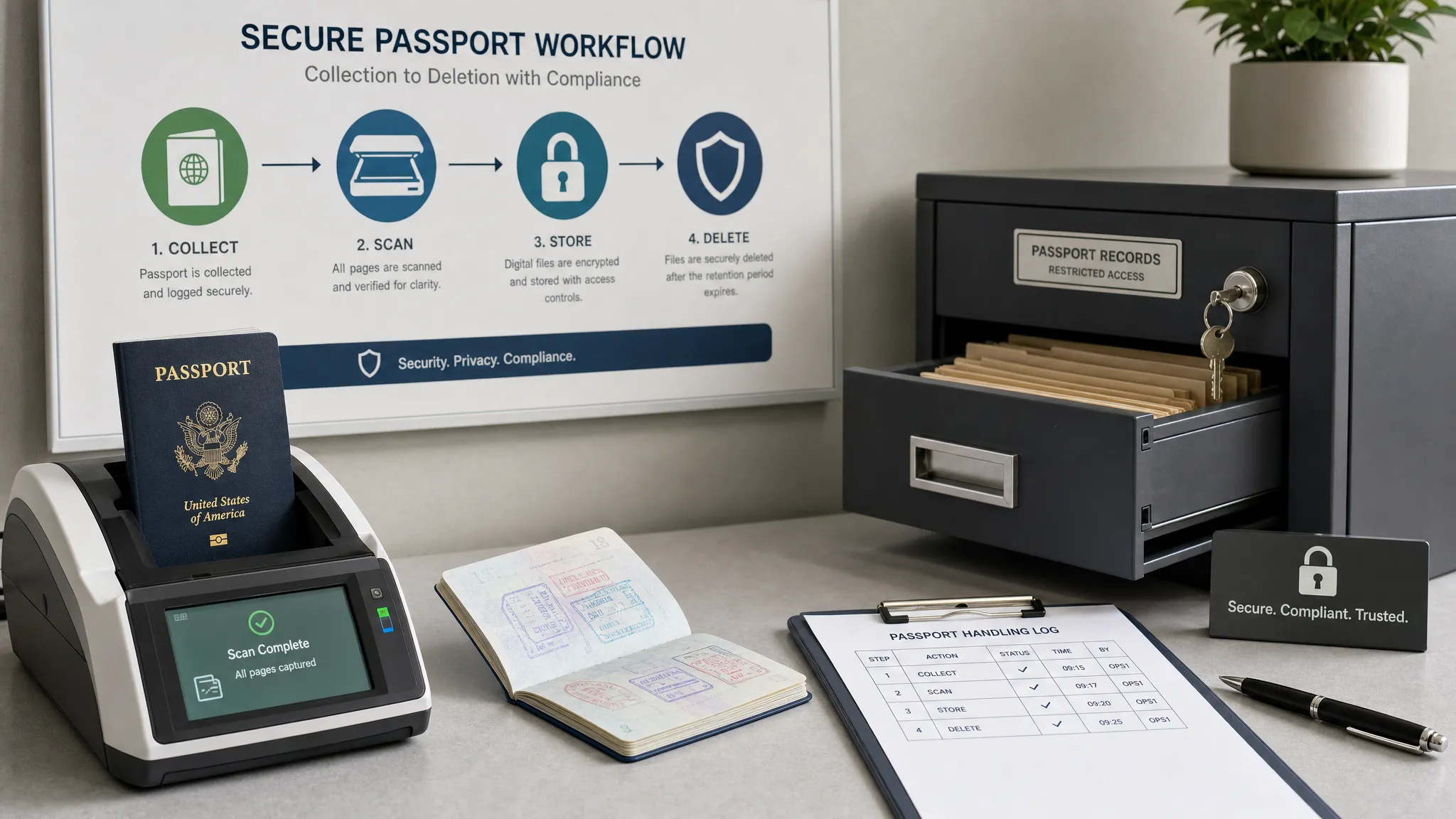
Passport data has become one of the most operationally important, and legally sensitive, data sets in travel. Airlines, OTAs, tour operators, cruise lines, TMCs, and travel agencies increasingly collect passport information not just at check-in, but during booking, post-booking servicing, eVisa applications, electronic travel authorization flows, and customer support interactions.
That shift creates a clear opportunity: better visa guidance, fewer denied boardings, smoother border crossing, and new ancillary revenue. It also raises the compliance bar. In 2026, passport data compliance is no longer just an IT security concern. It is a product design, vendor management, legal, customer experience, and revenue protection issue.
This guide outlines what travel companies should know, what controls to prioritize, and how to build safer passport data workflows around online visa processing and travel document automation. It is general information, not legal advice, but it can help teams ask the right questions before collecting, storing, or sharing traveler identity data.
Why passport data compliance matters more in 2026
Travel companies now operate in a world where border requirements are increasingly digital. eVisas, eTAs, ETIAS-style authorizations, advance passenger information, and automated document checks all rely on structured identity data. Passport number, nationality, date of birth, expiration date, and machine-readable zone information can determine whether a traveler is eligible to board, apply online, or complete an electronic visa application.
At the same time, privacy regulation is becoming more fragmented. The EU GDPR and UK GDPR remain central for companies serving European travelers. U.S. state privacy laws continue expanding, with California treating passport numbers as sensitive personal information under the CCPA/CPRA framework. Biometric laws and AI governance rules are also relevant when companies use facial matching, liveness checks, OCR, or automated document validation.
For travel brands, the stakes are practical as well as legal. Poor passport data handling can lead to:
- Application errors that delay or derail eVisa approvals
- Fraud exposure from stolen passport scans or identity documents
- Customer support risk when agents request documents through unsafe channels
- Regulatory penalties, breach notifications, and reputational damage
- Lower conversion when travelers do not trust the application flow
- Operational friction when data is duplicated across booking, visa, and check-in systems
A strong compliance program protects travelers, but it also supports conversion. When customers see clear explanations, secure upload flows, and transparent retention policies, they are more likely to complete visa and border documentation steps inside your booking journey.
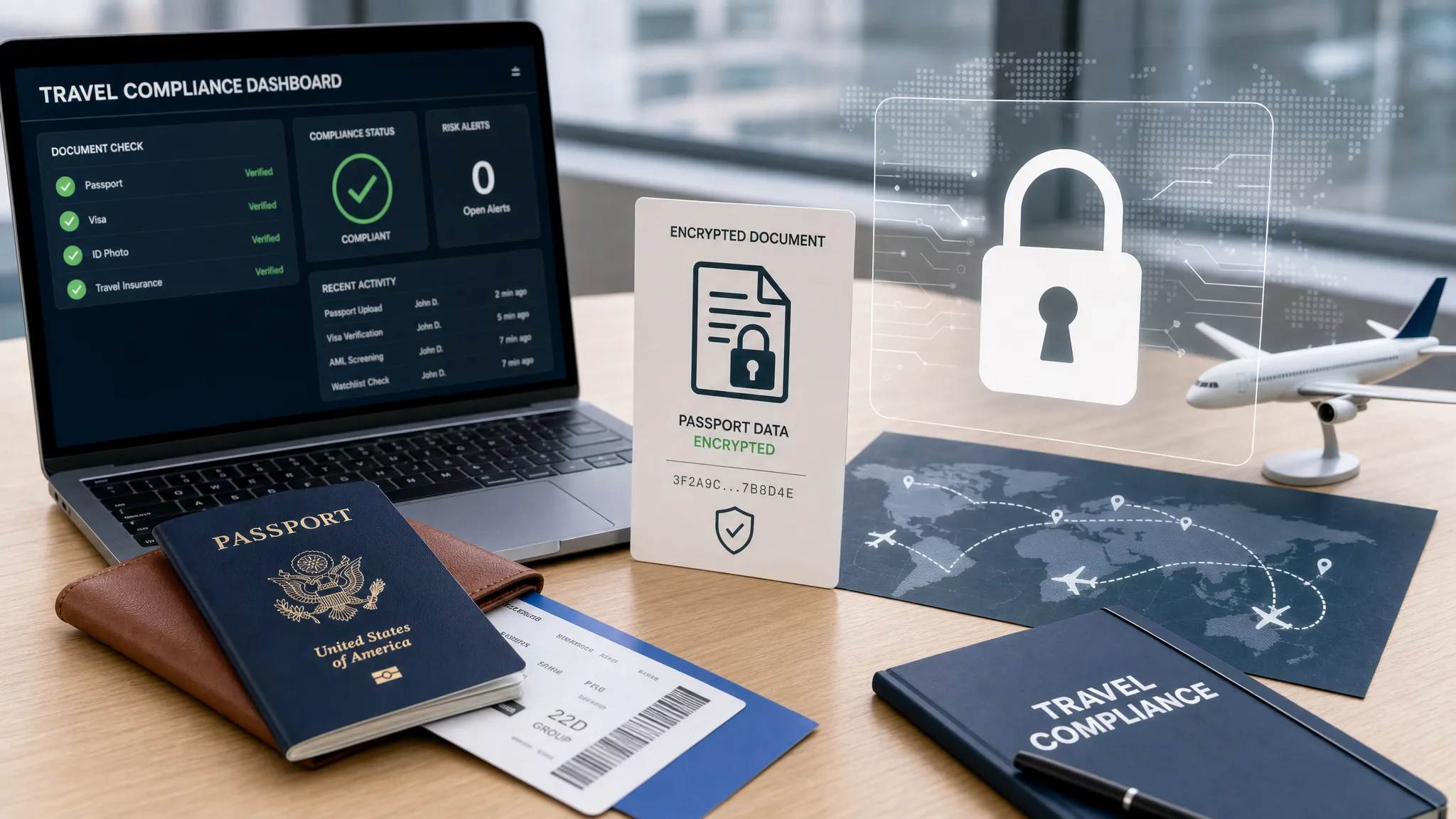
What counts as passport data?
Passport data is broader than the passport number alone. Travel companies often process direct identity fields, document images, travel context, and derived information created by systems such as OCR tools or eligibility engines.
| Data element | Common use in travel workflows | Compliance risk | Practical control |
|---|---|---|---|
| Full name, date of birth, nationality | Booking, eVisa, eTA, APIS checks | Identity matching, profiling, fraud | Validate against the passport, minimize reuse |
| Passport number, issuing country, issue and expiry dates | Eligibility checks, border requirements, application forms | Sensitive government ID data | Encrypt, mask, and restrict access |
| Passport scan or photo page | eVisa applications, manual review, document validation | High-risk identity document exposure | Use secure upload, avoid email, delete when no longer needed |
| MRZ data | OCR autofill, validation, error prevention | Machine-readable identity data can be copied at scale | Tokenize or store only parsed fields when possible |
| Selfie or face image | Identity verification, biometric matching, liveness checks | May become biometric data if used for unique identification | Apply enhanced notice, consent where required, and retention limits |
| Travel itinerary and accommodation data | Visa support documents, entry requirement checks | Reveals location and travel behavior | Limit access and avoid unnecessary sharing |
| Application status and visa decision data | Customer updates, support, reapplication workflows | Can reveal immigration outcomes or travel restrictions | Role-based access and careful support scripts |
The key principle is simple: the more complete the identity package, the more valuable it is to criminals and the more care regulators expect. A passport scan paired with an itinerary, payment data, email address, and visa status should be treated as a high-risk data set.
The 2026 regulatory landscape travel companies should watch
Passport data compliance depends on where your travelers are located, where your business operates, where your vendors process data, and which services you provide. A U.S.-based OTA selling trips to EU residents may face different obligations than a regional tour operator serving only domestic travelers, but both need clear controls.
GDPR, UK GDPR, and European expectations
Under the EU data protection framework, passport data is personal data. If a company processes biometric data for the purpose of uniquely identifying a person, that may trigger special category data rules under GDPR. Travel companies must also account for lawful basis, transparency, data minimization, storage limitation, processor contracts, security, data subject rights, and cross-border transfer mechanisms.
The UK GDPR follows a similar structure. The UK Information Commissioner's Office provides practical guidance for organizations through its UK GDPR resources.
For travel companies, GDPR compliance is not limited to having a privacy policy. Product teams need to know why each passport field is collected, whether it is required or optional, how long it is retained, and which third parties receive it.
U.S. state privacy laws and sensitive data rules
The U.S. does not have one comprehensive federal privacy law equivalent to GDPR, but state privacy laws increasingly regulate sensitive personal information. The California Attorney General's CCPA page explains rights and obligations under California's privacy framework, which includes passport numbers within sensitive personal information.
Travel companies serving U.S. customers should also consider consumer rights requests, notice requirements, vendor contracts, opt-out mechanisms where applicable, and the role of the FTC in enforcing unfair or deceptive data security practices.
Cross-border transfers and vendor ecosystems
Travel is inherently cross-border. A booking may originate in one country, be serviced in another, processed by a visa provider in a third, and submitted to a government portal elsewhere. This makes transfer mapping essential.
If GDPR applies, companies must evaluate international transfer mechanisms such as Standard Contractual Clauses and transfer impact assessments where needed. Even outside Europe, regulators increasingly expect companies to understand where sensitive personal data goes and which subprocessors can access it.
Biometrics, AI, and automated document processing
Many travel document automation tools use OCR to read the passport machine-readable zone, detect image quality, or prefill visa forms. Some systems also use facial comparison or liveness checks. These capabilities can improve accuracy and reduce traveler friction, but they introduce additional compliance questions.
The NIST Cybersecurity Framework 2.0 is a useful reference for organizing security governance, risk management, detection, response, and recovery practices. For AI governance, the EU AI Act is also relevant for companies using automated systems in high-impact contexts, and the European Commission maintains an overview of the EU AI regulatory framework.
| Compliance area | Why it matters for passport data | What travel companies should do |
|---|---|---|
| Privacy notice | Travelers must understand how passport data is used | Explain purposes clearly inside the journey, not only in a generic policy |
| Lawful basis | Different processing activities may need different justifications | Document basis for booking, visa support, fraud prevention, and legal obligations |
| Data minimization | Overcollection increases breach and enforcement risk | Collect only fields needed for the destination, nationality, and travel purpose |
| Security | Passport data can enable identity theft | Encrypt, mask, log access, and avoid insecure support channels |
| Retention | Storing scans indefinitely is difficult to justify | Define deletion triggers by workflow and legal requirement |
| Vendor management | Visa APIs and white-label apps may process traveler data | Sign DPAs, review subprocessors, and test deletion and incident processes |
| Cross-border transfers | Travel workflows often span jurisdictions | Map data locations and put proper transfer safeguards in place |
Build compliant passport data flows around the traveler journey
Compliance is strongest when it is designed into the travel journey from the beginning. If passport data is collected as an afterthought, it tends to spread into emails, spreadsheets, support tickets, and duplicate databases. That is where risk grows.
Pre-booking and eligibility checks
At the pre-booking stage, travelers often need a quick answer: do I need a visa, eVisa, eTA, or other travel authorization? In many cases, you may not need a full passport scan to answer that question. Nationality, destination, residence, travel dates, and trip purpose may be enough.
A compliant design collects the minimum data needed to determine requirements, then asks for additional passport details only when the traveler chooses to proceed with an application. This also improves conversion because the customer is not confronted with unnecessary identity requests too early.
If your team is still defining this layer, SimpleVisa's guide to travel document automation explains how rules engines, dynamic workflows, and status tracking fit into a modern travel stack.
Booking and post-booking workflows
Many travel companies collect passport data during booking, but visa needs are often discovered after payment. The post-booking phase is a powerful place to surface travel document requirements because the traveler has already committed and needs action-oriented guidance.
For compliance, the post-booking flow should separate operationally required data from optional ancillary offers. If a traveler is purchasing an online visa processing service, the interface should explain which passport fields are required for the application, which data may be submitted to government authorities or authorized partners, and how the company will send status updates.
Customer support interactions
Support teams are a common weak point in passport data compliance. Agents may ask travelers to attach passport scans by email, paste passport numbers into chat, or send documents through social media channels. These practices create unnecessary copies, unclear retention, and avoidable breach exposure.
A safer approach is to route customers back to a secure upload link, mask passport numbers in support tools, and use role-based access so only trained staff can view documents. Support scripts should tell agents what they can request, what they must not request, and when to escalate to a compliance or visa specialist.
Check-in and day-of-travel use
On the day of travel, teams often need to know whether the traveler has the right document, not necessarily see every underlying identity file. Status tokens, application references, or verified flags can reduce exposure. Where advance passenger information is legally required, companies should collect and transmit the data through secure, purpose-built channels rather than repurposed internal tools.
Core controls for passport data compliance
A good passport data compliance program does not need to be overly complex, but it does need to be explicit. Travel companies should be able to show what data they collect, why they collect it, who can access it, where it is stored, and when it is deleted.
Key controls include:
- Data mapping: Maintain a live inventory of passport data fields, systems, vendors, subprocessors, destinations, and retention periods.
- Purpose limitation: Use passport data only for the purpose explained to the traveler, such as visa application, eligibility checking, fraud prevention, or legal reporting.
- Data minimization: Avoid collecting full passport scans when parsed fields or a verified status are enough.
- Secure collection: Use encrypted forms and secure upload flows instead of email attachments or chat screenshots.
- Encryption and tokenization: Encrypt data in transit and at rest, and tokenize passport numbers where operationally feasible.
- Access controls: Apply least privilege, MFA, role-based access, and periodic access reviews for support and operations teams.
- Audit logs: Record access, changes, exports, submissions, and deletion events without exposing raw passport numbers in logs.
- Retention rules: Delete scans, abandoned application data, and temporary files according to documented triggers.
- Vendor contracts: Use DPAs, subprocessors lists, security requirements, and incident notification clauses.
- Incident response: Create a playbook for lost passport data, including legal review, containment, notification assessment, and traveler support.
These controls should be tested. A retention policy that exists only in a PDF is not enough. Teams should confirm that deletion jobs run, support tools mask sensitive fields, and vendors can honor deletion requests.
Vendor due diligence for visa platforms, APIs, and white-label apps
Most travel companies do not want to build every visa and passport data workflow from scratch. That is why many use a visa management platform, travel API, white-label visa application app, or no-code widget. Outsourcing can reduce operational burden, but it does not eliminate responsibility.
When evaluating a provider, ask practical questions rather than accepting generic security claims.
| Vendor due diligence question | Why it matters |
|---|---|
| What passport data fields do you collect for each product? | Confirms data minimization and avoids hidden collection |
| Are you acting as a processor, controller, or independent provider? | Clarifies GDPR roles and contract requirements |
| Where is passport data hosted and processed? | Supports transfer mapping and localization requirements |
| Which subprocessors can access traveler data? | Helps assess downstream risk |
| How are passport numbers, scans, and MRZ data encrypted or tokenized? | Tests whether controls match data sensitivity |
| Can we configure retention by workflow or market? | Supports storage limitation and local compliance |
| How do you handle deletion requests and traveler rights requests? | Ensures operational readiness, not just policy language |
| Do logs contain raw passport data? | Prevents sensitive data leakage through observability tools |
| How are API keys, webhooks, and admin users secured? | Protects integration points from abuse |
| What is your incident notification process? | Supports breach response timelines and customer communications |
For more technical evaluation criteria, see SimpleVisa's guide on the security features to demand in an electronic visa solution and the comparison of API vs. white-label app integration models.
The right integration model also affects compliance responsibilities. A deep travel API can deliver a seamless booking experience and give your product team more control, but it may also require more internal security engineering. A white-label or no-code implementation can reduce time to market and limit how much passport data touches your core systems, depending on the setup. The key is to document the data flow and responsibilities before launch.
Retention: stop storing passport scans forever
Retention is one of the clearest areas where travel companies can reduce risk. Passport data often remains in systems because no one owns deletion, not because the company still needs it.
A practical retention model should distinguish between raw documents, parsed fields, application status, financial records, support records, and audit logs. These data types may have different legal and operational needs.
| Workflow stage | Data commonly held | Retention principle |
|---|---|---|
| Eligibility check only | Nationality, destination, dates, trip purpose | Keep minimal data or anonymize for analytics when no application starts |
| Abandoned visa application | Partial form fields, uploaded files, payment attempt status | Delete or purge after a short documented window unless required for fraud or support |
| Submitted eVisa application | Passport fields, scans, itinerary, government submission references | Retain only as long as needed for processing, status support, legal obligations, and dispute handling |
| Approved or refused application | Decision status, reference number, traveler copy | Store minimal proof where needed, avoid keeping full scans without a defined reason |
| Customer support case | Messages, issue category, masked identifiers | Remove attachments and avoid raw passport data in ticket notes |
| Security and audit logs | Access events, submission events, deletion events | Keep logs without raw passport numbers when possible |
The best retention policy is specific enough for engineering teams to implement. Instead of saying, "we retain data as long as necessary," define triggers such as application completed, trip ended, dispute period closed, traveler deletion request verified, or regulatory hold applied.
AI, OCR, and biometric processing: useful, but higher risk
OCR and AI-assisted document checks can materially improve visa application quality. They can detect expired passports, unreadable scans, missing MRZ lines, and mismatches between a ticket name and passport name. In online visa processing, these checks reduce manual rework and help travelers avoid preventable refusals.
However, AI should not become a shadow data pipeline. If an OCR service extracts passport data, teams need to know whether the provider stores images for model improvement, whether data is used to train models, and whether logs include document images. If facial comparison is used, companies should assess biometric notice, consent requirements, local biometric laws, retention of templates, and opt-out or manual review alternatives where appropriate.
Human review also matters. Automated validation can flag inconsistencies, but high-impact decisions should have clear escalation paths. For travel companies, the goal is not to replace compliance judgment with automation. The goal is to use automation to make compliant workflows repeatable, accurate, and easier for travelers to complete.
A 30, 60, and 90-day roadmap for travel teams
Passport data compliance can feel overwhelming if it is treated as a single legal project. It becomes more manageable when split into operational phases.
| Timeline | Focus | Deliverables |
|---|---|---|
| Days 1 to 30 | Discover and map | Inventory passport data fields, systems, vendors, support channels, retention practices, and transfer locations |
| Days 31 to 60 | Fix the highest risks | Remove passport scans from email flows, enable masking, restrict access, update privacy notices, and confirm vendor contracts |
| Days 61 to 90 | Standardize and automate | Implement retention rules, secure upload flows, support scripts, audit logs, DPIA templates, and vendor review checklists |
| Ongoing | Monitor and improve | Review access quarterly, test deletion, update visa rules, train agents, and measure form completion and support issues |
This roadmap works especially well when product, legal, security, operations, and revenue teams collaborate. Passport data touches all of them. If compliance is isolated inside legal, workflow problems will remain. If it is isolated inside engineering, traveler communication may be weak. The strongest programs combine both.
Common mistakes travel companies should avoid
Even mature travel brands make preventable mistakes when passport data moves quickly across systems and markets. The most common issues are not always sophisticated cyberattacks. They are everyday workflow gaps.
Avoid these patterns:
- Requesting passport scans through email, messaging apps, or unencrypted support channels
- Collecting full passport images when eligibility checks only require nationality and dates
- Letting agents copy passport numbers into free-text ticket notes
- Storing raw passport numbers in logs, analytics tools, or data warehouses by default
- Using production passport data in test environments or vendor demos
- Treating consent as a universal solution instead of documenting the correct lawful basis
- Launching a travel API integration without mapping subprocessors and deletion workflows
- Forgetting that rejected or abandoned applications can still contain sensitive data
- Keeping traveler documents indefinitely for convenience or future marketing
A strong compliance culture makes the secure path the easiest path. If agents have secure upload links, they will use them. If booking flows dynamically ask only for necessary fields, customers will provide fewer unnecessary documents. If APIs return verified status instead of raw documents, internal systems hold less risk.
Measuring passport data compliance performance
Compliance teams often track policies, but travel companies should also track operational metrics. Measurement helps prove that better data handling supports both risk reduction and customer experience.
Useful metrics include:
- Percentage of passport uploads completed through secure channels
- Number of support tickets containing unmasked passport data
- Average time between application completion and document deletion
- Percentage of users who abandon at passport upload step
- Number of access reviews completed on time
- Number of vendor subprocessors reviewed annually
- Document error rate before and after OCR validation
- Visa application completion rate and support contact rate
These metrics connect compliance with business outcomes. If a secure eVisa workflow reduces document errors, speeds completion, and lowers support volume, compliance becomes part of growth rather than a blocker.
Frequently Asked Questions
Is a passport number considered sensitive personal information? In many jurisdictions, yes or functionally yes. Under California's CCPA/CPRA framework, passport numbers are included within sensitive personal information. Under GDPR, passport data is personal data and may be high risk due to identity theft potential, even when it is not special category data. If biometric processing is involved, additional rules may apply.
Can travel companies store passport scans? They can often store passport scans when there is a valid purpose, such as completing a visa application or meeting a legal travel requirement, but they should not store them indefinitely. Companies should document the purpose, secure the files, limit access, and delete scans once they are no longer needed unless a legal obligation requires retention.
Do eVisa applications require traveler consent? Sometimes, but not always. Consent may be needed for optional services, certain biometric uses, or specific jurisdictions. For core visa processing requested by the traveler, other lawful bases such as contract performance or legal obligation may be more appropriate under GDPR. The key is to identify the right basis for each processing activity and explain it clearly.
Who is responsible for compliance when using a visa API or white-label app? Responsibility depends on the legal roles and data flow. A travel company may remain responsible for transparency, lawful basis, vendor selection, and customer communications, while the provider may be responsible for secure processing under a contract. Roles should be defined in the DPA or service agreement before launch.
How long should a travel company keep passport data? There is no universal retention period. The correct period depends on the purpose, jurisdiction, application status, legal requirements, dispute needs, and customer support obligations. The safest approach is to define retention by workflow, keep the minimum necessary data, and automate deletion where possible.
What should a company do if passport data is exposed? First contain the incident, identify affected systems, preserve evidence, and involve legal, security, and executive stakeholders. Then assess notification obligations, vendor responsibilities, traveler impact, and remediation steps. A prepared incident response plan is essential because breach notification timelines can be short.
Make passport data compliance part of a better visa journey
Passport data compliance is not just about avoiding penalties. It is about building trust at the exact moment travelers are asked to share their most sensitive identity information. In 2026, the travel companies that win will be those that make border crossing administration simpler, safer, and more transparent.
SimpleVisa helps travel businesses guide customers through visa and border requirements with integration options such as travel API connectivity, white-label visa application experiences, no-code implementation, and custom data services. By bringing visa workflows closer to the booking journey, travel brands can improve customer experience while creating a stronger foundation for compliant online visa processing.
If your team is reviewing its passport data workflows, exploring eVisa automation, or evaluating a visa management platform, visit SimpleVisa to learn how streamlined border crossing solutions can fit into your travel business.