Travel Compliance Automation: Where to Start
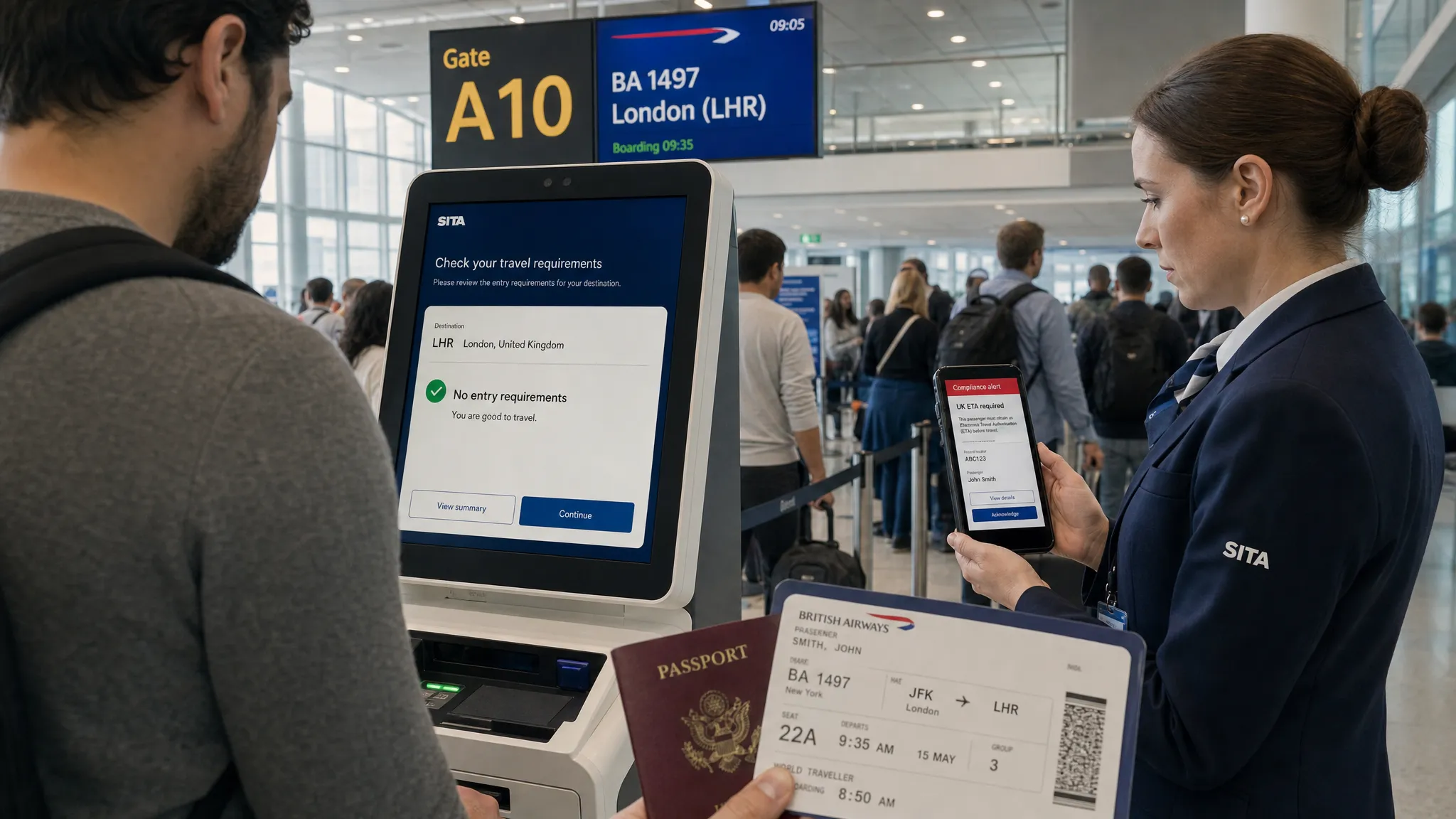
Travel compliance used to be a back-office checkpoint. Today, it is a customer experience, revenue, and risk management issue that appears throughout the journey, from search and booking to check-in and border crossing.
For airlines, OTAs, cruise lines, tour operators, TMCs, and travel platforms, the challenge is not simply “add a visa page.” The real challenge is knowing what each traveler needs based on passport, destination, transit points, purpose of travel, stay length, and changing government rules, then turning that answer into a guided, low-friction workflow.
That is where travel compliance automation comes in. Done well, it helps customers understand requirements earlier, complete electronic visa or ETA applications more accurately, reduce support volume, and create a new ancillary revenue channel. Done poorly, it adds another disconnected tool that customers ignore.
Here is where to start.
What travel compliance automation actually covers
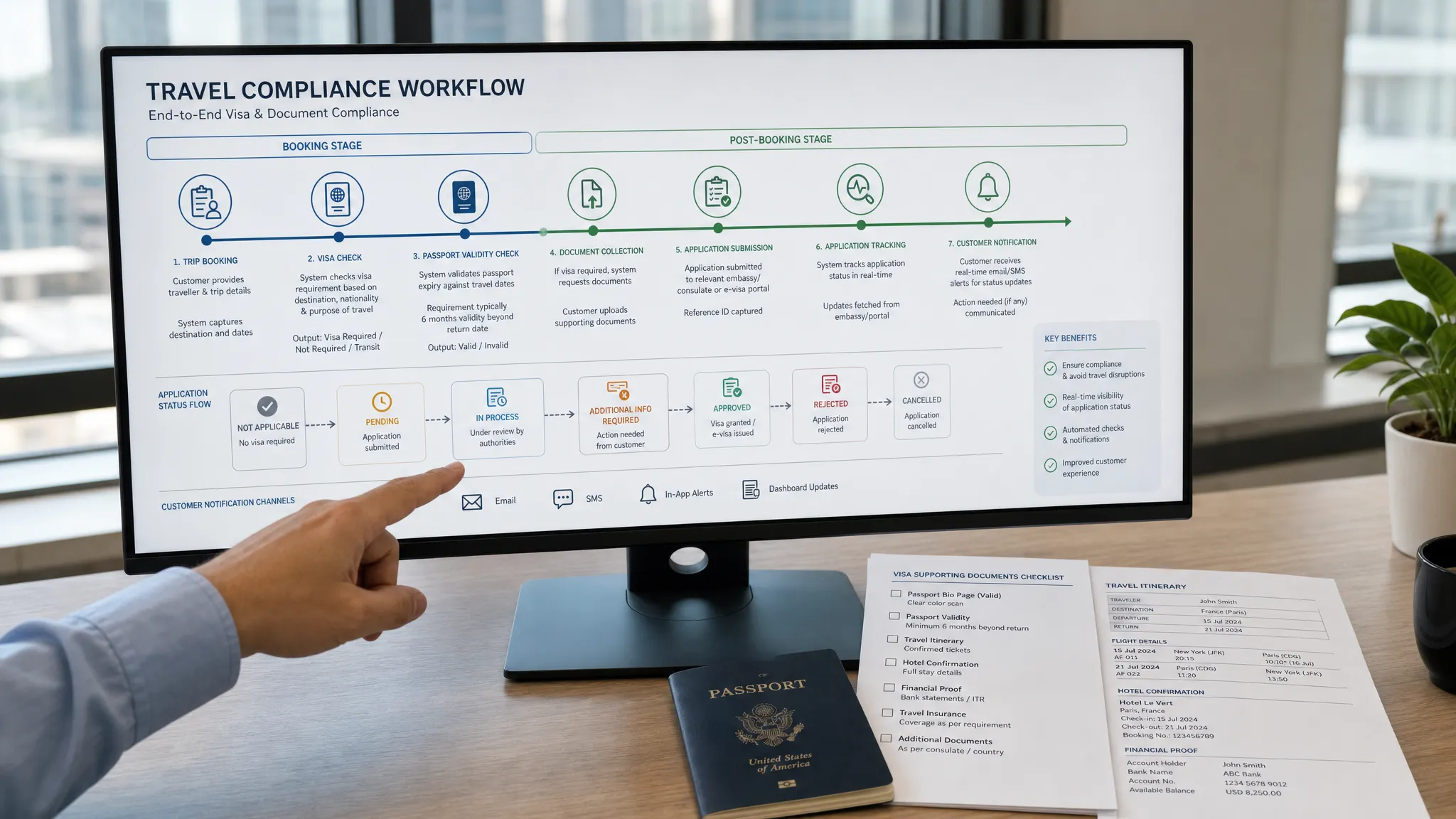
Travel compliance automation is the use of rules, data, workflows, and integrations to help travelers meet entry, transit, and document requirements before departure.
In practice, it can include:
- Visa, eVisa, ETA, and transit requirement checks
- Passport validity and blank-page rules
- Destination-specific document guidance
- Guided visa application workflows
- Payment, submission, and status tracking for online visa processing
- Customer notifications when action is required
- Audit logs and data handling controls for sensitive passport information
For travel businesses, the goal is not just compliance. The goal is to embed border crossing solutions into the traveler journey at the moment they are most useful.
For example, a traveler booking a multi-country itinerary should not discover a transit visa requirement at the airport. A family purchasing a package tour should not receive generic visa advice that ignores children’s documentation. A business traveler should not be pushed into a tourist eVisa workflow if their purpose of travel requires a different authorization.
Automation helps replace generic advice with contextual guidance.
Why travel compliance is becoming harder to manage manually
Governments are digitizing border processes quickly. The U.S. ESTA, the UK ETA, electronic visas, and Europe’s ETIAS framework all reflect a broader shift toward pre-travel screening and digital authorization. Official resources such as the EU ETIAS site, the UK ETA guidance, and the U.S. ESTA portal show how fragmented requirements can be across destinations and traveler profiles.
Manual handling struggles for four reasons.
First, rules change frequently. A spreadsheet maintained by one operations manager can become outdated quickly, especially when routes, nationalities, transit rules, and visa categories multiply.
Second, customer expectations have changed. Travelers expect the same clarity they get from baggage, seat selection, or insurance add-ons. If visa guidance is vague, hidden, or delayed, confidence drops.
Third, passport and visa data are sensitive. Travel brands need to handle personal data carefully, especially under frameworks such as GDPR and U.S. state privacy laws. Manual copying, email attachments, and uncontrolled storage increase risk.
Fourth, compliance mistakes are expensive. A missed eVisa requirement can lead to denied boarding, rebooking pressure, refunds, support escalation, and brand damage.
Start with one business problem, not the whole world
The biggest mistake is trying to automate every travel document scenario at once. Travel compliance automation works best when you start with a specific, measurable business problem.
A good starting problem might be:
- High support volume around visa questions for a few destinations
- Customers abandoning bookings when documentation requirements are unclear
- Missed ancillary revenue from eVisa services
- Repeated airport issues on specific routes
- Manual operations work for group, cruise, or package travel
- Compliance uncertainty for complex transit itineraries
A focused pilot helps your team prove value before scaling.
For example, an OTA might begin with eVisa eligibility checks for its top 10 international leisure destinations. A cruise line might start with shore-entry rules for the highest-volume itineraries. A TMC might begin with business travel corridors where traveler purpose and timing matter most.
The right starting point is usually where three conditions overlap: high traveler volume, frequent document requirements, and visible commercial or operational pain.
Map the traveler journey before choosing technology
Before evaluating a travel API, white-label app, or visa management platform, map where compliance decisions happen in your customer journey.
Most travel brands discover that visa friction is not isolated to one page. It appears across multiple moments:
| Journey stage | Compliance question | Automation opportunity |
|---|---|---|
| Search | Can this traveler enter the destination? | Show early requirement indicators by nationality and trip type |
| Booking | Is an eVisa or ETA required? | Offer a visa application option before checkout or immediately after payment |
| Post-booking | What documents must the traveler prepare? | Send guided checklists and deadlines |
| Pre-departure | Has the visa been approved? | Trigger automated status notifications and reminders |
| Check-in | Is the traveler cleared to board? | Surface final compliance status to agents or systems |
| Support | Why is the application delayed or rejected? | Route cases using status data and escalation rules |
This mapping exercise prevents technology from becoming disconnected from operations. It also clarifies which data you need and when you need it.
At minimum, most automated checks require nationality, destination, travel dates, transit countries, residence where relevant, purpose of travel, and passport validity. More advanced workflows may also need document uploads, contact details, prior visa history, or group travel information.
The rule is simple: collect enough data to deliver accurate guidance, but avoid collecting sensitive data before there is a clear purpose.
Build a source of truth for visa and entry rules
Travel compliance automation depends on reliable rules. If the underlying data is incomplete or outdated, every downstream workflow suffers.
Your source of truth should answer questions such as:
- Which travelers need a visa, eVisa, ETA, or no authorization?
- Which rules depend on nationality, residence, transit, trip purpose, or length of stay?
- What documents are required for each application type?
- What are typical processing times and traveler deadlines?
- What happens if the traveler has multiple passports or prior refusals?
- How are rules updated, verified, and logged?
This is where a dedicated visa management platform or specialized data service becomes valuable. Generic content pages can help with awareness, but they rarely provide the structured, traveler-specific data needed for automation.
If you are still defining your requirements, SimpleVisa’s guide to travel document automation is a useful companion because it breaks down the core components of automated visa, ETA, and entry-document workflows.
Prioritize the first workflows to automate
Once you know your problem and data requirements, decide which workflows to automate first. Not every travel business needs the same starting stack.
Here is a practical prioritization model.
| Workflow | Best starting use case | Business impact |
|---|---|---|
| Eligibility checks | High-volume international routes | Reduces uncertainty before purchase |
| Guided eVisa applications | Destinations with electronic visa availability | Creates ancillary revenue and improves customer experience |
| Document requirement checklists | Complex tourist, business, group, or cruise itineraries | Reduces support tickets and resubmissions |
| Status notifications | Applications with variable processing times | Lowers “where is my visa?” contact volume |
| Agent escalation tools | High-touch travel, premium service, TMC, MICE | Improves service consistency and response time |
| Compliance reporting | Airlines, enterprise travel, regulated operations | Supports auditability and operational oversight |
For most travel sellers, the fastest path to value is eligibility plus guided application. The eligibility check tells the traveler what they need. The guided application gives them a way to act immediately.
That combination turns compliance from a warning into a service.
Choose the right integration model
Travel compliance automation can be deployed in several ways. The right option depends on your engineering capacity, desired UX control, launch timeline, and commercial model.
| Model | How it works | Best for |
|---|---|---|
| No-code implementation | Add a hosted or embedded experience with minimal technical work | Fast pilots, small teams, route-specific launches |
| White-label visa app | Offer a branded visa application experience powered by a specialist platform | Brands that want speed and control without building a full system |
| API integration | Connect visa rules and application flows directly into your booking or post-booking journey | OTAs, airlines, superapps, and platforms with product teams |
| Custom data service | Use structured visa or border requirement data in internal systems | Companies needing rule data for multiple products or channels |
SimpleVisa supports these common entry points through API integration for travel sites, white-label visa application apps, custom data services, and no-code implementation options. That means a travel brand can start with a lightweight launch, then deepen integration as volume and requirements grow.
If you are deciding between embedded API and a hosted branded experience, the guide on API vs. white-label visa integration can help frame the trade-offs.
Define data privacy and security controls early
Passport, identity, and visa application data are high-sensitivity data. Security and privacy cannot be bolted on after the pilot.
Before launch, define how your organization will handle:
- Consent and privacy notices
- Data minimization
- Secure storage and retention periods
- Access permissions for agents and operations teams
- Vendor responsibilities and processor agreements
- Cross-border data transfers
- Incident response and audit logs
For customers, trust signals also matter. Travelers are more likely to complete an online visa processing flow if they understand why information is requested, how it will be used, and what happens next.
A good compliance automation project should involve product, legal, security, operations, and support teams from the beginning. Waiting until the integration is built often leads to rework, delayed approvals, or vague customer messaging.
For a deeper look at privacy obligations around passport and eVisa data, see SimpleVisa’s guide to data privacy for travel brands.
Create a small pilot with clear KPIs
A travel compliance automation pilot should be narrow enough to launch quickly and structured enough to prove impact. Avoid vague success criteria like “make visa handling easier.” Define measurable outcomes.
Common KPIs include:
| KPI | What it tells you |
|---|---|
| Eligibility check usage | Whether travelers are engaging with compliance guidance |
| eVisa attach rate | How often eligible travelers purchase or start an application |
| Application completion rate | Whether the application flow is usable |
| Approval rate | Whether travelers are submitting accurate, complete applications |
| Support tickets per booking | Whether automation is reducing manual help requests |
| Time to application completion | Whether the process is faster for customers |
| Ancillary revenue per booking | Whether compliance services are contributing commercially |
| Denied boarding or travel disruption incidents | Whether operational risk is decreasing |
A strong pilot design includes a control group or baseline. For example, compare routes with automated eligibility checks against similar routes using static visa information. Measure booking conversion, support tickets, and visa service revenue over a fixed period.
The goal is to learn quickly. If travelers ignore the offer, test placement and messaging. If they start but do not finish, improve the form flow. If support tickets remain high, review notifications and FAQs.
Decide who owns travel compliance internally
Automation reduces manual work, but it does not eliminate ownership. Someone still needs to monitor performance, handle exceptions, update processes, and coordinate with vendors.
In many travel companies, ownership is fragmented. Product owns checkout. Support owns traveler questions. Legal owns compliance language. Commercial owns ancillary revenue. Operations owns disruptions. This fragmentation is one reason visa workflows remain manual for so long.
A better model is to assign a single cross-functional owner for travel compliance automation, supported by clear responsibilities.
| Function | Responsibility |
|---|---|
| Product | Placement, UX, conversion, customer journey |
| Operations | Exception handling, process design, escalation paths |
| Support | Scripts, macros, traveler communication, feedback loops |
| Legal and privacy | Consent, notices, contracts, data retention |
| Engineering | API integration, data flows, monitoring |
| Commercial | Pricing, revenue share, attach-rate targets |
This structure helps the automation program improve over time instead of stopping after launch.
Build the business case around risk, experience, and revenue
Travel compliance automation is easier to fund when the business case includes more than one benefit. A pure risk-reduction argument may not excite commercial teams. A pure ancillary revenue argument may not satisfy legal and operations. The strongest case combines all three.
The core value drivers are:
- Risk reduction: Fewer missed requirements, fewer denied boarding scenarios, better auditability.
- Customer experience: Clearer guidance, fewer surprises, faster guided visa application support.
- Operational efficiency: Lower support volume, fewer manual checks, better escalation workflows.
- Ancillary revenue: Visa and eVisa services become a relevant, high-intent add-on.
A simple ROI model can start with this formula:
| Value area | Example input |
|---|---|
| Manual cost reduction | Visa-related tickets multiplied by average handling cost |
| Revenue upside | Eligible bookings multiplied by expected attach rate and net revenue per application |
| Disruption savings | Avoided denied boarding or rebooking incidents multiplied by average cost |
| Conversion impact | Incremental bookings from clearer compliance guidance multiplied by margin |
You do not need perfect data to begin. You need enough baseline data to compare before and after deployment.
Avoid the most common starting mistakes
Most failed compliance automation projects do not fail because the concept is wrong. They fail because the starting point is unclear.
Common mistakes include automating too many countries at once, launching after checkout only, using generic visa copy instead of personalized requirements, collecting sensitive data without a clear retention policy, and treating support teams as an afterthought.
Another frequent mistake is hiding visa help too late in the journey. If a traveler has already booked a non-refundable trip, compliance guidance can feel like a problem. If the same guidance appears early and includes a path to solve the issue, it feels like a service.
This is why travel compliance automation should be designed as part of the booking and post-booking experience, not as a static help-center article.
A practical 30-day starting plan
If you are starting from zero, use the first month to validate scope and prepare a focused pilot.
| Week | Focus | Output |
|---|---|---|
| Week 1 | Identify pain points and priority routes | Shortlist 3 to 5 use cases with volume, risk, and revenue potential |
| Week 2 | Map data and traveler journey | Define required fields, touchpoints, and ownership |
| Week 3 | Choose integration model and vendor criteria | Decide between no-code, white-label, API, or data service |
| Week 4 | Define pilot KPIs and launch plan | Build a measurable rollout plan with support and privacy controls |
After that, your team can move into implementation with a narrow, testable scope. For many travel businesses, this is more effective than spending six months designing a perfect global compliance architecture before customers see any value.
If you are evaluating vendors, SimpleVisa’s RFP checklist for visa management platforms can help you compare coverage, integration, security, operations, and commercial fit.
Frequently Asked Questions
What is the first step in travel compliance automation? Start by selecting one high-impact use case, such as eVisa checks for top destinations, transit compliance for complex routes, or guided applications for a high-volume market. Then map the traveler journey and required data before choosing technology.
Do we need an API to automate travel compliance? Not always. APIs are best when you want deep integration into booking flows or internal systems. If you want to launch quickly, a no-code implementation or white-label visa application app can be a practical first step.
Can travel compliance automation generate ancillary revenue? Yes. When visa or eVisa services are offered at the right moment, travelers can complete required applications through a guided flow. This can improve customer experience while creating a relevant ancillary revenue stream.
How do we know if automation is working? Track KPIs such as eligibility check usage, eVisa attach rate, application completion rate, approval rate, support tickets per booking, and ancillary revenue per booking. Compare results against a baseline or control group.
What data is usually needed for visa eligibility checks? Typical inputs include nationality, destination, travel dates, transit points, trip purpose, passport validity, and sometimes residence or prior travel history. The exact data depends on destination rules and the type of authorization.
Is travel compliance automation only for large airlines and OTAs? No. Tour operators, cruise lines, TMCs, travel insurance sellers, event travel companies, and niche agencies can also benefit, especially when they handle international itineraries or customer groups with recurring documentation needs.
Start with the workflow your travelers already need
The best place to start with travel compliance automation is not a massive transformation project. It is the point in your customer journey where visa uncertainty already creates friction, cost, or lost revenue.
SimpleVisa helps travel businesses automate visa processing, guide customers through border requirements, and integrate eVisa services through APIs, white-label apps, custom data services, or no-code options. Whether you want to test one route or build compliance into your full booking flow, the key is to start with a focused use case and measurable outcomes.
Explore SimpleVisa to see how your team can simplify border crossing administration and turn travel compliance into a smoother customer experience.