How Tour Operators Can Monetize Visa Help
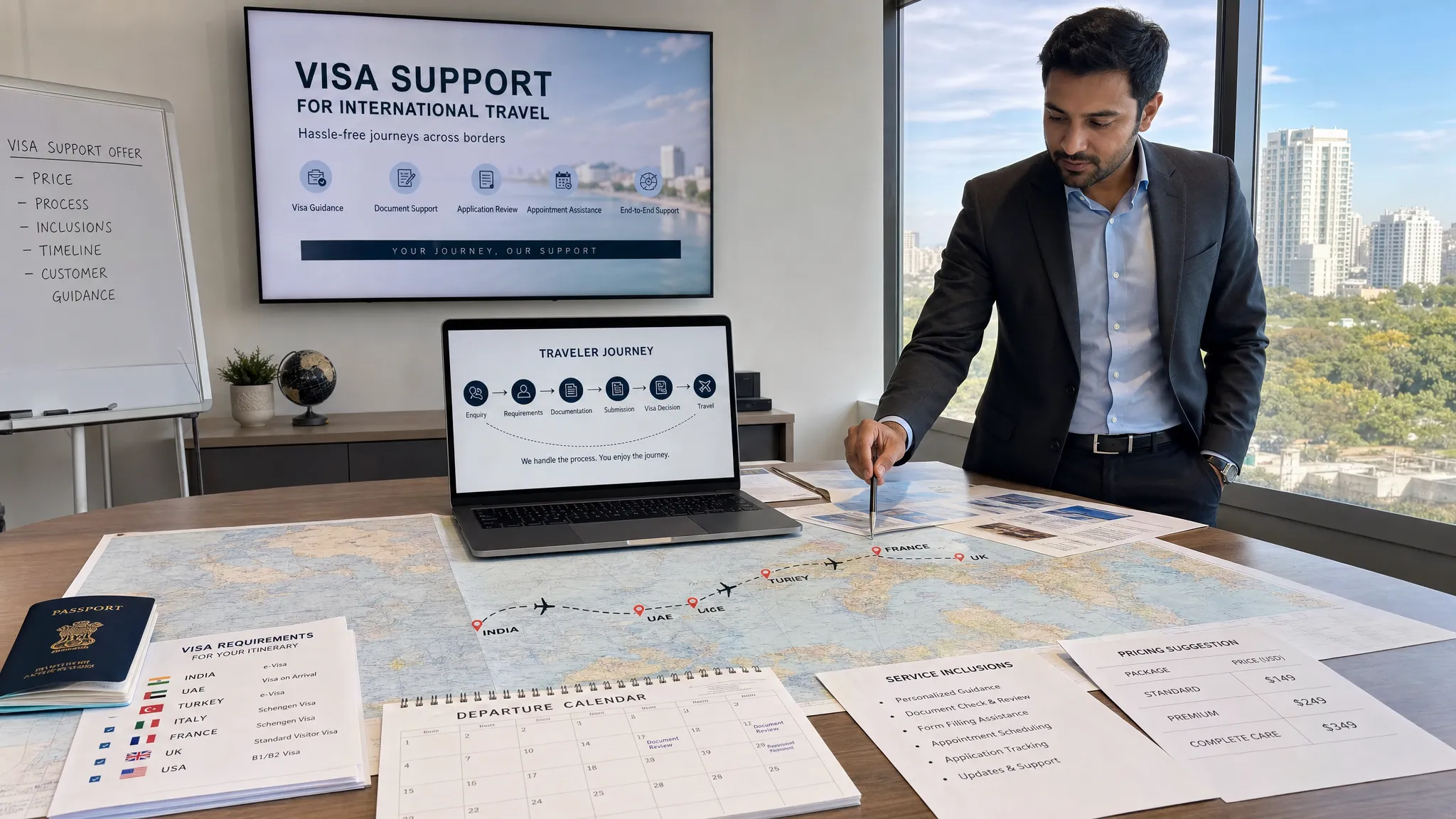
Visa questions used to sit at the edge of the tour booking process. Today, they affect conversion, customer satisfaction, support volume, and in some cases, whether a traveler can join the trip at all.
For tour operators, that creates a clear opportunity: visa help can become a useful, trusted ancillary service instead of an unpaid administrative burden. Travelers buying guided trips are not just paying for transportation and accommodation. They are paying for confidence. If you can help them understand requirements, submit cleaner applications, and avoid last-minute surprises, you can create value they are often willing to pay for.
The timing is favorable. UN Tourism reported that international tourism recovered to pre-pandemic levels in 2024, while governments continue to expand digital entry systems, eVisas, ETAs, and pre-travel screening. The UK's Electronic Travel Authorisation and Europe's ETIAS are part of a broader move toward digital border requirements.
The question for tour operators is no longer whether travelers need visa support. It is whether they will get that support from you, from a third-party site, or from a rushed Google search the night before departure.
Why visa help belongs in the tour operator revenue mix
Tour operators are in a stronger position than most travel sellers to monetize visa help because they already know the itinerary, dates, destination sequence, group profile, and traveler intent. That context matters.
A generic visa website may ask a traveler to interpret rules by nationality, purpose of travel, length of stay, transit route, and entry count. A tour operator can simplify the question: for this specific tour, with this passport, departing on this date, here is what you likely need to prepare.
That creates three commercial advantages.
First, visa help reduces booking anxiety. If a traveler is comparing two similar tours and one clearly explains the document path, the lower-friction option feels safer.
Second, visa support protects the trip experience. A traveler who misses a departure because of a missing eVisa is not just an individual problem. It can create rebooking work, refund disputes, group logistics issues, and negative reviews.
Third, visa help is naturally time-sensitive. Unlike generic travel add-ons, border documents have deadlines. That urgency makes the service relevant after booking, during final payment, and close to departure.
What counts as visa help?
Monetizing visa help does not always mean becoming a full-service immigration agency. Most tour operators should think in service levels, from basic requirement checks to managed eVisa workflows.
| Visa help level | What the traveler gets | Best monetization use |
|---|---|---|
| Requirement check | A destination and passport-specific answer on whether a visa, eVisa, ETA, or other authorization may be needed | Free conversion tool or low-friction upsell entry point |
| Guided checklist | A tailored list of documents, photos, deadlines, and steps for the booked itinerary | Low-cost add-on or included benefit for premium tours |
| Application review | Pre-submission checks for common mistakes such as name mismatches, photo issues, missing fields, and inconsistent dates | Paid service fee for travelers who want extra confidence |
| Managed eVisa support | Guided online visa processing, status updates, and delivery support where permitted | Per-application fee, margin, or revenue-share model |
| Group visa coordination | Centralized tracking for families, private groups, student groups, or MICE travel | Group administration fee or premium package feature |
| Reapplication guidance | Help understanding refusal reasons and preparing a cleaner reapplication when allowed | Premium support add-on with clear limits and disclaimers |
Tour operators should avoid presenting visa support as guaranteed approval or formal legal immigration advice unless they are qualified to provide it. The value is in guidance, automation, document quality, timing, and traveler communication.

Six practical ways tour operators can monetize visa help
The right model depends on your tour style, destinations, customer demographics, and operational capacity. A luxury operator selling multi-country private tours will package visa support differently from a high-volume adventure operator selling fixed departures.
1. Charge a transparent per-traveler service fee
This is the simplest model. The traveler pays government fees plus a clearly disclosed service fee for guidance, document checks, submission support, or status tracking.
This works well for destinations with frequent eVisa or ETA requirements, especially where travelers are likely to make avoidable mistakes. Keep the offer specific. Instead of selling vague assistance, describe the outcome: document checklist, application guidance, review before submission, and status notifications.
Transparency is essential. Separate government fees from your service fee so customers understand what they are paying for. If you want to improve trust around pricing, SimpleVisa's guide on showing visa fees upfront explains why fee clarity matters in travel checkout flows.
2. Offer a premium assisted application tier
Some travelers are happy to apply alone once they know the requirement. Others want a higher-touch service, especially families, older travelers, first-time international travelers, and customers booking expensive once-in-a-lifetime tours.
A premium tier can include deadline reminders, file format checks, passport scan review, photo guidance, itinerary consistency checks, and application status follow-up. The traveler is paying for reduced uncertainty and fewer administrative tasks.
This model works particularly well when the tour price is high enough that a modest support fee feels proportionate. A traveler spending several thousand dollars on a guided itinerary may not object to paying for help that protects the trip.
3. Include visa help in higher-value tour packages
Visa support can also be part of a premium package rather than a separate line item. For example, a standard tour may include basic visa information, while a premium or concierge package includes guided eVisa management.
This approach increases perceived value without forcing every traveler to buy the same level of support. It also fits naturally with luxury tours, private groups, educational travel, pilgrimage travel, and multi-country itineraries.
If you want to go deeper on bundle design, see SimpleVisa's guide on how tour operators can package visas into fixed-price bundles. For this article, the broader point is simple: visa help can support upsell tiers, not just one-off application fees.
4. Build post-booking visa prompts into the customer journey
Many operators miss revenue because they only mention visas in pre-departure documents. By then, the customer may have already applied elsewhere or may be too close to departure for a smooth process.
Better touchpoints include the itinerary page, checkout, booking confirmation, customer portal, final payment reminder, and pre-departure email sequence. The key is relevance. A traveler does not need a generic visa sales pitch. They need a specific action based on their passport, destination, and travel date.
| Journey stage | Best visa message | Revenue goal |
|---|---|---|
| Tour page | Check entry requirements before you book | Reduce hesitation and capture early intent |
| Checkout or deposit | Add guided eVisa support for this itinerary | Convert while trip details are fresh |
| Booking confirmation | Start your document checklist now | Drive post-booking attach rate |
| Final payment | Avoid delays by completing required travel authorization | Recover late buyers |
| Pre-departure | Confirm approval and save your documents | Reduce support tickets and travel disruption |
This is where travel document automation becomes valuable. A dynamic flow can show different requirements based on traveler data instead of sending everyone the same PDF. For a broader primer, read SimpleVisa's explanation of travel document automation.
5. Monetize group coordination
Group travel creates a different kind of visa problem. The operator may need to know who has applied, who is pending, who has been approved, and who needs follow-up before ticketing or rooming deadlines.
This is especially relevant for student groups, faith-based travel, sports teams, incentive travel, expedition cruises, and MICE programs. In these cases, the customer is not only buying individual visa help. The organizer is buying operational visibility.
A group coordination fee can cover centralized tracking, reminders, document intake, and exception management. It can also reduce the workload for the group leader, which makes your operator more attractive in competitive bids.
SimpleVisa's article on group and MICE visa applications explores this use case in more detail.
6. Use a partner revenue-share model
Not every tour operator wants to manage visa operations directly. A partner model lets you embed or refer customers to a visa management provider while earning revenue through a commercial agreement.
This can be a good fit if your team has limited support capacity, you operate across many destinations, or you want to test demand before building deeper integrations. The key is to choose a partner that supports a clear traveler experience, accurate requirement data, secure handling of passport information, and reporting that shows your revenue and performance.
SimpleVisa supports travel businesses through API integration, white-label visa application apps, custom data services, guided customer applications, premium eVisa management, and no-code implementation options. That flexibility matters because a tour operator may start with a simple white-label flow and later move to an API as volume grows.
How to price visa help without damaging trust
The biggest pricing mistake is treating visa help like a hidden fee. Travelers may accept paying for support, but they dislike being surprised by charges after they have committed to a trip.
A simple pricing formula is:
Customer price - government fees - provider cost - support labor - payment and refund costs = net margin
Use this formula by destination and tour type. Some destinations may be profitable with a modest service fee because the process is simple and scalable. Others may require higher pricing because the application requires more document review, translations, or traveler follow-up.
| Cost component | Why it matters |
|---|---|
| Government or consular fee | Usually a pass-through cost and should be clearly separated |
| Payment processing | Card fees, currency conversion, chargebacks, and refund handling affect margin |
| Support labor | Traveler questions, document corrections, and deadline reminders take time |
| Technology or partner cost | API, white-label app, data service, or managed application costs must be included |
| Rework and exception handling | Name errors, photo rejections, denials, and late applications can erode profit |
For modeling only, imagine a tour operator has 2,000 annual travelers on routes where an electronic visa or travel authorization is commonly required. If 30 percent buy a paid support option and the operator earns $22 net margin per traveler after costs, that creates $13,200 in annual contribution from one service line. The actual result depends on destination mix, attach rate, pricing, and support workload, but the exercise shows why visa help deserves a place in the ancillary revenue plan.
For a broader view of compliance-based add-ons, see SimpleVisa's guide to ancillary revenue from visa services.
The operating model behind profitable visa support
Visa help is profitable only if it is operationally controlled. If every application creates manual back-and-forth, your service fee can disappear into support costs.
Keep requirement data accurate
Visa rules depend on nationality, destination, transit, purpose, duration, passport validity, and entry type. Multi-country tours add another layer of complexity. A profitable model needs updated rules and a process for handling exceptions.
Standardize document intake
Many delays come from avoidable file problems: blurry passport scans, cropped photos, unsupported file types, expired passports, or itinerary mismatches. Automated pre-checks and clear upload instructions can reduce rework before an application is submitted.
Use status notifications
Travelers often contact support because they do not know what is happening. Automated status updates can lower call volume and improve confidence, especially for departures with tight timelines.
Protect passport and visa data
Visa support involves sensitive personal information. Tour operators should minimize data collection, define retention periods, use secure systems, and ensure vendors have appropriate privacy and security controls. SimpleVisa has a deeper guide on handling passport and eVisa data under GDPR and CCPA for teams building or reviewing workflows.
Set clear policies for denials and late applications
No tour operator should promise approval. Instead, define what happens if a traveler applies too late, submits inaccurate information, or receives a refusal. Publish refund, cancellation, and reapplication policies in plain language.
Technology options for tour operators
You do not need the same implementation as an airline or OTA to monetize visa help. The best starting point depends on your booking system, trip volume, and internal technical resources.
| Option | Best fit | Advantages | Limitations |
|---|---|---|---|
| Manual process | Small operators with low volume | Fast to start and easy to customize | Hard to scale, error-prone, limited reporting |
| White-label visa app | Operators that want a branded service without heavy development | Quick launch, consistent customer journey, easier support | Less control than a fully embedded API flow |
| No-code widget or hosted flow | Teams that want to test demand quickly | Low implementation effort and faster pilot | May not match every booking-flow detail |
| Visa API | Operators with technical resources and higher volume | Deep integration, automated eligibility checks, better data flow | Requires engineering and product planning |
| Custom data service | Operators that mainly need requirement data inside itineraries or agent tools | Useful for sales teams and pre-booking checks | Does not always include full application processing |
If your team wants to understand the technical path, SimpleVisa explains how eVisa APIs work and how to offer white-label visa services without writing code.
A 30-day pilot plan for tour operators
A full global rollout is not the best first step. Start with a narrow, measurable pilot.
- Choose 3 to 5 high-relevance itineraries: Pick tours where visa questions are common, eVisa availability is strong, or traveler anxiety is high.
- Map the current support burden: Review how many visa-related emails, calls, booking hesitations, and pre-departure issues your team handles today.
- Define the paid service scope: Decide whether you are selling requirement checks, guided applications, document review, status tracking, or full eVisa management.
- Set transparent pricing and policies: Separate government fees from service fees, define refund rules, and avoid approval guarantees.
- Add prompts to the customer journey: Test visa help on itinerary pages, booking confirmation emails, customer portals, and pre-departure reminders.
- Train sales and support teams: Give agents approved language, escalation rules, and a clear boundary between general visa support and legal advice.
- Measure weekly and adjust: Track attach rate, completion rate, revenue, support tickets, and traveler feedback before expanding.
This pilot approach helps you prove demand, refine messaging, and identify operational bottlenecks before rolling visa help across your full portfolio.
KPIs to track after launch
Visa help should be managed like any other ancillary product. If you cannot measure it, you cannot improve it.
| KPI | What it tells you | How to improve it |
|---|---|---|
| Attach rate | Percentage of eligible travelers who buy visa help | Improve placement, timing, and destination-specific messaging |
| Net visa revenue per traveler | Actual contribution after fees and costs | Adjust pricing, reduce manual work, and segment by tour type |
| Application completion rate | Whether travelers finish the process after starting | Simplify forms, clarify documents, and add reminders |
| On-time submission rate | Whether applications are submitted early enough | Trigger deadlines from booking date and departure date |
| Support tickets per application | How much operational load the service creates | Add better instructions, status notifications, and document validation |
| Approval rate | Whether applications are being submitted accurately and appropriately | Improve eligibility checks, file quality, and review steps |
| Customer satisfaction | Whether the service improves the overall tour experience | Ask post-approval and post-trip questions about confidence and ease |
Review these metrics by destination, traveler nationality, booking channel, and tour category. A visa offer that performs well for one itinerary may need different timing or pricing for another.
Frequently Asked Questions
Can tour operators legally charge for visa help? In many markets, tour operators can charge for administrative support, document guidance, and application assistance, but rules vary by jurisdiction and service scope. Avoid presenting the service as legal immigration advice unless qualified, and make government fees, service fees, and responsibilities clear.
Should visa help be optional or included in the tour price? It depends on your brand and itinerary. Optional add-ons work well for price-sensitive travelers. Included visa guidance can strengthen premium, luxury, educational, or group packages where customers expect a higher-touch experience.
What if a traveler's visa application is denied? Do not guarantee approval. Provide clear policies before purchase, explain what your service covers, and define whether reapplication help, refunds, or itinerary alternatives are available. The operator should also distinguish between government decisions and support services.
Do tour operators need an API to sell eVisa services? Not always. Smaller teams can start with a white-label app, hosted flow, or no-code implementation. An API becomes more useful when you want real-time eligibility checks, deeper booking-flow integration, and automated data exchange at scale.
When should visa help be offered to travelers? Offer it early enough to reduce booking anxiety, then repeat it after booking when the traveler is ready to act. The best touchpoints are itinerary pages, checkout, booking confirmation, customer portals, final payment reminders, and pre-departure emails.
How can operators avoid increasing support workload? Standardize the process. Use dynamic checklists, automated reminders, document validation, status notifications, and clear escalation rules. The goal is to replace scattered manual email threads with a repeatable workflow.
Turn visa questions into a better customer experience and a new revenue stream
Visa help is one of the most natural ancillary opportunities for tour operators because it solves a real traveler problem at a high-intent moment. Done well, it increases confidence, reduces support friction, protects departures, and creates incremental revenue.
SimpleVisa helps travel businesses streamline visa applications through API integrations, white-label visa application apps, custom data services, guided customer flows, premium eVisa management, and no-code implementation options. The platform is designed to help partners simplify border requirements while creating new ancillary revenue opportunities.
If you want to explore how visa help could fit into your tour booking journey, visit SimpleVisa and start a conversation about the right model for your itineraries, travelers, and team.