Visa Rules Engine Basics for Product Teams
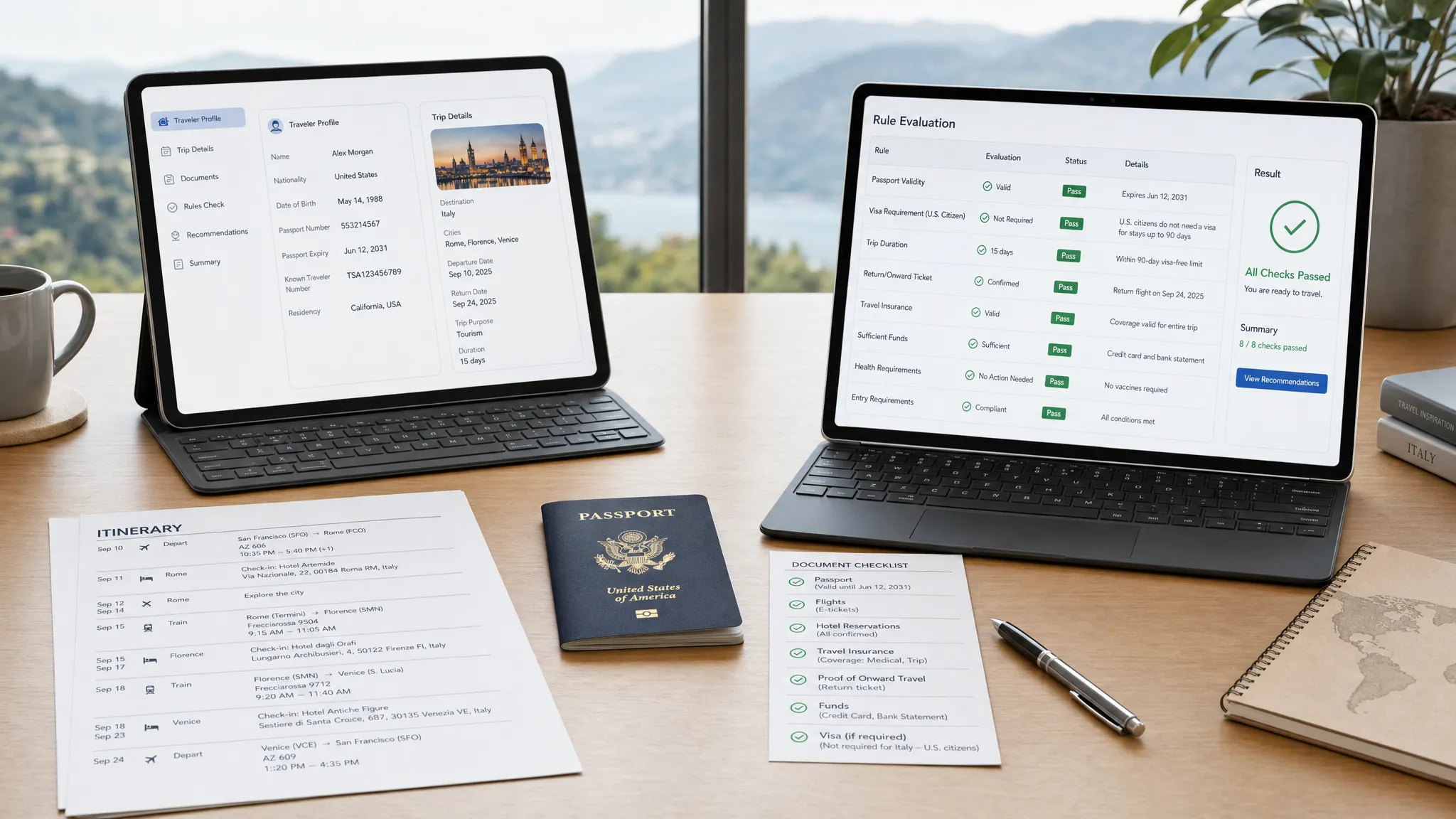
For travelers, visa requirements look like a simple question: “Do I need anything before I go?” For product teams, that question is a moving decision tree shaped by nationality, destination, transit points, travel dates, passport validity, trip purpose, age, residency, and government policy changes.
A visa rules engine turns that complexity into a product decision. It helps a travel app answer the right question at the right moment, then guide the customer toward the next step, whether that is no action, an electronic visa, an ETA, a consular visa, or a document checklist.
That makes it more than a compliance tool. Done well, it improves conversion, reduces support volume, prevents last-minute travel disruption, and opens a new ancillary revenue channel for airlines, OTAs, tour operators, cruise lines, TMCs, and travel insurance sellers.
What Is a Visa Rules Engine?
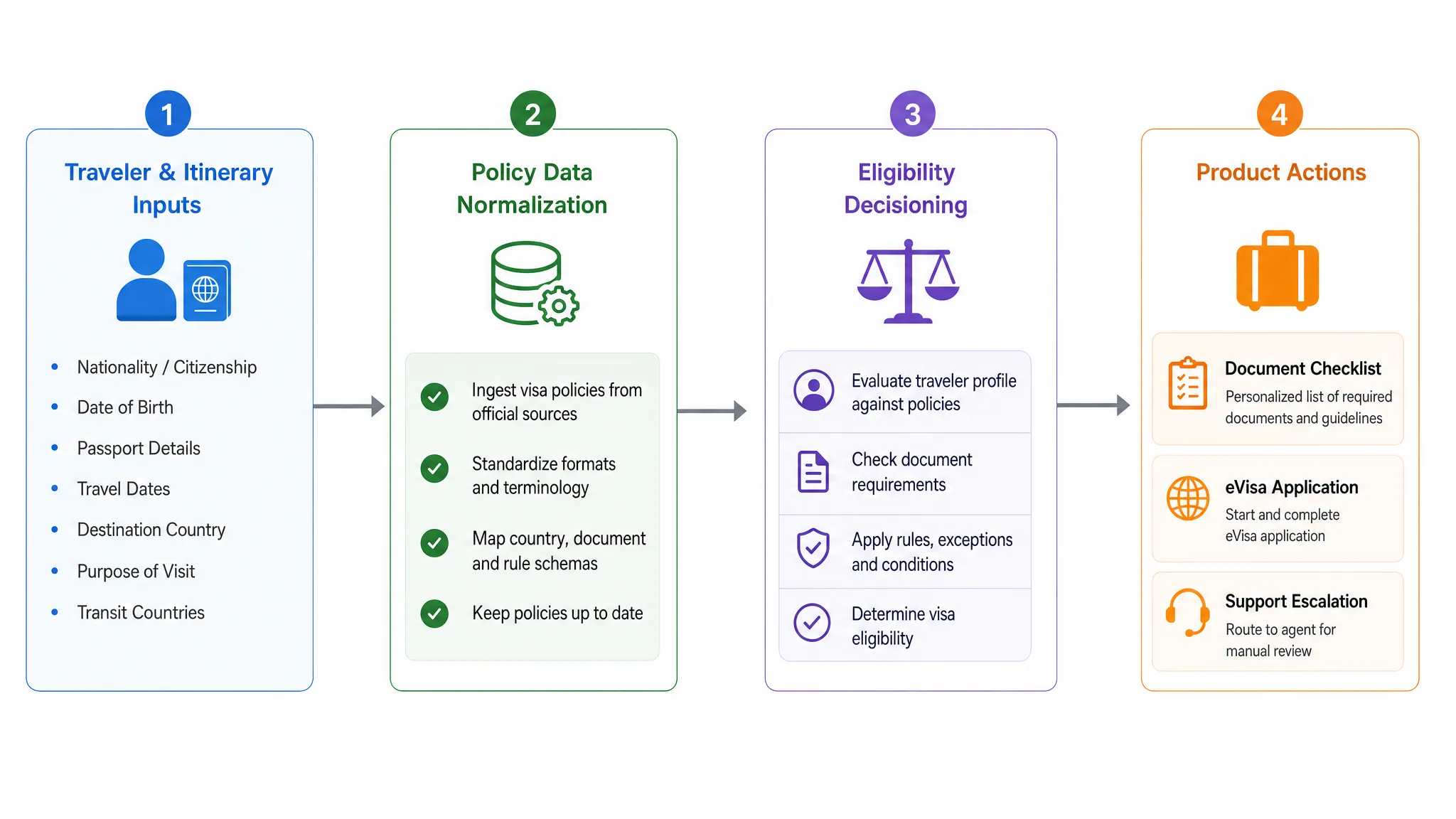
A visa rules engine is the decision layer that evaluates a traveler’s profile and itinerary against current border entry rules. It takes structured inputs, applies eligibility logic, and returns a clear output that your product can display or act on.
In practical terms, it answers questions such as:
- Does this traveler need a visa, eVisa, ETA, transit visa, or no document?
- Is the traveler eligible to apply online, or do they need a consular process?
- Which documents, fees, deadlines, and validity rules apply?
- Should the booking flow show an application CTA, a warning, a checklist, or an escalation path?
Government programs such as the UK Electronic Travel Authorization and Europe’s ETIAS show why this matters. Border requirements are becoming more digital, more personalized, and more likely to affect the booking journey before the traveler reaches the airport.
For a deeper definition of the broader category, see SimpleVisa’s guide to travel document automation.
Why Product Teams Should Care
Visa logic used to live in static help pages, call center scripts, or manual agent workflows. That approach no longer works when customers expect instant answers inside checkout and governments increasingly require pre-travel authorization.
A rules engine gives product teams a way to make border crossing requirements visible without making the user feel like they are reading legal documentation. The product goal is not to display every possible policy paragraph. The goal is to reduce uncertainty and present the next best action.
For travel businesses, the upside is both operational and commercial. When eligibility checks are embedded into the booking flow, customers are less likely to discover missing documents after payment. When the same experience offers guided online visa processing, the compliance moment can become a trusted add-on rather than a support burden.
The Core Inputs Your Rules Engine Needs
A strong visa rules engine starts with the right data contract. If you ask for too little information, the output becomes vague. If you ask for too much too early, customers abandon the flow. Product teams need to balance accuracy with friction.
| Input category | Typical fields | Why it matters for the decision |
|---|---|---|
| Traveler identity | Nationality, passport issuing country, residency, age | Visa rules often vary by passport and sometimes by residence or age group. |
| Passport details | Expiry date, document type, MRZ data, passport number | Many destinations require minimum validity, and machine-readable passport standards are guided by ICAO Doc 9303. |
| Itinerary | Origin, destination, layovers, ports, arrival and departure dates | Transit, multi-country, land-border, and cruise itineraries can trigger different rules. |
| Trip purpose | Tourism, business, transit, study, work, medical, remote work | The same traveler may need different authorization based on purpose. |
| Stay details | Duration, entries, accommodation, onward travel | Some rules depend on length of stay, number of entries, or proof of onward travel. |
| Risk and exceptions | Prior refusals, special document types, minors, dual citizenship | Edge cases may require manual review or a more cautious product message. |
The minimum viable input set for most travel products is nationality, passport issuing country, destination, travel dates, and purpose. For higher precision, add residency, transit points, passport expiry, document type, and mode of entry.
How a Visa Rules Engine Works Behind the Scenes
Product teams do not need to own every technical detail, but they should understand the layers that make the system reliable. A rules engine is not just a database lookup. It is a combination of policy data, normalization, decision logic, explainability, workflow triggers, and monitoring.
| Layer | Product-team question | What to define before launch |
|---|---|---|
| Source data | Where do rules come from, and how fresh are they? | Accepted sources, update cadence, fallback rules, and escalation owners. |
| Normalization | Can different country formats be compared consistently? | Standard categories for visa-free, eVisa, ETA, consular visa, transit visa, and unknown. |
| Decision logic | Which inputs change the answer? | Eligibility rules, exceptions, date calculations, routing logic, and confidence levels. |
| Explainability | Can the user and support team understand the result? | Reason codes, user-facing copy, agent notes, and audit logs. |
| Workflow orchestration | What happens after the decision? | Application CTA, document checklist, payment flow, status tracking, reminders, or handoff. |
| Observability | How do we know the system is working? | Latency, error rates, decision coverage, overrides, policy freshness, and support tickets. |
If your team is building closer to the API layer, SimpleVisa’s guide on real-time visa eligibility checks goes deeper into architecture and implementation patterns.
The Rules Logic Product Teams Should Understand
Visa rules are rarely simple if-then statements. The most important product work is knowing which rule patterns affect the customer journey.
Temporal rules
Many travel authorizations depend on timing. A passport may need to be valid for a minimum period after arrival or departure. An eVisa may have a validity window that starts on approval, on issue date, or on arrival. A stay limit may be calculated per trip or across a rolling period.
For product teams, temporal rules should become user-facing guidance. Instead of saying “passport validity issue,” say something like “Your passport may expire too soon for this destination. Renew it before applying.”
Route and transit rules
Transit is one of the most common sources of confusion. A traveler may not need a visa if they remain airside but may need one if they self-transfer, change airports, collect baggage, or leave the international transit zone.
This is why itinerary structure matters. A one-way destination check is not enough for many modern booking flows. Product teams should capture layovers, airport changes, stop duration, and mode of travel when the journey includes connections.
Purpose-of-travel rules
Tourism, business meetings, paid work, study, medical treatment, and digital-nomad stays can trigger different permissions. A traveler who is visa-free for tourism may still need a visa for business or work-related activity.
Good UX avoids legal jargon while still nudging the user toward accurate disclosure. Clear purpose labels, examples, and plain-language warnings can prevent incorrect applications.
Identity and document exceptions
Rules may differ for minors, dual citizens, residents of certain regions, holders of refugee travel documents, emergency passports, or diplomatic passports. These cases should not be forced through a generic answer.
A good rules engine includes uncertainty handling. If the system cannot confidently determine the requirement, the product should say so and offer a safe next step, such as expert review or customer support.
Design the Output, Not Just the Decision
A rules engine is only useful if the product can turn the response into an action. “Visa required” is not enough. The output should be structured enough for checkout, email, mobile push, customer support, analytics, and revenue reporting.
| Response status | What it means | Best product action |
|---|---|---|
| No travel authorization required | The traveler appears exempt for this itinerary and purpose. | Show reassurance and allow the booking to continue. |
| Electronic authorization required | The traveler needs an ETA or similar pre-travel approval. | Offer an application flow and deadline guidance. |
| eVisa eligible | The traveler can likely apply online for an electronic visa. | Show price, processing time, document checklist, and apply CTA. |
| Consular visa likely required | Online processing may not be available for this case. | Provide a checklist, timing warning, and support handoff. |
| Transit authorization required | A connection may trigger a visa or transit permit. | Explain the trigger, such as self-transfer or airport change. |
| Manual review recommended | The case has missing data or an exception. | Collect more details or route to trained support. |
Reason codes are especially valuable. They let your product show specific copy, power support macros, and analyze drop-off. Examples include passport_expiry_short, transit_self_transfer, purpose_not_supported, document_type_exception, and residency_needed.
The best experiences also separate confidence from eligibility. A “likely eligible” decision is not the same as a government approval. Product copy should make that distinction clear while still helping the traveler move forward.
Where to Surface Visa Rules in the Product Journey
The best placement depends on your business model, but visa rules are most effective when they appear before the traveler is anxious. If the first warning appears at the airport, the product has failed.
In search results, eligibility badges can help customers compare destinations or routes. In checkout, a visa add-on can convert a compliance requirement into a useful service. After booking, automated reminders can reduce support tickets and prevent forgotten applications. In customer support tools, the same rules can help agents answer questions consistently.
For teams deciding between integration models, SimpleVisa’s comparison of API vs. white-label visa apps can help clarify trade-offs.
Common Edge Cases to Plan For
Most rule-engine failures happen at the edges. Product teams should test beyond the happy path before launch.
- Dual citizens booking with one passport but applying with another.
- Self-transfer itineraries where the traveler must pass immigration to collect baggage.
- Multi-country trips where one destination is visa-free but another requires an eVisa.
- Cruise or land-border arrivals where rules differ from airport arrivals.
- Minors traveling with one parent or without legal guardians.
- Passport renewals after booking but before visa application submission.
- Travelers selecting “tourism” when the actual trip includes work, study, or paid activity.
- Last-minute policy changes that affect bookings already in progress.
Each edge case needs a product response. Sometimes that is an extra question. Sometimes it is a warning. Sometimes it is a manual review path. The important thing is to avoid pretending the edge case does not exist.
Build vs. Buy: Choosing the Right Approach
Product teams often begin by asking whether they should build a visa rules engine internally. The answer depends on your volume, geographic coverage, risk tolerance, engineering capacity, and revenue goals.
| Approach | Best for | Watch-outs |
|---|---|---|
| Static content pages | Low-volume sites with limited destinations | Quickly becomes outdated and does not personalize by traveler. |
| In-house rules engine | Large teams needing full control over logic and data | Requires policy monitoring, QA, legal review, support training, and ongoing maintenance. |
| Data-only travel API | Teams that want to power their own UX and workflows | You still need to build application flows, status tracking, and operational tooling. |
| Visa management platform | Teams that want eligibility, guided applications, online visa processing, and reporting | Requires vendor evaluation, integration planning, and commercial model alignment. |
| White-label or no-code flow | Teams that need faster time to market | Less custom UX control than a deep API integration. |
SimpleVisa supports multiple models, including travel API integration, white-label visa application apps, custom data services, and no-code implementation options. That flexibility matters because many teams start with a hosted or white-label flow, then move toward deeper API integration once demand is proven.
If you are evaluating vendors, this RFP checklist for visa management platforms can help structure procurement conversations.
A Practical Rollout Plan for Product Teams
A visa rules engine should not launch as a vague compliance project. Treat it as a product capability with scope, metrics, and ownership.
- Choose the first use case: Start with a high-volume route, destination cluster, traveler segment, or booking touchpoint where visa uncertainty creates measurable friction.
- Define the minimum data contract: Decide which traveler and itinerary fields are required for a confident decision, and which fields can be collected later.
- Create a response taxonomy: Standardize statuses, reason codes, confidence levels, and user-facing actions before engineers wire the flow.
- Map copy to decisions: For every status, write traveler copy, support copy, error states, and escalation guidance.
- Test realistic scenarios: Include transit, dual citizenship, minors, passport expiry, policy changes, and incomplete data in QA.
- Launch with monitoring: Track conversion, attach rate, latency, support tickets, and rework rates from day one.
- Expand coverage gradually: Add destinations, purposes, and deeper application automation once the first flow proves value.
This approach keeps the project focused. It also helps cross-functional teams align because product, engineering, legal, operations, support, and commercial stakeholders can all see how rules become user outcomes.
Metrics That Show Whether the Rules Engine Is Working
Approval rate matters, but it should not be the only metric. Government decisions depend on traveler circumstances and official discretion. Product teams should measure the full journey from requirement discovery to application completion and post-booking support.
| Metric | What it tells you |
|---|---|
| Decision coverage | Percentage of searches or bookings where the engine returns a usable answer. |
| Policy freshness | Time since the relevant rule was last validated or updated. |
| p95 response latency | Whether the rules engine is fast enough for checkout and search. |
| Application attach rate | How often eligible travelers start an eVisa or ETA application from the flow. |
| Completion rate | Whether the application journey is understandable and low-friction. |
| Support contact rate | Whether automated guidance is reducing “Do I need a visa?” tickets. |
| Rework or correction rate | How often travelers must fix documents, photos, or form fields. |
| Denied boarding incidents | Whether pre-travel checks are preventing operational disruption. |
| Ancillary revenue per booking | How much visa-related revenue the product generates per eligible booking. |
The governance layer is just as important as the dashboard. Version rules, store decision logs, record data sources, and make it clear which team owns policy updates. When data is uncertain, the product should fail safely rather than provide overconfident guidance.
Privacy also needs to be designed in from the start. Visa and passport data is sensitive, so teams should minimize data collection, use secure storage, define retention periods, and ensure consent language matches the actual workflow.
Frequently Asked Questions
What is a visa rules engine? A visa rules engine is software that evaluates traveler and itinerary data against border entry rules, then returns a structured decision such as visa-free, eVisa eligible, ETA required, transit visa required, consular visa required, or manual review.
Is a visa rules engine the same as an eVisa API? Not exactly. A rules engine determines requirements and eligibility. An eVisa API may also support application creation, document upload, payment, submission, status tracking, and approval retrieval. Many visa management platforms combine both.
What fields are needed for a minimum viable visa check? Most MVPs need passport nationality, passport issuing country, destination, travel dates, and purpose of travel. For better accuracy, add residency, layovers, passport expiry, mode of entry, and trip duration.
How often should visa rules be updated? Update frequency depends on destinations and risk level. High-volume routes and rapidly changing programs should be monitored continuously or near real time. Lower-volume markets still need scheduled validation, audit logs, and escalation paths for policy changes.
Can a visa rules engine generate ancillary revenue? Yes. When visa eligibility is surfaced at the right point in the booking flow, travel brands can offer guided visa applications, eVisa management, or premium support as relevant add-ons. The key is to present the service as helpful compliance support, not as a surprise fee.
How should product teams handle uncertain cases? Use confidence levels, reason codes, and manual review paths. If the system lacks enough data or detects an exception, the safest product response is to ask for more information or route the traveler to expert support.
Turn Visa Rules Into a Product Advantage
A visa rules engine helps product teams turn complex border requirements into clear, timely customer guidance. It can reduce friction, improve trust, prevent avoidable travel disruption, and create a new path for ancillary revenue.
SimpleVisa helps travel businesses embed visa processing automation through API integrations, white-label apps, custom data services, guided customer applications, premium eVisa management, and no-code implementation options. With solutions available across 400+ sites, SimpleVisa is built to help travel brands add border crossing solutions without slowing down the booking journey.
If your team is ready to make visa requirements part of a better travel product, talk to SimpleVisa about the integration model that fits your roadmap.