Top Mistakes in Online Visa Processing for Travel Brands
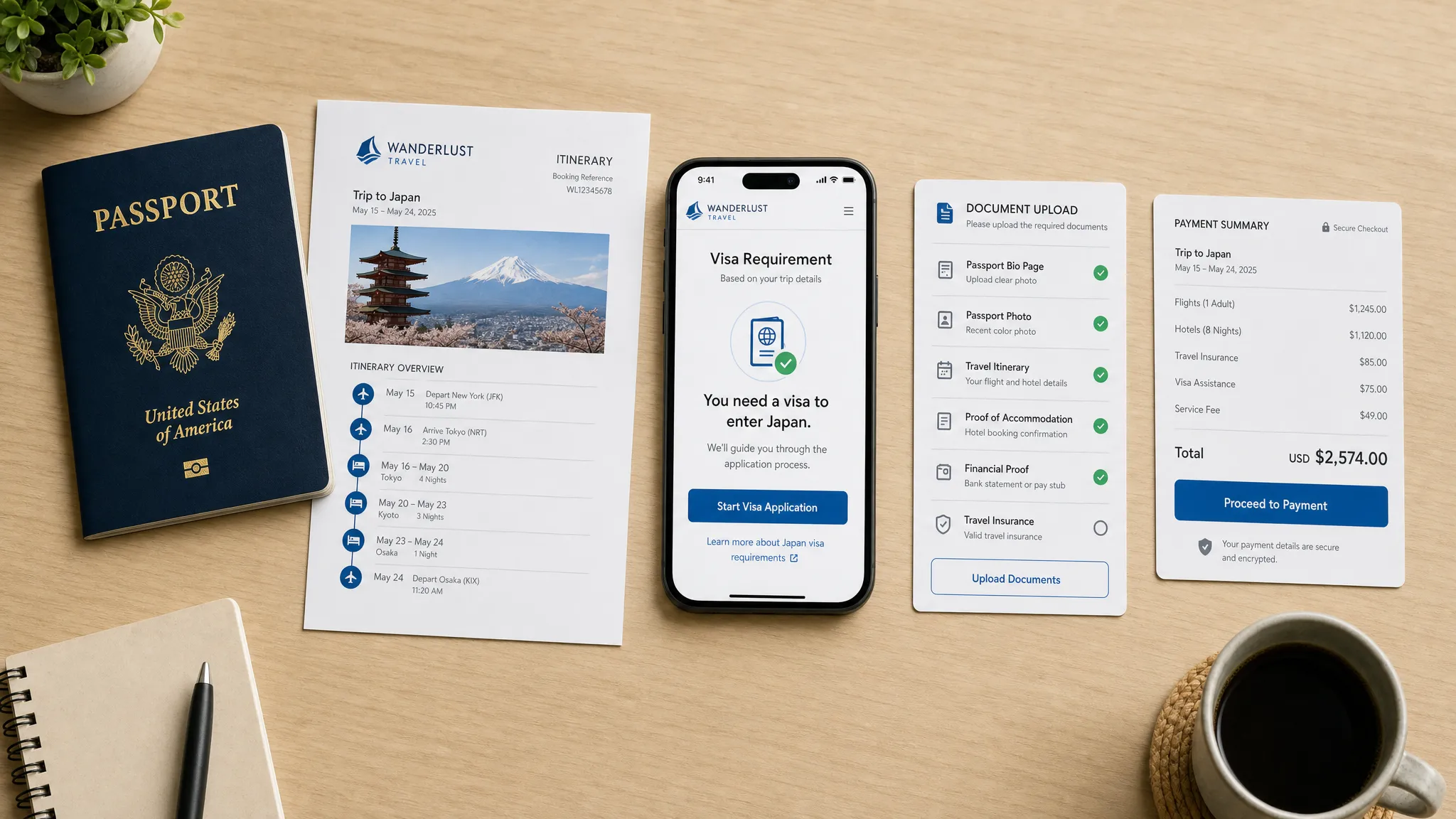
For travel brands, online visa processing is no longer a back-office afterthought. It is part of the booking experience, the customer support experience, and the ancillary revenue strategy.
When it works, travelers understand their border requirements before they pay, submit cleaner applications, and receive status updates without calling your team. When it fails, the consequences show up as abandoned carts, duplicate support tickets, refund disputes, denied boarding risk, and lost trust.
The challenge is that visa requirements are not a single data point. They depend on passport nationality, destination, residence, trip purpose, length of stay, transit points, travel dates, document quality, and fast-changing government rules. That complexity makes online visa processing easy to underestimate.
Below are the most common mistakes travel brands make when adding visa services, plus practical ways to fix them before they affect conversion, compliance, and customer experience.
Why online visa processing is harder than it looks
Most travel products are built around inventory and price. Visa processing is built around eligibility, identity, compliance, and timing. A flight can be available and still be impossible for a customer to use if they cannot obtain the right electronic visa, ETA, transit visa, or supporting document in time.
This is why travel brands should think of visa services as a border crossing solution, not just a link to a government website. The right setup combines accurate rules, guided applications, document validation, secure data handling, payment clarity, customer notifications, and reporting.
Official programs are also evolving quickly. The European Union's ETIAS guidance and the UK ETA guidance are good examples of how pre-travel authorization is becoming a standard part of trip planning for visa-exempt travelers. Travel brands that surface these requirements too late create avoidable friction.
Quick diagnostic: the top mistakes and their fixes
| Mistake | Business impact | Better approach |
|---|---|---|
| Treating visa rules as static content | Outdated advice, missed requirements, support risk | Use dynamic eligibility checks by passport, itinerary, purpose, and travel date |
| Showing visa options too late | Booking surprises, cancellations, lower trust | Surface requirements before checkout and again post-booking |
| Using generic application forms | Wrong visa category, incomplete data, rework | Use dynamic forms that adapt to traveler and destination rules |
| Skipping document pre-checks | Photo and passport upload rejections | Validate file type, size, readability, MRZ, and photo quality before submission |
| Weak privacy and consent UX | Regulatory exposure and customer hesitation | Minimize data, explain purpose, secure storage, and retention clearly |
| Hiding total fees or refund rules | Chargebacks, disputes, abandoned payment | Itemize government fees, service fees, timing, and refund status upfront |
| Ignoring mobile and accessibility | Form abandonment and support tickets | Design mobile-first, save progress, and follow accessibility standards |
| Providing poor status visibility | “Where is my visa?” calls and anxiety | Use real-time status notifications and clear next-step messaging |
| Missing transit and multi-country logic | Denied boarding and itinerary failures | Evaluate every stop, airport transfer, cruise port, and entry count |
| Measuring only revenue | Poor approval quality and long-term trust loss | Track conversion, approval rate, rework, support, refunds, and compliance KPIs |
Mistake 1: Treating visa rules as static content
A common starting point is a destination page that says, for example, “Travelers need an eVisa for this country.” That may be directionally useful, but it is rarely enough for operational online visa processing.
Visa rules can vary by passport nationality, residence, trip purpose, length of stay, entry type, transit route, arrival airport, passport validity, and even recent travel history. Some travelers may need an electronic visa, while others need an ETA, consular visa, visa on arrival, or no authorization at all.
The fix is to move from static content to dynamic eligibility logic. At a minimum, your system should evaluate the traveler’s passport, destination, travel dates, purpose of travel, and itinerary. For complex trips, it should also evaluate layovers, self-transfers, overland borders, cruise ports, and return rules.
For travel brands building this into their own product, a real-time travel API or visa management platform can reduce the burden of maintaining country-by-country rules manually. SimpleVisa explains the technical model in more detail in its guide to real-time visa eligibility checks.
Mistake 2: Introducing visa services after the booking is complete
If customers only discover visa requirements in a post-booking email, the travel brand has already missed the most valuable moment. By then, the traveler may have booked a trip they cannot take, selected dates that are too close for processing, or assumed the airline or agency would handle everything automatically.
This mistake is especially costly for OTAs, airlines, cruise lines, tour operators, and TMCs because the visa requirement is part of trip feasibility. It belongs in the booking flow, not just in the confirmation email.
A stronger pattern is to show a lightweight eligibility prompt before checkout. It does not need to interrupt the purchase. A simple message such as “Visa or travel authorization may be required for this itinerary” can open a guided path with timing, document requirements, and application options.
Post-booking reminders still matter, especially for travelers who skip the initial offer. But the first signal should happen early enough for the traveler to make an informed decision.
Mistake 3: Using one generic form for every traveler
Generic forms create two problems. They ask irrelevant questions that frustrate travelers, and they miss country-specific details that matter for approval.
A business traveler may need invitation details that a tourist does not. A minor may need parental consent. A dual citizen may need guidance on which passport to use. A transit passenger may need a different document from someone entering the country for a week.
The better approach is a guided, dynamic application flow. The form should adapt based on the traveler’s answers, visa type, destination, and trip purpose. This reduces confusion and improves the quality of submitted data.
For travel brands, this is where travel document automation becomes valuable. Instead of expecting customers to interpret government language, the system translates requirements into a step-by-step workflow. If you are still defining what automation should include, SimpleVisa’s guide to travel document automation provides a useful framework.
Mistake 4: Letting customers upload documents without validation
Many visa application problems start with a bad upload. A passport scan is blurry. A photo has shadows. A PDF is too large. The MRZ is cropped. The applicant uploads a screenshot instead of a proper bank statement. The traveler may not realize the issue until the application is delayed or rejected.
This is one of the easiest mistakes to prevent. Online visa processing should include pre-submission checks for file format, file size, image clarity, passport readability, photo dimensions, and document completeness. Even simple validation can reduce avoidable rework.
The best customer experience is immediate and specific. “Your file is too large” is more useful than a generic rejection. “The passport number is not readable, please retake the photo in brighter light” is even better.
This is especially important on mobile, where many travelers use phone cameras rather than scanners. Give clear instructions before capture, show a preview, and confirm that the document passed basic checks before moving to payment or submission.
For more practical detail, see SimpleVisa’s guide to file specs for eVisa uploads and its troubleshooting guide on visa photo rejections.
Mistake 5: Underestimating privacy and consent requirements
Visa flows collect some of the most sensitive data in travel: passport numbers, scans, travel history, identity photos, addresses, payment details, and sometimes biometric-adjacent information. A standard checkout privacy pattern is not enough.
Travel brands must be clear about what data is collected, why it is needed, who processes it, where it may be stored, how long it is retained, and how customers can exercise privacy rights. This is not just a legal issue. It is a conversion issue. Travelers hesitate when they are asked for passport data without clear explanations.
The European Commission’s data protection guidance emphasizes principles such as purpose limitation, data minimization, and security. Similar expectations appear in U.S. state privacy laws such as the CCPA/CPRA.
Strong privacy UX includes plain-language consent, role-based access, encryption, clear retention periods, vendor due diligence, and a process for deletion or data subject requests. If your brand works with a visa processing partner, privacy and security should be part of the procurement checklist, not a final legal review.
SimpleVisa covers this in depth in its guide to handling passport and eVisa data under GDPR and CCPA.
Mistake 6: Hiding fees, timing, and refund rules until payment
Surprise fees are a fast way to lose trust. In visa processing, pricing can include government fees, service fees, optional priority processing, currency conversion, and sometimes extra document handling costs. If those charges appear only at the end, travelers may abandon the flow or dispute the transaction later.
Refund rules also need to be clear. Government visa fees are often non-refundable once submitted, while service fees may depend on application status. If your refund logic is not aligned with processing milestones, your support team will spend time explaining decisions that should have been visible upfront.
A better pattern is to show a transparent fee breakdown before payment. Make it clear which fees are government-imposed, which are service fees, what is optional, and what happens if the traveler cancels or is refused.
For policy design, SimpleVisa’s guide to refunds, cancellations, and reapplications in online visa processing is a practical starting point. Fee transparency is not just a compliance safeguard, it also supports conversion because customers know what they are paying for.
Mistake 7: Designing for desktop when travelers apply on mobile
Many travelers book, upload documents, and complete forms on their phones. Yet many visa flows still behave like desktop portals squeezed onto a small screen. That creates avoidable abandonment.
Mobile visa processing needs large tap targets, camera-friendly upload flows, input masks for passport dates and numbers, save-and-resume functionality, clear progress indicators, and payment methods that work smoothly across regions. Long forms should be broken into manageable steps with clear explanations.
Accessibility matters too. Visa services are essential travel infrastructure, not a nice-to-have add-on. Following WCAG 2.2 guidance helps ensure that customers using assistive technologies can complete the process without unnecessary barriers.
Good mobile and accessibility design also reduces support volume. If customers can understand errors, recover from mistakes, and resume where they left off, they are less likely to call or abandon.
Mistake 8: Failing to provide status visibility after submission
Once a traveler submits a visa application, the next question is predictable: “What happens now?” If your brand cannot answer that clearly, customers will ask support.
A status page or notification flow should tell travelers whether the application is submitted, under review, pending more information, approved, refused, or ready to download. Messages should be plain-English and specific about next steps.
For travel brands, status visibility should also connect to internal operations. Support agents need the same status the customer sees, plus escalation notes and timestamps. Product teams need event data for drop-off analysis. Finance teams need status-aware refund logic.
This is where an integrated visa management platform can be much stronger than a manual process. Status notifications, partner dashboards, and API events help keep travelers and internal teams aligned without constant manual follow-up.
Mistake 9: Ignoring transit, layover, and multi-country edge cases
Visa logic is not limited to the final destination. Transit rules can be strict, and they often depend on the airport, terminal change, self-transfer, overnight stay, ticketing structure, passport nationality, and whether the traveler crosses immigration control.
Cruise itineraries add another layer. A passenger may need an eVisa or permit for a shore excursion even if the stay is only a few hours. Multi-country tours can involve different visa validity windows, entry counts, and passport validity requirements.
Travel brands that only check the destination country can miss these risks. The result may be a traveler who has a valid visa for the final destination but cannot board the first flight or disembark at a port.
A mature online visa processing flow evaluates the full itinerary. It should identify transit authorizations, airport transit visas, shore permits, entry-count limitations, and timing conflicts. For a deeper look at these scenarios, see SimpleVisa’s guide to transit visas and its cruise-focused guide to shore excursion eVisas and permits.
Mistake 10: Measuring only ancillary revenue
Online visa processing can be a strong ancillary revenue channel, but revenue alone is a narrow success metric. If the flow generates sales but creates refusals, support spikes, or refund disputes, the program is not healthy.
Travel brands should measure commercial, operational, and compliance outcomes together. Important metrics include visa attach rate, application completion rate, approval rate, document rework rate, average completion time, status-related support contacts, refund rate, chargebacks, customer satisfaction, and denied boarding incidents.
The goal is not simply to sell more visa services. The goal is to help the right traveler obtain the right authorization at the right time, with as little friction as possible.
SimpleVisa outlines a practical measurement framework in its guide to KPIs for visa management platforms.
What good online visa processing looks like
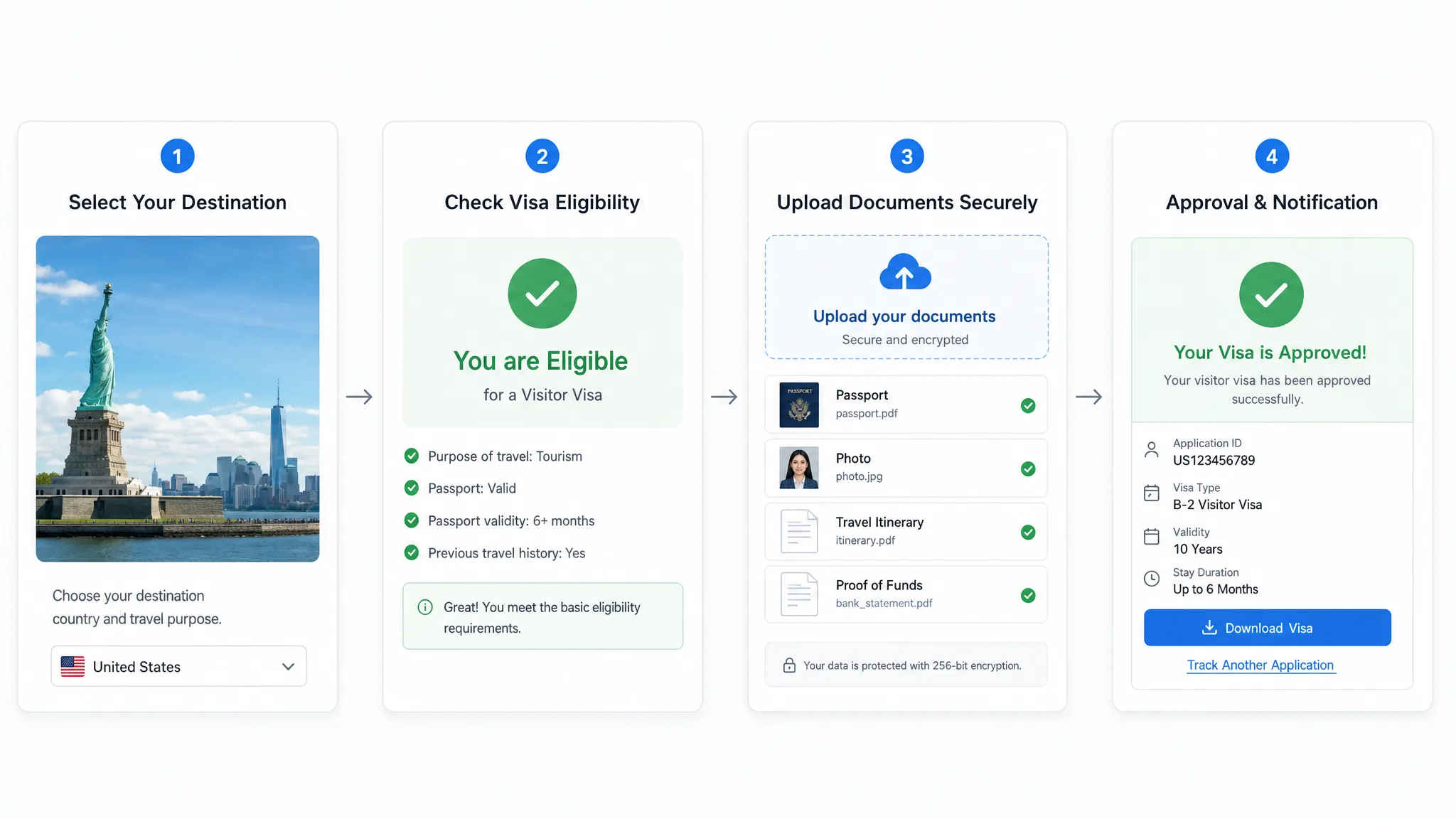
A high-performing visa journey is not just a form. It is an end-to-end experience that starts before booking and continues until the traveler has proof of authorization.
| Stage | Traveler experience | Business control |
|---|---|---|
| Eligibility check | Clear requirement based on passport and itinerary | Reduced compliance and denied boarding risk |
| Offer placement | Visa option appears at the right booking moment | Higher attach rate and ancillary revenue |
| Guided application | Dynamic questions and document prompts | Fewer incomplete applications |
| Document validation | Immediate feedback on uploads | Lower rework and faster processing |
| Secure payment and consent | Transparent fees and privacy explanations | Fewer disputes and stronger compliance |
| Status and delivery | Notifications, download links, and reminders | Lower support volume and better customer confidence |
This kind of journey can be delivered in different ways. Some brands want a deeply embedded travel API. Others need a white-label visa application app that launches quickly. Some start with a no-code implementation or custom data service before moving to a full integration.
The right model depends on your product roadmap, engineering resources, markets, and revenue strategy. If you are comparing options, SimpleVisa’s guide to API vs. white-label visa integration explains the trade-offs.
How to avoid these mistakes before launch
The best time to fix visa processing problems is before customers encounter them. Before launch, bring product, legal, compliance, support, finance, and marketing into the same conversation. Visa services affect all of them.
Start by mapping your highest-risk itineraries and highest-volume destinations. Then define where visa eligibility should appear, what data you need, how documents will be validated, what happens when requirements change, and how support teams will handle exceptions.
A practical launch checklist should answer these questions:
- Can we evaluate visa requirements by passport, itinerary, purpose, and travel date?
- Do travelers see requirements early enough to make informed booking decisions?
- Are document uploads validated before submission?
- Are fees, processing times, and refund rules clear before payment?
- Do privacy notices explain passport data handling in plain language?
- Can customers and support teams see real-time application status?
- Are transit, cruise, and multi-country scenarios covered?
- Which KPIs will we monitor weekly after launch?
If any answer is unclear, the risk is not only technical. It can affect conversion, customer satisfaction, and your brand’s credibility.
Frequently Asked Questions
What is the most common mistake in online visa processing for travel brands? The most common mistake is treating visa requirements as static destination content. Requirements depend on passport nationality, residence, route, travel date, purpose, stay length, and transit details, so travel brands need dynamic eligibility checks rather than generic country pages.
When should travel brands show visa requirements in the booking journey? The first signal should appear before checkout, especially when a visa, eVisa, ETA, or transit authorization may affect trip feasibility. Post-booking reminders are still useful, but they should reinforce the requirement rather than reveal it for the first time.
Can online visa processing generate ancillary revenue without hurting customer experience? Yes, if it is positioned as a helpful compliance service rather than a surprise upsell. Clear pricing, guided applications, document validation, and status updates make the service valuable while creating a new revenue stream.
Should an OTA or airline build visa processing in-house? It depends on engineering capacity, regulatory coverage needs, and speed to market. Building in-house may offer control, but it requires constant rule maintenance, security investment, support workflows, and compliance operations. Many brands start with an API, white-label app, no-code widget, or data service to reduce operational complexity.
What privacy controls matter most for visa application data? Travel brands should focus on data minimization, explicit purpose explanations, secure storage, encryption, access controls, retention limits, vendor due diligence, and clear processes for customer privacy requests. Passport and identity data should never be treated like ordinary checkout data.
How can travel brands reduce abandoned visa applications? Reduce abandonment by showing total fees upfront, designing mobile-first forms, validating documents instantly, using plain-language questions, saving progress, and sending proactive status updates. The less uncertainty travelers feel, the more likely they are to complete the process.
Turn visa complexity into a better travel experience
Online visa processing can either create friction or remove it. The difference comes down to timing, accuracy, UX, privacy, and operational design.
SimpleVisa helps travel businesses simplify border crossing administration with visa processing automation, travel API integrations, white-label visa application apps, custom data services, guided customer applications, and no-code implementation options. Whether you want to embed eVisa services into your booking flow or launch a branded visa journey quickly, SimpleVisa can help you reduce complexity while creating a new ancillary revenue opportunity.
Explore SimpleVisa to see how your travel brand can make visa applications simpler for customers and easier to manage at scale.