What a Good Visa Data Service Should Include
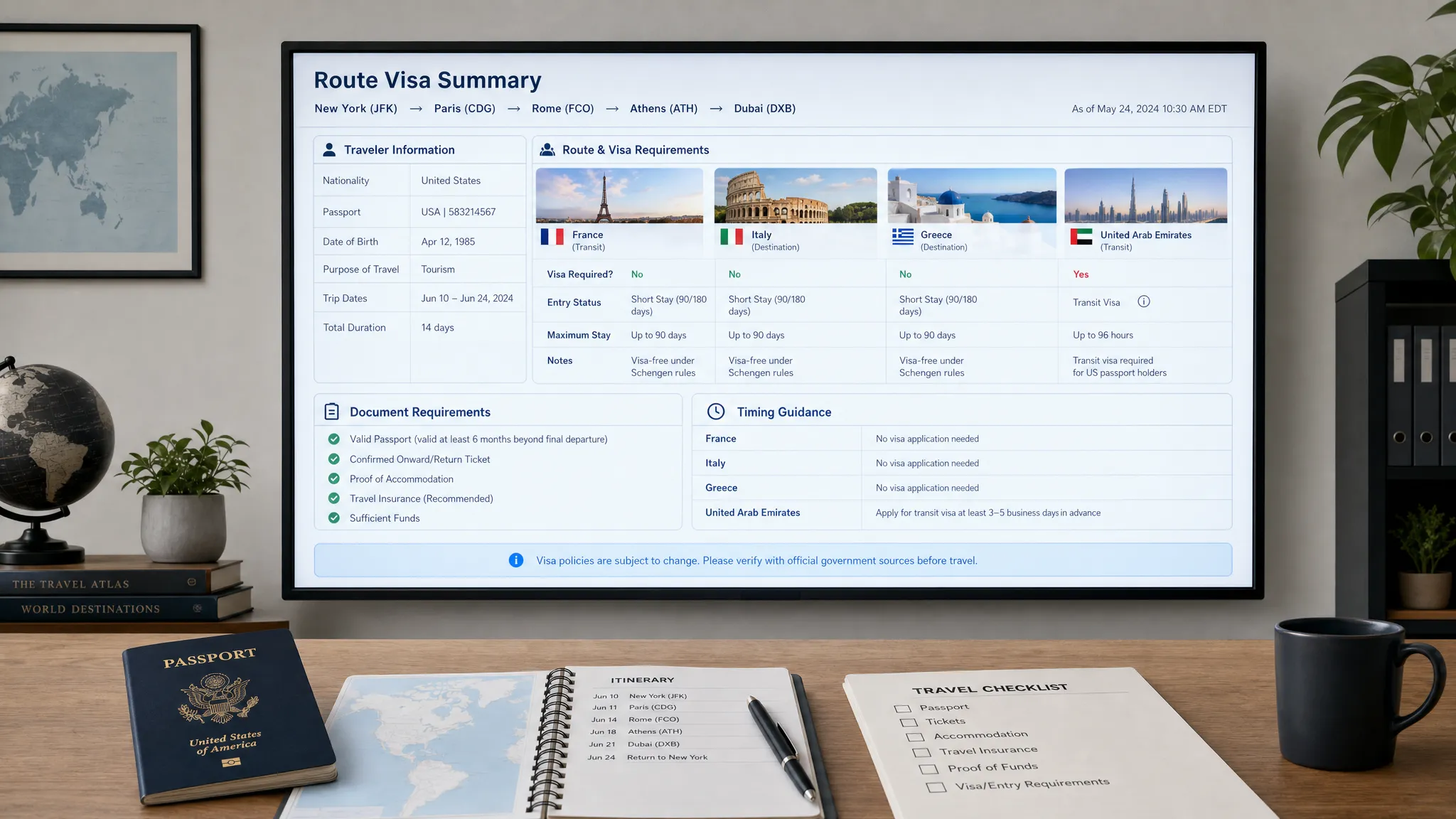
A visa data service is not just a database of country names and requirements. For airlines, OTAs, cruise lines, TMCs, tour operators, travel insurance sellers, and booking platforms, it is the compliance layer that tells a traveler what they need before they pay, before they check in, and before they reach the border.
The difference between a basic content feed and a good visa data service is simple: a basic feed answers, “Does this destination require a visa?” A good service answers, “For this traveler, on this itinerary, for this purpose, on these dates, what is the correct next step?”
That distinction matters. Visa rules vary by passport, residence, destination, transit airport, length of stay, travel purpose, document validity, age, and sometimes even transport mode. If your booking flow gives generic guidance, customers may abandon, contact support, miss an eVisa requirement, or face denied boarding. If your platform gives precise, timely, and actionable guidance, visa compliance becomes a smoother customer experience and a practical ancillary revenue opportunity.
Below is a practical framework for what a good visa data service should include, especially if you are evaluating vendors for a travel API, white-label flow, or broader travel document automation program.
Visa data service vs. visa management platform
Before comparing providers, clarify what you are buying. A visa data service and a visa management platform are related, but they are not identical.
A visa data service usually supplies structured requirements: who needs a visa, what type of authorization applies, what documents are required, how long processing may take, and where the traveler should apply. A visa management platform may go further by guiding the visa application, collecting documents, submitting or managing applications, taking payments, tracking statuses, and supporting exceptions.
| Capability | Visa data service | Visa management platform |
|---|---|---|
| Eligibility rules | Core function | Core function |
| Document requirement data | Core function | Core function |
| Fees and processing estimates | Common | Common |
| Application form completion | Sometimes | Usually |
| Document upload and validation | Sometimes | Usually |
| Status tracking | Limited unless connected to processing | Usually |
| White-label traveler experience | Sometimes | Often |
| Ancillary revenue support | Possible through recommendations | Stronger through embedded purchase and processing |
For many travel businesses, the right answer is not either-or. You may start with a visa data API to surface requirements in search or checkout, then add guided online visa processing where there is strong demand. SimpleVisa, for example, supports travel businesses with API integrations, no-code implementation options, white-label visa application experiences, and custom data services, so teams can choose the implementation model that fits their roadmap.
1. Traveler-specific eligibility logic
The first requirement is personalization. Visa rules are not destination-only rules. A traveler from Canada visiting Turkey may face a different process than a traveler from India visiting the same destination. A resident permit, transit point, cruise itinerary, or dual citizenship scenario can change the answer.
A strong visa data service should evaluate at least these inputs when relevant:
- Passport issuing country
- Traveler nationality or citizenship
- Residence country or long-term permit status
- Destination country or territory
- Transit countries, airports, or ports
- Arrival and departure dates
- Length of stay
- Travel purpose, such as tourism, business, study, transit, medical, or remote work
- Passport type, such as ordinary, diplomatic, service, refugee, or emergency passport
- Traveler age, especially for minors and fee exemptions
- Transport mode, including air, sea, cruise, land border, or rail
This matters because inaccurate over-simplification can create two costly problems. If your flow tells travelers they do not need a document when they do, you expose them to boarding and border risk. If your flow tells travelers they need a visa when they do not, you create unnecessary friction and reduce trust.
The best systems return a decision that is specific, conditional, and explainable. Instead of “visa required,” they should be able to say: “An eVisa is required for tourism stays up to 30 days when arriving by air,” or “No visa is required for this stay, but passport validity and onward ticket rules still apply.”
2. Structured, machine-readable outputs
A good visa data service should not force your product team to parse paragraphs of legal text. It should provide structured data that can power booking flows, support tools, emails, mobile apps, and agent dashboards.
Readable content still matters, but it should sit on top of clean data fields. This is especially important for teams building real-time eligibility checks, checkout add-ons, or post-booking reminders. If the data is not structured, every new destination or rule change becomes a manual product update.
| Output field | What it should tell your system |
|---|---|
| Requirement status | Visa-free, eVisa, eTA, visa on arrival, consular visa, transit visa, not eligible, or review needed |
| Recommended action | Apply online, carry documents, check embassy, contact support, or no action needed |
| Visa or authorization type | Tourist eVisa, business eVisa, ETA, transit permit, shore permit, or other category |
| Required documents | Passport scan, photo, accommodation proof, bank statement, invitation letter, return ticket, and similar items |
| Timing guidance | Earliest application date, recommended application date, typical processing window, and expiry considerations |
| Fee information | Government fee, service fee availability, currency, and whether fees are estimated or fixed |
| Validity and stay rules | Validity period, maximum stay, entry count, and renewal or extension notes |
| Source and update metadata | Last reviewed date, effective date, source category, and confidence level |
| Display content | Plain-language copy suitable for traveler-facing UX |
For developers, this is where a travel API becomes more than a lookup tool. It becomes a decision service. To go deeper on the technical side, see SimpleVisa’s guide to real-time visa eligibility checks.
3. Freshness, effective dates, and source governance
Visa rules change constantly. Governments introduce new electronic visa programs, update fees, change allowed stay periods, add biometric requirements, adjust passport validity rules, and revise eligibility lists. A good visa data service needs a clear approach to data freshness.
Look for three things: update cadence, source governance, and effective-date handling.
Update cadence tells you how often the provider reviews and refreshes rules. Source governance tells you where the provider gets information and how changes are verified. Effective-date handling tells you whether the service can distinguish between rules that apply today and rules that apply to a trip next month.
That final point is crucial. Travel sellers do not just need current rules. They need the rules that apply on the traveler’s arrival date. If a new authorization becomes mandatory on July 1, a traveler departing June 20 and returning July 5 may need different guidance than someone completing the same search for immediate travel.
Industry travel document data has long relied on structured, constantly maintained rule sources, such as IATA Timatic. Modern visa data services should bring the same seriousness to API-first, traveler-facing use cases. Ask vendors how they monitor official government portals, embassy notices, immigration announcements, carrier advisories, and regulatory updates. Also ask how they communicate changes to customers when a high-impact rule shifts.
4. Explainability for travelers, agents, and auditors
Eligibility decisions should not be black boxes. If the answer is “eVisa required,” your customer support team needs to understand why. If a traveler challenges the guidance, your agents need a plain-language explanation. If your compliance team reviews a disputed case, they need an audit trail.
A good visa data service should provide both machine-readable decisions and human-readable reasons. That might include the rule trigger, relevant traveler attributes, assumptions made, and any uncertainty.
For example, an explainable response might include: “Traveler requires an electronic visa because passport country is not visa-exempt for tourism, stay is under the eVisa maximum, and arrival is through an eligible port.” A weak response would simply say: “Visa required.”
Explainability also improves conversion. Travelers are more likely to complete an application when they understand why the document is needed, when to apply, and what happens if they do not complete it.
5. Document requirement intelligence
Visa failures often happen because travelers misunderstand documents. A requirement like “passport photo” or “proof of funds” sounds simple, but file type, image dimensions, background color, date range, naming conventions, and upload size can determine whether an application is accepted.
A good visa data service should include document-level details, not just document names. This is especially important when the service supports online visa processing or feeds a white-label application flow.
Useful document intelligence includes photo specifications, passport scan requirements, PDF limits, accepted proof formats, translation requirements, notarization rules, minor consent requirements, invitation letter rules, and country-specific exceptions. If the data can be paired with upload validation, even better. That reduces rework and helps travelers submit cleaner applications the first time.
This is also where visa data connects directly to user experience. Instead of surprising travelers after payment with a long document list, your flow can surface requirements early and progressively request only what is needed.
6. Coverage for edge cases, not just straightforward tourism
Many data services look accurate when tested against simple trips. The real test is edge cases.
A strong provider should handle scenarios such as transit without clearing immigration, airport changes that require entry, cruises with multiple shore stops, open-jaw itineraries, Schengen-style rolling stay limits, multiple-entry needs, dual citizenship, minors traveling with one parent, travelers holding residence permits in third countries, business visitors attending meetings, digital nomads, and travelers with prior refusals or unusual documents.
Not every edge case can be fully automated. In fact, a good service should be honest when human review is needed. The risky answer is not “review needed.” The risky answer is false certainty.
For travel businesses, edge-case handling is particularly important in high-value journeys: family travel, MICE groups, cruises, long-haul connections, corporate travel, and multi-country itineraries. Those are exactly the situations where a generic country page is least reliable.
7. Integration design for real booking flows
A visa data service should fit into the traveler journey, not sit outside it. The value is highest when visa guidance appears at the moment it can influence behavior.
| Journey touchpoint | What the data service should support |
|---|---|
| Search results | Early eligibility hints and destination risk indicators |
| Checkout | Clear visa requirement, fee estimate, timing, and apply option |
| Post-booking | Personalized reminders, document checklists, and application links |
| Pre-departure | Status prompts, urgent alerts, and support escalation |
| Agent console | Same traveler-specific rule logic used by customer support |
| Disruption handling | Alternative routing or destination guidance when requirements block travel |
From an API perspective, look for fast response times, clear documentation, sandbox access, stable endpoints, authentication options, rate-limit transparency, versioning, and helpful error messages. If your team may move from a hosted flow to a deeper API integration later, choose a provider that supports multiple models.
If you are comparing implementation paths, this guide on API vs. white-label visa integration explains the trade-offs between speed, control, and engineering effort.
8. Security, privacy, and data minimization
Visa data often sits close to highly sensitive traveler information: passports, birth dates, addresses, photos, payment data, and sometimes biometric or health-related details. Even if your first use case is an anonymous eligibility check, your longer-term visa application flow may collect regulated personal data.
A good visa data service should be designed around data minimization. If a simple eligibility decision can be made with nationality, destination, travel dates, and purpose, the service should not require a passport scan. When personal data is needed, the provider should explain why it is needed, how it is protected, how long it is retained, and how deletion or access requests are handled.
Privacy requirements differ by market, but travel brands serving U.S. and international customers often need to account for GDPR, CCPA or CPRA, and sector-specific security expectations. The European Commission’s GDPR business guidance is a useful reference point for principles such as lawful basis, transparency, minimization, and data subject rights.
For a deeper travel-specific view, see SimpleVisa’s guide to handling passport and eVisa data under GDPR and CCPA.
9. Operational reliability and vendor accountability
Visa guidance is operationally sensitive. If your service fails at checkout, you may lose an application sale. If it fails at check-in, you may create support spikes or boarding delays. If it returns stale data during a regulatory change, your brand takes the customer impact.
A good visa data service should include clear operational commitments. Ask about availability, latency, data freshness targets, incident notifications, escalation paths, support hours, disaster recovery, and status page practices. Also ask whether the vendor provides changelogs for rule updates and technical releases.
The best providers make it easy to answer these questions before you sign. They should be able to explain how they monitor their systems, how they test rule changes, how they roll back errors, and how customers are notified when a destination’s requirements change.
This is not just an engineering issue. It is a commercial issue. If your visa data powers ancillary revenue, every outage can affect conversion. If it powers compliance messages, every stale rule can affect customer trust.
10. Commercial and analytics capabilities
A good visa data service should help the business understand demand. Which routes trigger the most eVisa needs? Which destinations create the most abandoned applications? Which traveler segments respond best to embedded visa offers? Where do support tickets cluster?
These insights help travel companies decide where to add full online visa processing, where to invest in localized copy, and where to prioritize support training. They also help product teams measure the impact of visa automation on conversion, attach rate, refund rates, and customer satisfaction.
For travel businesses building ancillary revenue, data quality and commercial design go together. The service should not pressure every traveler into an unnecessary application. It should identify genuine requirements and present the right service at the right moment. That is how compliance becomes useful, trusted, and profitable.
A practical scorecard for evaluating a visa data service
Use this scorecard during vendor demos, RFPs, and pilots. The goal is not to find the longest feature list. The goal is to find a data partner that can support real traveler journeys with accuracy, transparency, and operational discipline.
| Requirement | Why it matters | What to ask |
|---|---|---|
| Personalized eligibility | Avoids generic and misleading guidance | Which traveler and itinerary fields do you evaluate? |
| Global coverage | Supports more routes and customer segments | Which countries, territories, visa types, and transit cases are covered? |
| Data freshness | Reduces stale-rule risk | How often are rules reviewed and how are urgent updates handled? |
| Effective dates | Supports future travel accurately | Can the API return rules based on arrival date? |
| Structured outputs | Enables automation across UX, support, and analytics | Are results returned as normalized fields, not just text? |
| Explainability | Builds traveler and support-team trust | Does each decision include a reason and assumptions? |
| Document specs | Reduces application errors and rework | Do you include photo, file, format, and proof requirements? |
| API quality | Speeds implementation and lowers maintenance | Do you provide sandbox access, versioning, docs, and test cases? |
| Privacy controls | Protects sensitive traveler data | What data is required, retained, encrypted, and deleted? |
| Commercial reporting | Helps prove ROI | Can we track conversion, attach rate, and common failure points? |
| Support and SLAs | Protects operations | What are your availability, response, and escalation commitments? |
| Expansion path | Avoids re-platforming | Can we move from data-only to embedded application or white-label processing? |
For a broader procurement checklist, you can also use SimpleVisa’s 15-question RFP guide for visa management platforms.
Red flags to watch for
A vendor may look good in a demo but fail in production if the underlying data is weak. Watch for warning signs during evaluation.
- The service only provides country-to-country summaries with no itinerary or traveler-specific logic.
- Rules are displayed as long text blocks with no structured API fields.
- The provider cannot explain update sources, review cadence, or effective-date handling.
- Transit, cruise, minors, residence permits, and dual citizenship are treated as afterthoughts.
- Fee and processing-time information is shown without currency, assumptions, or update metadata.
- There is no sandbox, versioning policy, or clear API error model.
- The vendor requires excessive personal data for simple eligibility checks.
- Support teams cannot see why a rule was returned.
- The product has no path from data guidance to guided visa application or eVisa fulfillment.
None of these red flags automatically disqualifies a provider for every use case. A small travel publisher may only need basic content. But if you run a booking platform, airline flow, cruise journey, TMC portal, or travel insurance checkout, weak data architecture becomes expensive quickly.
Where SimpleVisa fits
SimpleVisa helps travel businesses simplify border-crossing administration by bringing visa requirements and application support into the customer journey. Depending on your needs, that can mean API integration for travel sites, a white-label visa application app, custom data services, guided customer visa applications, premium eVisa management, or no-code implementation.
For partners, the business case is practical: reduce traveler confusion, guide customers through requirements, improve completion, and create ancillary revenue from compliant visa services. SimpleVisa is available across 400+ sites and is built for travel businesses that want visa data and visa application flows to work inside their existing booking or post-booking experience.
If your team is still defining the technical approach, start with the basics: identify your highest-risk routes, map where travelers currently ask visa questions, decide whether you need data-only guidance or embedded processing, then test the experience with real itineraries and edge cases.
Frequently Asked Questions
What is a visa data service? A visa data service provides structured information about entry requirements, visa types, eVisas, eTAs, transit rules, document requirements, fees, processing guidance, and related border rules. Travel businesses use it to power eligibility checks, booking messages, support tools, and application flows.
How often should visa data be updated? There is no universal update frequency that guarantees accuracy, but high-quality services should monitor rules continuously, review key destinations frequently, and communicate urgent changes quickly. Effective-date handling is just as important as update frequency because travelers book for future trips.
Is a visa data service the same as an eVisa API? Not always. A visa data service may only return eligibility and requirement data. An eVisa API may also support application creation, document upload, payment, submission, status tracking, and approval delivery. Some providers offer both.
What information is needed for real-time visa eligibility checks? At minimum, most checks need passport country, destination, travel dates, length of stay, and travel purpose. More complex cases may require residence country, transit points, transport mode, passport type, age, and itinerary details.
Can a visa data service guarantee entry? No. Final entry decisions are made by border authorities. A good visa data service can help travelers understand requirements and reduce errors, but it should clearly communicate that approval or possession of a visa does not guarantee admission.
How can visa data create ancillary revenue? Accurate visa data identifies when a traveler genuinely needs an eVisa, ETA, or related service. Travel brands can then offer guided application support during checkout or post-booking, improving convenience for customers while generating a compliant ancillary revenue stream.
Turn visa data into a better travel experience
Visa rules are becoming more digital, more dynamic, and more embedded in the booking journey. A good visa data service should help your customers understand what they need, help your teams reduce avoidable support work, and help your business turn compliance into a better product experience.
If you want to add visa requirements, eVisa guidance, or online visa processing to your travel flow, SimpleVisa can help you choose the right model, from custom data services and API integration to white-label and no-code implementation options.