B2B Visa Processing: What Travel Partners Need Most
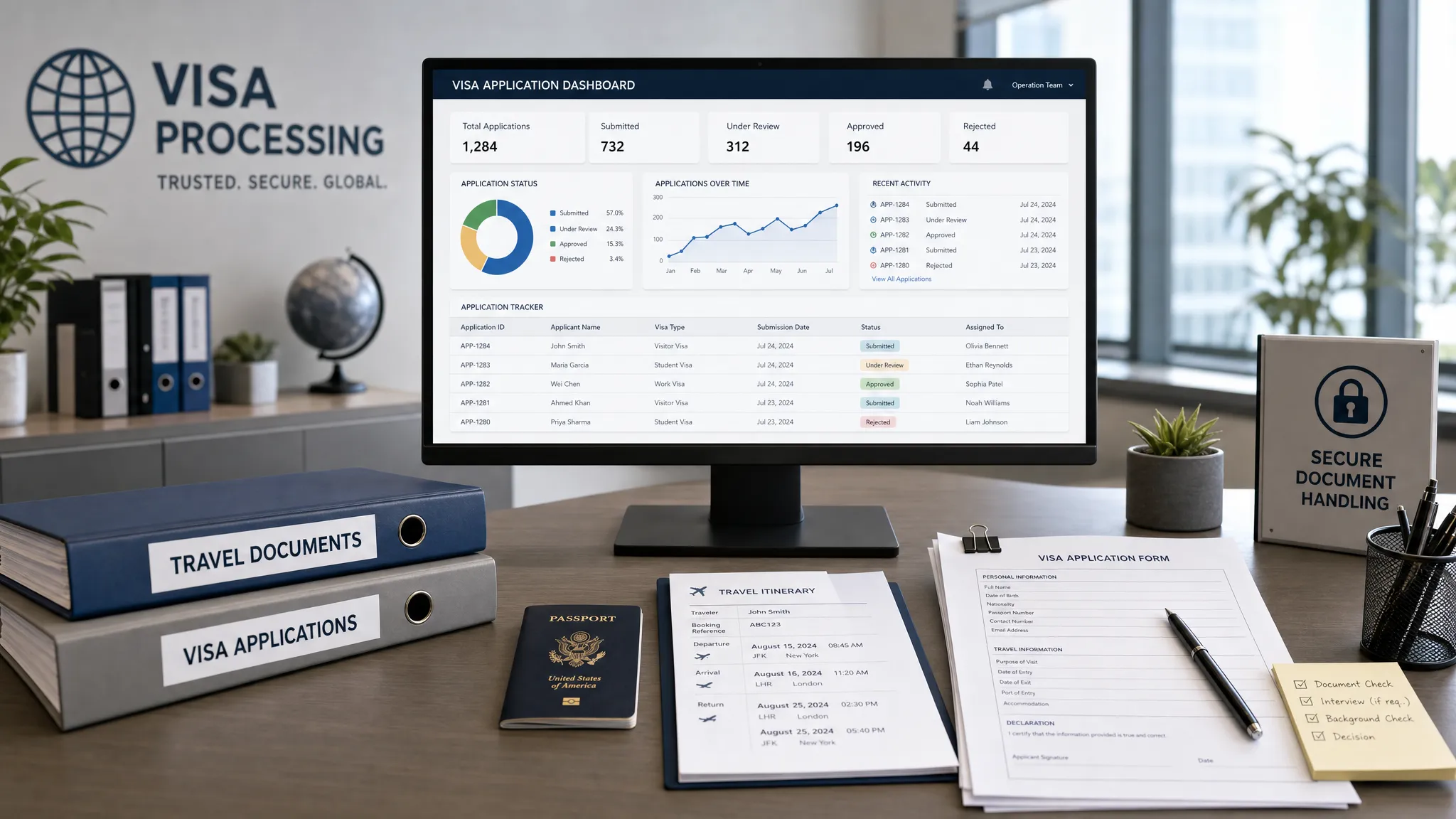
B2B visa processing used to sit at the edge of the travel experience. A customer booked a trip, then figured out the visa later through an embassy, a government website, or a third-party agency. That model no longer works for travel brands that compete on convenience, conversion, and end-to-end trip confidence.
Today, airlines, OTAs, tour operators, cruise lines, TMCs, and superapps need visa support that behaves like modern travel infrastructure. It has to identify border requirements early, guide travelers through the right application, protect sensitive passport data, and keep the partner informed when something changes.
In short, travel partners do not just need a visa form. They need a reliable B2B visa processing layer that supports customer experience, compliance, operations, and ancillary revenue at the same time.
Why B2B visa processing is now a core travel-tech layer
The growth of electronic travel authorizations, eVisas, and pre-travel screening systems has changed the role of travel sellers. Programs such as the UK Electronic Travel Authorization, the EU’s ETIAS framework, ESTA, eTAs, and country-specific eVisa portals mean more travelers must solve documentation questions before departure.
For B2B travel partners, the risk is not only a refused visa. The bigger problem is uncertainty. If a traveler does not know whether they can enter, whether a transit visa is needed, or whether their application is still pending, the uncertainty spills into every commercial and operational metric: booking conversion, support volume, refund requests, customer satisfaction, and day-of-travel disruption.
A modern B2B visa processing solution should answer three practical questions at scale:
- Can this traveler take this trip with this passport, route, purpose, and travel date?
- If they need a visa or travel authorization, what is the simplest compliant path to obtain it?
- How can the travel partner track progress, handle exceptions, and create value without adding friction?
That is why visa processing is no longer just an administrative service. It is part of the booking flow, post-booking journey, support stack, revenue strategy, and data governance program.
1. Accurate, contextual visa rules
The first thing travel partners need is reliable eligibility intelligence. A static country table is not enough because visa rules depend on context. Two travelers flying the same route may have different requirements based on nationality, passport type, residence, trip purpose, length of stay, airport transit, prior travel history, or the timing of entry.
Good B2B visa processing starts with a rules engine that can interpret itinerary-level details. For example, a traveler may not need a visa for the final destination but may need authorization for a connection. Another traveler may be visa-exempt for tourism but not for business meetings. Families may need extra documentation for minors. Cruise passengers may face different shore-entry rules at each port.
For partners, accuracy must also be explainable. Product, support, and compliance teams need to understand why a requirement was returned, when the rule was last updated, and what data fields influenced the result. This matters because frontline agents cannot confidently resolve customer questions if the answer appears as a black box.
A strong rules layer should include:
- Passport nationality, destination, transit, residence, date, and travel-purpose logic
- Clear distinctions between visa-free entry, eVisa, eTA, visa on arrival, and consular visa requirements
- Source-backed guidance where available, with update timestamps and confidence signals
- Edge-case handling for multi-country trips, minors, cruise ports, business travel, and transit scenarios
- Fallback pathways when automated eligibility is not enough
This is the foundation for every downstream workflow. If the eligibility answer is wrong or incomplete, the application flow, support process, and revenue model all inherit that risk.
2. A traveler experience that stays inside the booking journey
Travel partners need visa processing that feels native to their customer journey. Travelers should not have to leave a trusted booking flow, re-enter the same personal data, or interpret complex government language on their own.
The most effective visa journeys appear at the moments when the traveler is already thinking about trip readiness. That might be during destination search, checkout, confirmation, a post-booking email, a mobile app card, or a pre-departure reminder. The goal is not to overwhelm the user at purchase. It is to surface the right requirement at the right time with a clear next step.
A good B2B flow should feel simple even when the underlying requirements are complex. That means plain-language copy, dynamic questions, mobile-friendly document capture, visible progress, transparent fees, and proactive status updates. If the customer needs to upload a passport scan or photo, the interface should explain file requirements before the upload fails.
This is where embedded visa services become commercially powerful. When travelers can apply directly through a partner’s branded experience, the partner protects trust, reduces leakage, and keeps the service connected to the booking record. SimpleVisa supports this through options such as API integration, a white-label visa application app, custom data services, and no-code implementation, giving partners multiple ways to fit visa processing into their existing flow.
For a deeper look at implementation options, see SimpleVisa’s guide to how eVisa APIs work and the no-code approach to white-label visa services.
3. Automation that prevents avoidable application errors
Travel partners need more than submission capability. They need automation that reduces the errors that cause delays, rework, refusals, and support tickets.
Common visa application problems are highly predictable: name mismatches, expired passports, unreadable scans, incorrect photo dimensions, missing accommodation proof, inconsistent travel dates, wrong visa type selection, and payment issues. Manual checks can catch some of these, but they do not scale across high-volume booking environments.
The value of online visa processing is strongest when it includes pre-submission validation. This can include machine-readable zone checks, guided document uploads, dynamic document lists, form prefill, validation rules, and alerts when an application is likely to fail because required information is missing.
Travel partners should look for automation in four areas:
- Eligibility automation: Identifies which travelers need visas, eVisas, eTAs, or supporting documents.
- Document automation: Guides uploads, checks file quality, and flags missing or inconsistent information.
- Application automation: Prefills repeat data, routes travelers to the correct form, and reduces duplicate entry.
- Status automation: Sends updates when an application is received, submitted, approved, rejected, or requires action.
This is the difference between digitizing a form and improving the outcome of the whole visa journey. A travel document automation approach, explained in SimpleVisa’s guide to Travel Document Automation, helps partners move from reactive support to proactive trip readiness.
4. Flexible integration models for different business realities
Not every travel partner has the same engineering capacity, customer journey, or commercial goal. A large OTA may want a deeply embedded API experience. A tour operator may prefer a branded portal. A cruise line may need custom data for port-by-port requirements. A smaller agency may want a no-code launch first, then move to a fuller integration later.
That is why flexibility is one of the most important B2B requirements. A visa processing partner should not force every business into the same model.
| Integration model | Best fit | What travel partners need | Main trade-off |
|---|---|---|---|
| Visa rules data service | Search, destination pages, trip planning, agent tools | Accurate eligibility data and clear response logic | Partner builds most of the customer experience |
| Full travel API | OTAs, airlines, superapps, TMC platforms | Eligibility, application flow, status events, and reporting in existing systems | Requires more product and engineering work |
| White-label visa app | Tour operators, agencies, TMCs, affiliate partners | Branded application experience with faster time to market | Less control than a fully custom API flow |
| No-code widget or hosted flow | Fast pilots, smaller teams, new ancillary launches | Quick deployment, minimal technical lift, easy configuration | Limited customization compared with API integration |
| Custom data service | Cruise, MICE, complex itineraries, regional specialists | Tailored rules, itinerary logic, and partner-specific outputs | Requires close scoping and ongoing governance |
The best approach often starts with the fastest path to value. A partner can validate demand with a no-code or white-label flow, then move toward deeper API integration once volume and internal priorities justify it.
5. Security, privacy, and consent by design
Visa processing involves some of the most sensitive data in travel: passport numbers, scans, birth dates, addresses, travel history, photos, payment information, and sometimes biometric or identity-verification data. For B2B partners, this makes security and privacy non-negotiable.
Travel brands need a partner that treats privacy as part of the product experience, not as a hidden legal appendix. Travelers should understand why each data point is requested, how it will be used, and whether it is required for the application. Partners also need confidence that personal data is minimized, protected, retained only as needed, and deleted according to agreed policies.
Regulatory expectations vary by market, but frameworks such as the EU GDPR and U.S. state privacy laws have made data handling a board-level concern for travel companies. On the technical side, API-based products should also be evaluated against established security guidance such as the OWASP API Security Top 10.
At a minimum, travel partners should expect clear answers on:
- Encryption in transit and at rest
- Role-based access controls and audit logging
- Data retention and deletion workflows
- Consent language and data-processing responsibilities
- Subprocessor transparency and cross-border transfer controls
- Incident response, breach notification, and support procedures
- Secure API authentication, key rotation, rate limits, and webhook verification
For vendor evaluation, SimpleVisa’s guide to security features in electronic visa solutions provides a useful checklist.
6. A commercial model that creates revenue without eroding trust
Visa processing can be a strong ancillary revenue channel, but only when it is presented as a useful travel service rather than an opaque add-on. Customers are willing to pay for convenience, guidance, and reduced risk, but they react poorly to surprise fees, unclear refund rules, or confusing service charges.
Travel partners need commercial models that match their brand and customer base. Some prefer revenue share. Others use fixed service fees, subscription arrangements, API pricing, white-label licensing, or hybrid models. The right structure depends on booking volume, visa incidence, average order value, support burden, and the partner’s appetite for operational involvement.
The key is transparency. Visa fees should be separated clearly from service fees. Refund and cancellation rules should be visible before payment. If an application is rejected, the customer should know whether reapplication support exists and what costs apply.
| Commercial requirement | Why it matters for partners |
|---|---|
| Upfront fee display | Reduces payment friction, refund disputes, and abandoned applications |
| Flexible pricing model | Lets partners match costs to volume, margin goals, and launch maturity |
| Revenue reporting | Helps finance and product teams track ancillary performance |
| Reapplication logic | Protects customer trust when applications are denied or incomplete |
| Currency and localization support | Improves conversion across markets and reduces payment confusion |
| Clear service scope | Prevents misunderstanding between government fees, platform fees, and support services |
Visa processing is most effective when it is framed as trip protection and readiness. For more detail on the commercial side, see SimpleVisa’s guide to ancillary revenue from compliance services and its overview of B2B pricing models for visa management platforms.
7. Operational visibility and exception handling
Even the best automated visa journey needs operational support. Government portals can slow down. A traveler may upload the wrong document. A destination may change a requirement. A high-value corporate traveler may need urgent escalation. A family booking may involve multiple linked applications with different statuses.
Travel partners need real-time visibility into the application lifecycle. This does not always require a large support team, but it does require usable status information. Agents should be able to see where an application stands, what action is needed, and whether the customer has already received a notification.
Common statuses might include application started, documents pending, submitted, government review, action required, approved, rejected, expired, or refunded. The exact labels are less important than consistency and clarity. If a traveler calls support, the agent should not have to search through email threads or ask the customer to forward government messages.
Operationally mature B2B visa processing includes:
- Status webhooks or dashboard updates for application events
- Escalation paths for urgent travel dates and complex cases
- Support macros and plain-language explanations for common issues
- Audit trails for compliance, refunds, and customer disputes
- Resilience planning for government API outages and delayed responses
- Reporting that connects visa outcomes to bookings, revenue, and support volume
This is especially important for airlines and OTAs, where the cost of a single unresolved travel-document issue can include call-center time, refunds, missed departures, and customer churn.
8. Reporting that connects visa processing to business outcomes
Travel partners need to prove that B2B visa processing improves more than compliance. The strongest business case connects visa workflows to measurable outcomes across the journey.
A useful KPI framework should include both operational and commercial metrics:
| KPI | What it reveals |
|---|---|
| Eligibility-check coverage | How many relevant bookings receive visa guidance |
| Visa attach rate | How often eligible travelers purchase or start the visa service |
| Application completion rate | Whether the flow is simple enough for travelers to finish |
| Approval or success rate | Whether guidance and validation reduce avoidable failures |
| Time to completion | How quickly travelers move from application start to submission |
| Support contact rate | Whether automation and notifications reduce customer questions |
| Refund and reapplication rate | Whether policies and guidance are working as intended |
| Ancillary revenue per booking | Whether the service contributes to margin without hurting trust |
The point is not to track every possible metric on day one. It is to create a feedback loop. If completion rate is low, improve UX. If support contact rate is high, improve notifications. If attach rate is low, test placement and messaging. If document-related rejections are high, improve validation.
What different travel partners prioritize most
The best B2B visa processing strategy depends on the partner type. An airline cares heavily about boarding readiness. A tour operator cares about group coordination. A TMC cares about policy compliance and traveler duty of care. A superapp may care most about embedded convenience and revenue per user.
| Travel partner | Highest-priority needs | Why it matters |
|---|---|---|
| Airline | Real-time eligibility, status visibility, denied-boarding prevention | Visa issues can disrupt airport operations and customer trust |
| OTA | Embedded checkout, conversion optimization, ancillary revenue | Visa guidance can reduce booking uncertainty and create a new add-on |
| Tour operator | Group workflows, fixed-price packaging, support visibility | Many travelers follow the same itinerary but have different passports |
| Cruise line | Port-by-port requirements, transit logic, last-minute updates | Shore-entry rules vary by port, nationality, and itinerary |
| TMC | Corporate policy alignment, reporting, urgent escalation | Business travelers need reliable documentation with minimal disruption |
| Travel insurance seller | Embedded readiness checks, cross-sell timing, compliant data handling | Visa friction affects trip risk, claims, and customer confidence |
| Superapp | Fast API response, native UX, localized payments | Visa services must feel like a natural one-tap extension of travel booking |
The common thread is that partners need a visa workflow that fits their business model, not a generic consumer agency process repackaged for B2B.
Build vs. buy: what travel partners should consider
Some travel companies consider building visa processing internally. That can make sense for narrow use cases, such as one destination, one traveler profile, or a low-volume support tool. But for multi-market travel businesses, the true cost includes far more than the initial engineering work.
Internal teams must maintain rule updates, build eligibility logic, handle exceptions, secure passport data, manage application workflows, monitor government changes, train support teams, and maintain reporting. They also need resilience planning for external system downtime and enough operational knowledge to handle edge cases.
A specialized visa management platform can shorten time to market because the core infrastructure already exists. Partners can then focus on placement, branding, pricing, and customer experience. This is where SimpleVisa fits: it helps travel businesses guide customers through border requirements, automate visa applications, and integrate services through API, white-label, custom data, or no-code options.
For travel partners, the best question is not simply “Can we build it?” The better question is “Can we maintain it accurately, securely, and profitably across every market we sell?”
A practical vendor checklist for B2B visa processing
When evaluating providers, travel partners should use demo sessions to test real scenarios rather than only reviewing slideware. Bring sample itineraries, difficult passports, transit cases, family bookings, corporate trips, and last-minute departure dates.
Ask these questions before choosing a visa processing partner:
- Which traveler and itinerary inputs does your eligibility engine use?
- How often are visa rules updated, and how are changes verified?
- Can your response explain why a visa is required or not required?
- Which integration models do you support: API, white-label, no-code, or data service?
- How do you handle document validation before submission?
- What application statuses can be sent through webhooks or dashboards?
- How are government outages, delayed approvals, and reapplications handled?
- What data is collected, where is it stored, and how long is it retained?
- How are fees displayed, refunded, reconciled, and reported?
- Which KPIs are available for product, operations, and finance teams?
- What launch support, training, and escalation paths are included?
- How can the solution scale from a pilot to a global rollout?
The right partner should be able to answer with examples, not generalities. B2B visa processing is too close to revenue, compliance, and customer trust to rely on vague promises.
Frequently Asked Questions
What is B2B visa processing? B2B visa processing is the technology and operational workflow that lets travel businesses check visa requirements, guide customers through applications, process eVisas or travel authorizations, and track outcomes inside their own travel journey.
How is B2B visa processing different from a consumer visa agency? A consumer agency usually serves individual travelers directly. A B2B visa processing platform supports travel partners at scale through APIs, white-label apps, data services, dashboards, automation, reporting, and commercial models such as revenue share or platform pricing.
Which travel partners benefit most from visa processing automation? Airlines, OTAs, tour operators, cruise lines, TMCs, superapps, and travel insurance sellers can all benefit. The value is highest when customers travel internationally, itineraries are complex, or visa rules frequently affect booking confidence and support volume.
Can visa processing become ancillary revenue? Yes. Visa and travel authorization services can create ancillary revenue when they are positioned transparently as a useful trip-readiness service. Success depends on accurate eligibility checks, clear pricing, smooth UX, and strong post-purchase support.
Is an API always the best integration model? Not always. An API is best for partners that need deep control and have engineering resources. White-label apps, no-code widgets, and custom data services may be better for faster launches, smaller teams, or partners that want to validate demand before a full integration.
What should partners prioritize first when launching a visa solution? Start with accurate eligibility checks and a clear customer journey. Once travelers know what they need and how to apply, partners can optimize automation, pricing, status notifications, reporting, and support workflows.
Make visa processing a stronger part of your travel journey
Travel partners need visa processing that is accurate, embedded, secure, operationally visible, and commercially useful. When those pieces work together, border requirements stop being a source of friction and become a better customer experience.
SimpleVisa helps travel businesses streamline visa applications, integrate border requirements into booking flows, and launch visa services through API, white-label, custom data, and no-code options. If you want to reduce documentation friction while creating a new ancillary revenue opportunity, connect with SimpleVisa to explore the right model for your business.