Visa Revenue Share Models That Make Sense in 2026

Visa services used to sit outside the commercial core of travel. A traveler discovered the requirement late, left the airline or OTA website, searched for an official portal, and often returned only when something went wrong. In 2026, that pattern is no longer good enough.
Electronic visa and ETA requirements are expanding, booking flows are becoming more embedded, and travelers expect the same clarity for border documents that they get for baggage, seats, insurance, or transfers. For travel brands, that creates a real ancillary revenue opportunity. But it also raises a harder commercial question: which visa revenue share models are sustainable, transparent, and fair in 2026?
The answer is not simply “take the highest commission.” A good model should align incentives across the travel brand, the visa provider, and the traveler. It should reward conversion without encouraging hidden fees. It should account for support, refunds, reapplications, government fee changes, chargebacks, and data privacy obligations. Most importantly, it should make the visa journey easier, not just more profitable.
Why 2026 Changes the Economics of Visa Revenue Share
Travel authorization is becoming a normal part of digital trip planning. The UK’s Electronic Travel Authorization is already part of mainstream travel preparation for many visitors, and the EU states that ETIAS is expected to start operations in the last quarter of 2026. Across regions, more countries are replacing embassy paperwork with electronic visa, eTA, and pre-travel screening systems.
That matters commercially because the “visa moment” is moving upstream. Instead of being a separate administrative chore, visa eligibility can be surfaced during search, checkout, post-booking, mobile check-in, customer support, or itinerary management. Each of those touchpoints can reduce travel disruption and create incremental revenue if the offer is handled properly.
At the same time, travelers are more sensitive to fee transparency. Regulators and payment networks are also putting pressure on digital merchants to disclose total costs earlier, handle personal data carefully, and reduce misleading pricing. A 2026-ready revenue share model has to respect that environment.
The strongest models now share value from genuine service delivery: eligibility checks, guided applications, document validation, status updates, premium support, and successful processing workflows. The weakest models depend on unclear markups, confusing government fee presentation, or commissions that do not reflect who carries operational risk.
Start With the Right Revenue Base
Before comparing models, define what revenue is actually being shared. This is where many partnerships become messy.
Government visa fees should usually be treated as pass-through amounts. They are set by authorities, can change without much notice, and do not represent the partner’s service margin. Sharing a percentage of government fees may look attractive on paper, but it can create accounting, tax, refund, and transparency issues.
A cleaner revenue base is net service revenue. In practical terms, this means the commercial share is calculated after separating official government fees from the value-added services provided by the platform or travel brand.
| Revenue component | Should it be shared? | Why it matters |
|---|---|---|
| Government visa or ETA fee | Usually no | It is a pass-through cost set by authorities, not commercial margin. |
| Service or handling fee | Yes | This is the clearest pool for revenue sharing. |
| Premium assistance fee | Yes, if applicable | It reflects extra support, document review, or managed service effort. |
| Payment processing cost | Usually deducted first | Card fees, fraud costs, and chargebacks affect real margin. |
| Refunds and reapplications | Depends on contract | The agreement should define who absorbs failed, canceled, or resubmitted cases. |
| FX spread or local payment fees | Sometimes | Only if disclosed clearly and compliant with local rules. |
A simple formula helps procurement, finance, and partnership teams stay aligned:
Net shareable revenue = traveler-paid service fees + premium service fees – refunds – chargebacks – direct payment costs – agreed discounts
This structure is not the only option, but it avoids one of the biggest mistakes in online visa processing: confusing gross transaction value with real commercial margin.
Six Visa Revenue Share Models That Make Sense in 2026
The best model depends on your traffic, technical resources, traveler profile, and appetite for operational involvement. Below are six structures that can work in 2026 when they are implemented transparently.
1. Net Service Fee Split
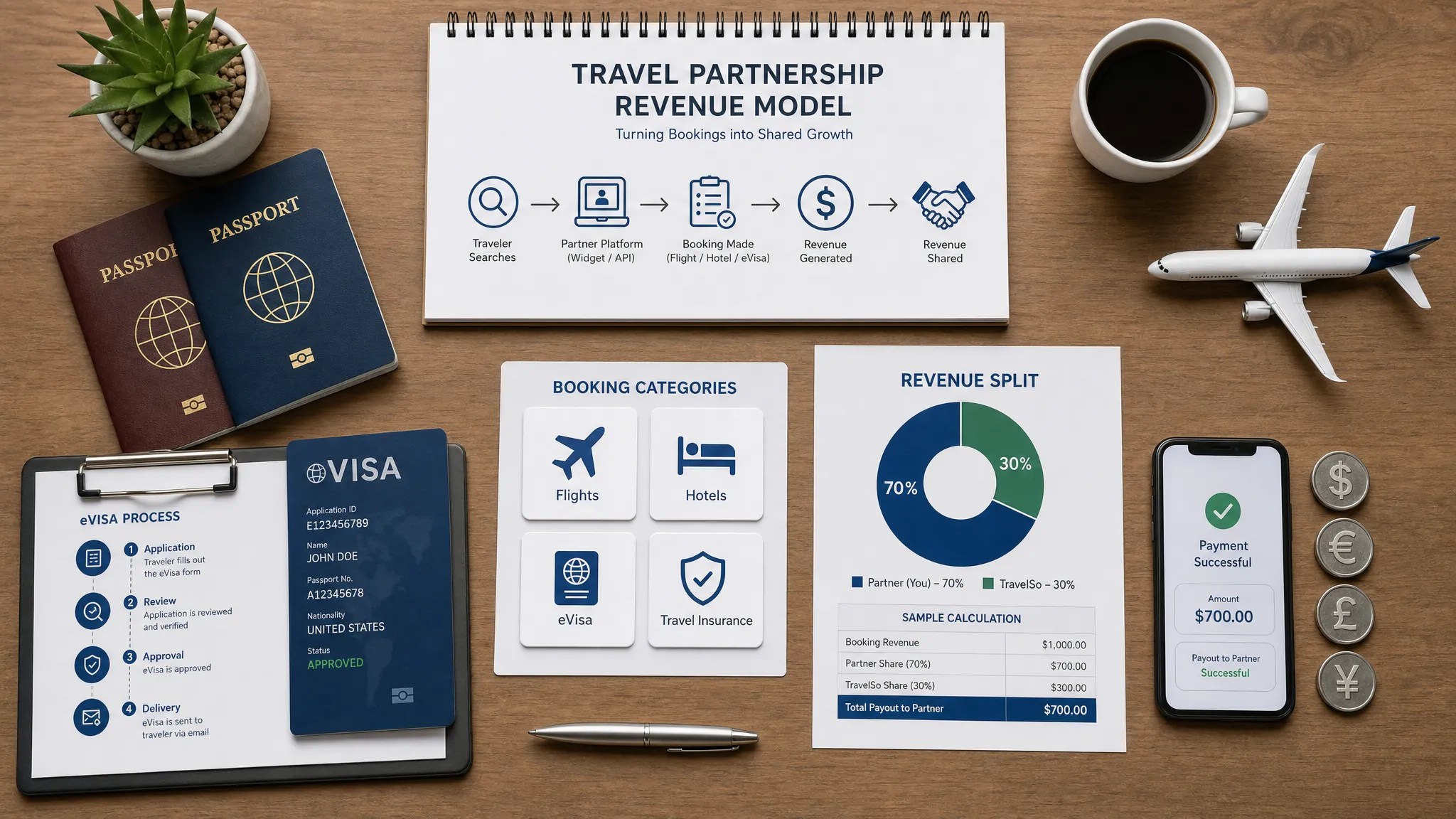
This is the cleanest starting point for most travel brands. The traveler pays the official government fee plus a disclosed service fee. The travel brand and visa provider split the net service fee according to an agreed percentage.
This model works well when the partner can drive qualified traffic but does not want to own visa operations. It is also easy for finance teams to audit because the revenue pool is clearly separated from government fees.
The main negotiation point is the split itself. A high-volume OTA or airline may justify a larger share because it provides distribution at scale. A smaller partner with limited traffic may accept a lower share in exchange for implementation support, branding, and operational coverage.
2. Tiered Performance Share
A tiered model adjusts the partner’s share based on performance thresholds. Instead of paying the same percentage on every transaction, the share increases when the partner reaches agreed milestones such as completed applications, attach rate, or monthly volume.
This model makes sense when both sides want to invest in optimization. It rewards the travel brand for better placement, clearer messaging, and stronger customer engagement. It also protects the provider from overpaying before the channel proves its quality.
The safest tiers are based on completed and paid applications, not just clicks. Click-based incentives can encourage low-quality traffic and create unnecessary support volume. Application completion, paid conversion, and low refund rates are better indicators of real value.
3. Hybrid Platform Fee Plus Revenue Share
Some travel companies want more than a referral link. They need a branded white-label visa application app, an embedded widget, or a travel API integration that fits into their own checkout and post-booking journeys. In those cases, a hybrid model can make sense.
The travel brand pays a fixed platform or implementation fee, then receives a share of net service revenue. The fixed fee helps cover setup, compliance configuration, localization, and technical support. The revenue share keeps both sides motivated to improve conversion after launch.
This model is especially useful when the partner wants more control over UX, data flows, or branding. It can also reduce the pressure to inflate service fees because the provider is not relying only on per-application margin to recover integration costs.
If you are comparing integration options, SimpleVisa’s guide to API vs. white-label visa services explains how different implementation paths affect ownership, time to market, and commercial design.
4. Data Service Fee Plus Conversion Bonus
Not every travel brand wants to process full visa applications. Some only need real-time eligibility, document requirements, and destination rules inside their booking engine. For those companies, a data-led model can work well.
The partner pays for a data service, API access, or eligibility checks. If the traveler later converts into a visa application through the provider’s flow, the partner receives a bonus or revenue share on the resulting service fee.
This model fits airlines, cruise lines, metasearch platforms, TMCs, and travel insurance sellers that need accurate requirements but may not want to present a full application journey at every step. It is also practical for compliance-first use cases where reducing denied boarding risk is the primary goal and ancillary revenue is secondary.
For product and engineering teams, this model pairs naturally with real-time checks inside search, checkout, or itinerary management. SimpleVisa’s overview of how eVisa APIs work gives more context on how eligibility, application submission, and status updates can connect to travel platforms.
5. Managed eVisa Service Split
Some routes, traveler profiles, or visa types require more support than a simple online form. Families, group bookings, cruise itineraries, business travelers, and multi-country trips often need document guidance, corrections, status monitoring, or reapplication help.
For these use cases, the commercial model should reflect the extra operational work. A managed eVisa service split shares premium service fees, not just standard application fees. The provider typically owns application guidance and processing support, while the travel brand contributes distribution, customer context, and booking data.
This model is strongest when the traveler sees a clear premium value proposition: expert review, guided document collection, proactive updates, or assistance for more complex cases. It should never be positioned as a guarantee of approval, since visa decisions remain with the relevant authority.
6. Minimum Guarantee With Revenue Reconciliation
For very large distributors, a minimum guarantee can unlock deeper partnership investment. The travel brand commits to a minimum revenue or volume target over a defined period. In return, it may receive better commercial terms, dedicated rollout support, or custom configuration.
This model should be used carefully. It works best when both parties already have enough traffic data to forecast demand. Without reliable baseline data, minimum guarantees can create pressure to over-promote visa services or push offers to travelers who do not need them.
A fairer version is a guarantee with reconciliation. If performance exceeds the target, the partner earns upside. If policy changes, route mix shifts, or a government portal outage affects volume, the contract defines how targets are adjusted.
| Model | Best fit | Main advantage | Watch out for |
|---|---|---|---|
| Net service fee split | Most OTAs, airlines, agencies | Simple, transparent, easy to audit | Define refunds and government fee treatment clearly. |
| Tiered performance share | High-traffic partners optimizing attach rate | Rewards real distribution effort | Use completed applications, not clicks, as the tier trigger. |
| Hybrid platform fee plus share | Brands needing API, widget, or white-label flows | Balances setup costs and long-term upside | Avoid overcomplicated fee schedules. |
| Data fee plus conversion bonus | Compliance-led platforms and itinerary tools | Monetizes requirement checks without forcing full processing | Track attribution windows carefully. |
| Managed service split | Groups, complex trips, premium travelers | Aligns revenue with human or expert support | Do not imply approval guarantees. |
| Minimum guarantee with reconciliation | Large distributors with predictable volume | Supports deeper partnership investment | Build in policy-change and outage protections. |
Match the Model to Your Travel Business
The right commercial structure depends on where the visa offer appears and how much of the customer journey you own. A post-booking email link may justify a different model than a fully embedded checkout experience with saved traveler data and status notifications.
| Travel business type | 2026 priority | Revenue share model that often fits |
|---|---|---|
| Online travel agency | Increase attach rate and ancillary revenue during checkout | Net service fee split or tiered performance share |
| Airline | Reduce denied boarding risk while monetizing eligible routes | Data service fee plus conversion bonus, or hybrid API model |
| Tour operator | Bundle visas into package value and reduce pre-departure friction | Managed service split or fixed-price bundle with net share |
| Cruise line | Handle multi-port requirements and shore-entry complexity | Data API plus managed application share |
| Travel management company | Support business travelers with policy compliance | Hybrid platform fee plus revenue share |
| Superapp or fintech travel product | Add compliant travel services without building operations | White-label or no-code model with net service fee split |
A useful rule of thumb is this: the deeper the integration and the more operational responsibility you take on, the more customized the commercial model should be. A light referral model can be simple. A full visa management platform embedded into your traveler experience needs a broader discussion about data, SLAs, refunds, and support.
Contract Terms That Matter More Than the Percentage
Many teams negotiate the commission percentage first. In practice, the surrounding terms often matter more than whether the headline share is a few points higher or lower.
Payout timing is a good example. Visa applications can involve refunds, government submission delays, or post-payment corrections. A contract should define when revenue is considered earned: at traveler payment, government submission, application approval, or after a refund window closes.
Refund responsibility is equally important. If an application is canceled before submission, the traveler may expect a different outcome than if the government has already processed the fee. Your agreement should distinguish refundable service fees, non-refundable government fees, and goodwill credits.
Support ownership also affects margin. A partner earning a large share but sending every traveler question to the provider creates a different cost profile than a partner with trained agents and clear first-line support. For higher-volume programs, define support tiers, escalation paths, and response-time expectations.
Data protection cannot be treated as boilerplate. Visa applications involve passport data, travel details, identity documents, and sometimes sensitive supporting evidence. Contracts should cover data minimization, retention, breach notification, sub-processors, deletion workflows, and traveler consent. For a deeper procurement lens, see SimpleVisa’s guide to visa application services, pricing, SLAs, and results.
Finally, policy-change handling is essential in 2026. Government fees, eligibility rules, and document requirements can change quickly. A strong agreement specifies how pricing updates are pushed, who approves traveler-facing copy changes, and how revenue share is recalculated when official fees move.
Metrics to Use When Evaluating Revenue Share Performance
A visa revenue share model should be measured like any other digital travel product. Revenue matters, but it is not the only indicator of success. If the model increases complaints, abandoned bookings, or support tickets, the headline commission may not be worth it.
The most useful metrics include attach rate, completed application rate, ancillary revenue per booking, refund and chargeback rate, average support contacts per application, application approval outcomes, and time to completion. For embedded products, you should also track where travelers enter the flow and where they abandon it.
A good dashboard separates commercial performance from operational quality. For example, if revenue per application rises because premium support is genuinely helping travelers complete complex cases, that may be healthy. If revenue rises because fees are hidden until payment, that creates long-term trust and compliance risk.
This is where travel document automation becomes more than a back-office tool. With the right platform, visa requirements can be surfaced earlier, application data can be validated before submission, and status updates can reduce inbound support. SimpleVisa’s guide to travel document automation explains how these workflows support both conversion and compliance.
Revenue Share Mistakes to Avoid in 2026
The first mistake is sharing or marking up government fees without clear disclosure. Travelers may not understand the difference between an official fee and a service fee, but your pricing page should make it obvious.
The second mistake is optimizing for commission rather than completion. A visa offer that generates clicks but leaves travelers confused can hurt the core booking relationship. The best ancillary revenue protects the trip as well as monetizing it.
The third mistake is applying one global percentage to every destination, channel, and visa type. A simple ETA, a complex tourist visa, and a group cruise itinerary do not create the same work or risk. Commercial terms should allow segmentation where necessary.
The fourth mistake is ignoring negative events. Denials, incomplete documents, government outages, payment disputes, and traveler cancellations all affect economics. If the contract does not define those scenarios, the partnership will eventually rely on ad hoc decisions.
The fifth mistake is choosing a model that your product team cannot actually implement. A sophisticated tiered model is not useful if your systems cannot track attribution, status, and refunds accurately. Match the commercial ambition to the technical foundation.
Where SimpleVisa Fits
SimpleVisa helps travel businesses add visa and border-crossing services without turning their teams into visa departments. Depending on the partner’s needs, SimpleVisa can support API integration for travel sites, a white-label visa application experience, no-code implementation options, custom data services, guided customer applications, and premium eVisa management.
That flexibility matters because the best revenue share model is tied to the implementation model. A no-code rollout may start with a simple net service fee split. A deeper API integration may support data services, status automation, premium assistance, and more advanced commercial terms. A white-label app may sit somewhere in between, giving the travel brand a branded experience without requiring a full internal build.
For travel brands, the goal is not just to add another checkout add-on. It is to make border-crossing administration easier for travelers while creating a recurring ancillary revenue stream that is transparent, compliant, and measurable.
Frequently Asked Questions
What is a fair visa revenue share in 2026? A fair share depends on traffic volume, implementation effort, support ownership, refund exposure, and whether the partner is driving qualified applications or only sending clicks. The cleanest approach is usually to share net service revenue rather than government fees.
Should travel brands earn commission on government visa fees? In most cases, no. Government fees are pass-through costs set by authorities. Revenue share should usually apply to disclosed service fees, premium assistance fees, or other value-added commercial services.
Is revenue share better than a SaaS subscription for visa services? It depends on the use case. Revenue share is attractive when volume is uncertain or the partner wants low upfront cost. Subscription or hybrid pricing can be better when a travel business needs guaranteed access, deep integration, data services, or enterprise controls.
Can a visa revenue share model work with an API integration? Yes. API integrations often support more sophisticated models because they can track eligibility checks, application starts, completions, status updates, refunds, and attribution. That data makes revenue share easier to reconcile.
How should denials and refunds be handled? The contract should define each scenario before launch. Common distinctions include pre-submission cancellations, post-submission government fee refunds, service fee refunds, reapplications, chargebacks, and goodwill credits. Clear rules prevent disputes later.
What is the biggest revenue share opportunity for 2026? The biggest opportunity is embedding visa eligibility and application support into the booking or post-booking journey before travelers become anxious or non-compliant. The commercial upside is strongest when the offer is timely, transparent, and genuinely useful.
Build a Visa Revenue Share Model That Travelers Can Trust
The winning 2026 model is not the most aggressive percentage on a spreadsheet. It is the model that aligns incentives, protects traveler trust, and turns visa complexity into a reliable ancillary revenue stream.
If your travel business is evaluating how to offer electronic visa services, integrate a travel API, or launch a branded visa application flow, SimpleVisa can help you compare implementation options and design a commercial model that fits your market.
Contact SimpleVisa to explore API, white-label, no-code, and data-service options for your visa revenue strategy in 2026.