e Visa on Arrival vs eVisa: What Changes for You
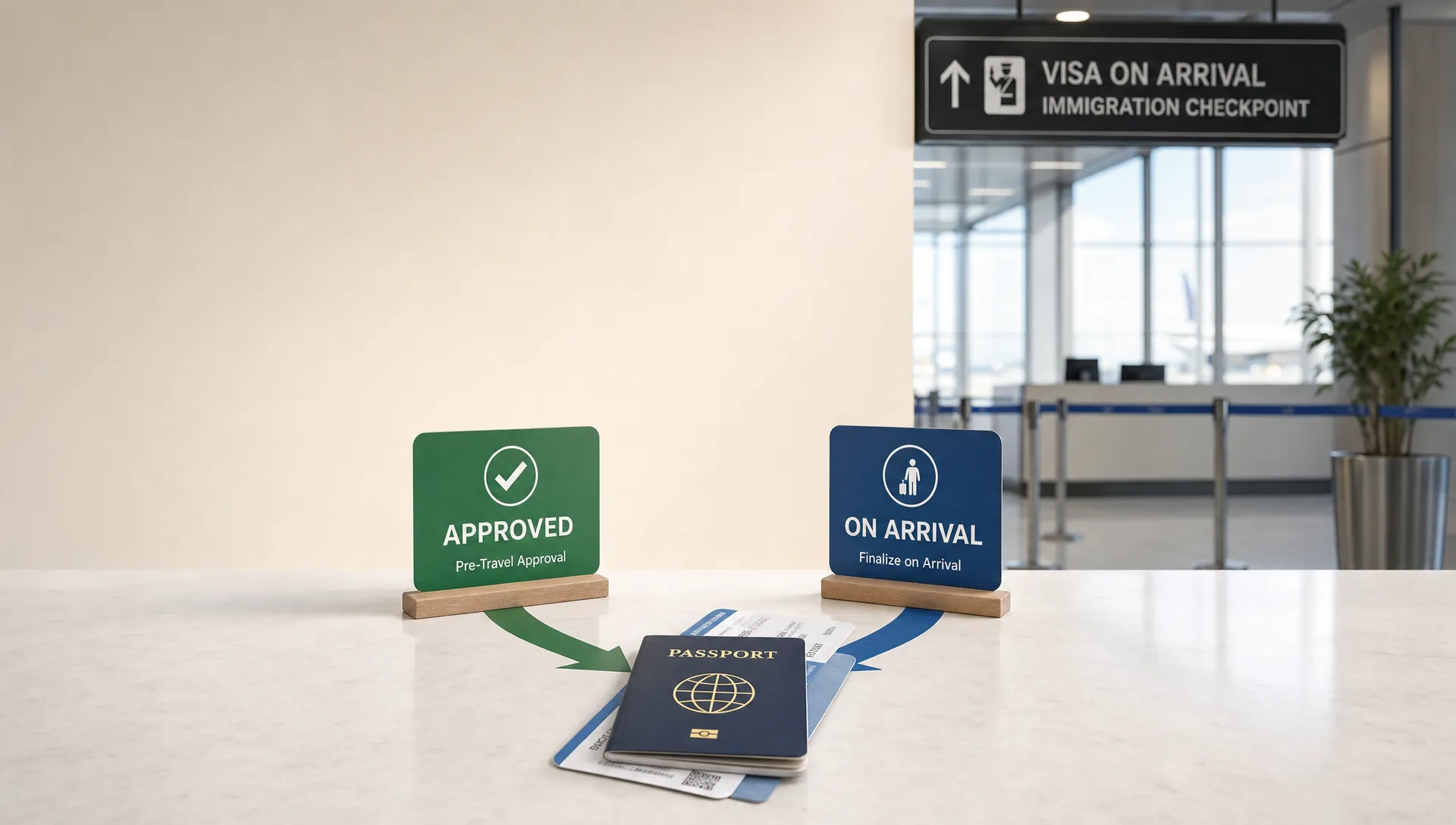
Digital visas have made border administration easier, but they have also made the vocabulary more confusing. If a destination offers an e visa on arrival and another page talks about an eVisa, the difference can sound small. For travelers, it can affect when the application is reviewed, what the airline expects at check-in, how long the arrivals process takes, and how much uncertainty remains after boarding.
The short version: an eVisa is usually approved before you travel, while an e Visa on Arrival is usually a digital way to pre-register, prepay, or speed up a visa that is issued or finalized when you land. That single difference changes the traveler experience more than most people expect.
One caution before we compare them: governments do not use these labels consistently. A product called eVOA in one country may work almost like a full eVisa, while another may be closer to a traditional visa on arrival with an online form. Always check the official rules for your nationality, passport type, purpose of travel, and point of entry.
Quick comparison: what changes for you?
| Travel step | e Visa on Arrival | eVisa | What changes for you |
|---|---|---|---|
| When you apply | Online before travel, often close to departure | Online before travel, usually with approval required before departure | You may need more lead time for an eVisa |
| When the decision happens | Often finalized or activated at the border | Usually decided before you fly, although admission is still checked at the border | An eVisa can reduce uncertainty before boarding |
| What you show at check-in | eVOA confirmation, receipt, QR code, or proof of eligibility | eVisa approval or digitally linked visa | Airline document checks may be simpler with an approved eVisa |
| What happens on arrival | You may use a special eVOA or visa-on-arrival lane | You usually proceed to immigration, and sometimes to an e-gate if eligible | eVOA can still involve a counter or queue |
| Payment | Sometimes online, sometimes on arrival, sometimes both | Usually online during the application | You need to verify payment methods and receipts |
| Main risk | Arriving with a pre-registration that does not meet final border requirements | Not receiving approval before travel or having incorrect details | Both require careful data entry and document checks |
What an eVisa actually means
An eVisa is a visa issued electronically before travel. Instead of visiting a consulate or receiving a physical sticker in your passport, you complete the application online, upload documents, pay the fee, and receive an approval by email or through a government portal. In many systems, the approval is also linked electronically to your passport number.
This does not mean border officers stop checking you. Final admission is always subject to the destination's immigration rules. You may still be asked for your return ticket, hotel address, proof of funds, travel purpose, or supporting documents. The difference is that the core visa decision has usually happened before you arrive.
That pre-travel decision is why eVisas are often preferred for trips with higher consequences: business travel, family vacations with children, cruises, organized tours, and itineraries with tight connections. If you are comparing digital options more broadly, SimpleVisa's guide to the benefits of electronic visas explains why online visa systems have become popular with both travelers and travel providers.
What an e Visa on Arrival actually means
An e Visa on Arrival, often shortened to eVOA, is best understood as a digital layer added to the traditional visa-on-arrival process. Instead of filling out all paperwork at the airport, you may complete a form online, upload passport details, pay a fee, or receive a QR code before departure. The visa may then be issued, confirmed, or activated when you reach the destination.
This can be much more convenient than a purely manual visa on arrival. It may reduce paperwork, shorten payment steps, and help immigration officers process travelers faster. But it can still be an arrival-based process. In other words, the online step does not always equal full pre-approval.
This is the part that trips people up. If the destination's rules say your visa is only granted at the port of entry, you should plan for arrival checks, possible queues, and document verification. If you see terms like eVOA, online VOA, or electronic visa on arrival, read the conditions carefully. For a deeper look at one common version of this model, see SimpleVisa's explainer on VFS eVOA.
The biggest practical difference: before-departure certainty
The main traveler benefit of a true eVisa is certainty before departure. If your application is approved and the information is correct, you start the trip knowing you have met the visa requirement for that route and purpose, subject to final border checks.
With an e Visa on Arrival, you may still have some certainty, but it depends on how the destination runs the program. Some systems issue a strong pre-approval. Others simply let you register and pay in advance, while the border decision remains more substantive. That matters because a problem discovered after landing is harder to fix than a problem discovered while you are still at home.
For example, a passport scan that is slightly unclear may be corrected online before an eVisa is issued. With an eVOA, the same mismatch might be discovered at the arrival counter, when the traveler is tired, the queue is long, and onward transportation is waiting.
Documents: what you should prepare in both cases
The document list depends on the destination, but the logic is similar. You need to prove who you are, why you are traveling, how long you will stay, and that you can leave when required. The difference is when these details are reviewed.
For an eVisa, document checks usually happen during the online application. If something is missing, the application may be delayed, rejected, or returned for correction. For an e Visa on Arrival, some documents may be checked online, while others may still be reviewed at the airport.
Before you rely on either option, confirm these essentials:
- Passport validity and blank page requirements
- Exact spelling of your name and passport number
- Eligible nationality and passport type
- Allowed travel purpose, such as tourism, business, or transit
- Approved arrival airport, land border, or seaport
- Return or onward ticket requirements
- Accommodation address or invitation details
- Accepted payment method and currency
- Whether a printed copy is recommended
Timing also deserves attention. Some travelers assume digital means instant, but processing time can vary by country, season, nationality, and system workload. If you need a planning framework, SimpleVisa's guide to electronic visa online timing, costs, and documents breaks down the main factors to check before applying.
Airline check-in: why terminology matters
Your first document check may happen before you ever reach immigration. Airlines must verify that passengers appear to meet entry requirements for their destination and transit points. If your paperwork is unclear, you can be delayed at the counter or even denied boarding.
An approved eVisa is often easier for airline staff to interpret because it shows that the application has already been accepted. An e Visa on Arrival confirmation can still be valid, but the airline may need to confirm that your nationality, route, airport, and travel purpose are eligible for that arrival-based process.
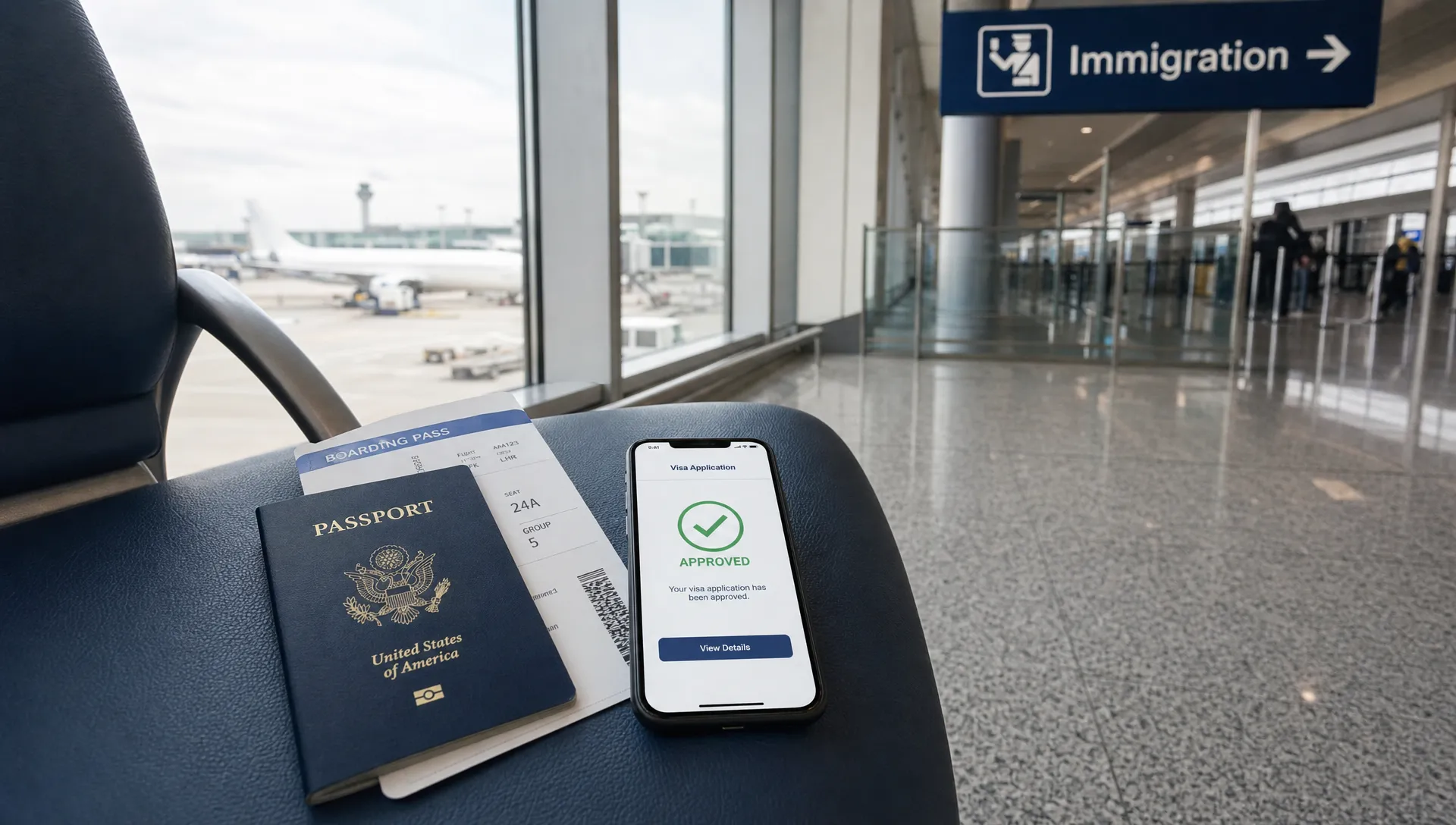
This is why you should carry more than a single email. Save the approval PDF offline, take screenshots of the QR code if allowed, keep your payment receipt, and print a copy when the destination recommends it. If the visa is linked to your passport, the passport number in the application must match the passport you use to check in.
Arrival experience: where you queue and what you show
On arrival, the difference becomes visible. With many eVisas, you proceed directly to passport control, where the officer checks your passport, visa record, biometrics if required, and entry conditions. If e-gates are available and you are eligible, the process may be even faster.
With an e Visa on Arrival, you may need to visit a dedicated eVOA lane, kiosk, visa counter, or payment desk before passport control. Even when the process is streamlined, it can still involve extra steps. Families, groups, and travelers arriving during peak times should factor this into airport pickup, hotel transfer, and connection planning.
If you are entering through a smaller airport, land border, or seaport, check that the digital arrival visa is accepted there. Some programs are limited to specific ports of entry. A visa option that works at the main international airport may not work at a remote land crossing.
Costs: the fee is not the whole cost
When travelers compare an eVisa and an e Visa on Arrival, they often focus on the official government fee. That is important, but it is not the full cost of the experience.
An eVisa may involve an online application fee paid before travel. If your plans change or the application is denied, the fee may be non-refundable, depending on the destination's rules. However, it can reduce the chance of unexpected airport delays and may help you avoid scrambling for cash, card acceptance, or payment counters on arrival.
An e Visa on Arrival may look more flexible, especially if it can be completed close to departure. But hidden costs can appear if the arrival queue is long, if payment systems are unavailable, if your card is declined, or if a delay affects transfers and connections. For families and groups, even a small arrival delay can multiply quickly.
The better question is not only which option is cheaper. It is which option gives the right balance of cost, certainty, and convenience for your trip.
Which option should you choose?
There is no universal winner. The best choice depends on how the destination defines each document, how soon you travel, and how much uncertainty you can tolerate.
| Your situation | Usually better fit | Why |
|---|---|---|
| You have a tight itinerary or connection | eVisa, if available | More checks happen before departure |
| You are traveling with children or a group | eVisa, if available | Fewer arrival variables for multiple travelers |
| You booked last-minute | e Visa on Arrival, if eligible | Some programs are designed for faster pre-registration |
| You may change travel dates | Depends on validity rules | Some approvals are date-specific, others allow a broader window |
| You enter through a small port | Verify before choosing | Not all ports support eVOA or eVisa systems |
| You need maximum predictability | eVisa | Approval before travel generally reduces surprises |
If both options are available and the cost difference is small, many travelers prefer the eVisa because it moves more of the uncertainty to the pre-departure stage. If the e Visa on Arrival is the official recommended route for your nationality and port of entry, it can still be a smart choice, as long as you understand what remains to be done at arrival.
A practical pre-departure checklist
A smooth digital visa experience usually comes down to careful basics. The technology is convenient, but it is unforgiving when names, dates, or passport numbers are wrong.
Use this checklist before you depart:
- Recheck the destination's official entry rules within 72 hours of travel
- Confirm your visa type matches your purpose of travel
- Make sure your arrival port accepts the document you hold
- Verify that your passport number, name, and date of birth are exact
- Save approvals offline and keep a printed backup if recommended
- Carry proof of onward travel, accommodation, and funds if required
- Keep the payment receipt and application reference number
- Use the same passport for booking, application, check-in, and arrival
- Check transit requirements, not only final destination requirements
Visa administration is only one part of a lower-stress departure plan. If you are leaving a home or business unattended for an extended trip, it can also be worth reviewing professional security support for your property before you go, so your border paperwork and back-home arrangements are both covered.
What travel businesses should do differently
For travel businesses, the difference between an eVisa and an e Visa on Arrival is not just a technical label. It shapes the customer experience. If a booking flow says online visa without explaining that the traveler must still visit an arrival counter, customers may expect a faster journey than the document actually provides.
Clear visa guidance can reduce support tickets, missed departures, refund disputes, and airport stress. It also creates an opportunity to offer useful ancillary services at the moment travelers are already thinking about trip readiness.
A good customer-facing flow should answer five questions in plain language: who is eligible, when to apply, what documents are needed, what happens at check-in, and what happens on arrival. It should also show route-specific rules, because nationality, transit, purpose of travel, and port of entry can all change the answer.
SimpleVisa helps travel businesses guide customers through border requirements with visa processing automation, API integration, white-label application options, custom data services, guided visa applications, and premium eVisa management. For travel sellers, airlines, tour operators, and online booking platforms, that means visa requirements can be presented closer to the point of booking, where they are most useful.
Frequently Asked Questions
Is an e Visa on Arrival the same as an eVisa? Not always. An eVisa is usually approved before travel, while an e Visa on Arrival is often an online pre-registration or payment process for a visa that is issued or finalized at the border.
Can I still be refused entry with an approved eVisa? Yes. An eVisa can satisfy the visa requirement, but border officers can still check your purpose of travel, funds, return ticket, documents, and admissibility under local law.
Is an e Visa on Arrival faster than a regular visa on arrival? Often, yes. It can reduce paperwork and payment steps at the airport, but it may still require a dedicated counter, biometric checks, or final approval on arrival.
Should I print my eVisa or eVOA confirmation? If the destination recommends printing, you should print it. Even when digital copies are accepted, an offline copy and a printed backup can help if your phone battery dies or airport Wi-Fi is unreliable.
What happens if I renew my passport after applying? Many digital visas are linked to the passport number used in the application. If you renew your passport, you may need a new application or an official update, depending on the destination's rules.
Make digital visa requirements easier to understand
The real difference between an e Visa on Arrival and an eVisa is not just when you fill out a form. It is when uncertainty is resolved, what happens at check-in, and how much time you should allow at the border.
For travelers, the safest habit is to verify the exact rules before booking and again before departure. For travel businesses, the opportunity is to make those requirements clear inside the customer journey, before confusion becomes a service issue.
If your business wants to simplify visa guidance and application support for customers, SimpleVisa can help you bring clearer border requirement information into your booking flow, app, or travel service.