About Us Visa Services: API, White-Label, and Data

Border requirements can be the fastest way to lose a booking.
Even when the flight and hotel are “one-click easy,” travelers still get stuck on the hardest part to Google correctly: what they need to cross the border, and how to apply. For travel brands, that friction shows up as checkout abandonment, support tickets, and (in worst cases) denied boarding.
SimpleVisa exists to make travel simple by taking care of border crossing administration. For travel businesses, that means providing visa services in a way that fits your product, your team, and your customer journey.
This “about us visa services” guide explains the three ways SimpleVisa typically delivers visa capabilities: API, white-label, and data services, plus how to choose the right model.
What “visa services” means for modern travel businesses
Visa services are no longer just a back-office task handled after a booking. In 2026, borders are increasingly digital, and traveler expectations are too.
Many destinations now rely on electronic workflows (eVisas, eTAs/ETAs, pre-travel authorizations) and travelers expect:
- Clear eligibility answers for their passport and itinerary
- A guided application that reduces errors
- Status visibility and proof they can present at check-in or at the border
Meanwhile, travel operators need the same experience to be:
- Embedded (so it doesn’t break conversion)
- Accurate (because rules change and exceptions are common)
- Operationally safe (because support and compliance costs can erase margin)
SimpleVisa’s approach is to offer visa services as productized building blocks that travel brands can deploy in different ways, depending on how much control you want and how quickly you need to launch.
SimpleVisa’s three delivery models: API, white-label, and data
1) Visa services via API (embedded into your booking flow)
A visa API is the right fit when you want visa handling to behave like a native feature inside your site or app.
With an API integration, your product can:
- Surface visa requirements based on itinerary and traveler attributes
- Guide users through the application steps without sending them away
- Create a consistent end-to-end journey across web, mobile, and post-booking
This model is most common for OTAs, airlines, TMCs, and travel platforms that treat compliance as a core conversion lever.
If you want a primer on the mechanics, SimpleVisa also breaks down the flow in How eVisa APIs work: Step by Step.
Where API integrations tend to shine
API integrations are typically chosen when you care about:
- User experience control (copy, UX patterns, localization, and funnel placement)
- Operational automation (reducing manual handling and support)
- Scalability across brands, markets, and channels
If your developers are assessing feasibility, the authentication and operational considerations matter as much as endpoints. The SimpleVisa team covers common pitfalls and security best practices in Developer Q&A: Best Practices for Authenticating Against the SimpleVisa API.
2) White-label visa application app (fast launch, branded experience)
A white-label model is designed for speed to market.
Instead of building a visa journey from scratch, you launch a branded visa application experience that can be:
- Linked post-booking
- Embedded via a widget
- Offered as a standalone visa portal under your brand
This is often the best path when you want to validate demand, prove ancillary revenue potential, or launch without heavy engineering work.
To see what “no-code” can look like in practice, SimpleVisa has a detailed guide: How to Offer White-Label Visa Services Without Writing Code. If you are deciding between integration paths, API vs. White-Label App: Which Visa Integration Model Suits You? is the most direct comparison.
Why travel brands choose white-label
White-label is usually chosen for:
- Time-to-value (launch quickly, iterate later)
- Lower engineering dependency (especially for lean teams)
- Branded trust (travelers stay within a familiar, consistent experience)
3) Visa data services (rules, requirements, and decisioning)
Some companies don’t need a full application experience, but they do need reliable answers.
Data services typically support scenarios like:
- Showing visa requirements on destination pages
- Powering a “Do I need a visa?” checker
- Driving internal support tooling and agent workflows
- Running pre-trip compliance checks (for example, before ticketing or check-in)
This is especially relevant when you have your own UX and workflows already, but need a partner that can provide structured visa and border requirement data and keep it current.
SimpleVisa positions this as part of “travel document automation,” where rules and workflows adapt to the traveler context. For a broader framing, see What Is Travel Document Automation? Definitions, Benefits, and Myths.
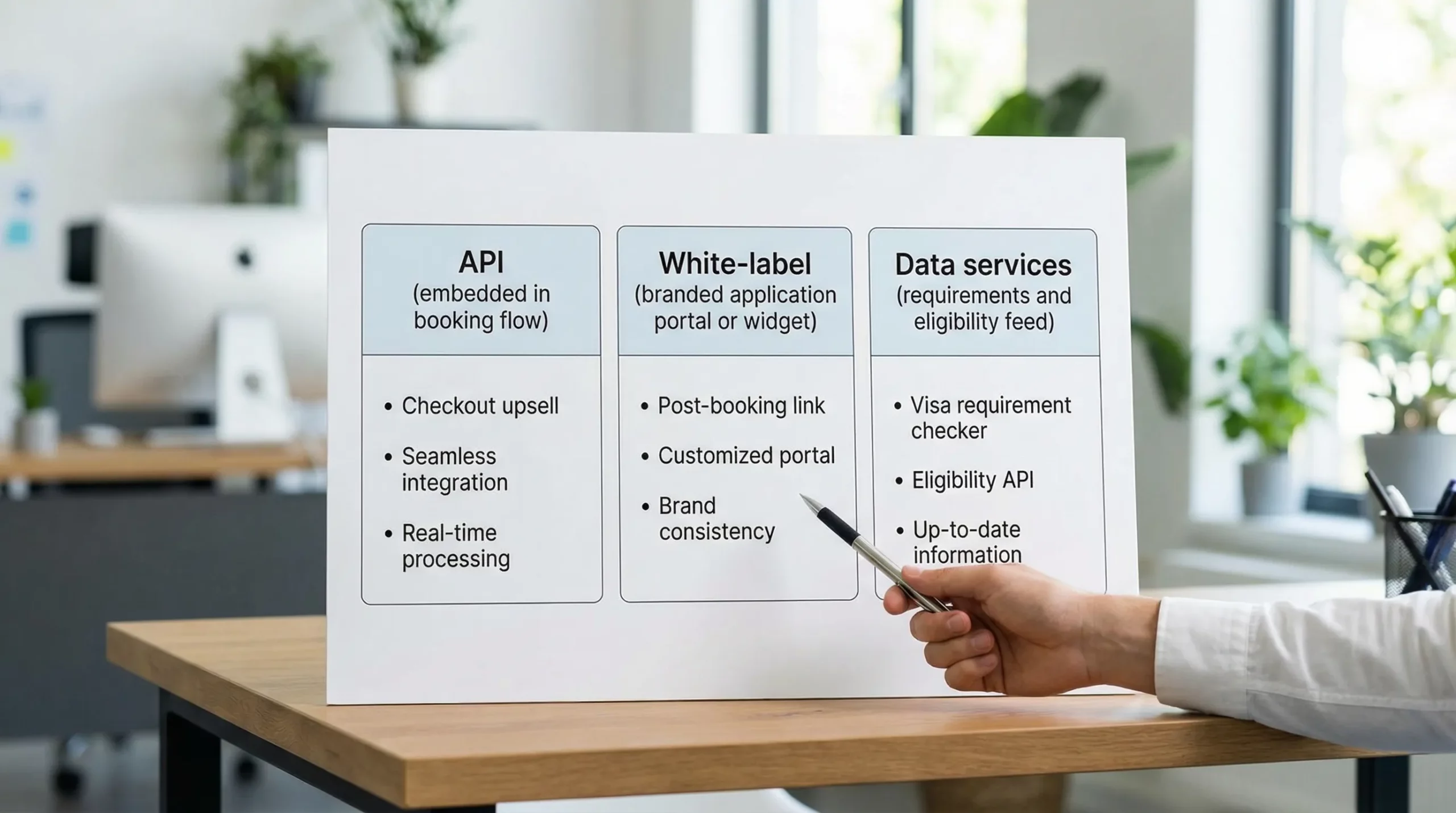
API vs. white-label vs. data: how to choose the right model
Most travel brands do not pick an integration model based on technology alone. They pick it based on where visa friction happens in their journey and what they need to optimize: conversion, speed, compliance, or support load.
Here’s a practical comparison:
| Model | Best when you need | Typical owner | What you control most | Common launch pattern |
|---|---|---|---|---|
| API | Deep integration, native UX, automation at scale | Product + Engineering | Funnel placement, UX, data capture, orchestration | Embedded during checkout and/or in post-booking flows |
| White-label | Fast deployment with minimal build | Partnerships + Ops + Marketing | Branding, entry points (link/widget), messaging | Post-booking portal first, then move earlier in funnel |
| Data services | Requirements and eligibility answers without full application flow | Product + Content + Support | How rules are displayed and acted on | Requirements pages, eligibility widgets, internal tooling |
If you are unsure, a common strategy is:
Start with a white-label launch to validate demand and operational fit, then expand into an API integration as visa attach rate, revenue, and support patterns become predictable.
Where SimpleVisa fits in the travel journey
Visa services can be introduced at multiple moments. The best choice depends on your customer base, destinations, and how frequently travelers discover visa needs “late.”
In-flow (during booking)
This is the conversion-focused moment. The traveler is already in purchase mode, so the value proposition must be simple: “Get ready to travel, without leaving checkout.”
Teams often focus here when they are treating visas as an ancillary product line. SimpleVisa explores the commercial upside in Why Border Crossing Solutions Are the Next Big Ancillary Opportunity.
Post-booking (after purchase, before departure)
This is the compliance-focused moment. It is often where urgency increases, but patience decreases.
If you are building a post-booking journey, the operational playbook matters as much as the UI. A strong starting point is Building a Seamless Post-Booking Visa Journey: Tools & Templates.
When travelers get stuck (support and recovery)
Many travel brands underestimate how much visa friction becomes a customer service problem.
If you already see high volumes of “Do I need a visa?” or “I submitted, what now?” tickets, you may want your solution to include guided flows and clear escalation paths. For how SimpleVisa approaches support, see Visa Contact Us: Get Instant Support.
What partnering with SimpleVisa looks like (without the guesswork)
Because SimpleVisa serves travel businesses (not just individual travelers), partnership success usually depends on aligning early on the following:
- Your integration approach (API, white-label, data)
- Your funnel placement (checkout, post-booking, or both)
- Your operational model (who handles exceptions, traveler questions, and edge cases)
- Your commercial goals (ancillary revenue, reduced denied boardings, lower support costs)
A useful internal exercise before you talk to any visa provider is to document:
- Your top destinations by passenger volume
- Your top origin passports
- Your current “visa friction” metrics (support ticket tags, abandonment points, or denied boarding incidents)
If you want a more formal evaluation framework, SimpleVisa also provides vendor selection guidance in How to Evaluate a Visa Processing Company.
Security, trust, and accuracy: what matters in visa services
Visa processing involves sensitive personal data and high-stakes outcomes. That makes trust signals, data handling, and workflow integrity essential.
When assessing any “about us visa services” provider, prioritize clarity on:
- How eligibility is determined and updated as rules change
- How errors are prevented (validation, document checks, guided inputs)
- How users authenticate and how sessions are protected
- What happens when an application is rejected or needs corrections
SimpleVisa publishes technical guidance on secure integrations (for example, authentication and verification patterns) in its developer content, including the API authentication Q&A linked above.
Next step: pick the model, then validate fast
If you are deciding between API, white-label, and data services, the best move is usually to start with one concrete journey, then expand.
- If you want maximum UX control and native conversion impact, start with the API.
- If you want fast go-live with minimal engineering, start with white-label.
- If you mainly need accurate visa requirements and eligibility decisioning, start with data services.
To explore options with SimpleVisa, visit SimpleVisa or use the contact pathways in Contact Us: Contact Options, Hours, and Response Times.