Airline DCS Integration: Where Visa Checks Belong
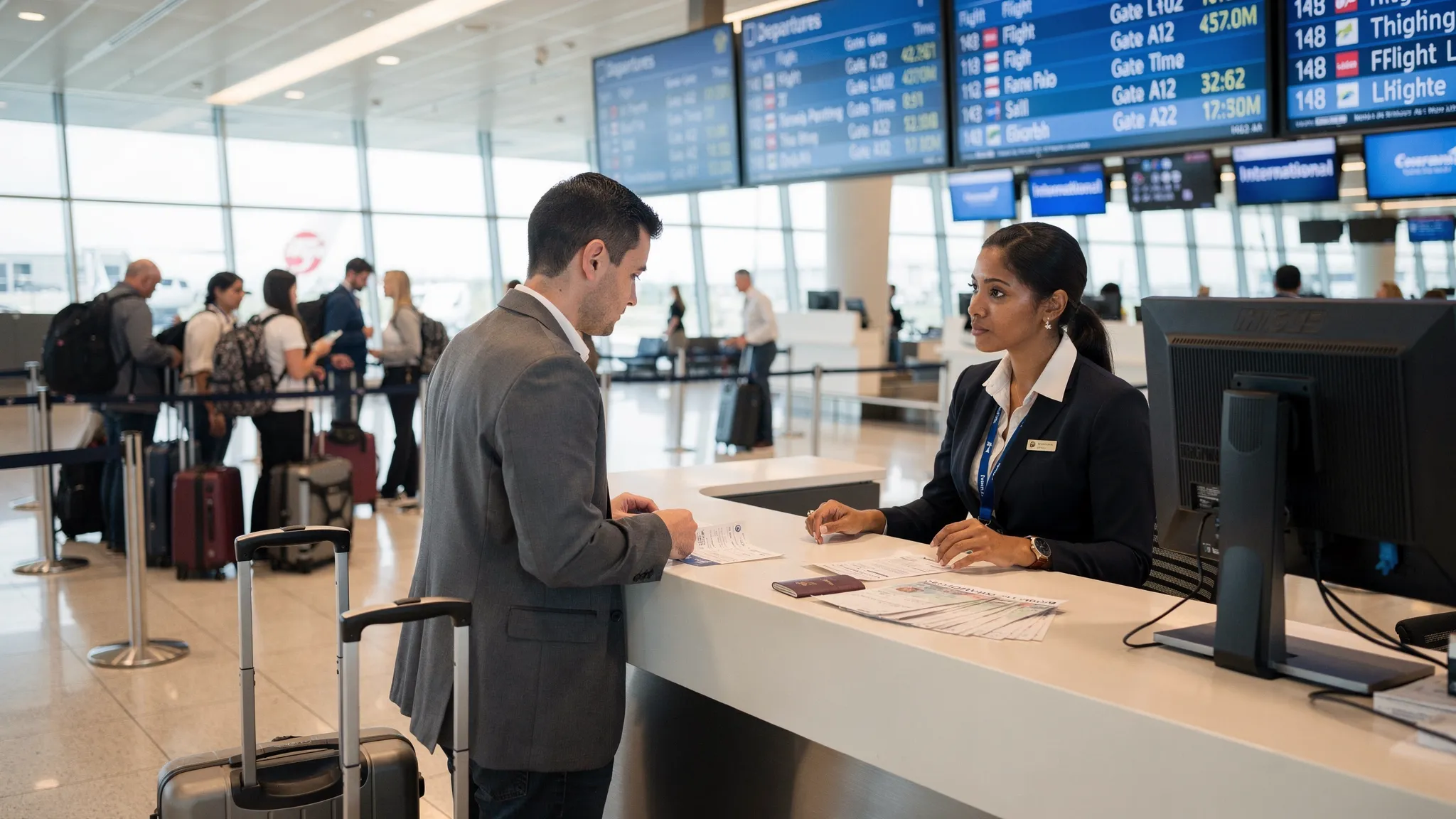
Airlines have spent decades refining the systems that decide whether a passenger can fly. Yet visa and entry requirements are still too often treated as a last minute, check-in counter problem. That approach creates predictable outcomes: longer queues, higher manual override rates, denied boarding incidents, and avoidable carrier liability.
The fix is not “do visa checks in the DCS” or “do visa checks at booking.” It is to put the right checks in the right systems, then connect them so the Departure Control System (DCS) can confidently issue a boarding pass.
This article breaks down where visa checks belong in an airline architecture, what DCS integration should look like, and how to keep both compliance and conversion in balance.
What a DCS is responsible for (and what it is not)
A DCS is built for day-of-departure execution: check-in, seat assignment, baggage acceptance, boarding, load control, and final passenger reconciliation. It is optimized for operational speed and auditability.
Visa and entry eligibility, on the other hand, is a regulatory rules problem that changes constantly and depends on:
- Passport nationality and document type
- Destination, transit points, and connection times
- Purpose and length of stay
- Existing visas, eVisas, eTAs, ETAs, residence permits
- Special cases (one-way tickets, minors, emergency passports, dual nationality)
That rules layer is dynamic, and airlines typically source it from services like IATA Timatic or equivalent rule databases. Timatic is widely used across the industry to help airlines validate travel document requirements prior to boarding. You can see IATA’s overview here: Timatic by IATA.
Key idea: DCS should be the final enforcement point, not the primary place where rules are interpreted, sold, or remediated.
The real question: “Where do visa checks belong?”
Visa checks belong in multiple places, with different depth, timing, and owners.
The 4-layer model airlines should aim for
- Shopping and booking layer (conversion-first): surface eligibility and required actions early to prevent bad bookings.
- Post-booking layer (remediation and completion): drive travelers to complete missing eVisa/ETA steps before airport day.
- DCS layer (operational enforcement): block boarding pass issuance if requirements are not met.
- Airport and gate layer (exception handling): handle last-mile issues and document edge cases with the right tooling.
Here is how that maps to systems.
| Journey moment | What should be checked | System of record | Outcome |
|---|---|---|---|
| Search and fare selection | High level visa or travel authorization needed, based on itinerary and nationality | Booking engine, rules API | Reduce “unflyable” bookings and support contacts |
| Checkout | Eligibility confidence check, document reminders, offer to apply | Booking flow + visa management platform | Higher conversion, earlier compliance |
| Post-booking (T-30 to T-3) | Status tracking, missing docs, nudges, assisted application | Visa management platform + messaging stack | Fewer airport surprises |
| Check-in (T-24 to T-0) | Final OK-to-board decision | DCS (consumes eligibility decision) | Boarding pass issuance or hard stop |
| Boarding gate | Re-validation for disruptions, reroutes, standby | DCS + agent tools | Controlled exceptions with audit trail |
Why “only at check-in” is too late
When eligibility is discovered at the airport:
- The traveler has less time to fix the issue (and may not be able to fix it at all).
- Agents must interpret complex rules under pressure.
- Flights depart with empty seats, even when there was paid demand.
- Airlines incur disruption costs, refunds, and reputational damage.
It also increases carrier liability exposure. Many jurisdictions place responsibility on carriers to ensure passengers meet entry requirements, with penalties for transporting inadmissible passengers. Exact regimes vary by country, but the operational reality is consistent: airlines want fewer “inadmissible at arrival” cases.
Why “only at booking” is not enough either
Booking-time checks alone can fail because:
- Requirements can change between booking and departure.
- Travelers change passports, names, or routes.
- Interline and codeshare flows add complexity.
- Some requirements depend on data not available at booking (final passport details, residency, prior travel history).
So the DCS still needs a reliable final decision at check-in. The goal is to avoid making DCS the first time the airline learns there is a problem.
What a good DCS integration looks like
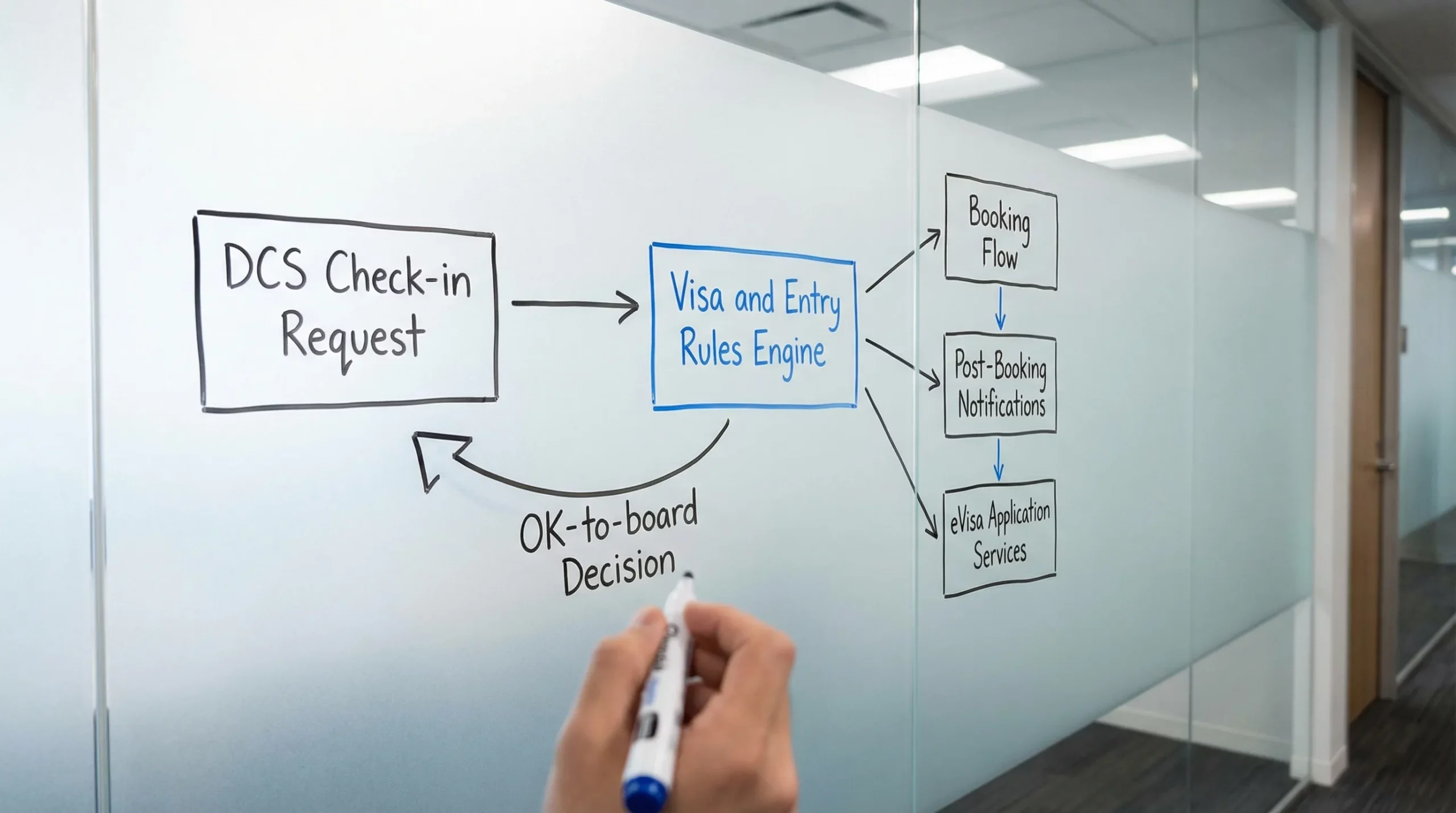
A strong pattern is to treat the DCS as a policy enforcement point that calls a dedicated eligibility and visa workflow service.
Core principle: DCS asks, “Can I issue a boarding pass?”
At check-in, the DCS should receive a clear response that supports operational execution:
- OK_TO_BOARD
- NOT_OK_TO_BOARD (with reason codes and required remediation)
- OK_WITH_DOC_REVIEW (agent must verify a specific document)
The DCS does not need to compute “why” from scratch. It needs:
- A decision
- A minimal explanation for the agent
- A consistent audit trail
Where SimpleVisa typically fits
SimpleVisa is designed to sit in the layer that interprets requirements, guides applications, and automates visa processing, then returns a usable decision signal to airline and travel systems.
Depending on your product strategy, SimpleVisa can be used via:
- An API integration into your booking and servicing flows
- A white-label visa application app
- Custom data services for requirements and eligibility
- No-code implementation options for faster pilots
You can explore the broader concept in SimpleVisa’s overview of Travel Document Automation and how eVisa APIs work.
The integration blueprint: booking, then DCS, then exceptions
1) Booking flow: detect, disclose, and convert
At booking, the objective is not to do perfect document verification. It is to:
- Identify if a visa, eVisa, or travel authorization is likely required
- Explain it in plain language
- Offer a guided path to complete it
This is where airlines can generate ancillary revenue while reducing downstream operational costs. SimpleVisa has detailed playbooks for embedding these upsells in the funnel, for example in the Ultimate Guide to Marketing eVisa Services During the Booking Flow.
2) Post-booking: turn “unknown” into “ready to fly”
Most failures happen in the gap between “ticket issued” and “passenger shows up at the airport.” The best programs run automated nudges and status tracking:
- Email/SMS/push reminders keyed off departure time
- Status checkpoints (submitted, pending, approved)
- Escalation paths for manual review
A practical approach is described in Building a Seamless Post-Booking Visa Journey: Tools & Templates.
3) DCS: enforce the final decision, fast
At check-in, the objective is speed and certainty.
The DCS should:
- Pull passenger and itinerary context (including last changes)
- Trigger an eligibility call that returns the current OK-to-board result
- Store the decision and supporting reference (for audit)
- Allow controlled overrides with reason codes
Implementation note: If you operate kiosks and mobile check-in, your integration needs to support low latency and high availability. When the eligibility service is unavailable, you need a defined fallback policy (for example, revert to a cached decision if it is recent enough, or require manual agent processing).
Data objects that matter in DCS-linked visa checks
Airlines often underestimate the “data plumbing” required for accurate eligibility.
Passenger identity and document data
To make correct determinations, you need clean capture of:
- Passport number, issuing country, expiry
- Name as per MRZ (machine-readable zone)
- Date of birth, gender
- Residency when required
Mistmatches are a major operational trigger. If you want a deeper guide on preventing them, see Handling Name Mismatches on Tickets, Passports, and eVisas.
Itinerary reality, not itinerary intent
Eligibility depends on what the passenger will actually do, including:
- Transit airports and minimum connection times
- Re-accommodation changes
- Irregular operations reroutes
This is why DCS integration matters. Your booking-time conclusion may be wrong by departure day.
Interline, codeshare, and alliance scenarios (where DCS clarity is critical)
The hardest eligibility scenarios show up when:
- The marketing carrier is not the operating carrier
- One segment is checked in on a partner DCS
- Travel document responsibility is unclear across the journey
In these cases, define explicitly:
- Which carrier runs the eligibility check
- Where the OK-to-board status is stored
- How it is shared or revalidated on partner systems
If you cannot reliably share status, default to a model where each operating carrier can validate eligibility at its own check-in, while upstream systems still push early remediation.
What to measure after you connect visa checks to DCS
DCS integration is not just a compliance project, it is a measurable operational and commercial improvement.
Here is a KPI set that connects “visa readiness” to airline outcomes.
| KPI | Why it matters | What improves it |
|---|---|---|
| Denied boarding rate (doc-related) | Direct cost, reputational impact | Earlier remediation + consistent DCS enforcement |
| Average check-in handling time | Queue time, staffing cost | Clear OK-to-board signals and fewer manual lookups |
| Manual override rate | Compliance risk, inconsistency | Better rules accuracy and better traveler preparation |
| Attach rate for eVisa/ETA service | Ancillary revenue | Booking and post-booking UX and messaging |
| No-show and airport “bounce” patterns | Revenue leakage | Proactive eligibility checks and reminders |
SimpleVisa also outlines measurement frameworks in its KPI content, for example 5 KPIs to Track After Deploying a Visa Management Platform.
Common pitfalls (and how to avoid them)
Pitfall 1: Treating “visa check” as a single yes or no
In real operations you need a state machine, not a binary.
A better status model includes:
- Unknown (insufficient passenger data)
- Action required (traveler must apply)
- Pending (submitted, awaiting decision)
- Approved (ready)
- Not eligible (cannot travel as ticketed)
Your DCS logic should then map these states into operational actions.
Pitfall 2: Over-collecting data too early
Collect only what you need, when you need it. Many requirements can be determined without storing full document images. For privacy and compliance, design for data minimization and retention controls.
Pitfall 3: No playbook for irregular operations
Disruptions can create new visa and transit requirements instantly.
If a passenger is rerouted through a different transit country, the airline needs a quick re-check. This is where event-driven revalidation (triggered by itinerary change) prevents gate chaos.
How to decide what stays in DCS vs what stays outside
Use this rule of thumb:
- Outside DCS: rules interpretation, application workflows, payments, traveler guidance, long-running status tracking.
- Inside DCS: final decision enforcement, boarding pass gating, controlled overrides, operational audit.
If you want a broader view of where this sits in airline and OTA stacks, SimpleVisa’s Travel Tech Stack 2025 is a useful reference point.
Frequently Asked Questions
Should visa checks happen in the DCS or the PSS? Visa checks should be distributed. The PSS and booking flows should surface requirements early, but the DCS should enforce the final OK-to-board decision at check-in and boarding.
What is the minimum a DCS needs to know to enforce visa compliance? The DCS needs a clear OK-to-board outcome, reason codes for failures, and an auditable reference to the eligibility decision. It does not need to own full visa application workflows.
How do airlines handle visa checks for mobile and kiosk check-in? The same eligibility decision service should be callable from all check-in channels. When requirements are not met, route the passenger to a guided completion flow or an agent, rather than relying on staff to interpret rules.
How do eVisas and ETAs change the DCS role? They increase the need for real-time status and data consistency. Since authorizations are electronic and can be granted close to departure, airlines need post-booking tracking plus a final DCS validation.
What is the biggest operational win from integrating visa checks properly? Fewer document-related denied boardings and less check-in friction. Airlines also reduce manual handling and can capture ancillary revenue earlier in the journey.
Build a DCS-ready visa check layer without turning DCS into a visa engine
If you are designing an airline DCS integration, aim for a model where DCS remains fast and operational, but never blind.
SimpleVisa helps travel brands add visa processing automation, guided customer applications, and visa checks through flexible deployment models (API, white-label app, data services, and no-code options). To see how it can fit your architecture, explore SimpleVisa and request a partner walkthrough.