API or White Label: Best Visa Setup for Travel Brands

Visa requirements used to be treated as a post-booking detail. Today, they are part of the travel purchase itself. Travelers expect to know whether they need an eVisa, ETA, or traditional visa before they pay, and travel brands increasingly see visa support as both a service obligation and an ancillary revenue opportunity.
That creates a practical product question: should you connect a visa service through a travel API, or launch a white-label visa application experience?
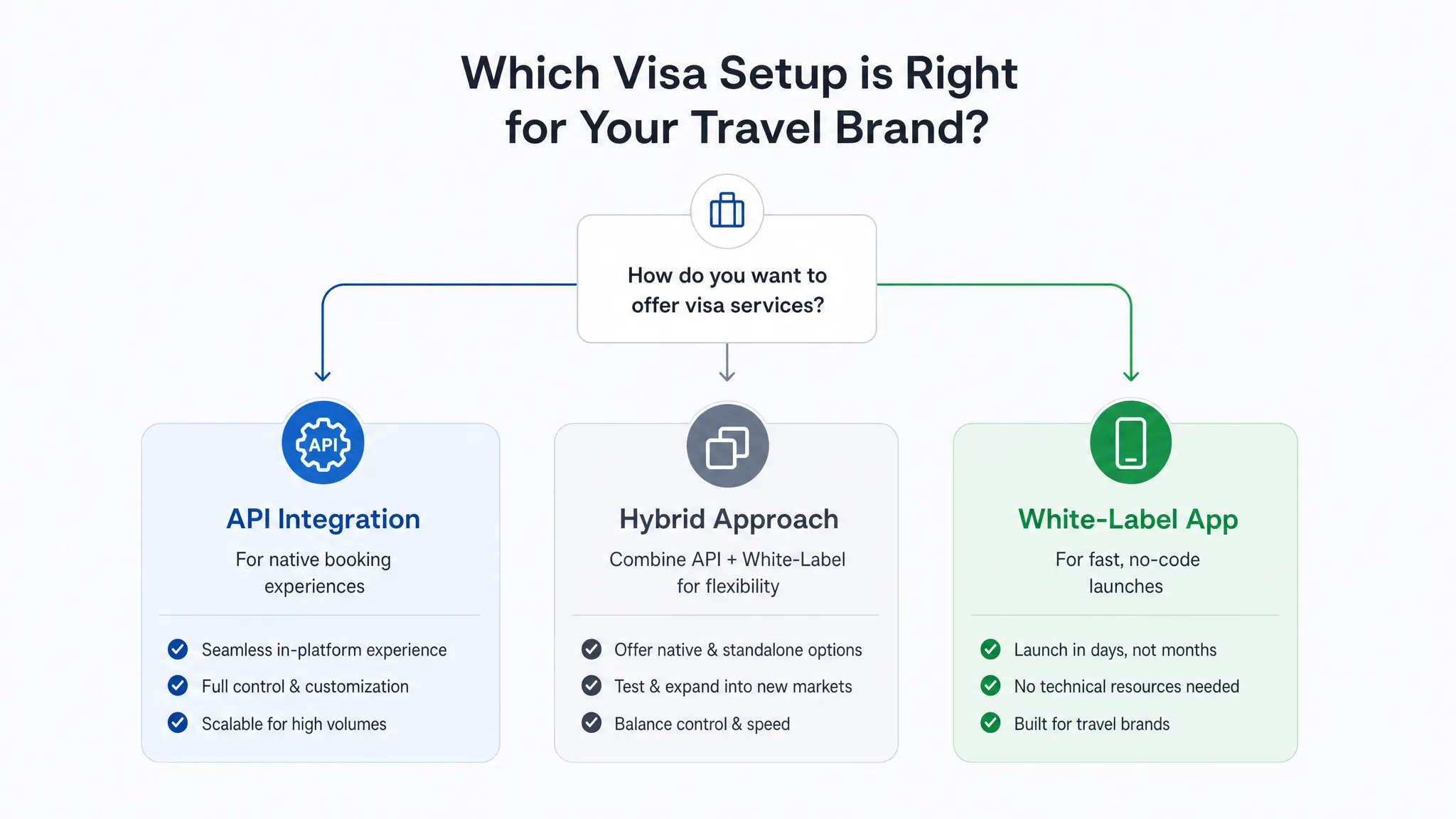
The short answer is that neither model is universally better. An API setup gives you the most control over the customer journey, data flow, and checkout experience. A white-label setup gets you to market faster with less engineering effort. The best visa setup depends on your brand's digital maturity, booking flow, support model, and revenue goals.
Why this decision matters more in 2026
Digital border requirements are expanding. The EU's ETIAS travel authorization, the UK's Electronic Travel Authorization, and the continued growth of electronic visa programs show how travel documentation is moving online.
For airlines, OTAs, tour operators, cruise lines, and TMCs, this shift changes the commercial role of visas. A visa application is no longer just a compliance task. It can influence booking confidence, reduce support pressure, prevent last-minute disruption, and create a new ancillary revenue stream.
The setup you choose affects four things:
- How early travelers see visa requirements
- How seamlessly they can complete online visa processing
- How much control you have over branding and data
- How quickly your team can launch, learn, and scale
What an API visa setup looks like
A visa API connects visa rules, eligibility checks, application flows, and status updates directly into your own travel platform. Instead of sending travelers to a separate journey, you surface visa requirements inside your booking path, app, agent tool, or post-booking account area.
For example, an OTA could show visa requirements after a traveler selects a flight. An airline could trigger an eVisa offer during checkout or check-in. A TMC could integrate travel document automation into its corporate booking workflow so travelers and managers see requirements before approval.
With an API setup, your brand controls the user interface. The traveler may never feel like they left your ecosystem.
API is strongest when native UX matters
An API setup is usually the best fit when visa services are part of a broader digital commerce strategy. If your product team already optimizes seat selection, bags, insurance, hotels, transfers, and payments inside one flow, adding visa services natively can create a more consistent experience.
API integration also gives you more flexibility around timing. You can show a requirement at search, recommend an application during checkout, trigger reminders after booking, or surface document checks before departure.
This matters because visa intent varies. A mandatory travel authorization should appear early enough to reduce uncertainty. An optional premium service may perform better after booking, when the traveler is ready to complete trip administration.
For a deeper technical walkthrough, see SimpleVisa's guide to how eVisa APIs work.
What to plan before choosing API
API projects need product ownership. Your team should be ready to define the customer journey, manage front-end design, test edge cases, and coordinate engineering work. You also need clear rules for data handling, support escalation, and status notifications.
That does not mean API integration has to be heavy or slow. But it does mean the value comes from customization. If your team will not use that flexibility, a white-label setup may be more efficient.
What a white-label visa setup looks like
A white-label visa app gives travelers a branded visa application experience without requiring your team to build the full workflow from scratch. It can be linked from confirmation emails, embedded in post-booking pages, shared by agents, or offered as a no-code solution for faster deployment.
The traveler still sees your brand, but the visa application journey is powered by a specialist platform. This is often the fastest way to offer guided customer visa applications, premium eVisa management, and compliant document collection without rebuilding complex border crossing solutions internally.
SimpleVisa's white-label option is designed for travel businesses that want to launch visa services quickly, test demand, and create ancillary revenue without a major development project.
White-label is strongest when speed matters
White-label is usually the better starting point when you need a low-friction launch. Tour operators, agency networks, destination specialists, and smaller OTAs often do not want to wait for a full product roadmap cycle before offering visa support.
It is also useful when you have many brands, partners, or agents. Instead of each team building its own visa flow, a centralized white-label app can create a consistent application experience across markets.
For more on this route, read SimpleVisa's guide to offering white-label visa services without writing code.
What to plan before choosing white-label
The main consideration is the handoff. A white-label journey works best when travelers understand why they are being sent there, what they need to complete, and how the service connects to their booking.
Brand trust matters. The entry point should be clear, the messaging should be simple, and support responsibilities should be defined before launch. A white-label setup can convert well, but only if it feels like a natural extension of the travel brand.
API vs white-label visa setup: quick comparison
| Decision factor | API setup | White-label setup |
|---|---|---|
| Time to market | Best when you can allocate product and engineering resources | Best when you want a faster launch with minimal development |
| UX control | Highest control over placement, design, and user flow | Branded experience with less front-end customization |
| Engineering effort | Requires integration planning, testing, and maintenance | Lower effort, especially with no-code implementation |
| Conversion potential | Strong for in-flow upsell during search, checkout, and check-in | Strong for post-booking, agent-assisted, and partner-led journeys |
| Data and analytics | More granular control over events and customer behavior | Depends on reporting and data-sharing setup with the provider |
| Operational complexity | More internal ownership of product logic and exceptions | More provider-managed application experience |
| Best fit | Large OTAs, airlines, TMCs, mature digital platforms | Tour operators, agencies, fast pilots, multi-brand networks |
| Long-term scalability | Excellent when visa is part of a broader travel API strategy | Excellent when rollout speed and operational consistency matter |
Which setup is best for your travel brand?
The right model often depends on your distribution channel. A high-volume OTA has different needs from a boutique tour operator. A cruise line has different border crossing complexity from a domestic agency selling occasional international packages.
| Travel brand type | Likely best starting point | Why |
|---|---|---|
| Large OTA | API or hybrid | Visa offers can be embedded in search, checkout, and post-booking flows at scale |
| Airline | API or hybrid | Travelers benefit from document checks across booking, manage booking, and check-in |
| Tour operator | White-label | Faster launch, strong brand control, and lower engineering dependency |
| Cruise line | Hybrid | API data can support complex port requirements, while white-label can handle applications |
| TMC | API or custom data service | Corporate travelers need requirement checks inside approval and duty-of-care workflows |
| Retail travel agency network | White-label | Agents can share a branded application link without needing technical integration |
| Event or sports travel seller | White-label | Best for seasonal peaks, group travel, and fast campaign deployment |
A practical decision framework
If you are choosing between API and white-label, do not start with technology. Start with the customer moment you want to improve.
If travelers frequently abandon bookings because they are unsure about border requirements, an API can surface answers inside the booking flow. If your support team is overwhelmed by visa questions after booking, a white-label app can quickly give customers a guided path.
Use this scorecard to clarify direction.
| If this describes your business | Better fit |
|---|---|
| You need to launch a visa service quickly without writing code | White-label |
| You want the visa journey fully embedded in your checkout | API |
| Your product team wants to A/B test placement and messaging | API |
| Your visa upsell opportunity is still unproven | White-label |
| You manage many sub-brands or agency partners | White-label |
| You need real-time visa requirement data across itinerary changes | API or custom data service |
| You want a staged rollout with low initial risk | White-label first, API later |
| You want visas to become a core ancillary product | API or hybrid |
When hybrid is the smartest answer
Many travel brands do not need to choose one model forever. A hybrid setup can combine the best of both.
One common approach is to use an API for eligibility checks and requirement messaging, then send the traveler to a white-label app to complete the visa application. This gives the brand real-time visibility at the highest-intent moments without requiring the internal team to build every application step.
Another approach is to start with white-label to validate demand, measure attach rate, and understand customer questions. Once the business case is proven, the brand can add API integration in the highest-performing markets or channels.
A hybrid model is especially useful when your destination mix is uneven. You may want a native API flow for high-volume routes and a white-label application path for long-tail destinations.
Implementation blueprint for either model
Whether you choose API or white-label, the goal is the same: help travelers understand requirements, complete applications accurately, and feel confident before departure.
A strong implementation usually includes these five steps:
- Map the visa moments: Identify where travelers need visa guidance, such as search, checkout, confirmation email, manage booking, agent call, or pre-departure reminder.
- Define the data flow: Decide which fields are needed, such as nationality, destination, travel dates, purpose of travel, passport details, and booking reference.
- Design the handoff: Make it clear why the traveler is seeing a visa offer, what happens next, and whether the service is mandatory or optional.
- Set support rules: Clarify who handles application questions, payment issues, document problems, refusals, and government processing delays.
- Measure performance: Track attach rate, completion rate, approval outcomes, support tickets, and ancillary revenue per booking.
For a broader platform selection framework, see Travel Document Automation 101.
Security and compliance cannot be an afterthought
Visa services involve sensitive traveler data, including passport details, identity documents, travel plans, and sometimes financial or employment evidence. Your setup should be designed around privacy from the beginning.
At minimum, ask any provider how they handle data minimization, encryption, access controls, audit logs, retention periods, and deletion requests. You should also understand how traveler consent is collected and how data moves between your platform, the visa management platform, and any relevant government systems.
The ICAO Traveller Identification Programme highlights the importance of trusted identity management in modern travel. For travel brands, the practical takeaway is simple: a smoother visa journey must also be a secure one.
How to measure whether your setup is working
A visa launch should be managed like any other revenue and customer experience initiative. The most successful teams measure both commercial performance and traveler outcomes.
| KPI | What it tells you |
|---|---|
| Visa attach rate | How often eligible travelers choose the visa service |
| Application completion rate | Whether the flow is simple enough for travelers to finish |
| Approval rate | Whether guidance and document checks are improving application quality |
| Time to submission | How quickly travelers complete the process after booking |
| Support tickets per application | Whether the setup is reducing or creating operational workload |
| Ancillary revenue per booking | How much commercial value the visa service adds |
| Customer satisfaction | Whether travelers see the service as helpful, not intrusive |
SimpleVisa has a dedicated guide on KPIs to track after deploying a visa management platform if you want to build a reporting framework.
Common mistakes to avoid
The first mistake is choosing the model based only on engineering preference. API is powerful, but it is not automatically better if your team does not have the capacity to optimize the journey. White-label is fast, but it still needs thoughtful placement, messaging, and support design.
The second mistake is treating visa requirements as static content. Border rules change, traveler eligibility varies by passport and itinerary, and simple country pages cannot handle every scenario. Travel document automation works best when requirements are dynamic and personalized.
The third mistake is hiding visa support too late. If travelers discover a required electronic visa only after booking, they may blame the travel brand for the surprise. In many cases, visa guidance should appear before payment or immediately after confirmation.
The fourth mistake is focusing only on revenue. Ancillary revenue matters, but visa services also reduce anxiety, protect customer experience, and lower avoidable support volume. The strongest business case combines all three.
Frequently Asked Questions
Is an API always better than a white-label visa app? No. An API is best when you need deep integration and full UX control. A white-label visa app is often better when you need a faster launch, a no-code setup, or a branded experience without heavy development.
Can a travel brand start with white-label and move to API later? Yes. Many brands start with white-label to validate demand, then use API integration for higher-volume routes, checkout placement, or more advanced personalization.
Which model creates more ancillary revenue? It depends on placement and traveler intent. API can perform well because it embeds visa offers into high-intent booking moments. White-label can also generate strong revenue when promoted clearly through confirmation emails, agent workflows, and post-booking journeys.
Do visa APIs handle full applications or only requirement checks? It depends on the provider. Some APIs only return visa requirement data. Others support guided applications, document collection, status tracking, and online visa processing. Ask exactly which parts of the journey are covered.
Is white-label suitable for enterprise travel brands? Yes. White-label is not only for smaller companies. Enterprise brands may use it for rapid pilots, secondary markets, partner programs, or long-tail destinations while using API integration in core flows.
What should procurement teams ask before choosing a provider? Ask about country coverage, rule update frequency, security controls, data retention, branding options, reporting, revenue model, support process, application success metrics, and integration flexibility.
Can SimpleVisa support both API and white-label models? Yes. SimpleVisa offers API integration, a white-label visa application app, custom data services, guided customer visa applications, premium eVisa management, and no-code implementation options for travel businesses.
Build the visa journey around how your customers buy
The best visa setup is not the most technical one. It is the one that fits your customer journey, internal resources, and commercial strategy.
Choose API if visas should become a native part of your booking engine, mobile app, or travel API ecosystem. Choose white-label if you want to launch quickly, keep implementation simple, and provide a branded visa application experience without building the entire workflow yourself. Choose hybrid if you want fast validation now and deeper integration later.
SimpleVisa helps travel brands simplify border crossing administration, guide customers through visa applications, and generate ancillary revenue through API, white-label, no-code, and data-service options. To explore the best setup for your business, visit SimpleVisa and request a demo.