Dynamic Visa Pricing: Markups, Caps, and Trust Signals

Visa upsells are one of the cleanest ancillary opportunities in travel because the customer problem is non-optional: if they need a visa or eTA, they must solve it before departure. The pricing problem is harder.
Price too high and you trigger abandonment, distrust, and chargebacks. Price too low and you leave margin on the table, or you cannot fund the service level your customers expect.
That’s where dynamic visa pricing comes in: a controlled way to set markups, enforce caps, and add trust signals that keep conversion high while protecting your brand.
What “dynamic visa pricing” actually means in visa checkout
In travel, “dynamic pricing” often implies algorithms that change in real time. For visas, the word usually means something more practical and safer:
- Separating price components clearly (government fees vs service fees vs optional add-ons like expedited processing where available).
- Adjusting your service fee by context (channel, basket, urgency, destination complexity, customer segment), while keeping guardrails.
- Enforcing caps so pricing never surprises the traveler or looks exploitative.
- Strengthening trust signals because visas are a scam-heavy category and customers are risk-sensitive.
Two important constraints are unique to visa products:
- The government fee is not yours to “price.” You can display it, collect it (depending on your flow), but it should not be treated like a margin lever.
- Perceived legitimacy matters as much as cost. A traveler will often pay slightly more for a visa flow that looks official, secure, and well-supported.
If you want a refresher on how fees are typically structured, SimpleVisa’s breakdown is a good starting point: Fee for Visa: How Costs Are Calculated.
Markups: choosing a model that fits visas (not just flights)
A markup is your commercial layer over the underlying costs of delivering the visa experience: identity and document capture, verification, support, operational handling, payment processing, fraud prevention, and the partner economics behind online visa processing.
The key is to pick a markup model that is easy to explain, easy to cap, and consistent with your brand.
The 4 markup models that tend to work best
| Markup model | How it works | Best for | Primary risk | How to mitigate |
|---|---|---|---|---|
| Flat fee per application | Same service fee regardless of itinerary value | High-volume OTAs, airlines, post-booking flows | Underpricing complex cases, overpricing simple ones | Tier by destination complexity, add add-ons rather than raising the base |
| Percentage of government fee | Service fee scales with official fee | When government fees vary widely by destination | Looks like you are “taxing” a government charge | Cap aggressively, label components clearly, avoid large percentages |
| Basket-aware fee | Service fee changes based on booking value, cabin, trip length | Premium brand positioning, corporate travel | Perceived unfairness if discovered | Use mild bands, explain that support and handling differ |
| Urgency-based fee | Higher service fee as departure date approaches | Last-minute travelers, disruption recovery | “Surge pricing” backlash | Use transparent urgency bands and strong caps, offer alternatives |
A common pitfall is copying airline ancillaries playbooks too directly. Visa checkout has different psychology:
- Customers are often anxious about approval risk and timing, not just price.
- They fear fraud and data misuse because they must upload sensitive documents.
- They need clarity on what happens if they are refused.
That means your markup strategy must be paired with trust design, not treated as a pure revenue lever.
A simple way to tier markups without over-optimizing
Instead of dozens of micro-rules, most teams do better with 3 to 5 pricing tiers based on operational reality:
- Low complexity (few fields, minimal documents, fast decisions)
- Medium complexity (additional document checks, more traveler questions)
- High complexity (long forms, more supporting docs, higher support load)
You can still be dynamic by mapping destinations and document types into these tiers, while keeping the front-end pricing simple.
Caps: the guardrails that protect conversion and brand trust
In visas, caps are not optional. They are your defense against:
- A legitimate pricing rule that accidentally produces a shocking total.
- A partner fee or currency conversion change that pushes the displayed price beyond expectations.
- A social media moment that reframes your visa offer as “price gouging.”
Three cap types to consider
| Cap type | What it limits | When it’s useful | Watch-outs |
|---|---|---|---|
| Absolute cap | Maximum service fee in currency terms | Keeps price “sane” across high-fee visas | Requires localization by market/currency |
| Percentage cap | Max service fee as a percentage of the government fee | Prevents extreme outcomes when official fees are low | Can still look odd if government fee is very high |
| Tier cap | Different caps for low/medium/high complexity destinations | Aligns cap with support effort | Requires a maintained destination-tier mapping |
Cap design rule: tie caps to “what customers would consider reasonable”
A cap is not only a finance tool, it is a customer-experience tool. The test is simple:
- If a customer screenshots your fee breakdown and posts it, does it still look fair?
That screenshot test should be part of your pricing approval process.
Add a “markup floor” too
Caps protect you from overpricing, but you also need a floor to prevent underpricing that makes the service unsustainable.
Why it matters:
- Visa flows can generate support tickets at the worst times (72 hours before departure).
- Underfunding support drives slower response times, lower satisfaction, and higher chargebacks.
The floor should be based on your real costs (support, payment processing, vendor fees, refund handling). If you are using a partner model, align it with your commercial structure. SimpleVisa outlines common partner economics here: 7 Revenue-Sharing Models for Online Visa Processing Partners.
Trust signals: the conversion multiplier in visa pricing
Visa upsells sit in a high-skepticism category. Customers routinely encounter:
- Fake “official” websites
- SEO ads that mimic government portals
- Hidden service charges
So your job is not only to be fair, but to look fair and look legitimate.
The trust signal stack that works (and where to place it)
| Checkout stage | Customer fear | Trust signals that reduce it |
|---|---|---|
| Offer card (booking or post-booking) | “Is this required?” “Is this legit?” | Plain-language eligibility summary, “government fee varies by nationality,” brand association (your logo), link to learn more |
| Fee breakdown modal | “Why is this so expensive?” | Line-item breakdown (government fee vs service fee), currency clarity, what’s included (support, document checks) |
| Document upload | “Is my passport safe?” | Security copy, data handling summary, recognizable payment/security cues, clear file requirements to prevent rework |
| Payment page | “Will I get scammed?” “Can I refund?” | Transparent refund policy, customer support access, confirmation of next steps and timelines |
| Confirmation page | “What happens now?” | Tracking expectations, clear status updates, what to do if denied, how you will contact them |
Two SimpleVisa resources that pair well with this stage-based approach:
- Why Travelers Abandon Visa Forms—and 6 UX Fixes That Convert
- Electronic Visa Scams: How to Protect Yourself from Fraud
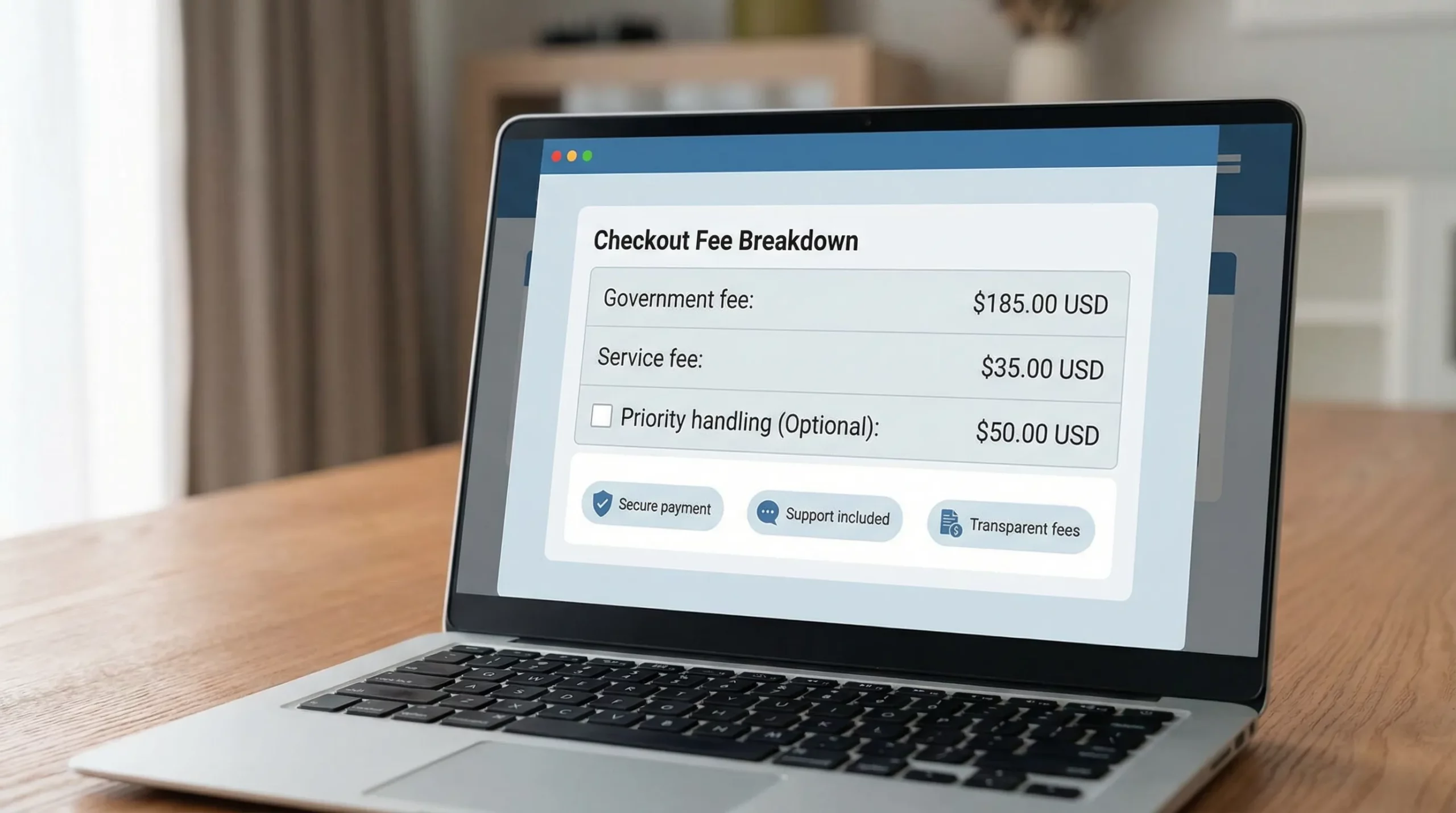
The single most important trust signal: a transparent fee breakdown
If you only fix one thing, fix this.
A strong breakdown:
- Labels the government fee as official.
- Labels your service fee as the cost of handling and support.
- Avoids ambiguous labels like “processing fee” when it mixes official and non-official charges.
- Shows the total early, not at the final step.
This is also where caps become invisible but powerful: if your service fee never looks extreme, the breakdown reinforces trust instead of triggering suspicion.
Trust signal that many teams forget: consistent pricing across touchpoints
Nothing destroys trust faster than seeing one price in the booking flow and a different one after clicking.
If you are using dynamic rules, keep these aligned:
- Offer card price (or range)
- Details view price
- Payment page price
- Confirmation email price
When price must vary (for example, because eligibility changes after passport selection), show that dependency explicitly.
Putting it together: a practical dynamic pricing policy (template)
Dynamic visa pricing should be a policy, not a collection of hacks.
Here is a policy structure many travel brands use successfully.
1) Define your “priceable” components
Most teams keep it simple:
- Government fee (pass-through, not priceable)
- Your service fee (priceable)
- Optional add-ons (priceable, if supported by the process)
If you are unsure what belongs where, align with the general framework in What Is Travel Document Automation? Definitions, Benefits, and Myths.
2) Choose one markup model as your default
Pick one “default truth” for customers, such as:
- “We charge a flat service fee per traveler for guided visa processing.”
You can still be dynamic behind the scenes (tiers, urgency bands), but your external logic remains coherent.
3) Add caps first, then optimize
Set caps before you run experiments. That prevents a successful test from being a reputational risk.
A typical ordering:
- Absolute cap per market
- Tier cap by destination complexity
- Percentage cap as a final safety net
4) Align pricing with support and refund realities
Visa outcomes vary. Your pricing policy must answer, internally and customer-facing:
- What happens if the traveler cancels?
- What happens if the traveler is denied?
- What part is refundable vs not refundable?
Be careful with language and avoid implying guarantees. (Even government-issued travel authorizations like ESTA explicitly note approval is not guaranteed; see the official U.S. Customs and Border Protection ESTA information.)
5) Instrument the funnel with the right metrics
Dynamic pricing without measurement becomes guesswork. At minimum, track:
- Attach rate (visa offer take-up)
- Application start rate
- Application completion rate
- Payment success rate
- Support contact rate per 1,000 applications
- Chargeback and refund rates
For a deeper KPI set, SimpleVisa covers operational and commercial metrics here: 5 KPIs to Track After Deploying a Visa Management Platform.
Common mistakes in dynamic visa pricing (and safer alternatives)
Mistake 1: hiding the service fee until the last step
This often increases short-term clicks and destroys completion rate.
Safer alternative: show a clear breakdown early, and use trust signals to justify the service fee (support included, guided application, secure handling).
Mistake 2: pricing purely off government fee
It seems tidy, but customers interpret it as a “tax on a tax.”
Safer alternative: a flat fee with tiers, then apply a percentage cap as protection rather than as the core pricing logic.
Mistake 3: letting urgency pricing feel like a penalty
Last-minute travelers are already stressed.
Safer alternative: present urgency pricing as a choice between service levels where possible, and keep the standard option visible.
Mistake 4: ignoring scam context
If your offer looks like “another visa site,” price sensitivity spikes.
Safer alternative: layer legitimacy cues, consistent branding, and clear support access. If you want a broader evaluation lens, use: Online Visa Services Compared: What Matters Most.
Where SimpleVisa fits (without over-promising)
SimpleVisa helps travel businesses add visa processing into the customer journey through API integration, a white-label visa application app, and no-code implementation options. If you are building dynamic visa pricing, the practical path is to treat it as part of your broader commercialization and UX strategy, not as a standalone pricing toggle.
If you want to pressure-test markup ideas, define caps, or review how trust signals should appear in your booking flow, start with a quick partner discussion and map the policy to your funnel.
Explore SimpleVisa’s partner options at simplevisa.com or review how embedded flows work in How eVisa APIs work: Step by Step.
The takeaway
Dynamic visa pricing works when it is disciplined:
- Markups are tied to real service value, not hidden complexity.
- Caps prevent reputational and conversion blowups.
- Trust signals do the heavy lifting that pricing alone cannot, especially in a scam-prone category.
If you get those three right, visa becomes a rare ancillary that can increase revenue and reduce disruption at the same time.