Easy Visa Company: 10 Questions to Ask Before You Buy

Choosing an easy visa company sounds straightforward until you realize “easy” can mean two very different things:
- Easy for your team to implement (fast launch, minimal support load)
- Easy for travelers to complete (high conversion, fewer mistakes, fewer last-minute disruptions)
The right partner delivers both, without compromising on security, compliance, or rule accuracy. Use the 10 questions below as a practical buying checklist for demos, RFPs, and reference calls.
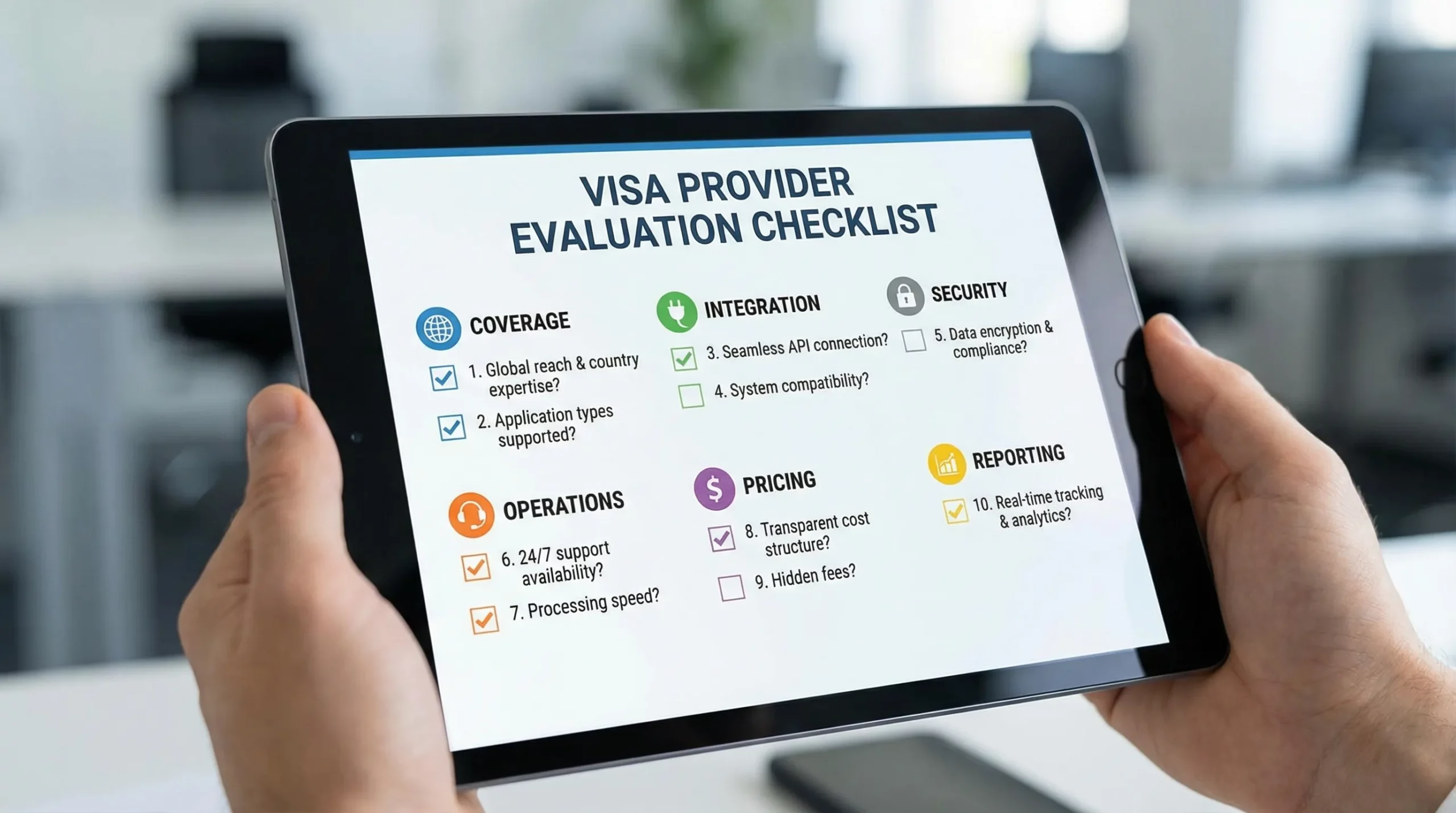
A quick scorecard you can use in vendor calls
Before the deep dive, align internally on what “good” looks like. This table gives you a fast way to score providers consistently.
| Question area | Why it matters | Evidence to request | Red flags |
|---|---|---|---|
| Coverage and rule accuracy | Wrong rules cause denied boarding and refunds | Data sources, update cadence, audit logs | “We update when needed,” no QA process |
| Integration and launch time | Long launches kill momentum and ROI | Implementation plan, sandbox, sample flow | Vague timelines, heavy custom work for basics |
| Security and privacy | You handle passports and sensitive data | SOC 2/ISO docs, DPIA support, encryption details | No third-party audits, unclear data retention |
| Traveler UX and completion | UX friction drives abandonment | Funnel metrics, mobile UX demos, drop-off analysis | Blames travelers for errors, no conversion reporting |
| Support and SLAs | Visa issues happen on nights/weekends | SLA, escalation paths, multilingual coverage | Email-only support, no incident process |
| Commercials and total cost | “Low fee” can hide high operational cost | Pricing schedule, refund rules, chargeback policy | Surprise fees, unclear responsibility split |
| Reporting and optimization | You need to improve attach and margin | Event schema, dashboard examples, webhooks | No analytics, no A/B testing support |
| Future-proofing | New ETAs and digital borders keep coming | Roadmap, policy-change process, migration plan | No roadmap, slow updates |
If you want a broader framework, SimpleVisa also publishes a detailed guide on how to evaluate a visa processing company. The questions below focus specifically on what makes a provider truly “easy” in real-world travel operations.
Question 1: What exactly do you cover, and how do you define “coverage”?
Coverage is not just “how many countries.” You need to know what the provider supports end-to-end for your customers and operations.
Ask the vendor to break coverage into:
- Eligibility and requirements (visa, eVisa, ETA, passport validity, onward travel rules)
- Application execution (forms, document capture, payment, submission)
- Post-submission handling (status tracking, corrections, rework, approvals, denials)
If your business sells multi-stop itineraries, ask how they handle connections, transits, and mixed document types. A provider can be “easy” for simple point-to-point leisure trips and still fail on complex itineraries.
Question 2: How do you keep visa and entry rules accurate, and how often do you update?
Rule accuracy is the foundation. Out-of-date requirements create customer churn, extra support tickets, and in the worst cases, passengers turned away at check-in or at the border.
Ask:
- What are your primary sources (government portals, airline-grade datasets, direct integrations, human research)?
- What is your update cadence, and what triggers urgent updates?
- Do you maintain change logs and a quality-assurance workflow?
A serious provider should be able to explain a repeatable process, not just promise “real-time.” If you want background on how travel document automation systems typically manage rules engines, see What Is Travel Document Automation? Definitions, Benefits, and Myths.
Question 3: Where does the visa offer appear in the journey, and can we control placement?
“Easy” means the visa step shows up at the right moment, with the right context, using your brand voice.
Depending on your model, you may want visas:
- During checkout (highest intent, fewer later surprises)
- Post-booking (lower checkout friction, but requires reminders)
- In a standalone portal (for travel advisors or offline-to-online journeys)
Ask to see real examples of:
- A full traveler flow on mobile
- A post-booking reminder strategy (email/SMS/push) and how it integrates
- Group or family flows (multiple travelers, shared documents)
If you’re deciding between implementation options, compare models in API vs. White-Label App: Which Visa Integration Model Suits You?.
Question 4: What does implementation really require (engineering, content, compliance, approvals)?
“Easy implementation” should be measurable. Ask for a launch plan with owners, timelines, and dependencies.
At minimum, request:
- Sandbox access and test cards
- A clear event schema (for tracking attach rate and conversion)
- Brand customization options (logo, colors, language, tone)
- A no-code path if your team cannot prioritize engineering
If you want to sanity-check vendor claims about speed, compare their plan to a concrete deployment walkthrough such as embedding an eVisa widget in under 30 minutes.
Question 5: How do you reduce form errors and document rejections?
Visa applications fail most often due to preventable issues: wrong passport details, mismatched names, incorrect photo format, or missing supporting documents.
A truly easy visa company invests in error prevention, not just “submitting forms.” Ask whether they support:
- Automated field validation (name order, date logic, passport expiry rules)
- OCR or scan-based capture for passports and documents
- Photo compliance checks (size, background, glare, cropping)
- Document completeness prompts that adapt to nationality and trip purpose
Then ask for proof: What percentage of cases require rework, and how is that handled? A vendor that cannot discuss rework rates is often hiding operational complexity.
Question 6: What security controls protect traveler data, and what standards do you meet?
You are asking customers to share highly sensitive information. “Easy” must never come at the cost of security.
Ask for specifics on:
- Encryption in transit and at rest
- Access controls (role-based access, least privilege)
- Logging and audit trails
- Vulnerability management and incident response
- Data retention and deletion policies
If the provider claims compliance, ask what they can produce (for example, SOC 2 report, ISO 27001 certificate, penetration test summary, or security whitepaper). For baseline guidance on API risks, you can reference the OWASP API Security Top 10.
If you operate in regulated markets, confirm readiness for privacy obligations such as GDPR and applicable US privacy laws. Also clarify whether data processing agreements (DPAs) are standard and how sub-processors are managed.
Question 7: Who owns compliance risk, and what happens when something goes wrong?
This is the unglamorous part of “easy,” but it determines whether your support and legal teams will end up firefighting.
Ask:
- Do you provide clear disclaimers about final border decisions?
- Who is responsible if a traveler applies for the wrong document type?
- How are chargebacks and disputes handled?
- What is the process for corrections after submission?
Also ask how they handle edge cases, such as dual citizenship, name changes, or passport renewals close to departure. Ideally, the vendor can show playbooks rather than improvising.
Question 8: What are your support SLAs, and do you cover the time zones we sell into?
Visa questions spike when travelers are packing, checking in, or mid-trip. If support is slow, your brand absorbs the frustration.
Ask for:
- Support hours and channels (chat, email, phone, partner desk)
- Escalation paths for urgent departures
- Typical response times, plus P1 incident definitions
- Multilingual support coverage, if you sell internationally
Then verify it in reference calls. Ask partners how often the vendor resolves issues without bouncing travelers back to the airline, OTA, or agency.
Question 9: What KPIs do you track with partners, and will we have access to the data?
If the vendor cannot measure outcomes, they cannot make your program easier over time.
At minimum, you should be able to track:
- Visa attach rate (how many eligible travelers buy)
- Application completion rate and time to complete
- Approval and denial outcomes (where available)
- Support contact rate and top ticket drivers
Request a sample dashboard or reporting pack and ask whether you can export raw events into your BI tools.
For a metrics-oriented view of what to measure after go-live, see 5 KPIs to Track After Deploying a Visa Management Platform.
Question 10: What is the total cost, including hidden operational costs?
Pricing is rarely just a per-application fee. “Easy” vendors make costs predictable and explain who pays for what.
Ask for a written breakdown that includes:
- Setup costs and minimums (if any)
- Revenue share or commission mechanics
- Refund policies (government fees vs service fees)
- FX and payment processing handling
- Operational costs you may still carry (support workload, disputes)
A good provider will discuss commercial alignment honestly, including how they help you increase ancillary revenue without harming checkout conversion.
One last thing: how do you know the vendor will still be “easy” next year?
Digital border requirements are expanding, not shrinking. New electronic authorizations, changing data requirements, and shifting security checks mean your vendor needs a durable update process and a roadmap.
Ask what they have shipped recently, how quickly they respond to policy changes, and whether they offer multiple delivery models (API, white-label, data service) as your product matures.
If you want to compare vendors side-by-side, you may also find it useful to read Online Visa Services Compared: What Matters Most.
If you’re evaluating providers now
If your goal is to add visa support with minimal lift, SimpleVisa offers multiple implementation paths, including API integration, a white-label visa application app, custom data services, and a no-code implementation option. It is already used across hundreds of travel sites, which can matter when you need proven operational reliability.
To explore fit for your booking flow and timelines, start with the integration model guide (API vs. White-Label App) or visit SimpleVisa to request a demo.