Easy Visa: Cut Paperwork with eVisa-Ready Routes
Visa friction silently kills bookings, especially when a dream itinerary turns into an embassy errand. The fix is simple in concept and powerful in practice, curate eVisa‑ready routes so customers can get authorized online, inside your booking flow, without paperwork or consulate visits. The result is higher conversion, fewer support tickets, and a smoother day of travel.
What is an eVisa‑ready route?
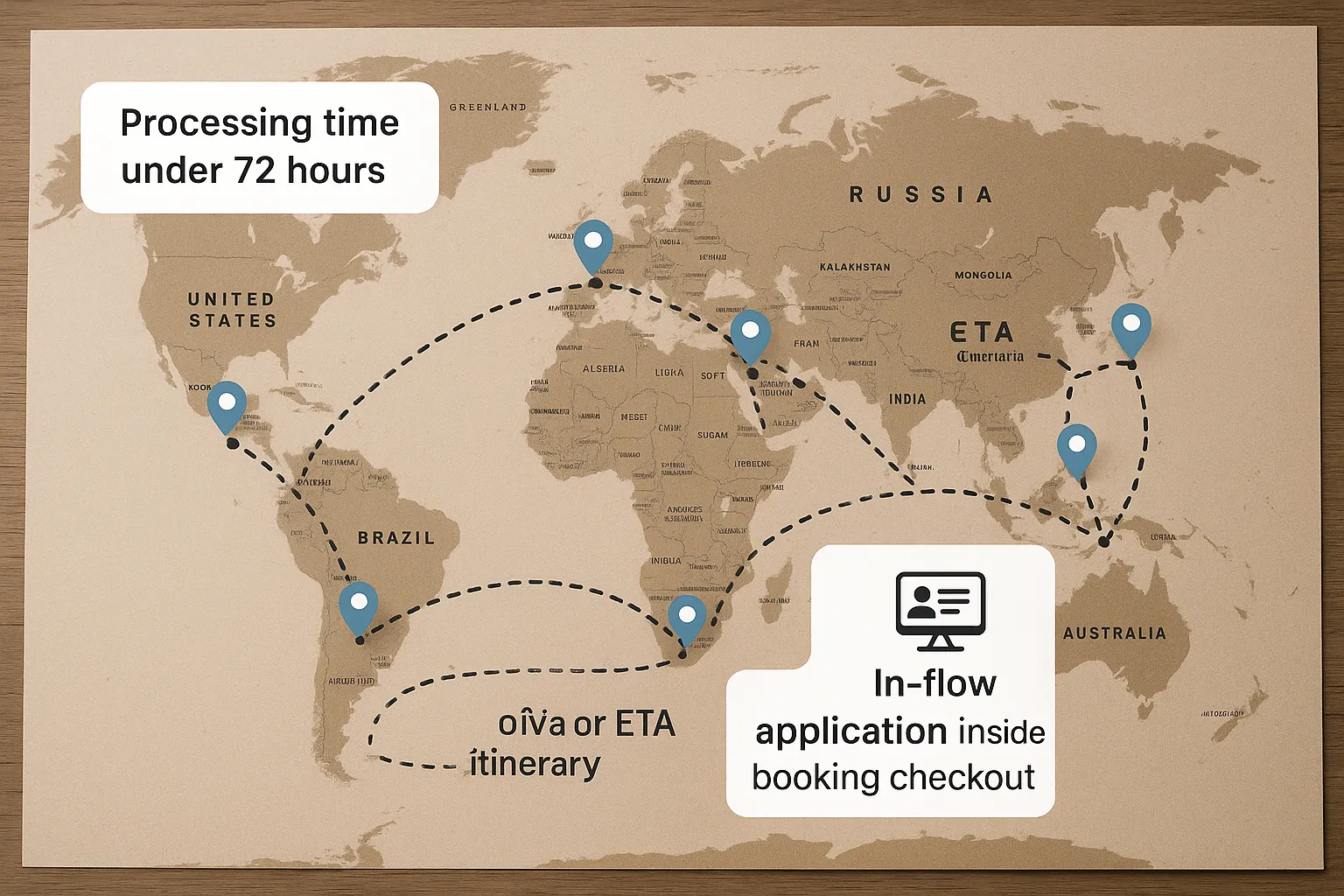
An eVisa‑ready route is any itinerary or product bundle where border permissions can be secured digitally, with predictable timelines and minimal documents, and where the application fits neatly into your checkout or post‑booking journey.
Typical criteria used by travel brands:
- All stops support eVisas or ETAs for your target origin markets, no in‑person embassy visits.
- Standard processing turnaround under 72 hours for at least 80 percent of applicants, with pay‑for‑priority options when needed.
- Fully online payment and document upload, plus status tracking that can be surfaced to the traveler.
- Clear entry rules for transits, cruises, and land crossings.
When your inventory meets these thresholds, you can confidently market Easy Visa as a feature of the route, rather than a risk factor that might derail the trip.
Why this matters now
- Conversion, visa forms are a top reason for cart abandonment on long‑haul and multi‑country trips. Reducing offline steps keeps shoppers in your funnel.
- Last‑minute demand, short approval times enable late bookings and disruption recovery, which are historically higher margin.
- Operational relief, fewer denied boardings and fewer where‑is‑my‑visa tickets to support.
- Ancillary revenue, eVisa attachments monetize compliance while improving traveler confidence.
Our analysis of millions of bookings shows that eVisa attach rates vary by region, and that choosing the right markets can unlock double‑digit uptake. See the hotspots in our research, Which regions generate the highest eVisa upsell rates, new research.
The business case in one glance
| Aspect | Classic multi‑country route | eVisa‑ready route |
|---|---|---|
| Time to book | Days or weeks while waiting for embassy slots | Minutes to hours, application in‑flow or post‑booking |
| Docs burden | Scans, forms, in‑person biometrics | Digital uploads, mobile capture, no visits |
| Abandonment | High, especially on mobile | Lower, cleaner checkout and status tracking |
| Support load | Frequent where‑is‑my‑visa queries | Proactive updates and fewer escalations |
| Ancillary revenue | Limited | Predictable eVisa attach and higher ARPB |
A 5‑step framework to design eVisa‑ready routes
-
Map source markets and passports. Start with your top origin countries and segment by passport strength and reciprocity. For each cohort, list destinations that allow eVisa or ETA and note black‑spots that trigger embassy interviews.
-
Score destinations with a Ready Score. Use a simple weighted model to rank candidate routes, then compose products that only include high‑scoring stops.
- Coverage, share of segments eligible for eVisa or ETA.
- Speed, median and 90th percentile processing times.
- Cost, total out‑of‑pocket fees per traveler.
- Risk, historic refusal rates and policy volatility.
- UX, document simplicity and mobile friendliness.
-
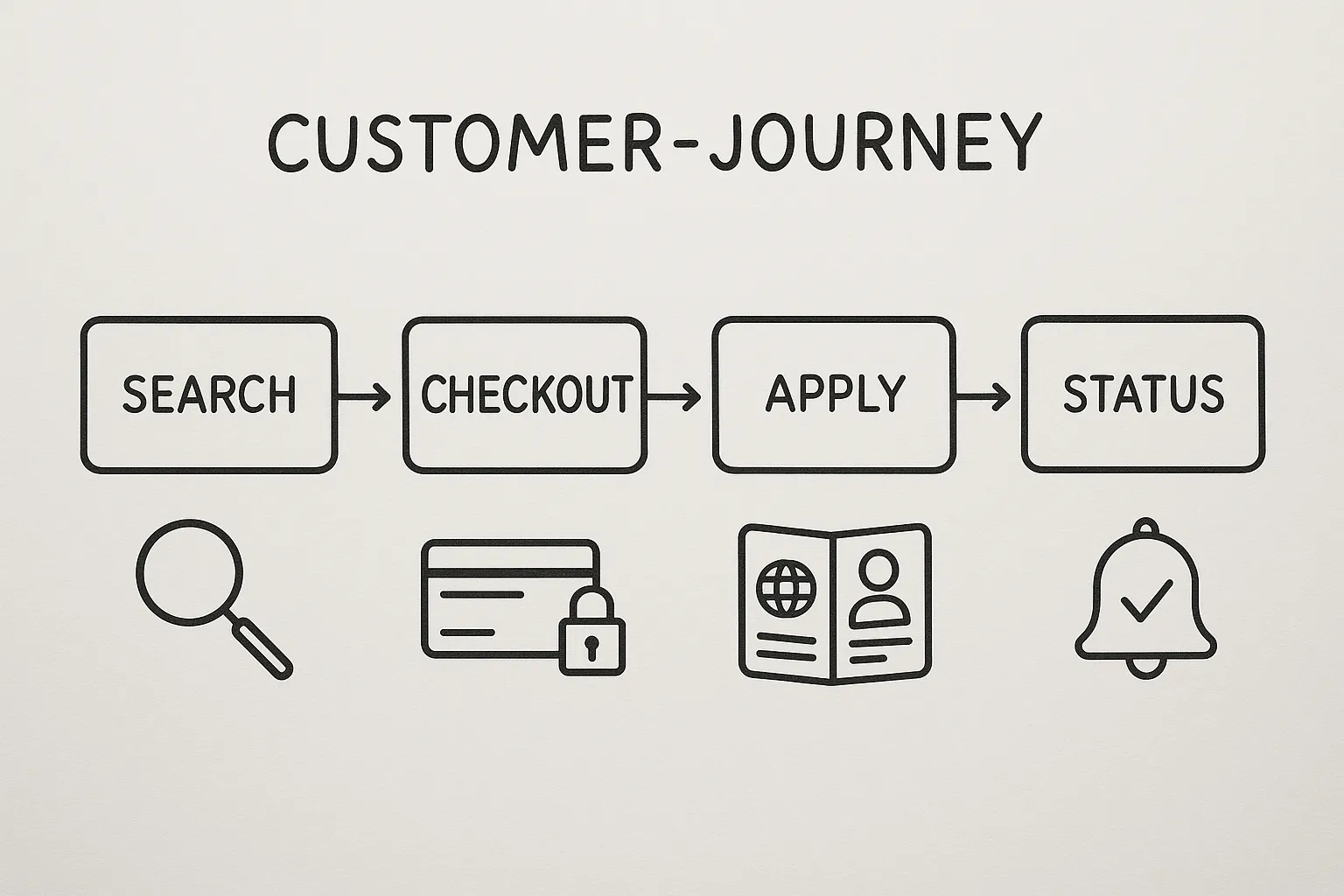
Design the booking journey. Offer instant eligibility checks, surface exact documents, and enable one‑click application handoff or embedded forms. For implementation details, see How eVisa APIs work, step by step and the Ultimate guide to marketing eVisa services during the booking flow.
-
Price and package. Bundle Easy Visa as an add‑on at search results, in cart, and in post‑booking emails. Use price anchoring and promise dates, for example Apply in 6 minutes, approval typically within 48 hours.
-
Set contingency rules. Define fallbacks when an applicant is in manual review, for example re‑route to an alternative port or trigger a premium processing offer. Clear policies reduce refund friction and protect NPS.
Implementation patterns that ship in weeks, not quarters
Travel brands usually pick one of three approaches, then expand over time.
- No‑code widget, fastest go‑live to validate demand and generate attach revenue without engineering.
- White‑label portal, branded experience with guided applications and compliance dashboards for ops teams.
- API integration, fully embedded, from eligibility in search to application in checkout and status post‑booking. See Future of travel APIs, from flights to visas in a single call for the end‑to‑end pattern.
SimpleVisa supports all three models, with visa processing automation, guided applications, premium eVisa management, and custom data services. Our solutions are already live on hundreds of partner sites, with a no‑code option if you want to test quickly.
Payments and back‑office, make Easy Visa easy for finance too
Visa fees and supplier deposits often require reconciliation across government portals, consulates, or local handlers. To reduce fraud exposure and accelerate month‑end close, many agencies, OTAs, and tour operators use virtual cards for controlled, one‑time payments. For a practical playbook on this topic, see how to secure supplier deposits with virtual cards from Elia Pay. Besides tighter security, you gain cleaner cost‑of‑goods tracking for every PNR or booking reference.
Operational tips:
- Split traveler‑paid government fees and your service fees on separate lines.
- Tokenize card details and enforce 3‑D Secure for applicant payments.
- Store immutable logs of each application milestone for audits.
- Build a policy for partial refunds and reapplications to keep chargebacks low.
Privacy and compliance, trust is part of the product
Travelers are handing you their most sensitive data, passports, photos, and sometimes biometrics. Demand modern protections from any eVisa provider, including end‑to‑end encryption, MFA, and liveness‑checked biometrics. Share your stance publicly in plain language, and link to your data retention policy inside the flow. If you are preparing an RFP, use this checklist, Top 8 security features to demand in any electronic visa solution.
Product playbooks by segment
- Airlines, add eligibility in search and offer Easy Visa bundles in ancillaries. Use pre‑departure status monitoring to reduce denied boardings.
- OTAs and metasearch, personalize offers by passport and trip purpose. Promote Easy Visa for couples and families with shared checklists.
- Tour operators, certify itineraries as eVisa‑ready and include it in your brand standard. Pre‑collect documents at booking to protect departure dates.
- Cruise operators, eliminate shore‑visa friction with per‑port requirement checks and one post‑booking workflow.
Measuring success, the 5 KPIs that matter
- Visa‑related conversion rate, percentage of eligible bookings that add the eVisa product.
- Ancillary revenue per booking, incremental ARPB attributed to Easy Visa and related services.
- Application completion time, average minutes to submit, monitor on mobile versus desktop.
- Approval rate, by route and passport segment, watch the 90th percentile for edge cases.
- CSAT and support, tickets per thousand bookings tied to visas and time to first response.
For benchmarks and dashboard tips, see 5 KPIs to track after deploying a visa management platform.
A 30‑day launch plan
- Days 1 to 5, pick two origin markets and three destinations, compute Ready Scores, select a route cluster.
- Days 6 to 10, implement the no‑code widget or white‑label app, configure payment rails, write microcopy.
- Days 11 to 20, run QA across devices, enable email and SMS notifications, set up BI events and alerts.
- Days 21 to 30, A or B test placement, go live to 10 percent traffic, roll to 50 percent, then 100 percent with learnings.
Real‑world snapshot, building an Asia long‑weekend bundle
A mid‑sized OTA serving Singapore and Malaysia launched eVisa‑ready weekend routes to Vietnam and Thailand. They targeted passports with high eVisa eligibility, embedded an eligibility check in search, and enabled a one‑click handoff to a branded application after payment. Within six weeks they saw higher basket completion on mobile and fewer customer contacts about visa status. The lesson, curate for eVisa coverage first, then obsess over in‑flow clarity.
Frequently asked questions
What exactly qualifies a route as eVisa‑ready? Routes where the vast majority of travelers from your target origin markets can obtain required permissions online, within predictable timelines, and without an embassy visit.
How do ETAs fit into the Easy Visa promise? ETAs are pre‑travel authorizations that are usually faster than eVisas and are fully online. You can include ETA destinations inside eVisa‑ready products and message them as part of the same Easy Visa bundle.
What about mixed‑passport groups on one PNR? Use a rules engine to evaluate each traveler individually. Offer Easy Visa to those who qualify, and provide alternatives or re‑routing suggestions to those who do not.
How much lead time should I promise? Publish a conservative promise date based on your 90th percentile processing time, and offer a paid priority option when available. Many brands set a 72‑hour promise for Easy Visa routes.
Which regions convert best for eVisa attach? It depends on your origin markets, fees, and trip purpose. Recent analysis shows strong performance in parts of Southeast Asia and the Gulf for many origin cohorts. For more detail, see our regional attach‑rate research.
How do I reduce the risk of a denial? Present plain‑language requirements, validate documents before submission, and proactively flag conflicts like overstays or misaligned trip purpose. Our guide on common mistakes and a pre‑submission checklist can help.
Take the next step, ship Easy Visa this quarter
If you want to cut paperwork and lift conversion with eVisa‑ready routes, SimpleVisa can help. Choose a no‑code widget, a white‑label app, or a full API integration, guide customers inside your flow, and start generating ancillary revenue with fewer operational surprises.
Book a 30 minute demo at simplevisa.com and get an implementation plan tailored to your inventory and origin markets.