Easy Visa Services for Airlines: Launch in 30 Days
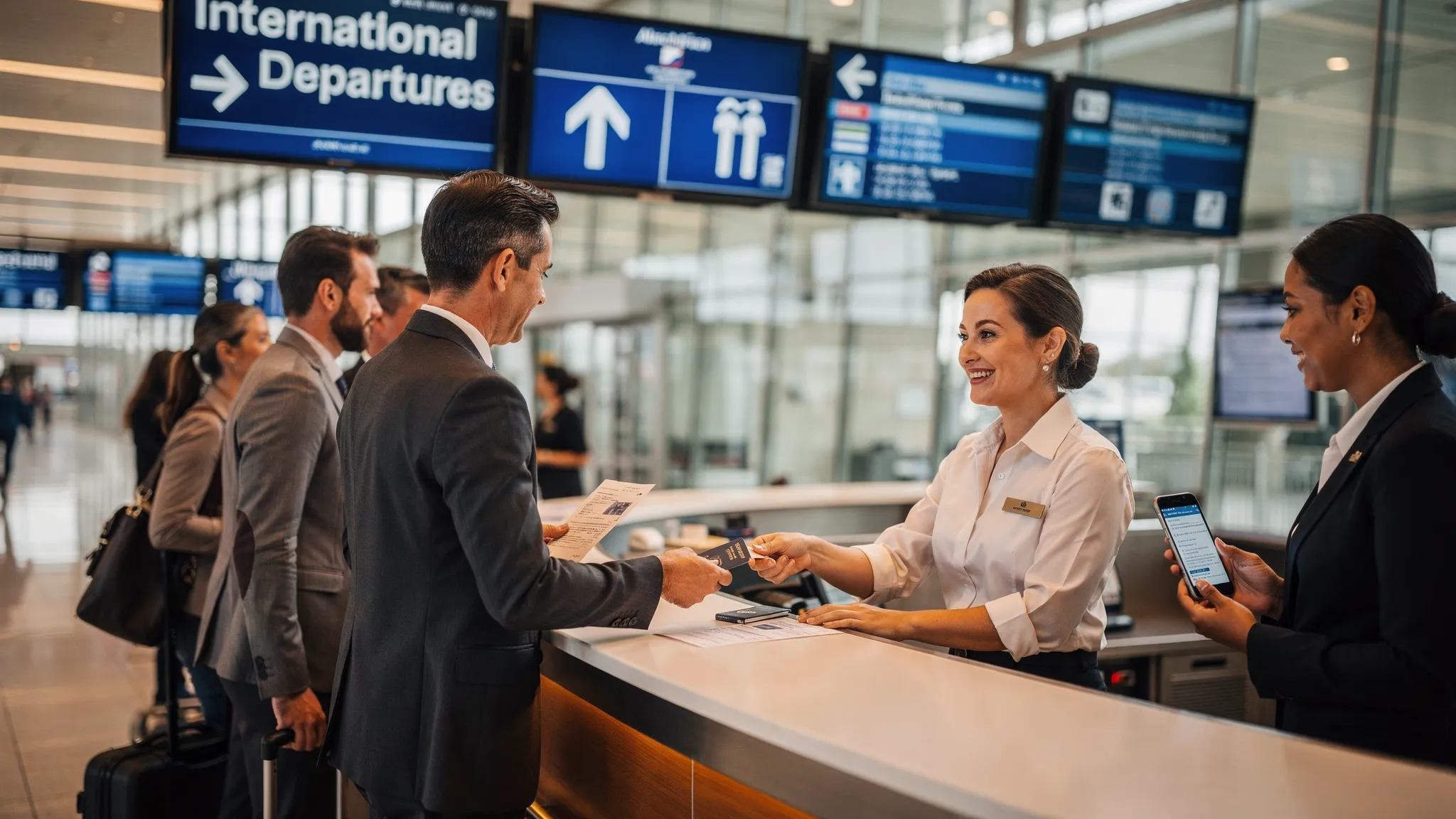
Airlines are under pressure to make international travel feel as “one-click” as domestic. Yet visas, eVisas, and electronic travel authorizations (ETAs) still create some of the biggest points of friction: passengers abandon bookings, contact centers get flooded, and airport teams face stressful last-minute document issues.
The opportunity is straightforward: add easy visa services directly into the airline journey, so passengers can check requirements and apply in the right place, at the right time, without leaving your ecosystem.
Below is a practical, airline-specific blueprint to launch in 30 days, using a modern visa partner like SimpleVisa (API, white-label, or data service) without turning your roadmap upside down.
What “easy visa services” means for an airline
For airlines, “easy” does not just mean “we provide a link.” It means the service is:
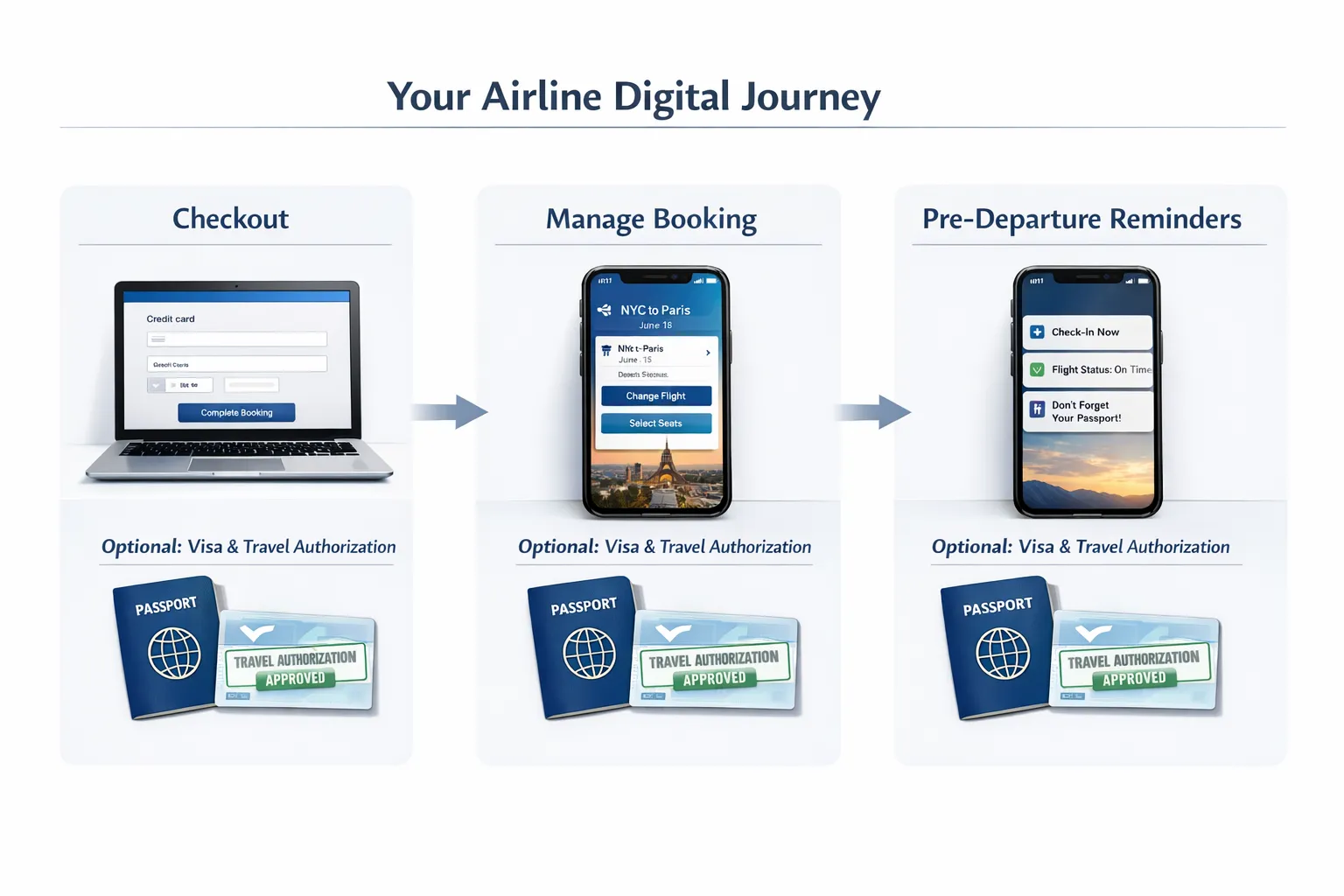
- Embedded where passengers already are (checkout, Manage Booking, pre-departure reminders)
- Personalized (based on nationality, destination, transit points, dates, purpose when relevant)
- Actionable (eligibility check plus guided application, payment, tracking)
- Operationally safe (clear rules, auditability, support workflows, and data protection)
In practice, airlines typically aim for two outcomes:
- Fewer last-minute document issues that disrupt airport operations.
- New ancillary revenue that feels helpful, not pushy.
Why airlines are prioritizing visa add-ons right now
Three forces are accelerating adoption in 2025 and 2026:
Increasing digitization of border controls
Many countries are expanding eVisas and ETAs, and new authorizations (like Europe’s upcoming ETIAS) are training travelers to expect “digital permission to travel” as a normal step.
Higher cost of disruption on departure day
When travelers show up without the correct authorization, the impact cascades: longer queues, more gate exceptions, and more pressure on frontline staff.
Passengers want certainty earlier
Customers increasingly expect airlines to help them avoid mistakes, especially for complex, multi-country itineraries.
For airlines, an integrated visa solution becomes both a customer experience feature and an operational risk reducer.
The 30-day launch plan (what happens each week)
A fast launch is realistic when you treat this as a product integration, not a “content update.” Here is a proven 30-day structure that keeps scope tight.
| Week | Primary goal | Airline deliverables | Visa partner deliverables |
|---|---|---|---|
| Week 1 | Align scope and choose integration model | Journey mapping, markets to launch, legal review kickoff, success metrics | Sandbox access, integration guidance, data coverage confirmation |
| Week 2 | Build and connect | Frontend placement, backend wiring (or no-code embed), analytics events | API/white-label configuration, test credentials, webhook/event setup |
| Week 3 | Validate operational readiness | Customer support SOPs, edge-case flows, QA/UAT, content review | Test cases, troubleshooting support, monitoring setup |
| Week 4 | Soft launch then scale | Controlled rollout, A/B testing, KPI review cadence | Performance monitoring, optimization recommendations |
The key is choosing a launch scope that is narrow enough to deliver quickly, but meaningful enough to prove ROI.
Step 1: Pick the simplest integration model that still hits your goals
Airlines usually have three viable launch options. The “best” one depends on your tech capacity and how tightly you want the visa experience integrated into your booking flow.
| Model | Best for | Pros | Trade-offs |
|---|---|---|---|
| No-code / widget embed | Fast pilots, limited engineering capacity | Fastest time-to-market, minimal build | Less UX control than a fully custom flow |
| White-label visa app | Branded experience without deep engineering | Strong branding, guided journey, standalone destination for passengers | Usually sits adjacent to booking rather than fully native |
| API integration | Airlines with mature digital product teams | Deepest integration and personalization, strongest measurement | Requires more engineering and QA effort |
SimpleVisa supports these approaches via API integration, a white-label visa application app, and custom data services, with a no-code implementation option when speed matters.
If you want a deeper technical explainer to align stakeholders, SimpleVisa’s walkthrough on how eVisa APIs work is a useful reference.
Step 2: Decide where visa services appear in the passenger journey
To keep your launch tight, choose one primary touchpoint and one backup touchpoint.
Recommended primary touchpoints for airlines
Checkout (best for conversion): Offer visa help immediately after itinerary and passenger details are entered.
Manage Booking (best for rescue): Catch customers who booked quickly, then realize they need documentation.
Pre-departure reminders (best for operational protection): Email or app notifications that prompt action before check-in.
A common 30-day approach is:
- Start with Manage Booking (less sensitive than checkout, easy to message)
- Add checkout placement after you validate attach rate and support impact
Step 3: Get the data inputs right (this is where “easy” is won)
Visa flows feel difficult when passengers must repeatedly type information the airline already has. In your first release, prioritize prefill and validation.
Typical inputs you should be prepared to pass (or collect once and reuse):
- Passenger nationality and residence (when relevant)
- Destination and transit countries
- Travel dates
- Passport details (number, expiry, issuing country)
- Contact email/phone
Also define your UX stance on document upload:
- Mobile-first upload is critical, most passengers will complete forms on phones.
- Clear guidance on photo and scan requirements reduces drop-offs and rework.
If your team is actively optimizing conversion, the product patterns in Why Travelers Abandon Visa Forms, and 6 UX Fixes That Convert can help you avoid predictable friction.
Step 4: Treat compliance and passenger trust as product requirements
Airlines operate in a trust-heavy environment. Visa services touch sensitive identity data, so your launch needs clear ownership across Legal, Security, and Customer Care.
What to confirm before launch
- Data handling and consent: What data is collected, how it is used, and how consent is presented.
- Brand and liability positioning: Clear statements that issuance decisions are made by governments, not airlines.
- Fraud prevention: Basic protections against fake documents or account takeover.
- Support boundaries: What issues are handled by airline support vs. the visa provider.
You do not need a perfect enterprise rollout in 30 days, but you do need a clean baseline that your legal and security teams can sign off.
Step 5: Operational readiness (how to prevent day-of-travel escalations)
A visa upsell that increases support tickets is self-defeating. The fastest way to protect your operation is to standardize what your teams say and do.
Minimum operational toolkit for launch
- A short internal playbook: “What we can help with” vs. “What must be escalated”
- Macro responses for common questions (status checks, document upload issues, corrections)
- Clear cutoffs for when passengers should stop waiting and choose a different itinerary
If you want a structured ramp plan, SimpleVisa has a practical blueprint on training customer support teams on eVisa rules in one week.
Step 6: Build the commercial offer (without damaging customer experience)
Airlines win when visa services are positioned as protection and convenience, not fear.
High-performing merchandising tends to:
- Use plain language (“Check if you need a visa”) rather than legal jargon
- Show timing expectations (“Most travelers should apply X days before departure”) when available
- Emphasize confidence (“Avoid denied boarding and last-minute surprises”)
Where airlines often find unexpected demand: medical travel
Medical and wellness trips are a growing segment, and they frequently involve short booking windows plus high anxiety about documentation.
For example, passengers traveling to Romania for elective procedures may be coordinating clinics, flights, and recovery schedules. Airlines serving Bucharest routes sometimes support these travelers with destination guidance and reputable providers (for instance, a clinic site like Dr. Diana Gheorghiță, cosmetic surgery in Bucharest can help passengers plan the non-flight side of their trip). When the trip purpose is high stakes, integrated visa help becomes even more valuable.
A realistic KPI set for the first 30 to 60 days
The goal of a fast launch is to prove impact quickly, then iterate.
| KPI | Why it matters | How to measure in an airline context |
|---|---|---|
| Attach rate (visa offer) | Validates merchandising and placement | Visa clicks and purchases per eligible bookings |
| Completion rate | Indicates form friction and trust | Started applications vs. submitted applications |
| Approval rate | Signals application quality and guidance effectiveness | Approved vs. decided applications (where available) |
| Support contact rate | Protects your cost-to-serve | Visa-related contacts per 1,000 pax |
| Airport exception volume | Protects operations | Day-of-travel doc issues, denied boarding reasons |
Avoid trying to optimize everything at once. In early phases, attach rate and support contact rate usually tell you the most.
30-day airline launch checklist (tight scope, high confidence)
Use this as a final readiness check before you go live:
- Placement confirmed (Checkout or Manage Booking)
- User journey reviewed on mobile and desktop
- Analytics events defined (view, click, start, submit, purchase)
- Customer support macros and escalation path published
- Legal disclaimers and consent language approved
- QA covers edge cases (round trips, transit, name mismatches, passport expiry)
- Soft launch plan defined (one market, one route cluster, or one sales channel)
Frequently Asked Questions
Can an airline really launch visa services in 30 days? Yes, if the first release is scoped to one primary touchpoint (often Manage Booking) and you use a partner that supports no-code, white-label, or a well-documented API. The 30-day window is typically about launching a reliable MVP, then improving conversion and expanding markets.
Should we start with a visa data checker or a full application flow? If your goal is ancillary revenue and fewer last-minute issues, a guided application flow is usually more impactful than data-only. Data-only can still be useful for early awareness, but it often creates a handoff problem (“Now go apply somewhere else”).
Where should visa services appear for best results? Checkout usually delivers the highest conversion, but it is also the most sensitive part of the funnel. Many airlines start in Manage Booking to validate performance, then move the offer into checkout.
What about cases where passengers do not need a visa? The flow should quickly confirm “no visa required” when applicable and stop there. That outcome still improves customer experience and can reduce unnecessary support contacts.
How do we avoid increasing customer support tickets? Make the journey self-serve (prefill, clear document guidance), add tracking/status visibility, and train agents on the boundaries of what they can resolve. Also ensure escalation to the visa provider is frictionless.
Do visa services create liability for the airline? Airlines typically manage this with clear disclosures about government decision-making, accurate requirement presentation, and well-defined support responsibilities between the airline and the visa provider.
Launch easy visa services with SimpleVisa
If your team wants to add easy visa services for airlines without a long build cycle, SimpleVisa offers multiple go-to-market paths: visa processing automation, API integration for travel sites, a white-label visa application app, and custom data services, plus a no-code implementation option for fast pilots.
To explore what a 30-day rollout could look like for your routes and digital touchpoints, visit SimpleVisa and request a demo.