Easy Visa to Get: Top Options for Short Notice Trips

Last-minute travel is usually limited by one thing, not flights or hotels, but entry permission. When someone searches for an easy visa to get, they are typically trying to answer a practical question: “What can I realistically qualify for and receive fast enough to travel next week (or tomorrow)?”
The good news is that “easy” does not always mean “no paperwork.” In 2026, the fastest paths are usually digital (eVisa, eTA/ETA) or low-friction (visa-free, visa on arrival). The key is choosing the right category for your passport, trip purpose, and timeline.
What “easy visa to get” actually means (and what it does not)
A visa is “easy” when it is:
- Fast to obtain (often minutes to a few days, depending on checks)
- Low effort (online form, limited documentation)
- Low risk (clear eligibility criteria, fewer in-person steps)
- Predictable (you can confirm requirements and status without ambiguity)
It does not mean guaranteed entry. Even with an approved eVisa or travel authorization, border officers can still refuse entry if you do not meet conditions (purpose of travel, funds, onward ticket, etc.).
The top short-notice options (ranked by speed and certainty)
Different authorizations solve different last-minute scenarios. Here is a practical comparison you can use before you commit to non-refundable bookings.
| Option | What it is | Typical speed | Best for short-notice trips when… | Key risk to plan for |
|---|---|---|---|---|
| Visa-free entry | No visa required for short stays (for eligible passports) | Immediate | Your passport has visa-free access and your trip fits permitted activities | You still must meet entry conditions (return ticket, funds, length-of-stay rules) |
| eTA / ETA / ESTA | Digital travel authorization (not always a “visa”) | Often same day | You are visa-exempt but need pre-travel clearance | Mistakes in passport data can cause delays or denial |
| eVisa | Visa issued digitally, usually applied for online | Often days, sometimes faster | The destination supports eVisas and your documents are ready | Photo/passport scan format errors, mismatched details |
| Visa on arrival (VoA) | Permission issued at the airport/land border on arrival | Same day, at border | The country reliably offers VoA to your nationality and you can accept waiting | Airline check-in denial if staff cannot confirm eligibility |
| Expedited consular visa | Traditional visa via embassy/consulate with an expedite request | Variable | You must travel for urgent reasons and no digital option exists | Appointments, interviews, courier times, unpredictable approvals |
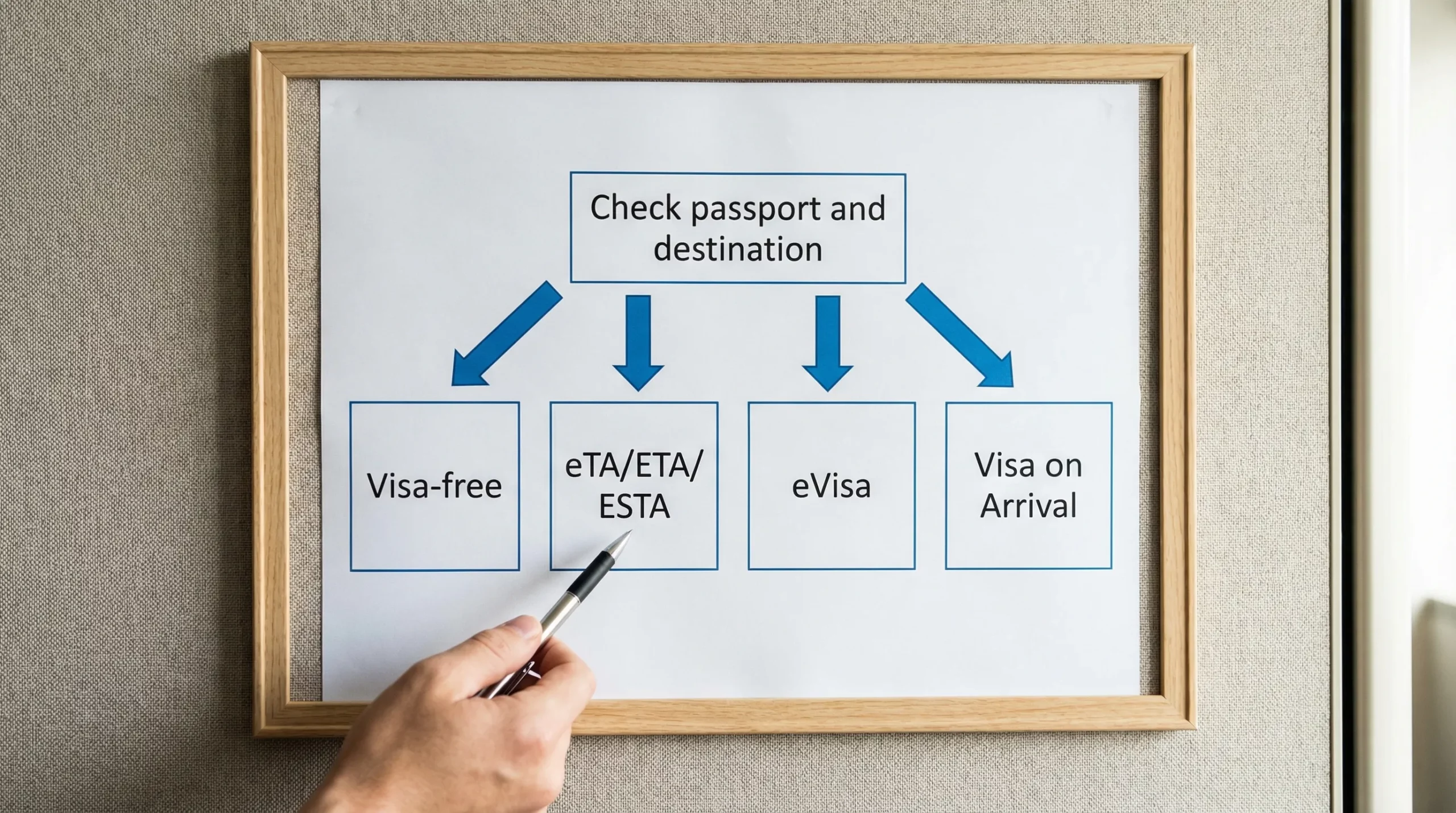
Option 1: Visa-free destinations (the true “instant approval” path)
If your passport allows visa-free entry, this is usually the easiest route for short-notice travel because you avoid the processing queue entirely.
What to check (even when visa-free):
- Length of stay limits (for example, 30 days, 60 days, 90 days)
- Purpose restrictions (tourism only vs business meetings allowed)
- Passport validity rules (many destinations require 3 to 6 months validity beyond arrival)
- Onward/return ticket expectations
Practical tip: if you are planning a spontaneous weekend or 5-day getaway, visa-free often beats “easy visa” because it eliminates approval risk and waiting.
Option 2: eTAs/ETAs/ESTA, fast clearance for visa-exempt travelers
Many travelers think of these as “easy visas,” but in most cases they are travel authorizations required for visa-exempt visitors. They are often the best short-notice option because:
- Applications are typically fully online
- Required data is usually limited to passport and personal details
- Decisions are frequently automated, with occasional manual review
Common examples you will see in traveler workflows:
- ESTA for eligible travelers to the United States under the Visa Waiver Program
- eTA for eligible travelers to Canada
- ETA-style programs used by multiple countries for short visits
Short-notice pitfalls to avoid:
- Applying with a passport that expires soon
- Typing errors in passport number or name order
- Using unofficial sites that add fees (or worse, scams)
If you want a quick primer on how these differ from visas (and why that matters for eligibility), see SimpleVisa’s explainer on eVisas vs. eTAs.
Option 3: eVisas, the best “easy visa to get” when you still need an actual visa
An eVisa is generally the strongest answer to “easy visa to get” because it is still a visa, but it is handled digitally.
For short-notice planning, eVisas are ideal when:
- The destination supports a real online issuance process
- The documentation is light and standardized (passport scan, photo, basic itinerary)
- You can apply and receive the approval notice digitally
Where last-minute applicants lose time is not the government processing itself, but preventable submission issues:
- Photo size or background not accepted
- Passport scan glare or cropped MRZ (the machine-readable zone)
- Inconsistent travel dates across fields
If your trip is coming up fast, it helps to use a checklist that forces “format and consistency” checks before you pay. SimpleVisa has a practical pre-submission resource here: Checklist: Everything You Need Before Submitting an Online Visa Application.
Option 4: Visa on arrival (VoA), fast in theory, risky in practice
Visa on arrival can feel like the easiest option because you “deal with it at the airport.” For short-notice travelers, the hidden risk is pre-boarding checks.
Even if a country offers VoA, airlines are responsible for ensuring passengers meet entry requirements. If check-in staff cannot confirm your eligibility quickly, you could be denied boarding.
VoA works best when:
- Your nationality is clearly eligible and widely recognized in airline systems
- You have all supporting documents ready (return ticket, accommodation details)
- You arrive during hours when border processing is fully staffed
If you choose VoA for a tight timeline, over-prepare. Bring printed backups of key documents and keep digital copies offline on your phone.
Option 5: Expedited consular visas (only when you have no digital alternative)
If your destination does not offer eVisas or travel authorizations, you may be forced into a traditional embassy process.
For urgent travel, “expedited” usually depends on:
- Appointment availability
- Local consulate workload
- Your reason for travel and proof (business letters, medical documentation, etc.)
This is typically the least predictable route for short-notice trips. If you can switch your destination to one with visa-free entry or an eVisa, you often should.
A 48-hour last-minute travel checklist (documents you should prepare now)
Even the easiest visa to get becomes slow if you do not have clean digital inputs. Before you apply anywhere, prepare a “submission-ready” folder with:
- A passport scan that is clear, uncropped, and readable
- A compliant passport-style photo (correct size, neutral background)
- Your itinerary details (arrival date, departure date, address)
- Proof of onward travel (when required)
- Proof of accommodation (hotel address and booking reference)
- A payment method that works for international online transactions
Accommodation is surprisingly important because many applications ask where you will stay, and some borders ask again on arrival. If you are booking on short notice, it helps to have a reliable place to search and confirm quickly, for example by using hotel booking deals to lock in an address and reservation details.
How to choose the “top option” for your specific trip (fast decision framework)
When time is tight, you do not need more options, you need a faster decision.
Start with your passport and destination pairing
Most visa mistakes happen because travelers search “easy visa countries” without matching it to their passport. Requirements can change dramatically based on nationality.
If you are unsure where to begin, use a structured reference that separates visa-free, eVisa, and travel authorizations. SimpleVisa maintains a practical overview here: Visa Requirements by Country: A Quick Reference.
Then filter by purpose and length of stay
A destination might be “easy” for tourism but not for:
- Paid work
- Journalism/media projects
- Long stays
- Volunteer activities
If you apply under the wrong purpose, short-notice travel can turn into a denial and a rebook.
Finally, choose the route with the least operational risk
For last-minute trips, “operational risk” matters as much as approval speed:
- Visa-free and eTA-style programs are typically low-risk operationally
- eVisas are great if you can submit clean documents
- VoA can be operationally risky at check-in
For travel businesses: why “easy visas” should be offered inside the booking flow
If you sell travel (airline, OTA, tour operator, cruise, agency), last-minute requirements are not just a traveler problem. They are a conversion problem.
Common outcomes when visa friction shows up late:
- Higher abandonment at checkout
- More customer support tickets (“Do I need a visa?” “How fast can I get it?”)
- Denied boarding costs and reputational damage
- Lost ancillary revenue from customers who would pay for convenience
This is exactly where automated eligibility checks and guided digital applications help. If you want a deeper look at how these systems integrate technically, SimpleVisa’s walkthrough on how eVisa APIs work is a good starting point.
Frequently Asked Questions
What is the easiest visa to get for a last-minute trip? For most travelers, the easiest path is visa-free entry when eligible. If you still need permission, an eTA/ETA (like ESTA-style authorizations) or an eVisa is usually faster than an embassy visa.
Are eVisas faster than visas from an embassy? Often, yes. eVisas are designed for online submission and digital issuance, which can remove appointment scheduling and physical document handling. Processing time still varies by country and traveler profile.
Is visa on arrival a safe choice for short-notice travel? Sometimes. The biggest risk is not the border itself, but getting denied boarding if the airline cannot verify your eligibility quickly. If you use VoA, bring strong supporting documentation and backups.
Can an approved eVisa or travel authorization guarantee entry? No. Approval allows you to travel to the border and request entry. Final admission is decided by border officials based on eligibility and compliance with entry conditions.
What is the biggest reason “easy” online visas get delayed? Preventable submission errors, especially incorrect passport details, non-compliant photos, and unclear scans. Applying through trusted channels and double-checking data reduces delays.
Make last-minute visas easier for your customers
If you are a travel brand trying to reduce booking friction, SimpleVisa helps streamline border crossing administration by guiding customers through visa and entry requirements, then supporting digital applications through API, white-label, or data services.
Explore SimpleVisa’s solutions at simplevisa.com to see how visa processing automation can fit into your booking flow and help you capture ancillary revenue without adding operational burden.