Entry Visas: Types, Validity, and Proofs Required
Borders are the last administrative step of any trip, and the rules behind entry visas are not one size fits all. The type you choose, how long it stays valid, and the proofs you must show can change by country, purpose, and even the way you apply, consulate, eVisa, visa on arrival, or travel authorization. This guide breaks down the essentials so you can prepare correctly the first time.
What is an entry visa?
An entry visa is written permission to request entry at a border for a specific purpose and time period. It can be a physical sticker in your passport, a digital eVisa linked to your passport number, a visa on arrival granted at the airport, or a travel authorization, for example an ETA, that pre clears you but is not a visa. Approval to enter is always at the discretion of border officers.
If your route is visa free, you may still need a travel authorization, for example UK ETA or EU ETIAS when phased in. Always confirm your exact requirements with official sources or your carrier, since policies evolve.
Entry visa types at a glance
Below are the most common entry visa categories and what they typically involve. Details vary by country.
| Type of entry visa | Typical purpose | Usual validity window | Max stay per visit | Common proofs required |
|---|---|---|---|---|
| Tourist/Visitor | Leisure, visiting friends or family | Often 30 to 180 days validity | Often 30 to 90 days | Passport, photo, itinerary, accommodation, return or onward ticket, proof of funds, travel insurance where required |
| Business | Meetings, conferences, short client visits | 30 days to 1 year, sometimes multi entry | Often 30 to 90 days per trip | Invitation letter, employer letter, event registration, accommodation, funds, return ticket |
| Transit | Airport or short city transit | Valid for journey dates only | Usually up to 24 to 96 hours | Confirmed onward ticket, valid visa for next destination if required |
| Student | Study programs, exchange, research | Program length, often multi year | Varies by program and country | Letter of acceptance, proof of funds, housing, health insurance, sometimes police clearance and medicals |
| Work | Employment, intra company transfer | Contract period, often with extensions | Varies by permit type | Employer sponsorship, labor authorization, qualifications, funds, police clearance, medicals |
| Family/Visit | Family reunions, private visits | 30 to 180 days, sometimes multi entry | Often 30 to 90 days | Invitation letter, proof of relationship, accommodation or sponsor proof, funds, return ticket |
| Medical | Treatment abroad | Treatment duration | As approved | Hospital letter, appointments, funds, insurance or payment guarantee |
| Visa on Arrival | Granted at port of entry to eligible nationals | Short windows similar to tourist | Often 15 to 30 days | Same as tourist plus fee on arrival, risk of refusal if proofs are weak |
| eTA/Travel Authorization | Pre screening for visa exempt visitors, not a visa | Often 2 to 5 years with multiple entries | Commonly up to 90 days per visit | Online form, fee, valid passport. At the border you still show funds, itinerary, accommodation |
Note on formats: Many of the types above are now offered as eVisas, which are applied for online and issued digitally. The underlying purpose and proofs are similar to paper visas, but the submission is faster and paperless.
Validity, permitted stay, and entries explained
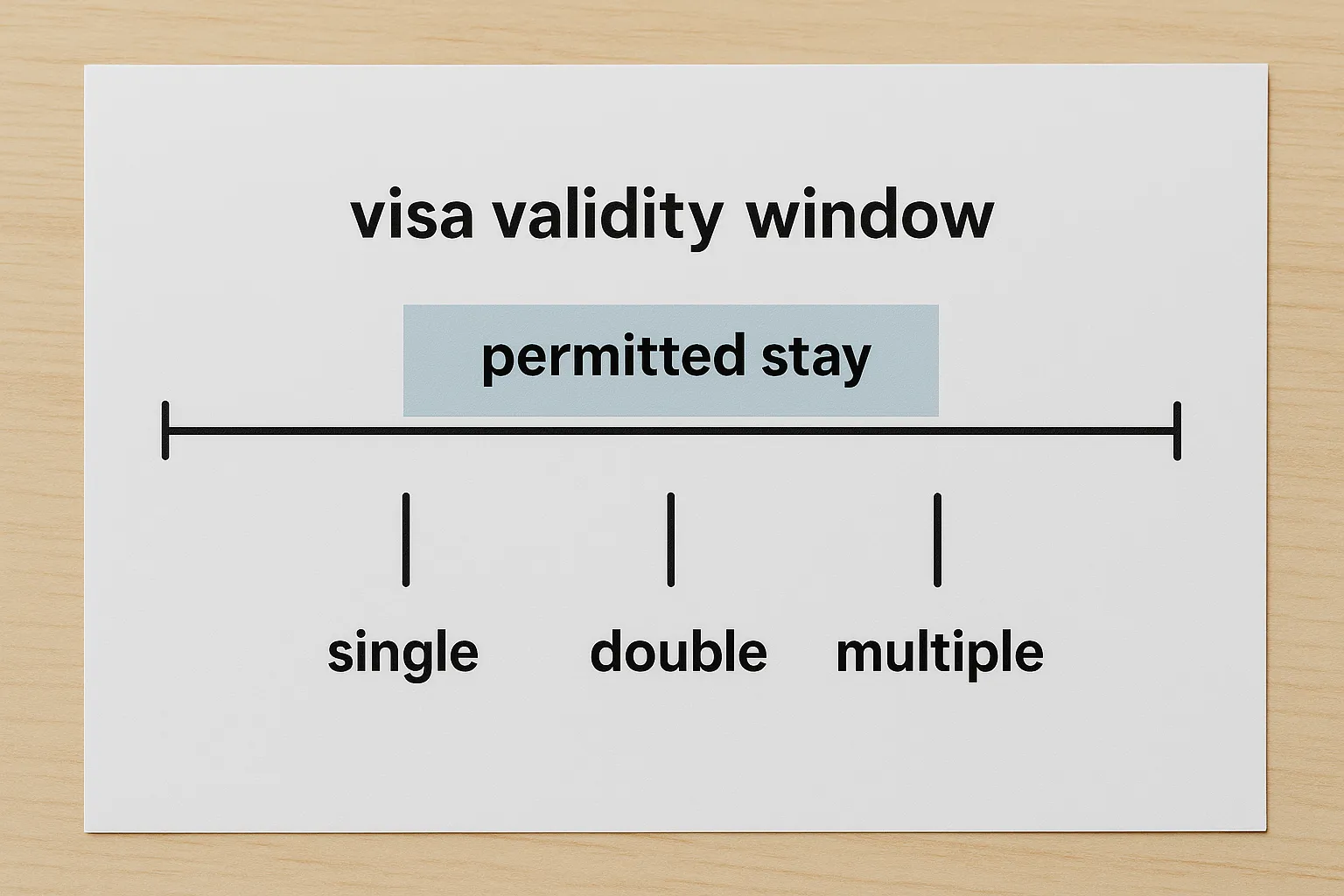
Visa wording can be confusing. Three fields matter most:
- Validity window, the dates between which you may seek entry. Some visas start validity on the day of issue, others let you choose a start date.
- Duration of stay, how long you may remain per visit. A visa can be valid for six months, but each stay may still be limited to 30 or 90 days.
- Entries allowed, single, double, or multiple. Multiple entry lets you leave and re enter during the validity window, subject to stay limits.
Other important points:
- Passport linkage, many countries require your passport to remain valid for several months beyond entry, and a visa’s validity cannot outlast your passport.
- Regional caps, some regions apply cumulative stay limits, for example the EU’s short stay rule within the Schengen Area is commonly expressed as 90 days in any 180 day period. Check official guidance from the European Commission for the latest rules.
- Overstays, exceeding your permitted stay can trigger fines, removal, and future visa difficulties. Keep dated proof of your entries and exits.
Proofs required for an entry visa application
Exact documentation varies by country and visa type, but most consular visas and eVisas draw from the same categories. Provide clear, consistent, recent documents, and follow the format rules for scans and photos.
Identity and travel plan
- Valid passport with blank pages and enough remaining validity
- Compliant photo, size and background vary by country
- Travel dates and itinerary, round trip or onward ticket when required
- Accommodation, hotel bookings or host invitation with address and contact details
Financial capacity and home ties
- Proof of funds, recent bank statements or other liquid assets
- Employment or enrollment letter, payslips, tax letters, or business registration for self employed
- Evidence of ties to your home country, property, family commitments, job or study confirmations
Purpose specific documents
- Tourist or family visit, invitation letters and proof of relationship where relevant
- Business, company invitation, event registration, meeting schedule
- Student, official admission or enrollment, tuition receipts where requested
- Work, employer sponsorship, contract, labor approvals, professional credentials
- Medical, hospital letter, appointment confirmations, payment or insurance guarantee
Health, security, and insurance
- Travel medical insurance is mandatory for some visas, for example many short stay visas in Europe
- Police clearance and medical exams may be required for long stay work or study routes
- Vaccination certificates where relevant, for example yellow fever for some countries. The World Health Organization maintains guidance on health requirements for international travelers
For a deeper preparation checklist, including digital file formats and naming tips, see SimpleVisa’s guide, Checklist, Everything You Need Before Submitting an Online Visa Application.
Proofs you may be asked to show at the border
A visa does not guarantee entry. Border officers or airline agents can request documents before boarding or upon arrival. Be ready to show:
- Return or onward ticket within your allowed stay
- Proof of accommodation for at least your first nights
- Sufficient funds for the trip
- Purpose of travel, event tickets, meeting invitations, or tour confirmations
- Travel insurance where the destination requires it
Carriers can deny boarding if they believe you lack required documents. Pre validating your papers reduces last minute surprises.
Special cases to plan for
- Visa free but authorization required, some countries require a digital travel authorization for visa exempt visitors. For the UK see the official ETA guidance on GOV.UK. For Europe’s ETIAS, monitor the European Commission’s official site as rollout proceeds in phases.
- Airport transit, some nationalities need a transit visa even if they do not pass immigration. Requirements depend on both your passport and the airport. The IATA Travel Centre is a reliable starting point for entry and transit rules.
- Minors, traveling children often need additional documents, for example birth certificates and notarized consent from non traveling parents or guardians.
- Dual citizens, choose the passport that gives the most favorable entry conditions and use the same passport when you apply, check in, and arrive. See SimpleVisa’s guide, 8 Tips for Navigating Electronic Visa Requirements for Dual Citizens.
How to submit a stronger application
A careful file reduces questions, delays, and denials.
- Match every data point across documents, names, dates, and passport numbers must be consistent
- Show a realistic itinerary, flight segments and accommodation should fit your stated purpose and budget
- Demonstrate ties and solvency, include recent bank statements and proof you will return home on time
- Follow photo and scan rules exactly, size, background, file format, and resolution are frequent rejection triggers
- Apply early, country processing times vary and peak seasons create backlogs. If you are applying for an eVisa, review SimpleVisa’s 10 Tips for a Smooth Electronic Visa Application Process
For travel providers, reduce friction with integrated entry visa checks
Travel brands can prevent denied boardings and create new ancillary revenue by surfacing entry visa requirements and guided applications inside the booking flow. SimpleVisa offers multiple integration options, including a no code white label app and an API for direct embedding. Travelers get clear, step by step guidance and you gain conversion uplift and fewer support tickets. Learn more at SimpleVisa.
FAQs
What is the difference between visa validity and permitted stay? Visa validity defines the date window when you can arrive at the border. Permitted stay is how long you may remain per entry. A visa can be valid for six months, while each visit is limited to 30 or 90 days.
Do I need an entry visa if my passport has visa free access? Maybe not, but some countries require a travel authorization for visa exempt visitors. Examples include ETA style systems. Always check official sources before you book.
What happens if my passport expires soon? Many destinations require several months of passport validity beyond your arrival or departure date. Some will not issue a visa that runs past your passport expiry. Renew the passport first to avoid complications.
Are eVisas accepted the same way as sticker visas? For permitted routes, yes. eVisas are linked to your passport number. You usually bring a printed or digital copy as backup, but the record is checked electronically at the border.
Which proofs are most important for a tourist entry visa? A clear itinerary, proof of accommodation, return or onward ticket, sufficient funds, and travel insurance where required. Strong ties to your home country also help demonstrate intent to return.
Can I work on a tourist entry visa? No. Entry visas are purpose specific. Paid work generally requires an approved work permit or work visa.
Make entry visas simple
- Travelers, check your entry visa requirements, prepare documents, and submit online with confidence. Start at SimpleVisa.
- Travel brands, add guided visa checks and applications to your booking flow with a no code widget or API. Request a demo at SimpleVisa.
References and official resources
- IATA Travel Centre, passport, visa, and health requirements
- European Commission, ETIAS official site
- GOV.UK, Electronic Travel Authorization guidance
- World Health Organization, International travel and health