eVisa Express: Is Faster Processing Worth It?

eVisa Express sounds like the obvious choice when a traveler is short on time. Pay more, get approved faster, reduce stress, board the flight. In some situations, that logic is absolutely right.
But faster processing is not always better value. An express eVisa service can shorten the administrative timeline, improve document checks, and give travelers clearer guidance, yet it cannot override eligibility rules, missing documents, security screening, or government processing constraints.
For travelers, the real question is not simply whether eVisa Express is fast. It is whether the speed reduces enough risk to justify the extra cost. For travel businesses, the question is broader: can a faster visa option improve conversion, reduce support pressure, and create a better customer experience without overpromising?
What eVisa Express Usually Means
An eVisa is an electronic authorization that allows a traveler to apply online rather than submitting a paper application at an embassy or consulate. Depending on the destination, the approval may arrive by email, be attached electronically to the passport, or be available through a government portal.
The term eVisa Express usually refers to one of two things. In some countries, the government itself offers a priority or expedited processing lane. In other cases, a visa service provider offers faster handling, document review, guided form completion, application monitoring, or customer support to reduce avoidable delays.
Those are not the same. A government priority lane may directly affect the queue. A private express service may accelerate preparation and submission, but the final decision still belongs to the immigration authority.
A reliable express option should make these details clear:
- What part of the process is faster
- Whether the timing estimate comes from the government or a service provider
- When the processing clock starts
- What happens if the traveler uploads incomplete or incorrect documents
- Whether faster processing affects approval odds or only speed
This distinction matters because many travelers assume express means guaranteed approval by a specific deadline. In reality, the strongest express services reduce preventable friction. They do not remove border requirements.
When Faster eVisa Processing Is Worth Paying For
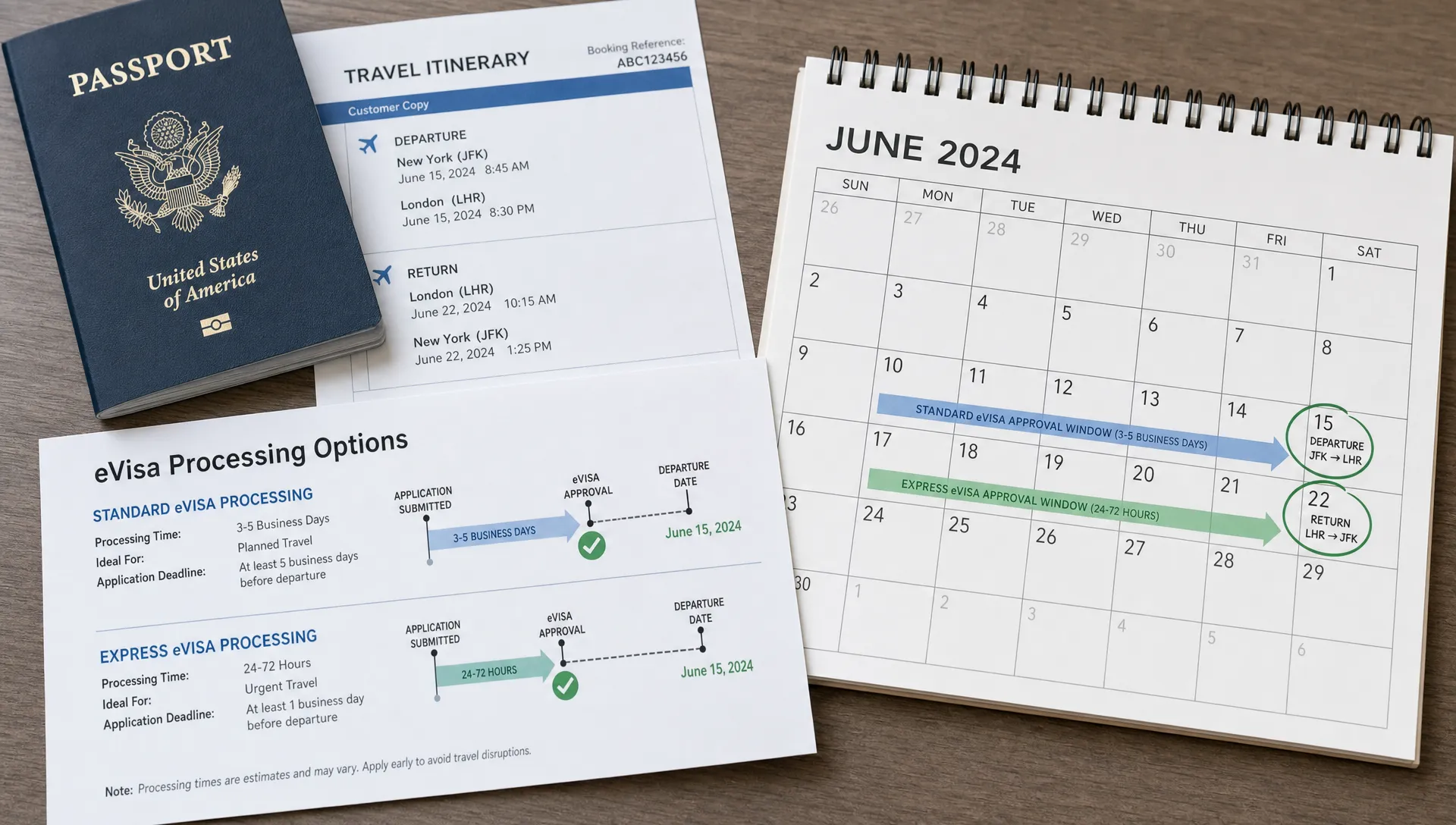
Express processing tends to be worth it when the cost of waiting is higher than the upgrade fee. That cost may be financial, such as a nonrefundable flight, or practical, such as missing a business meeting, event, cruise departure, or connecting itinerary.
For example, a traveler departing in three days who has already paid for flights and hotels may reasonably pay for express handling. Even if the fee feels high, it may be small compared with rebooking costs. A traveler departing in eight weeks, on the other hand, usually has enough time to use standard processing if the destination is known for predictable approvals.
Here is a practical way to think about it:
| Situation | Is eVisa Express likely worth it? | Why |
|---|---|---|
| Departure is within a few days | Usually yes | The cost of delay may be higher than the express fee |
| Trip includes nonrefundable flights, tours, or cruises | Often yes | Visa uncertainty can put the entire itinerary at risk |
| Traveler has complex documents or dual nationality | Sometimes | Extra guidance may prevent avoidable mistakes |
| Destination has slow or unpredictable processing | Often yes | Faster handling can reduce uncertainty if priority options exist |
| Trip is several months away | Usually no | Standard processing is often sufficient with early preparation |
| Application is incomplete | No | Express service cannot fix missing eligibility or required documents |
| Destination already offers near-instant approvals | Rarely | The upgrade may add little real value |
The most important factor is not panic. It is exposure. If a delay would create a major loss, express may be rational. If a delay would be inconvenient but manageable, standard processing may be the better choice.
Travelers should also benchmark destination-specific timelines before deciding. Processing speed varies widely by country, season, nationality, document quality, and security checks. SimpleVisa has a useful comparison of eVisa processing times by region that can help travel sellers and travelers set more realistic expectations before choosing an upgrade.
What eVisa Express Can and Cannot Speed Up
A faster visa service can be valuable, but only if expectations are realistic. The best way to evaluate eVisa Express is to separate controllable delays from government-controlled delays.
Controllable delays include mistakes in the application form, low-quality passport scans, wrong photo formats, missing hotel details, inconsistent travel dates, and late payment. These are common causes of avoidable slowdowns, especially for travelers applying under pressure.
Government-controlled delays are different. Immigration authorities may require manual review, additional documents, background checks, biometric steps, or follow-up questions. In those cases, express handling may help the traveler respond faster, but it cannot force an approval.
A credible express process can help with:
- Document quality checks before submission
- Faster application preparation
- Guided form completion
- Earlier detection of inconsistencies
- Priority handling when the destination officially supports it
- Status tracking and traveler communication
It cannot reliably help with:
- Ineligible travelers
- Incorrect passport details after submission
- Mandatory interviews or biometrics
- Security or background checks
- Country-specific entry bans or restrictions
- Expired passports or documents that do not meet validity rules
This is where many disappointing experiences come from. A traveler pays for speed, then discovers the real issue was not speed at all. It was eligibility, passport validity, or an application error.
How to Compare the Cost Against the Risk
The express fee is only one part of the decision. A smarter comparison looks at the total risk of not receiving the eVisa in time.
Consider the traveler who is choosing between standard processing and express processing. The standard option may be cheaper, but if the visa arrives too late, the traveler could face flight changes, hotel penalties, missed tours, lost vacation days, or denied boarding. In that context, the express fee is a form of risk reduction.
| Cost or risk | What to consider |
|---|---|
| Express processing fee | Compare it with the value of the trip, not only the government visa fee |
| Nonrefundable bookings | Flights, hotels, cruises, tours, and event tickets increase the value of speed |
| Time sensitivity | Business travel, weddings, conferences, and medical trips often justify faster handling |
| Document readiness | Express is more useful when documents are complete and accurate |
| Destination reliability | Some eVisa systems are predictable, while others vary by season or nationality |
| Support needs | Travelers who are unsure about requirements may benefit from guided help |
A useful rule of thumb is this: if the express fee is small compared with what the traveler could lose by waiting, it may be worth paying. If the traveler has time, flexibility, and simple documents, standard processing is usually enough.
Why eVisa Express Matters for Travel Businesses
For travel agencies, tour operators, online travel platforms, airlines, and destination management companies, visa timing is more than an administrative detail. It affects bookings, cancellations, customer satisfaction, support tickets, and ancillary revenue.
When visa requirements are unclear, travelers hesitate. They may abandon a booking, call support, or choose a different destination. When a trip is already booked and a visa issue appears late, the customer experience can deteriorate quickly.
Offering a clear eVisa Express option can help travel businesses in three ways.
First, it gives urgent travelers a structured path instead of leaving them to search across government portals and unofficial websites. Second, it helps capture ancillary revenue in a way that is genuinely useful when speed has real value. Third, it reduces the burden on support teams by guiding travelers through a defined process.
The same operational logic appears in many industries: businesses often rely on specialist partners for repetitive but high-impact tasks, whether that is payment processing, fulfillment, or sector-specific suppliers such as custom cardboard packaging producers that remove complexity from day-to-day operations. Visa administration can work the same way for travel companies. The goal is not to make the core product more complicated. It is to make a necessary step smoother for the customer.
For travel businesses evaluating providers, the best eVisa Express setup is not just the fastest one. It is the one that fits naturally into the booking journey, explains requirements clearly, and avoids unrealistic promises. If you are comparing solutions, it helps to focus on the electronic visa service features that actually matter, such as guided applications, integration options, data accuracy, and customer handoff.
Red Flags Before Paying for Express Processing
Not every express offer is worth trusting. Travelers and travel sellers should be cautious when a provider makes claims that sound stronger than any visa service can reasonably deliver.
Be especially careful with promises such as guaranteed approval, guaranteed approval within hours for every traveler, no-document visa approvals, or claims that the service can bypass immigration rules. These statements are usually a sign that the offer is oversimplified or misleading.
Before paying, check whether the service explains the difference between government fees and service fees. The traveler should understand what is refundable, what is not, and when the application is considered submitted. If the service does not show clear terms, privacy information, or destination-specific requirements, that is another warning sign.
Accuracy is also critical. A single typo in passport number, nationality, date of birth, or travel date can delay the application or create problems at boarding. Express processing should never mean rushing through the details.
A Simple Decision Framework
The fastest way to decide whether eVisa Express is worth it is to answer four questions.
First, how soon is the traveler departing? If departure is close, speed has higher value. Second, how much money or opportunity is at risk if approval is late? The higher the exposure, the stronger the case for express. Third, are the traveler’s documents complete and straightforward? If not, preparation matters more than priority handling. Fourth, does the destination actually support faster government processing, or is the express value mainly in guided service and faster submission?
If the answers point to urgency, high trip value, complete documents, and a destination where processing time is uncertain, eVisa Express is often worth it. If the answers point to plenty of time, low risk, simple requirements, and predictable standard processing, the traveler can usually save the fee.
The best travel businesses do not push express processing on everyone. They help customers understand when it protects the trip and when it is unnecessary.
Frequently Asked Questions
Is eVisa Express the same as guaranteed approval? No. eVisa Express may speed up preparation, submission, support, or priority processing where available, but the immigration authority still decides whether to approve the application.
How fast is eVisa Express? It depends on the destination, traveler nationality, document quality, and whether the government offers a true priority lane. Some approvals may be fast, while others still require manual review.
Should I choose express processing if my trip is months away? Usually not. If you have plenty of time and your documents are straightforward, standard processing is often the better value. Express is most useful when timing risk is meaningful.
Can a travel company offer eVisa Express during booking? Yes, provided the offer is transparent. Travel businesses should clearly explain what is accelerated, what fees apply, and what remains outside their control.
What is the biggest mistake travelers make with express eVisas? The biggest mistake is assuming speed can compensate for errors. Incorrect passport details, missing documents, or poor-quality uploads can still cause delays, even with express processing.
Make Visa Speed Easier for Your Customers
eVisa Express is worth it when it reduces real travel risk, not when it simply sounds faster. For travel businesses, the opportunity is to help customers make that choice confidently, with clear requirements, guided applications, and reliable visa workflows.
SimpleVisa helps travel businesses streamline visa applications through automation, API integration, white-label options, custom data services, and guided eVisa management. If visa uncertainty is creating friction in your booking flow, a smarter visa experience can make travel simpler for your customers and your team.