Handling Visa Refund Requests: Scripts and Policy Rules

Visa refund requests are rarely about “the money” alone. They are usually a symptom of unclear expectations, unclear fee breakdowns, and unclear responsibility between the traveler, the travel seller, the visa platform, and the issuing authority. In 2026, as more visas and travel authorizations move online, support teams are handling these requests at higher volume and under higher time pressure, especially when trips are close.
This guide gives you a practical refund policy framework and copy-paste scripts your team can use to respond consistently, reduce chargebacks, and protect ancillary revenue, without creating compliance or reputational risk.
Why visa refund requests are uniquely tricky
Unlike many travel add-ons, a visa application is a regulated process with at least two “fee owners”:
- Government fees (set and collected for the issuing authority, often non-refundable once submitted).
- Service fees (charged for assistance, automation, review, submission, or premium management).
Refund friction shows up when customers think they bought a “guaranteed visa,” when they cannot distinguish government fees from service fees, or when timing is not communicated (for example, “submitted” vs “in progress” vs “approved”).
A good policy is less about saying “no,” and more about making outcomes predictable.
The refund policy rules you should define (before you need them)
A workable visa refund policy has three parts:
- A status-based rule set (what happens pre-submission, post-submission, approved, refused).
- A fee-based rule set (what portion is refundable: government fee, service fee, add-ons).
- An evidence-based rule set (what your team must collect to decide quickly and defensibly).
Rule set 1: Status-based refund eligibility
Define the status milestones your business recognizes, and map refund outcomes to each.
| Status milestone | What it means operationally | Typical refund approach (policy level) |
|---|---|---|
| Draft started | Traveler opened the flow but did not submit | Refund any service fee if charged, or cancel with no charge |
| Submitted to service provider (not to government) | Data captured, checks underway, submission not transmitted | Refundable or partially refundable service fee, depending on work performed |
| Submitted to issuing authority | Application transmitted to government portal | Government fee usually non-refundable, service fee may be non-refundable or partially refundable |
| Decision issued (approved) | Authorization granted | No refund (service delivered) except duplicate/overcharge errors |
| Decision issued (refused/denied) | Authorization not granted | Usually no government-fee refund, decide whether service fee refunds apply based on error responsibility |
Important nuance: travelers often confuse “submitted” with “approved.” Your policy should include a plain-English definition of “submitted.”
Rule set 2: Fee-based refund eligibility
Make the fee breakdown explicit in receipts and in support responses.
| Fee component | Who controls it | Refundability principle | What support should say |
|---|---|---|---|
| Government fee | Issuing authority | Usually non-refundable after submission | “Government fees are set by the issuing authority and typically cannot be refunded once submitted.” |
| Processing/service fee | Travel brand or visa partner | Policy-based | “Our service fee covers eligibility checks, validation, and processing support.” |
| Optional premium handling | Travel brand or visa partner | Policy-based | “Premium handling is refundable only if premium service has not started.” |
| Payment errors (duplicate charges) | Travel brand or payment processor | Refundable | “We can refund duplicate charges once verified.” |
This structure is also what helps you win chargeback disputes: clear fee breakdowns and clear delivery milestones.
Rule set 3: Evidence required (what to collect on every refund ticket)
Standardize your “minimum viable evidence” so agents do not improvise. At minimum:
- Traveler full name and passport nationality (or the nationality used for the application)
- Destination and intended entry date
- Order ID, application reference, and payment receipt
- Current application status (draft, submitted, decision issued)
- Refund reason category (cancellation, duplicate, delay, refusal, mistake)
If you embed visa services inside a booking flow, this evidence should be automatically attached to the case where possible.
A practical decision tree for agents (no guesswork)
Below is a simple, repeatable logic that works for most travel sellers.
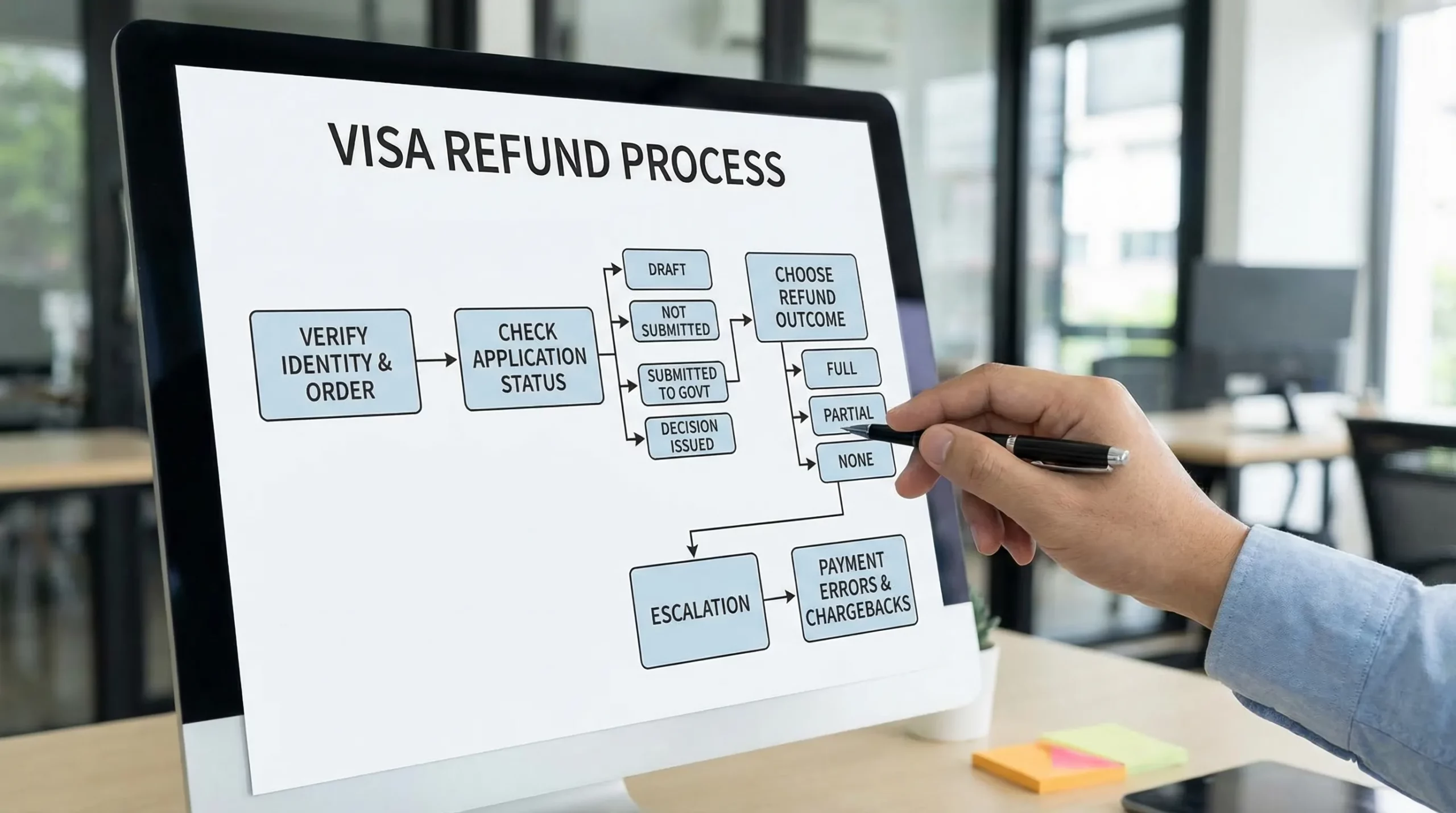
Step 1: Confirm what was purchased
Agents should confirm whether the traveler purchased:
- A guided visa application service
- A government fee passthrough
- A premium add-on (for example, priority handling)
If your checkout does not clearly display this, your refund volume will stay high regardless of scripts.
Step 2: Identify who caused the problem (traveler, policy, provider, government)
This is the fastest way to decide what is fair and consistent.
| Root cause | Examples | Most defensible outcome |
|---|---|---|
| Traveler cancellation | Trip canceled, changed destination, changed dates | Refund only if not submitted to government, otherwise no government-fee refund |
| Traveler error | Wrong passport number, wrong name, wrong travel document selected | Usually no refund after submission, offer paid correction support if possible |
| Data quality or UX issue | Confusing form fields, unclear instructions, upload failure | Consider service-fee refund or credit, especially if submission did not occur |
| Processing delays | Government backlogs, additional screening | No refund if submitted, but proactive comms reduce escalations |
| Provider error | Duplicate submission, incorrect routing, missed required document check | Refund service fee, and handle government-fee recovery only if actually recoverable |
Step 3: Apply policy, then offer the next best alternative
Even when the answer is “not refundable,” you can often prevent escalation by offering an alternative:
- Fast re-application (if feasible)
- A credit for future service fees (only if your business model supports it)
- A clear travel options message (change dates, change destination, or use a different entry product)
Copy-paste scripts for handling visa refund requests
These scripts are designed for chat and email. Replace bracketed fields.
Script A: First response (acknowledge + set expectations)
Message:
Hi [Name], thanks for reaching out. I can help with your refund request. To review it quickly, please confirm your [order ID/application reference] and the traveler’s [full name] as shown on the passport.
Once I verify the application status (draft, submitted, or decided), I will confirm what portion is eligible for refund based on the fee type (government vs service fee) and where the application is in the process.
Script B: Refund approved (full or partial)
Message:
Hi [Name], I have reviewed your request and confirmed the application status is [status].
- Refund amount: [amount]
- What it covers: [service fee/government fee/duplicate charge]
- Refund timeline: refunds typically appear back to the original payment method in [X business days] (timing depends on the bank).
If you would like, I can also help you restart the application with the correct details so your trip stays on track.
Only promise timelines you can support. If you cannot guarantee, say “typically” and reference the payment method.
Script C: Not refundable because submitted to issuing authority
Message:
Hi [Name], I understand why you are requesting a refund. I checked your application and it was submitted to the issuing authority on [date/time].
At that stage, government fees are typically non-refundable, because the application has entered official processing. Our service fee covers the work completed to prepare and submit the application.
If you tell me the reason you need to cancel (trip canceled, dates changed, or details need correction), I can recommend the best next step so you do not lose more time.
Script D: Refusal or denial (stay factual, avoid “guarantee” language)
Message:
Hi [Name], I’m sorry the application was refused. Visa decisions are made by the issuing authority, and approval cannot be guaranteed.
Regarding refunds, government fees are generally non-refundable after submission, even when a decision is negative. For the service fee, I can review whether there was a processing error on our side (for example, missing required information or an incomplete submission) and confirm the outcome.
If you can share the refusal notice (or the exact refusal reason text), I will advise whether reapplying is possible and what changes would be needed.
Script E: Duplicate charge (fast win)
Message:
Hi [Name], thanks for flagging this. Duplicate charges are refundable once verified.
Please share a screenshot or the last 4 digits of the card plus the two charge timestamps/amounts. I will confirm whether one payment is an authorization hold or a completed capture, and then process the refund for the duplicate.
Script F: “I want a refund because it’s taking too long”
Message:
Hi [Name], I understand the urgency. I checked your case and the status is currently [status].
Processing times can vary based on the issuing authority’s workload and any additional screening. Because the application has already been submitted, the government fee is typically not refundable.
What I can do now is: confirm the latest status, verify there are no missing items, and share the best contingency plan if you are traveling on [date].
Policy guardrails that prevent chargebacks
Chargebacks often happen when customers believe they did not receive what they paid for. For visa services, you can reduce that risk with three guardrails.
1) Define “service delivered” in plain language
In your terms and in your support macros, define delivery milestones such as:
- Eligibility check completed
- Application submitted to issuing authority
- Status tracking provided
This matters because the traveler might not view “submission” as delivery, but card networks often will if you can show a timestamped record and the customer’s consent.
2) Put refund rules next to the purchase decision
A refund policy hidden in a footer will not prevent disputes. A short summary at the point of purchase is far more effective.
A useful benchmark for clarity can be found outside travel as well. Many service businesses publish straightforward policy language on their main site, for example clear service and refund expectations from Lumina Skin Sanctuary. The industry differs, but the principle is the same: say what happens, when, and why.
3) Store consent and status logs
When a traveler disputes a charge, the most persuasive evidence is:
- The itemized receipt (government fee vs service fee)
- The acceptance of terms
- The submission timestamp or proof of work performed
If you support travel brands at scale, these logs should be automatically retrievable per order.
Common refund scenarios and the “fair but firm” outcomes
The table below can be turned into internal macros, or into a public-facing policy summary.
| Refund request reason | If NOT submitted to issuing authority | If submitted to issuing authority | Recommended support posture |
|---|---|---|---|
| Traveler canceled trip | Refund service fee (minus work performed, if any) | No government-fee refund, service-fee refund only if your policy allows | Empathetic, offer reapply guidance |
| Wrong details entered by traveler | Refund only if cancellation happens before submission | No refund, offer paid correction path | Calm, factual, focus on next steps |
| Duplicate payment | Refund duplicate immediately after verification | Refund duplicate immediately after verification | Confident, quick resolution |
| Processing delay | Consider goodwill credit if you choose | No refund, provide timeline expectations and contingency plan | Proactive, reduce anxiety |
| Visa refused | N/A | Usually no refund, review if your side made an error | Sensitive, avoid blame |
| Fraud suspicion | Freeze and escalate | Freeze and escalate | Security-first |
Where automation helps (without promising what you cannot control)
Most refund escalations come from uncertainty: the traveler does not know what is happening, and the agent cannot quickly prove what happened.
A visa management platform can reduce this by standardizing:
- Guided customer visa applications to reduce traveler-caused errors
- Online visa processing automation to shorten time to submission
- Premium eVisa management for time-sensitive cases
- API integration or white-label app flows so status and receipts are tied to the booking context
SimpleVisa’s approach is designed for travel businesses that want to embed visa flows in booking, or deploy a white-label visa application app, while keeping border requirements and operational handling consistent.
Frequently Asked Questions
Are visa fees refundable if the traveler cancels the trip? It depends on whether the application was submitted to the issuing authority. After submission, government fees are typically non-refundable.
Should we refund the service fee if a visa is refused? Many businesses do not, because the service was delivered (guidance, checks, submission). If the refusal was caused by your processing error, consider refunding the service fee.
How do we explain “government fee vs service fee” without upsetting customers? Use simple, non-legal language and show the itemized receipt. Customers are more accepting when they see who controls each fee and when it becomes non-refundable.
What evidence do we need to win visa-related chargebacks? Itemized fee breakdown, proof of terms acceptance, and timestamped records showing work performed or submission status.
How can we reduce refund requests in the first place? Put refund rules at checkout, reduce form errors with guided flows, and send proactive status updates so travelers do not feel left in the dark.
Make refund decisions consistent (and protect ancillary revenue)
If your team is handling visa refund requests manually, inconsistency is the real cost. A clear status-based policy, paired with scripted responses and reliable status records, reduces escalations and chargebacks while keeping your visa ancillary program healthy.
If you want to operationalize this with automated visa processing, integrated eligibility and submission flows, and partner-ready tooling, explore SimpleVisa at SimpleVisa and align your refund handling with a documented, auditable visa journey.