How Travel Brands Can Add Visa Services Without Heavy Dev Work

Adding visa services used to sound like a major product initiative. New data flows, compliance reviews, document uploads, payment handling, customer support scripts, status tracking, and destination-specific rules could quickly push the project into a crowded engineering roadmap.
That is no longer the only path. Travel brands can now offer guided visa applications, eVisas, ETAs, and other border crossing solutions without rebuilding their booking engine or hiring a dedicated visa operations team.
The key is to choose the right integration model for your stage of growth. Some brands need a no-code white-label app they can launch quickly. Others need a lightweight widget or a travel API that fits inside an existing checkout. The best approach is not always the most technical one. It is the one that gets travelers the right document at the right moment, while creating measurable business value for the brand.
Why visa services belong in the travel booking journey
Travelers rarely think about visas when they compare flights, hotels, cruises, or packages. They usually discover requirements later, often after payment, when they read the confirmation email or search online in a panic.
That creates friction for everyone. The traveler has uncertainty. The travel brand receives support questions. The trip may be delayed, canceled, or disrupted if the customer misses a visa deadline. For airlines, OTAs, tour operators, cruise lines, TMCs, and travel marketplaces, visa requirements are not just administrative details. They are part of the customer journey.
Adding visa services helps travel brands solve three problems at once:
- It gives customers clearer guidance before departure.
- It reduces manual support around changing entry requirements.
- It creates a relevant ancillary revenue opportunity tied directly to the trip.
Unlike generic add-ons, online visa processing is highly contextual. If a traveler needs an electronic visa for the destination they just booked, the offer is not random. It is useful, timely, and directly connected to trip completion.
The modern approach: separate the visa workflow from the booking engine
The fastest way to add visa services without heavy dev work is to avoid forcing every visa step into your core booking system from day one.
Instead, think of the visa journey as a connected but separate workflow. Your booking flow identifies that a traveler may need an eVisa or travel authorization. The traveler is then guided into a branded application experience, where they can complete the visa application, upload documents, pay fees, and receive status updates.
This approach keeps your core booking infrastructure stable while still making visa services feel like part of your brand experience.
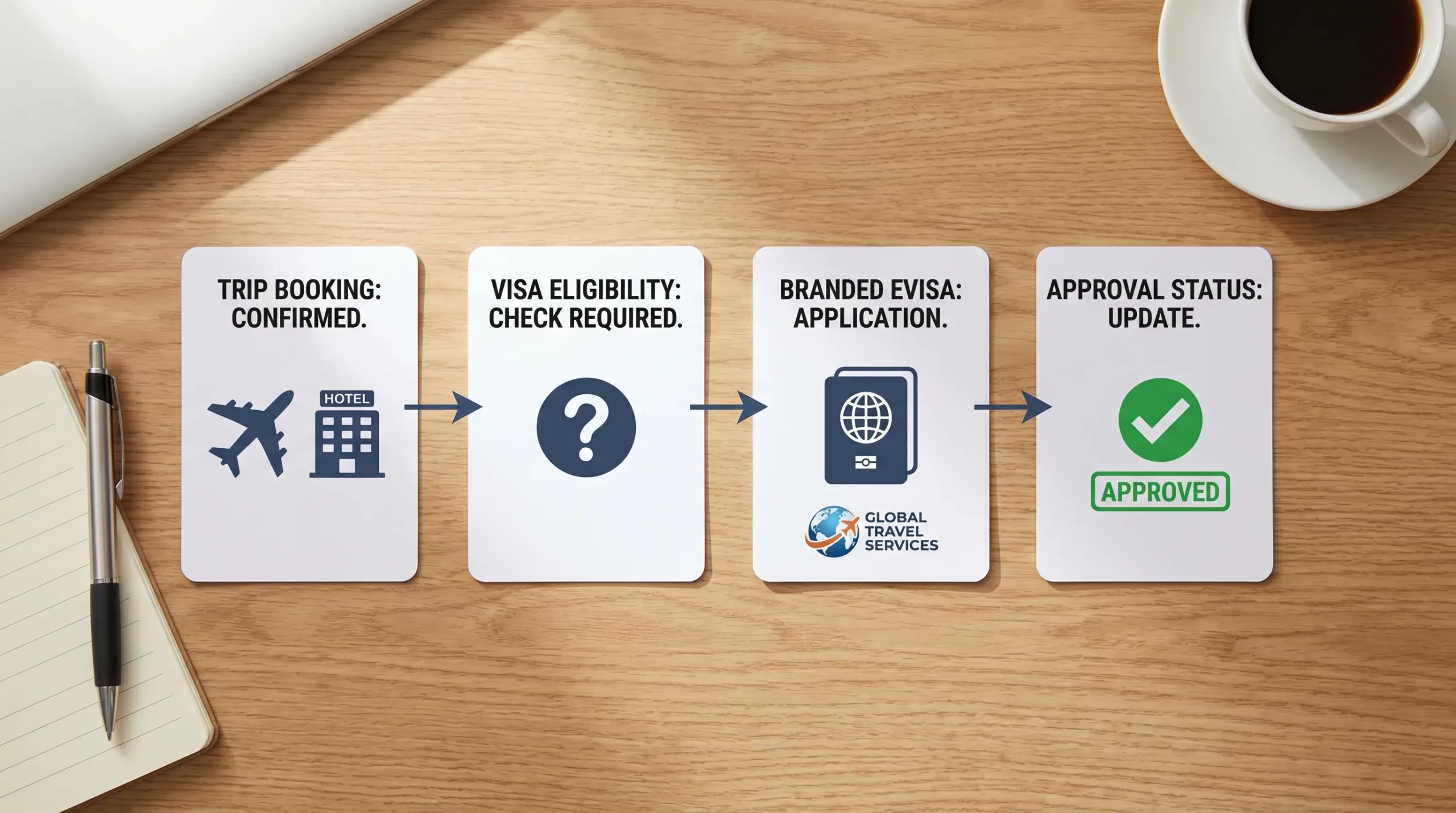
A decoupled setup is especially useful when your product team has limited engineering capacity. You can validate demand, measure conversion, and prove ancillary revenue before committing to deeper API integration.
Four low-effort ways to add visa services
Not every travel brand needs the same level of technical integration. A high-volume OTA may eventually want a fully embedded travel API. A boutique tour operator may only need a white-label visa application app. A cruise line may want visa requirement data first, then add processing later.
Here is how the main options compare.
| Integration model | Dev effort | Best for | What the traveler experiences |
|---|---|---|---|
| No-code link or landing page | Very low | Fast pilots, agencies, tour operators | Traveler clicks from email, booking confirmation, or help center into a guided visa flow |
| White-label visa application app | Low | Brands that want a branded experience without building one | Traveler completes the application in a branded environment outside the core booking engine |
| Embedded widget | Low to moderate | OTAs, airlines, marketplaces, post-booking portals | Traveler sees visa services inside booking, checkout, or manage-booking pages |
| API or custom data service | Moderate | High-volume brands that need control and personalization | Visa checks, pricing, and application steps are integrated into the brand’s own UX |
A useful rule of thumb is simple: start with the lowest-effort model that can prove demand. Then move deeper only when the data supports it.
If you are comparing the trade-offs between a hosted experience and a technical integration, SimpleVisa’s guide to API vs. white-label visa services is a helpful next read.
Where visa services should appear in the customer journey
Visa services perform best when they appear at moments of high relevance. The goal is not to interrupt the booking process. It is to remove uncertainty when the traveler is already thinking about destination, timing, and trip readiness.
During booking
A simple eligibility message can tell travelers that an eVisa, ETA, or other travel document may be required for their trip. At this stage, the message should be short and confidence-building. The traveler does not need the full visa rulebook. They need to know that the requirement exists and that the brand can help.
At checkout
Checkout is a strong moment for visa service placement because the traveler is already committing to the trip. The offer can be positioned as part of trip completion, similar to travel insurance, baggage, seat selection, or airport services.
The best checkout prompts are specific. Instead of a generic apply for a visa message, use language that connects the document to the traveler’s itinerary, nationality, and destination when that data is available.
Immediately after booking
Post-booking is often the easiest place to start because it requires less change to the core checkout. A link in the confirmation page, confirmation email, mobile app, or manage-booking area can send travelers to a guided visa application flow.
This is a practical first step for brands that want to launch quickly, especially if engineering resources are limited.
Before departure
Pre-departure reminders help travelers who ignored the first prompt. This is where automation matters. If a traveler has not started or completed the visa application, a timely reminder can prevent last-minute stress and reduce support volume.
What data do you need to power useful visa guidance?
Travel brands often assume visa services require large amounts of personal data at the start. In practice, the initial eligibility check can usually begin with a small set of trip and traveler attributes.
The most useful fields are often:
- Nationality or passport country
- Destination country
- Transit countries, when relevant
- Travel dates
- Purpose of travel
- Passport validity, when needed for eligibility checks
More detailed information, such as passport scans, photos, accommodation details, and supporting documents, can be collected later inside the guided visa application flow.
This staged approach is better for conversion and privacy. Travelers are more likely to engage when the first step is lightweight. Your brand also avoids collecting sensitive information before it is necessary.
A practical launch plan that does not derail your roadmap
Adding visa services without heavy dev work is not just a technology decision. It is an operational rollout. The best launches usually follow a phased plan.
Start with the highest-value routes or destinations
Do not try to cover every destination and passport combination on day one. Look at your booking data and identify routes where visa requirements are common, traveler confusion is high, or ancillary attach rates are likely to be strongest.
For example, an OTA may prioritize destinations with frequent eVisa demand. A cruise line may start with itineraries that include ports with shore-entry requirements. A TMC may focus on business travel routes where missed documentation creates expensive disruption.
Choose the simplest integration that supports the use case
If your goal is a 30-day pilot, a white-label app or no-code flow may be enough. If your goal is to show visa eligibility dynamically inside search results, you may need an API or data service.
The mistake is starting with a technical architecture before defining the customer moment. Start with the traveler problem, then choose the integration.
Align support, product, and commercial teams early
Visa services touch multiple teams. Product owns the user experience. Support handles traveler questions. Commercial teams care about revenue share, pricing, and attach rates. Legal and privacy teams care about data handling.
A lightweight internal playbook prevents confusion. It should define what your brand supports, what the visa provider supports, how escalations work, and what language agents should use when travelers ask whether a visa is guaranteed.
Test the full traveler path before launch
Before going live, test the journey from the traveler’s point of view. Click the offer, open the visa flow, enter test information, upload sample documents, review payment steps, and check confirmation messages.
A visa integration can be technically functional but still confusing. The traveler should always understand what they are applying for, what is included in the price, what happens after submission, and where to find help.
For teams exploring lightweight embed options, this eVisa widget tutorial shows how a small implementation can create a more connected experience.
Trust and compliance matter more than technical depth
Visa applications involve sensitive personal information. Even if you choose a no-code or white-label implementation, travelers still need to trust the experience.
That means the offer should make several things clear:
- Who is processing the application
- What fees are being charged
- What information is required
- How traveler data is protected
- Whether approval is guaranteed, which it generally cannot be
- Where customers can get help if rules or timelines change
This trust layer is not unique to travel. Any regulated or high-stakes digital service needs to reduce complexity while keeping users informed. You can see a similar principle in structured support models outside travel, where expert guidance, transparency, and clear eligibility criteria help users navigate decisions that should not feel like guesswork.
For visa services, trust is part of the product. A beautiful integration will not convert if travelers worry that the application is unclear, unsafe, or unofficial-looking.
How visa services generate ancillary revenue without feeling pushy
Ancillary revenue works best when the add-on solves a real problem. Visa services fit this model because they help travelers complete a required step for international travel.
The key is positioning. Avoid selling visa services as another optional extra. Instead, present them as guided support for an important travel requirement.
A strong visa offer usually includes three elements:
- Clear relevance, based on itinerary and passport information
- Transparent pricing, including government and service fees where applicable
- Reassurance, such as guided forms, document checks, and status updates
For travel brands, the commercial model can vary. Some prefer referral fees. Others use revenue share, markup, white-label service fees, or bundled premium support. The right model depends on volume, customer segment, and how much ownership the brand wants over the experience.
If you are designing the business case, review these revenue-sharing models for online visa processing partners.
What to measure after launch
A visa service should be treated like any other digital product. Launching is only the first step. Measurement tells you whether the offer is helping customers and creating business value.
| KPI | What it tells you | Why it matters |
|---|---|---|
| Visa offer view rate | How often eligible travelers see the offer | Confirms placement and eligibility logic are working |
| Attach rate | How many eligible travelers start or buy the service | Measures commercial traction |
| Application completion rate | How many started applications are completed | Highlights UX friction or document issues |
| Approval rate | How many submitted applications are approved | Indicates application quality and traveler fit |
| Support contacts per application | How often travelers need help | Shows whether guidance is clear |
| Ancillary revenue per booking | Revenue impact across total bookings | Helps finance and commercial teams assess ROI |
Do not judge success by revenue alone. A well-designed visa management platform can also reduce support workload, lower traveler anxiety, and prevent failed trips caused by missing documentation.
For a deeper measurement framework, see SimpleVisa’s guide to KPIs after deploying a visa management platform.
When to move from no-code to API integration
No-code and white-label solutions are often the right starting point. But as volume grows, some brands benefit from deeper integration.
Consider moving toward an API-based model when you need more control over the traveler experience, want to personalize offers inside your own checkout, or need visa data across multiple channels such as web, app, call center, and agent desktop.
API integration also becomes more valuable when visa guidance influences booking decisions. For example, if two destinations have similar prices but different entry requirements, showing visa information earlier in the journey can help travelers choose confidently.
The good news is that this does not have to be an all-or-nothing decision. Many travel brands start with a white-label or no-code implementation, then graduate to API integration once they have proof of demand, internal alignment, and clearer product requirements.
Common mistakes to avoid
The biggest mistake is waiting for the perfect integration. If visa services stay in the backlog for a year, travelers continue to search elsewhere and the brand loses both revenue and control of the experience.
Another common mistake is placing the offer too late. If the first visa reminder appears two days before departure, the customer may not have enough time to apply. Post-booking reminders should be early, clear, and repeated when necessary.
Travel brands should also avoid vague messaging. A generic visa help link is less effective than a contextual prompt tied to the customer’s destination. The more relevant the offer feels, the more likely travelers are to act.
Finally, do not ignore support readiness. Even with automation, customers will ask questions. A simple FAQ, escalation process, and agent script can prevent confusion and protect the customer experience.
How SimpleVisa helps travel brands launch faster
SimpleVisa is built for travel businesses that want to add visa services without turning the project into a major engineering initiative.
Depending on your needs, SimpleVisa can support no-code implementation, a white-label visa application app, API integration for travel sites, custom data services, guided customer visa applications, and premium eVisa management. The platform is designed to help brands streamline visa processing, improve the traveler experience, and generate ancillary revenue through relevant border crossing solutions.
For brands that want to validate demand quickly, a no-code or white-label approach can bring visa services to market with minimal disruption. For brands ready to scale, SimpleVisa’s travel API and data services can support more integrated workflows.
SimpleVisa services are available on 400+ sites, giving travel brands a practical path to add online visa processing without starting from scratch.
Frequently Asked Questions
Can travel brands add visa services without changing the booking engine? Yes. Many brands start with post-booking links, white-label flows, or no-code implementations. This lets customers access guided visa applications without requiring a deep rebuild of the booking platform.
Is a no-code visa service enough for larger travel brands? It can be enough for pilots, specific routes, or post-booking journeys. Larger brands may later move to widget or API integration when they need more control, personalization, or multi-channel visa data.
Will adding visa services increase customer support workload? It can reduce support workload if the flow is clear, eligibility guidance is accurate, and travelers receive status updates. Support teams still need a simple playbook for escalations and questions.
How do visa services create ancillary revenue? Travel brands can earn revenue through models such as referral fees, revenue share, service fees, or bundled premium support. The strongest results usually come from placing visa services at relevant moments in the booking or post-booking journey.
What is the safest way to start? Start with a focused pilot on high-value destinations or customer segments. Use a low-effort integration, measure attach rate and completion rate, then expand once the business case is clear.
Make visa services easier to launch
Travelers need clear visa guidance. Travel brands need solutions that do not overwhelm product and engineering teams.
SimpleVisa helps bridge that gap with no-code, white-label, API, and data service options for travel businesses. If you want to add guided visa applications, improve trip readiness, and unlock ancillary revenue without heavy dev work, talk to SimpleVisa about the right integration path for your brand.