Saudi eVisa for Indian Travelers: 2026 Guide
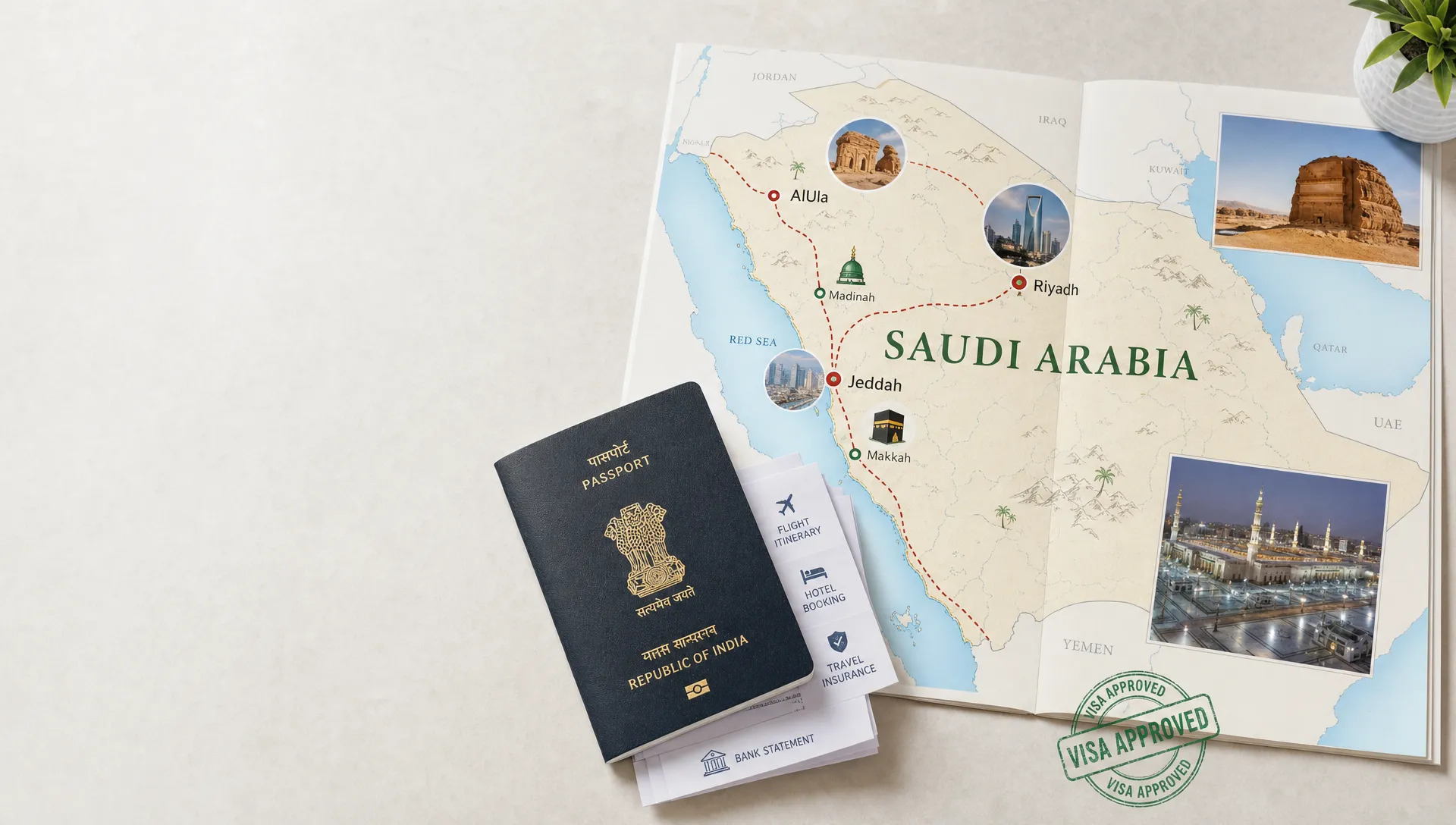
Saudi Arabia is one of the most in-demand destinations for Indian travelers in 2026, especially for Umrah, family visits, events, stopovers, and leisure trips to Riyadh, Jeddah, AlUla, and the Red Sea coast. The Saudi eVisa can make the journey much simpler, but there is one detail travelers often miss: Indian passport holders are not automatically eligible in every case.
For many Indians, eligibility depends on where they live, whether they hold a valid US, UK, or Schengen visa, or whether they are residents of a Gulf Cooperation Council country. That means the right advice at the booking stage can prevent denied boarding, delayed trips, and frustrated customers.
This 2026 guide explains who can apply, what documents Indian travelers need, how the application works, what the eVisa allows, and the common mistakes to avoid.
Can Indian travelers get a Saudi eVisa in 2026?
Yes, many Indian travelers can get a Saudi eVisa in 2026, but eligibility usually depends on an additional qualifying status. An Indian passport alone does not always make a traveler eligible for the standard Saudi tourist eVisa.
In practice, Indian citizens may be eligible if they meet one of the recognized conditions, such as holding a valid US, UK, or Schengen visa that meets Saudi requirements, having qualifying residence status in the US, UK, or EU, or being a resident of a GCC country under the applicable Saudi rules.
Because Saudi visa policy can change, travelers and travel companies should always verify eligibility before payment or ticketing. If a traveler is not eligible for the eVisa, they may need to use a Saudi embassy, consulate, authorized visa center, or another visa route depending on the purpose of travel.
| Indian traveler scenario | Likely Saudi visa route | Key point to check |
|---|---|---|
| Indian passport holder with valid US, UK, or Schengen visa | Often eligible for Saudi eVisa if conditions are met | The visa may need to be valid and previously used to enter the issuing country or region |
| Indian citizen with qualifying US, UK, or EU residence | May be eligible for online Saudi visa options | Residence status and document validity matter |
| Indian citizen living in a GCC country | May qualify through GCC resident rules | Residence permit validity and Saudi portal requirements should be checked |
| Indian passport holder without qualifying visa or residence | May need consular or authorized visa channel | Do not assume online eVisa eligibility |
| Indian traveler going for Hajj | Hajj visa route, not tourist eVisa | Hajj has separate rules and official channels |
If you want more detail on the Saudi online visa process itself, SimpleVisa’s guide to how MOFA Saudi eVisa works for 2026 travelers explains the broader application flow and terminology.
What the Saudi eVisa allows Indian travelers to do
The Saudi tourist eVisa is designed for short-term travel. For eligible Indian travelers, it can generally be used for tourism, attending events, visiting friends or family, and performing Umrah outside the Hajj period.
The tourist eVisa is not a work visa. It does not allow paid employment in Saudi Arabia, long-term residence, or Hajj. Business activities can also be a gray area, so travelers attending formal meetings, trade events, or commercial engagements should confirm whether a tourist eVisa is suitable or whether a business visa is required.
Most Saudi tourist eVisas are issued as multiple-entry visas and are commonly valid for up to one year, with stays typically limited to 90 days. The exact validity and stay conditions are shown on the visa approval, so travelers should read the visa notice carefully rather than relying only on general guidance.
Saudi eVisa requirements for Indian citizens
The exact document list can vary by eligibility route, but Indian travelers should prepare the basics before starting an application. A clean, consistent application is often the difference between a smooth approval and manual review.
Common requirements include a valid Indian passport, a recent passport-style photo, personal and contact details, accommodation information, and a valid payment card. Travelers applying through a qualifying US, UK, or Schengen visa route should also have details of that visa ready. GCC residents should have their residence permit details available.
| Requirement | What Indian travelers should check |
|---|---|
| Passport | Usually valid for at least six months from the intended entry date |
| Personal details | Must match the passport exactly, including spelling and date of birth |
| Photo | Clear, recent, and compliant with passport-style photo standards |
| Email address | Use an email the traveler can access throughout the trip |
| Payment card | International payments and currency conversion should be enabled |
| Qualifying visa or residence proof | US, UK, Schengen, GCC, or residence details must match Saudi eligibility rules |
| Travel purpose | Tourism, Umrah, family visit, event, or other permitted short-term purpose |
Indian travelers should also check whether their passport has enough blank pages, whether their airline requires printed visa copies, and whether any transit countries have separate visa rules.
How to apply for a Saudi eVisa as an Indian traveler
The Saudi eVisa application is completed online when the traveler is eligible. Before starting, confirm that the traveler’s nationality, residence status, and travel purpose match the visa category.
A typical application flow looks like this:
- Confirm eligibility: Check whether the Indian traveler qualifies through nationality plus a valid visa, residence status, or GCC residency.
- Prepare documents: Gather passport details, photo, email, travel dates, accommodation information, and qualifying visa or residence information.
- Complete the online form: Enter personal details exactly as shown on the passport, including all names and passport numbers.
- Review before payment: Check spelling, passport number, dates, and visa eligibility details before submitting.
- Pay the visa and insurance charges: The Saudi tourist eVisa process usually includes mandatory medical insurance as part of the total cost.
- Download the approval: Save a digital copy and carry a printed copy if recommended by the airline or travel provider.
Even when approval is fast, travelers should avoid applying at the last minute. Errors, unclear documents, payment issues, or eligibility questions can delay processing.
How long does Saudi eVisa processing take?
Saudi eVisa approvals can be quick, sometimes issued within a short time after submission. However, travelers should not plan around an instant approval. Manual checks, document inconsistencies, payment failures, or peak travel periods can add time.
For Indian travelers, applying at least one to two weeks before departure is a sensible buffer. Umrah travelers should consider an even longer planning window during busy seasons such as Ramadan or school holiday periods.
Airlines may verify visa status before check-in. If a traveler applies too close to departure and the approval is delayed, the airline may refuse boarding even if the traveler eventually qualifies.
Saudi eVisa fees for Indian travelers
Saudi eVisa cost can include several parts: the official visa fee, mandatory medical insurance, taxes, service fees, and currency conversion charges. The final amount can vary depending on the application channel, payment currency, insurance component, and whether a travel provider adds support or processing services.
For a detailed fee breakdown, see SimpleVisa’s 2026 guide to Saudi eVisa fees for travelers. It explains why the amount shown at checkout may be higher than the base visa fee and what travelers should review before paying.
Indian travelers living outside India should also think about the broader cost of travel administration. For example, Australia-based Indian professionals planning extended trips may need to keep records for tax residency, business expenses, or overseas income reporting, and consulting expert tax and accounting services in Australia can help them prepare before they travel.
Saudi eVisa rules at the border
A Saudi eVisa approval does not guarantee entry in every situation. Like most countries, Saudi Arabia gives border officials final authority to admit or refuse a traveler.
Indian travelers should carry the same passport used for the application. If the traveler renewed their passport after approval, the visa may not match the travel document, which can cause issues at check-in or arrival.
Travelers should also keep proof of accommodation, return or onward tickets, and travel insurance information accessible. The medical insurance included with the eVisa is not always a replacement for comprehensive travel insurance, especially for trip cancellation, baggage delay, or high-value medical coverage.
Overstaying is a serious mistake. The permitted stay shown on the visa must be respected, and travelers should not assume that leaving and re-entering automatically resets all stay limits. Always read the visa conditions and plan the itinerary accordingly.
Using a Saudi eVisa for Umrah
For many Indian travelers, the main reason to visit Saudi Arabia is Umrah. The Saudi tourist eVisa can generally be used for Umrah outside the Hajj season, but it is not a Hajj visa and cannot be used to perform Hajj.
Umrah rules can also involve timing restrictions, permit requirements, local platform guidance, and seasonal crowd controls. Travelers should confirm current requirements before booking flights and hotels, especially during Ramadan or near the Hajj period.
If Umrah is the main purpose of travel, SimpleVisa’s article on e Visa Umrah rules, timing, and common mistakes is a useful next step.
Common mistakes Indian travelers should avoid
The most common Saudi eVisa mistake is assuming that every Indian passport holder can apply online. Eligibility is the first thing to verify, not the last.
Other frequent errors include entering a name that does not match the passport, using an expired or unused qualifying visa, uploading a poor-quality photo, applying with a passport that expires too soon, and choosing the wrong visa route for the purpose of travel.
Indian travelers should also avoid booking non-refundable flights before confirming visa eligibility. While many people do receive approvals smoothly, a traveler who does not qualify for the eVisa may need a different process with a different timeline.
Travel agencies, airlines, and online travel platforms can reduce customer frustration by surfacing visa requirements early in the booking journey. A traveler who discovers an eligibility issue after payment is far more likely to cancel, complain, or abandon the trip.
What travel businesses should know about Indian travelers to Saudi Arabia
Indian outbound travel to Saudi Arabia is not a single segment. It includes pilgrims, family visitors, leisure tourists, expatriates living in the Gulf, business travelers, and Indian citizens based in the US, UK, Europe, Australia, and other markets.
That variety makes visa guidance difficult. Two Indian passport holders booking the same flight to Jeddah may have different visa options because one holds a valid Schengen visa and the other does not. A one-size-fits-all message such as “Saudi eVisa available” can create real operational risk.
For travel businesses, the best approach is to ask eligibility questions before checkout. Passport nationality, country of residence, existing visas, travel purpose, and intended travel dates can determine whether the traveler should see an eVisa flow, a consular guidance message, or a warning to check requirements before booking.
SimpleVisa helps travel companies streamline visa administration through automation, API integration, white-label application flows, data services, guided visa applications, and premium eVisa management. For businesses serving Indian travelers to Saudi Arabia, this can turn a complex compliance step into a clearer customer experience and an ancillary revenue opportunity.
Quick pre-trip checklist for Indian travelers
Before departure, Indian travelers should confirm that their visa details match their passport and travel plans. They should also check whether the airline has any document requirements beyond the visa itself.
A practical pre-trip review should include passport validity, eVisa validity, allowed stay duration, accommodation details, return or onward flight, medical insurance, Umrah permit guidance if relevant, and copies of all documents stored both online and offline.
Travelers should also monitor official updates close to departure. Visa rules, public holiday operations, Hajj-related restrictions, and health or insurance requirements can change, especially during busy pilgrimage periods.
Frequently Asked Questions
Can Indian citizens apply for a Saudi eVisa in 2026? Yes, many Indian citizens can apply, but not always based on an Indian passport alone. Eligibility often depends on holding a qualifying US, UK, or Schengen visa, having qualifying residence status, or being a GCC resident under Saudi rules.
Do Indian travelers need a US, UK, or Schengen visa to get a Saudi eVisa? Many Indian travelers use this route, but the qualifying visa usually must meet Saudi requirements, such as being valid and, in some cases, previously used. Travelers should verify the latest conditions before applying.
Can Indian Muslims perform Umrah on a Saudi tourist eVisa? In general, the Saudi tourist eVisa can be used for Umrah outside the Hajj season. It cannot be used for Hajj, and travelers should check current Umrah timing and permit requirements before booking.
How long can Indian travelers stay in Saudi Arabia with an eVisa? Saudi tourist eVisas are commonly valid for multiple entries with stays typically limited to 90 days, but the exact conditions are shown on the approval. Travelers should follow the visa notice carefully.
How early should Indian travelers apply for a Saudi eVisa? Applying at least one to two weeks before departure is a practical buffer. Travelers going during Ramadan, holidays, or peak Umrah periods should allow more time.
What happens if an Indian traveler is not eligible for the Saudi eVisa? The traveler may need to apply through a Saudi embassy, consulate, authorized visa center, or another visa category. They should not rely on airport approval if they do not clearly meet the requirements.
Make Saudi visa support simpler for Indian travelers
For Indian travelers, the Saudi eVisa can be convenient, but only when eligibility, documents, timing, and purpose of travel are handled correctly. For travel businesses, this is an opportunity to guide customers before problems appear at checkout or airport check-in.
If your travel brand serves customers traveling to Saudi Arabia, SimpleVisa can help you integrate guided visa support into your booking flow, white-label experience, or data service so travelers get clearer answers and fewer administrative surprises.