Tour Operator Visa Ops: A Weekly Workflow That Scales

Visa operations rarely break a tour operator on day one. They break you in month six, after you add more departures, more nationalities, and more last-minute bookings, and the “quick favor” of helping with an eVisa turns into a daily fire drill.
A scalable visa ops function is not about knowing every country’s rules by heart. It’s about running a repeatable weekly cadence that keeps requirements accurate, applications moving, customers informed, and revenue protected.
This guide lays out a practical weekly workflow you can adopt whether you manage visas in-house, use a specialist partner, or embed online visa processing into your booking journey.
What “visa ops” means for tour operators (in practice)
For most tour operators, visa ops sits across three outcomes:
- Trip continuity: reduce denied boarding, missed departures, and expensive rebooking.
- Customer trust: give travelers clear, proactive guidance instead of reactive scrambling.
- Ancillary revenue: sell visa help and premium handling in a compliant, trackable way.
Operationally, that translates into five repeatable workstreams:
- Rules and eligibility: keeping entry requirements current (eVisa vs consular visa vs ETA, validity rules, lead times, passport constraints, onward travel, etc.).
- Intake and document collection: collecting accurate traveler data early enough to act.
- Application execution and tracking: submitting applications, monitoring statuses, handling government requests.
- Exception handling: urgent departures, name mismatches, rejected photos, payment failures, denied applications.
- Traveler communications: templated updates, reminders, escalation messages, and “what to do next” guidance.
If you treat these as ad hoc tasks, you will scale headcount and still fall behind. If you treat them as a weekly system with clear owners and metrics, you can scale volume without scaling chaos.
The operating principles behind a scalable weekly workflow
Before the calendar, align on four principles. These are the “guardrails” that keep the workflow from collapsing during peak season.
1) Separate standard work from exceptions
Most visa volume is routine. Most cost comes from exceptions.
Your process should assume:
- Standard applications move via automation plus light review.
- Exceptions go to a dedicated queue with stricter SLAs and senior oversight.
2) Push data capture as close to booking as possible
Visa ops fails when the first time you learn a customer needs a visa is 10 days before departure.
Even if you cannot fully embed the flow, at minimum you want:
- An eligibility check and visa prompt at booking or immediately post-booking
- A structured traveler data intake link within the first 24 hours
3) Centralize “truth” in one place
If requirements live in email threads, PDFs, and personal spreadsheets, your team will give inconsistent advice.
Use one system of record for:
- Country requirement logic (by nationality, destination, dates)
- Application status history and timestamps
- Customer communications and consent
4) Run visa ops like a revenue product, not just compliance
Tour operators who monetize visa support consistently do two things:
- They package the offer (what’s included, what’s premium, what’s excluded).
- They measure funnel performance like any other add-on (attach rate, conversion, drop-offs).
If you plan to reposition visa help as a premium, branded service, it can be worth involving a specialized go-to-market team. A good example is a brand growth agency for challenger travel brands that can help you land the right promise and packaging without overcomplicating operations.
The weekly visa ops workflow (a cadence you can reuse)
The goal of a weekly workflow is simple: keep your rules current, keep your queues predictable, and keep exceptions from contaminating standard throughput.
Here is a high-performing cadence that works for both small teams (2 to 5 people) and larger ops desks.
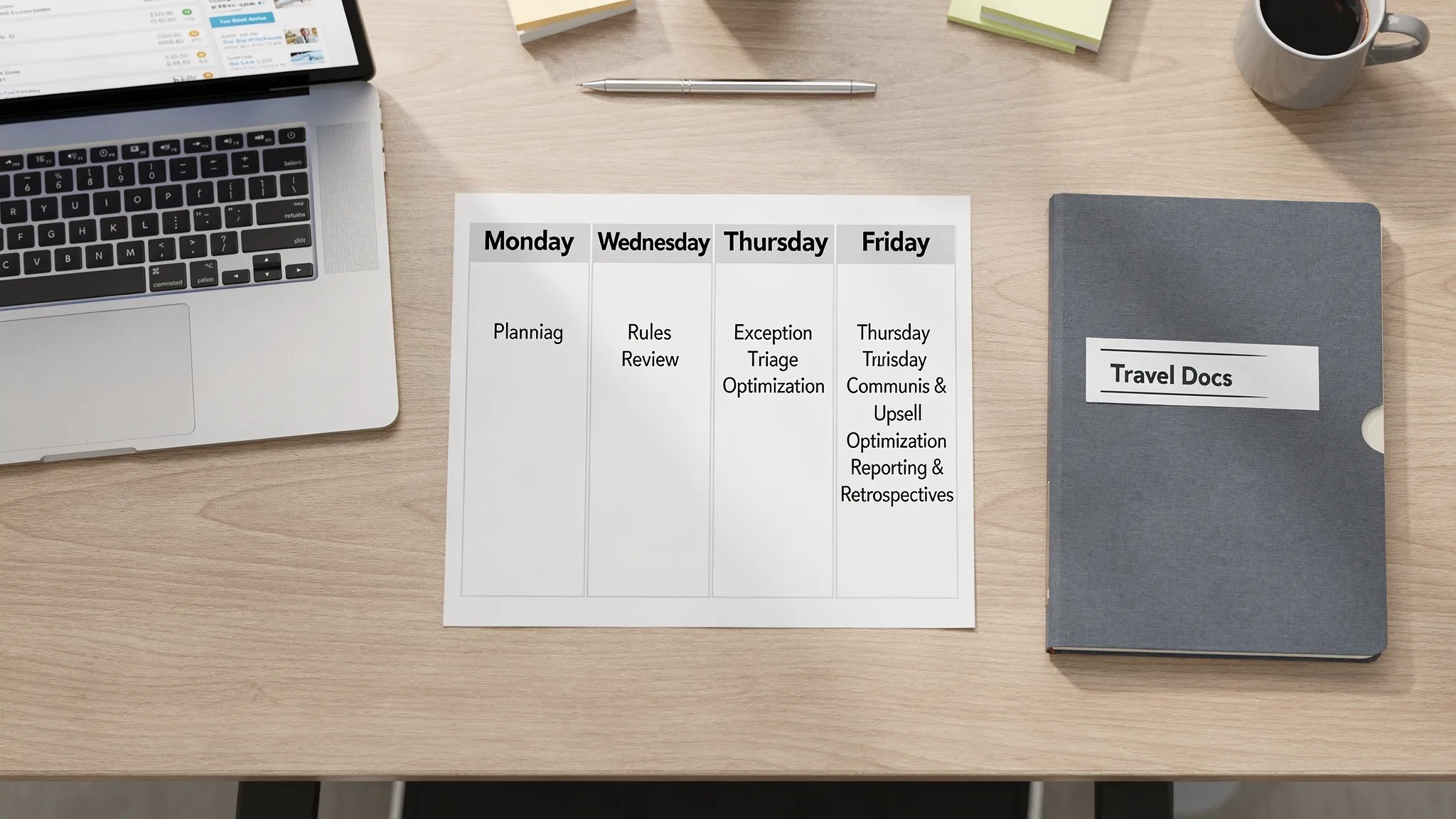
The weekly cadence at a glance
| Day | Primary outcome | What gets done | Who owns it |
|---|---|---|---|
| Monday | Control the week | Volume forecast, departure-risk scan, staffing plan, SLA targets | Visa Ops Lead + CX Lead |
| Tuesday | Keep requirements accurate | Rules updates, destination changes, comms template refresh | Visa Ops Lead + Compliance owner |
| Wednesday | Stop exceptions spreading | Exception queue triage, escalations, urgent case handling | Senior agent + Ops Lead |
| Thursday | Improve customer completion | Reminder campaigns, doc chase, UX fixes, upsell messaging tests | CX + Product/Marketing |
| Friday | Prove performance | KPI review, root-cause analysis, process improvements, partner review | Ops Lead + Finance/Product |
In addition to this, you run a short daily routine (15 minutes) for queue health and urgent departures.
Monday: Plan demand and protect departures
Monday is about preventing Friday disasters.
You want to answer two questions by noon:
- How many visa actions will we need this week? (new bookings, pending applications, departures)
- Which departures are at risk if we do nothing today?
A strong Monday checklist includes:
- Departure risk scan: filter bookings by departure date and visa status (for example: “departing in 14 days, no application started”).
- Capacity planning: estimate required touchpoints (document chases, reviews, submissions).
- SLA alignment: agree what “on track” means per departure window (T-30, T-14, T-7).
- Queue shaping: move cases into standard vs exception lanes.
If you work with multiple destinations, this is also when you align on high-change corridors (for example, Europe pre-travel authorizations like ETIAS, or the UK ETA). Where possible, verify changes on official sources such as the EU ETIAS site and the UK ETA guidance.
Tuesday: Maintain “rules integrity” (and update customer messaging)
Most teams underestimate how quickly a single outdated rule can create support volume.
Tuesday is your dedicated “rules integrity” block. The aim is not to re-research every country weekly, it’s to update what changed and reduce ambiguity.
A practical Tuesday routine:
- Change log review: new requirements, fee changes, new digital authorizations, updated photo specs.
- Top 10 destination audit: confirm rules for your highest-volume destinations and current season routes.
- Template refresh: update the exact sentences customers see (what they need, when they need it, what happens next).
- Agent enablement: share a short internal note covering what changed and which bookings are affected.
If you use a visa management platform or a travel API for requirements, Tuesday becomes less about hunting information and more about validating that your rules engine is aligned with your product promises.
Wednesday: Run exception triage like a control room
Wednesday is the day that keeps you scalable.
Create a hard separation between:
- Standard lane: complete data, eligible, within normal lead time.
- Exception lane: missing documents, name mismatch, urgent departure, prior refusal, technical failures, manual review required.
A good exception triage meeting (45 to 60 minutes) produces:
- A prioritized list of cases with owners
- An escalation decision (what you can solve, what needs partner or government guidance)
- A traveler communication plan for each high-risk departure
Common exception categories (and the owner you want)
| Exception type | What usually caused it | Best first owner |
|---|---|---|
| Name mismatch | Booking name does not match passport MRZ | CX agent with a scripted fix flow |
| Rejected photo/document | Wrong format, glare, cropping, background | Visa ops reviewer (with a “resubmit in 10 min” checklist) |
| Urgent departure | Late booking, traveler delayed intake | Senior agent with priority lane |
| Eligibility confusion | Dual nationality, transit rules, unusual itinerary | Ops Lead or compliance owner |
| Payment/portal error | Bank decline, government portal outage | Ops + tech contact |
The scaling lesson: exceptions need senior attention early, otherwise they bleed into every agent’s day and destroy throughput.
Thursday: Drive completion rates (and revenue) with communication systems
Thursday is where you win back time.
Most “visa work” is not submission, it’s chasing: missing scans, incomplete forms, travelers who do not understand what matters.
Make Thursday the day you improve completion by system, not by heroics.
Focus areas:
- Automated reminders: send “we’re waiting on you” messages at consistent intervals.
- Plain-language fixes: rewrite confusing steps, reduce legal jargon, add examples.
- Document quality nudges: show what a good scan/photo looks like.
- Premium routing: if you sell premium eVisa management, ensure those travelers get a shorter path and clearer SLAs.
If your visa support is embedded in the booking flow, Thursday is also a good day to review the add-on experience and adjust messaging. For ideas on building a smoother post-booking journey, see SimpleVisa’s guide on building a seamless post-booking visa journey.
Friday: Prove performance with a KPI review and a small retro
Friday is about turning visa ops into a predictable business function.
Run a 30 to 45 minute KPI review, followed by a short retrospective focused on fixes you can ship next week.
KPI set that actually helps you scale
Avoid vanity metrics. Track what drives cost, risk, and revenue.
| KPI | What it tells you | Why it matters |
|---|---|---|
| Visa attach rate | How often travelers buy visa help when eligible | Direct ancillary revenue signal |
| Application completion time | Time from start to “submitted” | Predicts departure risk and support load |
| Approval rate | Approvals vs refusals (where trackable) | Quality control and traveler outcomes |
| Tickets per 100 applications | Support load normalized by volume | Operational efficiency |
| Exception rate | % of cases requiring escalation | Scaling constraint indicator |
SimpleVisa publishes a clear framework for measurement in 5 KPIs to track after deploying a visa management platform. Even if you are not using a platform yet, the KPI definitions and event thinking are useful.
The Friday retro (keep it small)
Choose one improvement per week. Examples:
- Fix one high-frequency template that generates repeat questions.
- Remove one document request that is not actually required for your top destination.
- Adjust your intake form so it captures passport MRZ consistently.
Over 8 to 12 weeks, these small changes compound into a dramatically lower exception rate.
The daily rhythm (the part that prevents surprises)
Your weekly workflow is the backbone, but you still need a light daily rhythm.
A practical daily routine (15 minutes) should cover:
- Departures in the next 14 days with no “submitted” status
- Exceptions older than 48 hours
- Any government requests received (additional documents, clarifications)
- Capacity constraints for the day
Keep it operational, not strategic.
How this workflow scales with automation (without adding complexity)
A weekly workflow scales best when your tooling supports the separation between rules, intake, submission, and tracking.
For tour operators, the most common scaling path looks like this:
- Phase 1 (stabilize): standard templates, one system of record, consistent queues.
- Phase 2 (automate): online visa processing with guided applications and status updates.
- Phase 3 (embed): integrate visa prompts into booking flows via API or no-code modules.
This is where travel document automation becomes a force multiplier. If you want a neutral overview of what “automation” includes (rules engine, dynamic workflows, tracking), SimpleVisa’s explainer on travel document automation is a solid reference.
Where SimpleVisa typically fits (based on your operating model)
Without assuming anything about your current stack, here are common patterns tour operators use:
- If you want the visa experience inside your booking flow, a travel API integration can surface requirements and guide customers through the visa application.
- If you need speed and branding without heavy engineering, a white-label visa application app can provide a branded experience quickly.
- If you operate unusual itineraries or need specific datasets, custom data services can support your rules integrity and operations.
The point is not the channel, it’s the workflow. Your weekly cadence stays the same, the tooling reduces manual work and lowers exceptions.

A final note on compliance and customer expectations
Tour operators sit in a sensitive position: customers see you as the trip owner, even when visa decisions are made by governments.
Your workflow should protect trust by being explicit about:
- What you can guarantee (process guidance, completeness checks, timely submission)
- What you cannot guarantee (government processing times, final approval)
- What travelers must do (provide accurate information, respond to document requests)
When those expectations are built into weekly operations, you reduce escalations and chargebacks, and you can grow visa services as a real ancillary line.
If you implement only one thing next week
Start with the simplest scalable structure:
- A Monday departure-risk scan
- A Wednesday exception triage
- A Friday KPI review
That trio alone creates predictability. From there, you can automate and embed online visa processing as volume grows.