Travel to US: Entry Rules, ESTA, and Visas

Planning to travel to the United States in 2025 feels a lot easier when you know exactly which entry rules apply to you. Between the Visa Waiver Program (VWP) that issues an ESTA, traditional sticker visas placed in your passport, and the emerging wave of fully electronic U.S. visas, the alphabet soup of requirements can be confusing. This guide breaks it down step by step so you can pick the right authorization, avoid surprises at the airport gate, and arrive ready to explore.
1. Start With Your Passport and Nationality
Before looking at any form, confirm two essentials:
- Your passport’s expiration date (the U.S. expects at least six months of validity beyond your intended stay, unless your country is on the Six-Month Club reciprocity list).
- The country that issued that passport. Nationality is the main factor that determines whether you can enter with an ESTA or must apply for a visa.
2. ESTA or Visa? A Quick Eligibility Snapshot
If you carry a passport from one of 41 VWP countries—most of Western Europe, Australia, New Zealand, Japan, South Korea, Singapore, and a handful of others—you normally need only an ESTA (Electronic System for Travel Authorization) for short visits. Everyone else needs a visa. Use the table below to see which scenario fits your trip.
| Scenario | Travel Purpose | Max Stay | Typical Processing | What You Need | Notes |
|---|---|---|---|---|---|
| VWP passport, tourism or business | Vacation, conferences, transit | 90 days per visit | Median 5 minutes (instant up to 72 hrs) | ESTA ($21 fee) | No extension on U.S. soil; must exit and re-enter. |
| Non-VWP passport, tourism | Vacation, family visits | Up to 6 months | 2–6 weeks for most consulates | B-2 visa | Possible 30-day I-94 adjustment at entry officer’s discretion. |
| Non-VWP passport, short business | Meetings, trade shows | Up to 6 months | 2–6 weeks | B-1 visa | No labor or salary from U.S. entity allowed. |
| Investor or trader | Operate or invest in U.S. business | 2–5 years validity | 4–8 weeks + potential legal prep | E-1 / E-2 visa | Only if your country has an E-treaty with the U.S. |
| VWP passport but previous overstay / denied ESTA | Any | N/A | 4–8 weeks | B-1/B-2 visa | Overstay cancels ESTA eligibility until DHS grants a waiver. |
For a complete fee breakdown of U.S. e-visas—E-1, E-2, and others—see SimpleVisa’s deep dive on how much a US electronic visa costs.
3. Understanding the ESTA in 2025
The ESTA is not a visa; it is a pre-travel clearance that screens passengers in DHS databases before they board. Since May 2023, the ESTA application has collected social-media identifiers (optional but strongly advised for faster approvals) and includes dynamic security questions that change each year. In 2025, two new points matter:
- Dual nationals of VWP countries and Iran, Iraq, North Korea, Syria, or Sudan remain ineligible for ESTA and must apply for a B-visa.
- Overland arrivals from Canada or Mexico must now carry a QR-code receipt of their ESTA approval; CBP officers can no longer pull your approval using just a passport swipe at certain small land crossings.
Tip: Apply for ESTA as early as you book flights. A 2024 CBP report showed that 1.1 % of applications go to manual review, taking up to 72 hours.
How to Apply for ESTA
- Go to the only official site:
https://esta.cbp.dhs.gov. - Fill in biographic data exactly as it appears in your passport.
- Answer eligibility questions truthfully—misrepresentation is a lifetime ban.
- Pay the $21 fee by credit/debit or PayPal.
- Record your application number and download the PDF once approved.
Need a refresher on timing? SimpleVisa explains how long it takes to get a US electronic visa, including ESTAs processed in minutes.

4. The Standard Tourist & Business Visas (B-1/B-2)
Travelers outside the Visa Waiver Program, or VWP nationals staying longer than 90 days, need a B-class visa. Key points for 2025:
- DS-160 Online Form: The State Department modernized the interface in July 2024 with autosave and document-upload previews.
- Interview Backlogs: Pandemic-era queues have largely cleared, but “first-time visitor” slots in busy consulates (e.g., New Delhi, Manila, São Paulo) can still stretch to eight weeks in the summer peak. Check
https://travel.state.govfor real-time wait times. - Interview Waiver Renewals: If you held any U.S. visa that expired after July 1 2022, you may renew without appearing in person—subject to consular discretion.
Must-Have Documents
- Current passport + old passports with previous U.S. visas.
- DS-160 confirmation page with barcode.
- Proof of funds or employment (bank statements, employer letter).
- Ties to home country (property deeds, enrollment letters).
Common pitfall: Submitting a 2-inch x 2-inch photo shot against an off-white wall. Consular systems flag it immediately—stick to pure white background and recent (within six months) photos.
5. New Electronic Visas on the Horizon
The Department of State ran a limited “Digital Visa Authorization” (DVA) pilot in 2023 for crew members and plans to extend it to F-1 students from select universities in 2026. While the mainstream tourist B-visa remains a foil sticker, SimpleVisa’s industry sources indicate that fully digital visitor visas stored in a secure mobile wallet are likely by 2027. For now, SimpleVisa auto-pulls official rules directly from CBP and State APIs to ensure your application meets current requirements.
6. Health, Security, and Customs Rules You Shouldn’t Ignore
- Vaccination: The CDC rescinded the COVID-19 proof-of-vaccination requirement for air travelers in May 2023. No routine vaccines are mandated for entry, but measles outbreaks prompted the CDC to recommend an MMR booster for all non-immune adults.
- APIS & Secure Flight: Airlines still collect Advance Passenger Information plus your redress number (if you have one). Any mismatch means boarding denial.
- Currency Declaration: Bringing over $10,000 (or its equivalent) in cash or negotiable instruments? File FinCEN Form 105 on arrival or risk seizure.
- Agricultural Products: Even a forgotten mandarin in your carry-on can lead to a hefty fine—declare all food.
7. Timeline Planner: When to Apply
| Trip Type | Recommended Application Window | Why |
|---|---|---|
| Short holiday on VWP | 4–6 weeks ahead | Buffer in case ESTA goes to secondary review. |
| Long holiday (B-2) | 10–12 weeks ahead | Allows time for consulate interview slots + passport delivery. |
| Business conference (B-1) | 12 weeks ahead or ASAP after invitation | Some consulates ask for the event’s letter of introduction. |
| Investor (E-2) | 4–6 months ahead | Business-plan prep, corporate docs, and up to 8-week adjudication. |
| Student (F-1) | 4–5 months ahead | SEVIS fee + possible administrative processing. |
8. Five Mistakes That Still Derail U.S. Entries
- Name spelling mismatches between ticket, ESTA, and passport.
- Using ESTA to work (even remotely for a U.S.-based firm). CBP now checks LinkedIn on random audits.
- Assuming an ESTA update extends validity—it never does; the two-year clock starts at approval.
- Overstays of even one day void future ESTA eligibility.
- Incorrect transit assumptions: If you stop at LAX en route to Mexico and leave the airside area, you must have ESTA/Visa because the U.S. lacks sterile transit.
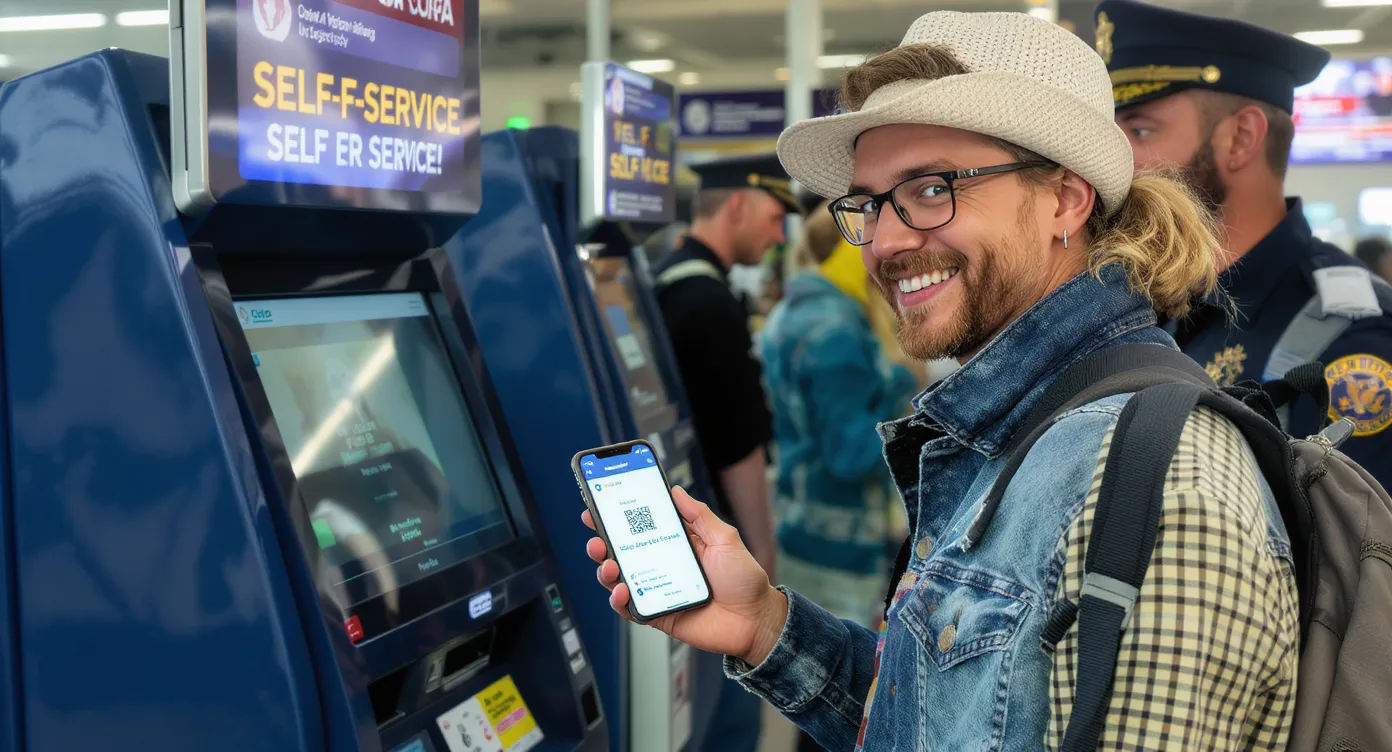
9. How SimpleVisa Makes All This Simple
- Automated Eligibility Check: Enter your passport country and travel dates; SimpleVisa’s engine tells you instantly whether ESTA or a visa applies.
- Smart Form Filling: The platform pre-fills DS-160 or ESTA fields from your booking data, cutting errors that cause 30 % of rejections (State Department, 2024).
- Document Validator: Drag-and-drop scans, and the AI flags glare, wrong dimensions, or background color in real time.
- Progress Tracking & Reminders: Email/SMS nudges when interviews open up or when your ESTA hits the 30-day-left mark.
- Revenue Share for Travel Brands: If you run an OTA, embed SimpleVisa via API or our no-code widget and earn ancillary revenue while improving customer satisfaction. Learn more in our guide to the future of travel APIs.
Frequently Asked Questions
Does an approved ESTA guarantee entry to the United States? No. The ESTA lets you board a carrier bound for the U.S. Final admission is always at the discretion of a CBP officer.
How long is a U.S. ESTA valid? Two years or until your passport expires, whichever comes first. Each visit can last up to 90 days.
Can I extend my stay beyond 90 days if I entered with ESTA? No. You must leave and, if eligible, re-enter. Overstaying even briefly voids future ESTA use.
I have dual nationality—one VWP passport and one non-VWP. Which should I use? Apply for ESTA with your VWP passport to avoid a full visa, provided you have no dual-nationality disqualifiers (e.g., Iranian citizenship).
What happens if my ESTA is denied? You must schedule a B-1/B-2 visa interview. SimpleVisa can transfer your application data to the DS-160 to save time.
Ready to Simplify Your U.S. Entry?
Whether you need a lightning-fast ESTA or a full B-visa, SimpleVisa can handle the heavy lifting—eligibility checks, smart forms, interview scheduling, and real-time status updates.
Plan your dream U.S. trip without the paperwork headache. Start your application with SimpleVisa today and travel with confidence.