Travel Visa Documents Explained for Multi-Country Trips

Multi-country trips are exciting, but they also multiply your chances of getting tripped up at the border. One extra connection, a quick side-trip, or a land crossing can change which travel visa documents you need, when you need them, and what “valid” actually means.
This guide breaks down the main visa and entry-document types (including electronic visa and eTA-style authorizations), then shows you how to plan them for an itinerary with multiple stops.
Start with the key idea: every itinerary has multiple “border events”
When travelers think “Do I need a visa?”, they usually picture the final destination. Border officers and airlines think differently.
They look at every border event, such as:
- Departing your origin country
- Transiting a hub airport (airside or landside)
- Entering Country A
- Exiting Country A
- Re-entering Country A after a side trip
- Entering a regional zone (for example, Schengen)
- Crossing by land, rail, ferry, or cruise tender
For a multi-country trip, your documentation plan should match each border event in order.
The travel documents you always need (even when you are “visa-free”)
Even if you do not need a visa, you still need to meet entry conditions. These are the foundational items to validate first.
Passport (validity rules matter more on multi-country trips)
For complex itineraries, passport issues are the most common “silent” failure.
Check:
- Expiration buffer: Many countries require your passport to be valid for a minimum period beyond arrival (often months). If you are hopping across borders, the strictest rule across your stops is the one that can derail your trip.
- Condition: Water damage, torn pages, or a loose cover can trigger extra scrutiny.
- Blank pages: Some destinations still issue stamps or paper visas, and some airlines check page availability.
If your passport is close to expiring, renewing before you plan visas is usually safer, because many approvals are tied to a specific passport number.
Proof of onward travel (frequently requested, often misunderstood)
On multi-country itineraries, “onward travel” is not always your flight home. It may need to show that you will leave the country you are entering within the allowed period.
That could be:
- A flight ticket to the next country
n- A train or ferry booking - A cruise itinerary
Some carriers enforce onward-travel rules at check-in even when immigration rarely asks. If you are building a flexible route, make sure you still have a credible onward plan.
Contact and itinerary basics
Keep a simple, consistent set of basics across applications:
- First night address (hotel or host)
- Rough itinerary dates
- Emergency contact
Small inconsistencies across countries can cause extra checks, especially if one application is reviewed manually.
The 4 main entry-permission types you will encounter
Most multi-country itineraries combine several permission models. Understanding the differences helps you avoid applying for the wrong thing, or applying too late.
| Entry permission type | What it is | How you receive it | Common multi-country trip impact |
|---|---|---|---|
| Visa-free entry | No visa required for your nationality, for short stays | Nothing issued in advance, entry is decided at the border | You still need to meet conditions (passport validity, onward travel, purpose of visit). Rules can change if you re-enter multiple times. |
| Electronic travel authorization (eTA, ETA, ESTA-style) | Pre-travel authorization for visa-exempt travelers | Usually an email/portal confirmation linked to your passport | Often required even for short stopovers. Some are multi-entry for a period, but passport changes can invalidate them. |
| eVisa (electronic visa) | A visa issued digitally after an online visa application | PDF/approval letter, or electronically linked to passport | Great for multi-country routes, but watch entry window, duration of stay, and single vs multiple entry. |
| Consular/embassy visa (sticker or label) | Traditional visa processed via consulate/visa center | Physical visa in passport (or sometimes a paper approval) | Usually highest lead time. Appointment availability can dictate your itinerary order. |
If you want a deeper comparison between eVisas and eTAs, see SimpleVisa’s explainer on key differences between electronic visas and eTAs.
Multi-country trip “gotchas” that change which visa documents you need
Transit is not always transit
Two travelers on the same flight can have different transit requirements depending on:
- Whether they stay airside (do not pass immigration)
- Whether they need to collect bags and re-check
- Whether they change terminals and must clear immigration
- How long the layover is
A common mistake is assuming “I am only connecting, so I do not need anything.” Some countries require transit visas for certain nationalities, and some require an eTA-style authorization even for short transits.
Single-entry vs multiple-entry (this is where side trips break plans)
On a multi-country itinerary, re-entry is the trap.
Example patterns that require multiple entries:
- Country A, Country B, then back to Country A for the return flight
- A regional hub stopover where you leave the airport, then later transit again
- A land crossing detour where you exit and re-enter the same country
Before you apply, confirm:
- Number of entries allowed
- Validity window (the period during which you can enter)
- Permitted stay (how long you can remain after entry)
These are different fields, and confusing them is a frequent reason travelers get denied boarding.
Regional rules can override “country-by-country thinking” (Schengen is the classic example)
Some regions apply shared entry rules, where time spent in one country counts against your allowance in the whole zone.
For Schengen short stays, the well-known rule is 90 days within any 180-day period for many visa-exempt travelers, but the practical issue on multi-country trips is how quickly the days add up when you move between countries.
If you are tracking Schengen planning, use official guidance (for example, the European Commission’s Schengen information pages) and keep your dates precise.
Land borders, ferries, and cruises can add document checks
Multi-country trips are often multi-modal. Different border points can have different processes.
- Land borders may ask for additional proof (onward travel, funds, accommodation)
- Ferry and cruise operators often perform airline-style document checks before boarding
- Some destinations handle eVisa verification differently at smaller ports
Practical takeaway: keep your visa approvals accessible offline and carry a printed backup when feasible, especially if you are crossing at remote points.
For a nuanced discussion on backups, see Do you need to print an electronic visa?.
Supporting travel visa documents that become more important as your itinerary gets complex
Many travelers focus only on the visa itself. In reality, multi-country travel increases the odds you will be asked for supporting documents.
Proof of accommodation and route logic
Border officers want to see that your plan makes sense.
Bring:
- First-night booking for each country (or a clear segment plan)
- A forward itinerary that matches your visa dates and entries
Proof of funds and ties
Some destinations require evidence that you can support yourself and that you intend to leave.
Common documents include:
- Bank statements
- Pay slips or employer letter
- Proof of enrollment (for students)
Travel insurance and health certificates
Depending on destination and route, you may need:
- Proof of travel medical insurance
- Vaccination documentation (yellow fever certificates are a well-known example for certain entry combinations)
Health requirements can depend on where you have been recently, not just where you are going next, which makes multi-country routes especially sensitive.
Minors and families (extra paperwork is common)
For children traveling with one parent, relatives, or a group, some borders request additional documentation (consent letters, custody documents). If your itinerary crosses multiple borders, plan for the strictest segment.
A practical workflow to plan travel visa documents for multi-country trips
Instead of researching visas in random order, use a repeatable process.
1) Write your itinerary as a list of border events
Create a simple table for yourself with:
- Country or zone
- Entry date and exit date
- Entry method (air, land, ferry, cruise)
- Whether you will re-enter
This clarifies where you need multiple entry permissions or transit documents.
2) For each border event, identify the permission type
Label each stop as:
- Visa-free
- eTA/ETA/ESTA-style authorization
- eVisa
- Consular visa
If you are unsure, always verify with official sources or trusted travel-document data.
3) Back-plan using the longest lead time, not the first destination
Multi-country reality: the country with the slowest processing or hardest appointment availability sets your project timeline.
A generic back-planning template looks like this:
| Time before departure | What to do | Why it matters |
|---|---|---|
| 8 to 12 weeks | Validate passport, confirm route feasibility, identify consular-visa needs | Passport changes can invalidate later approvals, and appointments can be the critical path |
| 4 to 8 weeks | Submit consular visas (if needed), prepare supporting documents | Reduces risk of itinerary changes due to delayed visas |
| 1 to 4 weeks | Submit eVisas and eTAs (based on published guidance and buffers) | Many online visas are fast, but manual review happens |
| 72 hours to 1 week | Final checks: names, passport number, entry dates, backups | Last-minute errors cause denied boarding more than true “visa denials” |
For a broader baseline, SimpleVisa also maintains a traveler-friendly overview: Travel visa basics: what to know before you book.
4) Build a “border-ready” document pack
Keep both digital and physical access to:
- Passport bio page scan
- eVisa PDFs and approval letters
- eTA/ETA/ESTA confirmations
- Proof of onward travel
- First-night accommodation
- Insurance and health documents (if relevant)
And double-check name consistency. If your booking platform and passport do not match exactly, fix it early. This is especially important when you will be checked repeatedly across multiple borders. (Related: Handling name mismatches on tickets, passports, and eVisas.)
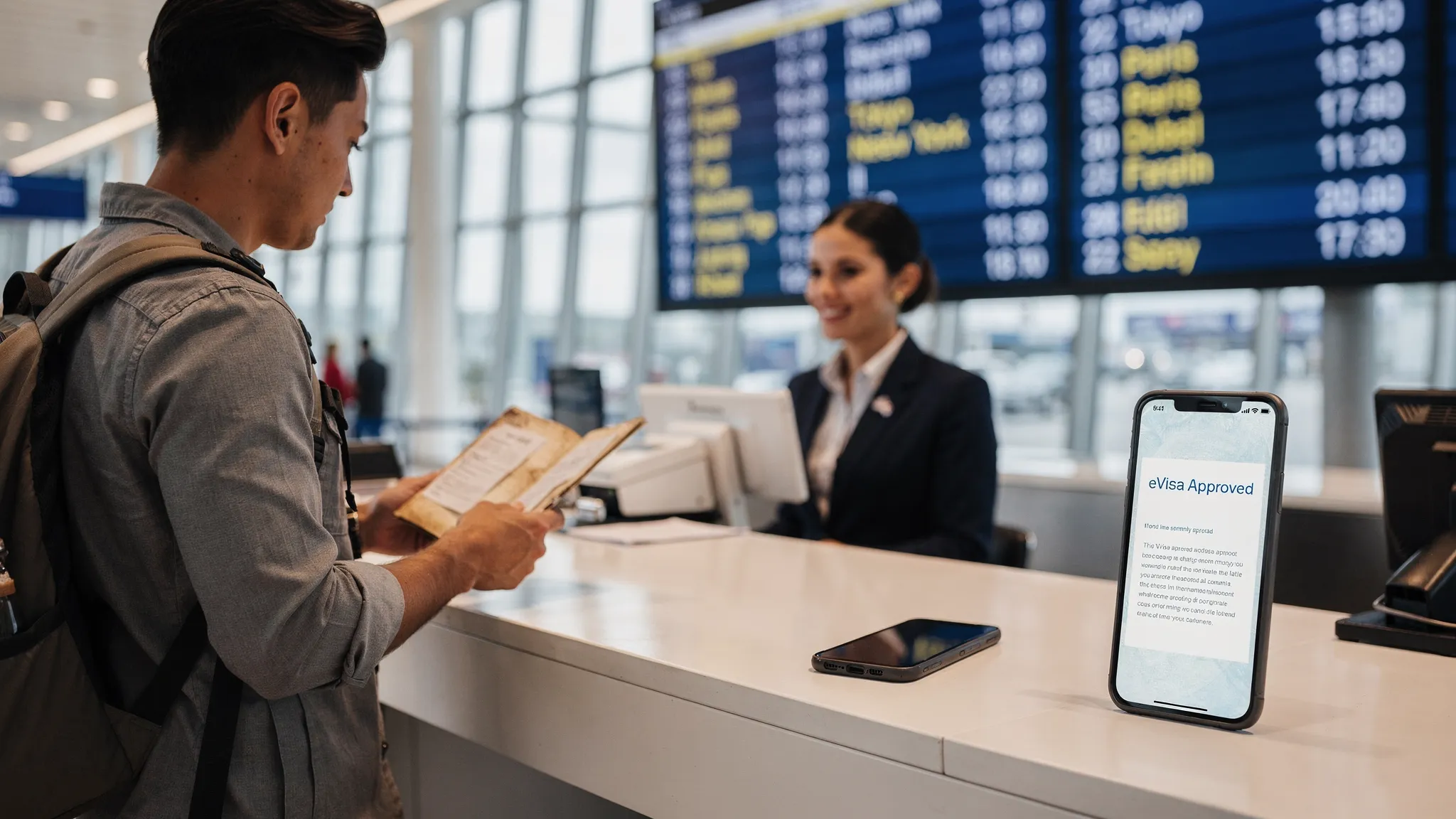
Common multi-country visa document mistakes (and how to prevent them)
| Mistake | Why it happens | How to prevent it |
|---|---|---|
| Forgetting a transit requirement | You assumed a connection does not require entry permission | Check whether you must clear immigration, re-check baggage, or change terminals |
| Using a single-entry visa on a route that re-enters | Side trips, hub returns, or open-jaw itineraries | Map border events, then match to single vs multiple entry |
| Confusing validity with duration of stay | “Valid for 90 days” can mean entry window, not stay length | Read the fields carefully: entry window, stay length, number of entries |
| Applying with the wrong passport details | Dual citizenship, renewed passport, typos | Apply with the passport you will travel on, copy details exactly |
| Not carrying backups | Limited internet, dead phone, small border posts | Save offline copies and bring printed backups when possible |
If you want a country-by-country baseline to start from, see Visa requirements by country: a quick reference.
For travel businesses: why multi-country trips are where automation pays off
If you are an OTA, airline, cruise line, or tour operator, multi-country itineraries create a predictable operational burden:
- More “Am I allowed to enter?” questions to customer support
- Higher risk of denied boarding and itinerary disruption
- More abandoned checkouts when travelers are uncertain about requirements
A visa management platform can reduce this friction by surfacing requirements in-context and guiding customers through the right online visa processing path.
SimpleVisa is built to streamline this for travel brands through API integration, a white-label visa application app, and custom data services, so customers can handle entry requirements without leaving the booking journey.

Frequently Asked Questions
Do I need separate visas for each country on a multi-country trip? Not always. Some stops may be visa-free, some may require an eTA/ETA-style authorization, and others may require an eVisa or consular visa. Treat each stop (and transit) as its own border event and verify requirements by passport nationality.
What is the difference between an eVisa and an eTA for multi-country travel? An eVisa is a visa issued digitally after an online visa application, while an eTA (or ETA/ESTA-style document) is usually a pre-travel authorization for visa-exempt travelers. Both can be required in the same trip.
Can a layover require a visa or travel authorization? Yes. If you need to pass immigration (for example, to collect baggage or change terminals), you may need a transit visa, an eTA-style authorization, or even a full visa depending on nationality and airport rules.
Should I print my electronic visa documents for a multi-country trip? Often it helps. Many borders accept digital proof, but printing is a good backup for low-connectivity areas, device failures, or carriers that want paper at check-in.
What is the biggest documentation risk on multi-country itineraries? Re-entry and timing. Single-entry permissions, misread validity windows, and day-count rules (such as regional stay limits) cause more issues than travelers expect.
Make multi-country visa planning simpler (for you or your customers)
If you are a travel brand managing complex itineraries, the fastest wins usually come from making visa and entry requirements visible at the right moments, then guiding travelers through the correct application flow.
Explore SimpleVisa’s approach to travel document automation at SimpleVisa or review integration options via the API vs. White-Label App guide.